Employee value proposition: How to attract and retain talent


Most employee value propositions (EVPs) look good on paper. Then the candidate joins. Promises about growth or flexibility can fall apart under a manager who never discusses development or dismisses requests to work from home a few days a week. The polished wording in your EVP means little if a new hire’s daily experience doesn’t match it.
Only 33% of employees say their organization consistently makes good on its promises.* If your company spends most of its time defining the EVP and little time enforcing it, it’s no surprise when even the most engaged employees stop trusting leadership or leave.
This guide explains how to build an EVP that holds up beyond recruitment and use employee feedback to test whether it works in practice.
* Gartner, 2024
What’s an employee value proposition?
An employee value proposition, or EVP, is what your organization offers employees in return for their skills and commitment. It combines compensation and benefits with the culture employees experience at work. It also covers the career development opportunities and flexibility available to them.
Now that you know what EVP stands for, here are its three core components.
Compensation and benefits
“Transparency doesn’t mean sharing every number. It means explaining the logic — how pay decisions are made, what criteria are used, and how people can grow within the structure.”
— Alexandra Edl, Senior HR Consultant, Interim Manager, Coach & Trainer, EDL Consulting
This component covers the financial and practical support employees receive from your organization. Compensation includes an employee’s base salary and any additional pay, such as bonuses. Benefits packages include non-salary provisions, such as comprehensive health coverage and paid time off.
Culture and values
Company culture describes the working environment employees experience, including how leaders manage and how colleagues work together. Values are the principles that guide behavior and decisions across the organization. Management styles and recognition practices also shape this part of the EVP.
Growth and flexibility
Growth covers the opportunities employees have to develop their skills or move into new roles. Flexibility refers to the choice they have over when or where they work. These elements influence how well a role supports an employee’s career and work life balance.
How to know if your EVP is actually working
You may think your EVP is strong because leaders like how it sounds. But employees who experience the value proposition promises firsthand may tell a different story. Gallup found that only 26% of employees would recommend their organization as a great place to work.
Choose one commitment in your EVP and define the KPIs that would show employees experience it. For example, if your EVP says you invest in your employees’ long-term future, take a look at your internal promotion rate. If you only fill 20% of new roles with internal promotions, you may need to reassess your development initiatives.
Consider the following signals for different stages of the employee lifecycle.
Offer acceptance and new hire expectations
Your offer acceptance rate shows whether candidates find your offer attractive. Make sure to collect feedback during the recruitment process so you understand why a candidate decides to accept or reject a job offer.
Use a 30-60-90-day pulse survey to see how a new hire feels about their onboarding experience. Does their role match the recruiter's job description? Have they received the flexibility or development benefits you discussed during the interview process?
Retention and turnover trendSs
Rising voluntary turnover alone can’t tell you that your EVP is failing. Connect employees’ reasons for leaving to a specific commitment. For example, if your EVP promises two remote days a week but high performers say in exit interviews that managers routinely denied those days, their departures expose a clear gap between policy and practice.
Company-wide retention and turnover figures can also hide where the problem sits. Break down metrics by team or manager. Then compare patterns by tenure and location. If one department loses employees while turnover elsewhere remains stable, leadership quality or local process may be causing the gap.
Engagement survey sentiment
“Emotions are data, but what your CEO wants to hear is: what does this mean for business?”
— Melanie Naranjo, chief people officer, Ethena
Engagement surveys show how employees feel about specific parts of your EVP. Questions about pay fairness and career growth can test whether those commitments hold up. At the same time, questions about culture can reveal if the work environment matches the organization’s claims.
Avoid rolling these employee engagement responses into one reassuring average. Review trends over time and read the written feedback behind the scores. Segmenting results can also show if a weak result reflects the broader workforce broadly or comes from a specific team.
Suppose your EVP says employees can build their careers with you. Track internal mobility and whether manager 1:1s take place. Use survey questions to learn whether employees see a path forward. If sentiment is weak, compare the results by team and manager. You may find that certain departments rarely host development conversations. Give the managers of those departments a structure for how to have those conversations and develop their direct reports.
Review mobility and survey sentiment again after one or two cycles. If neither improves, employees still aren’t experiencing the promised career growth. You then need to expand internal opportunities or revise the EVP to reflect what your organization can provide.
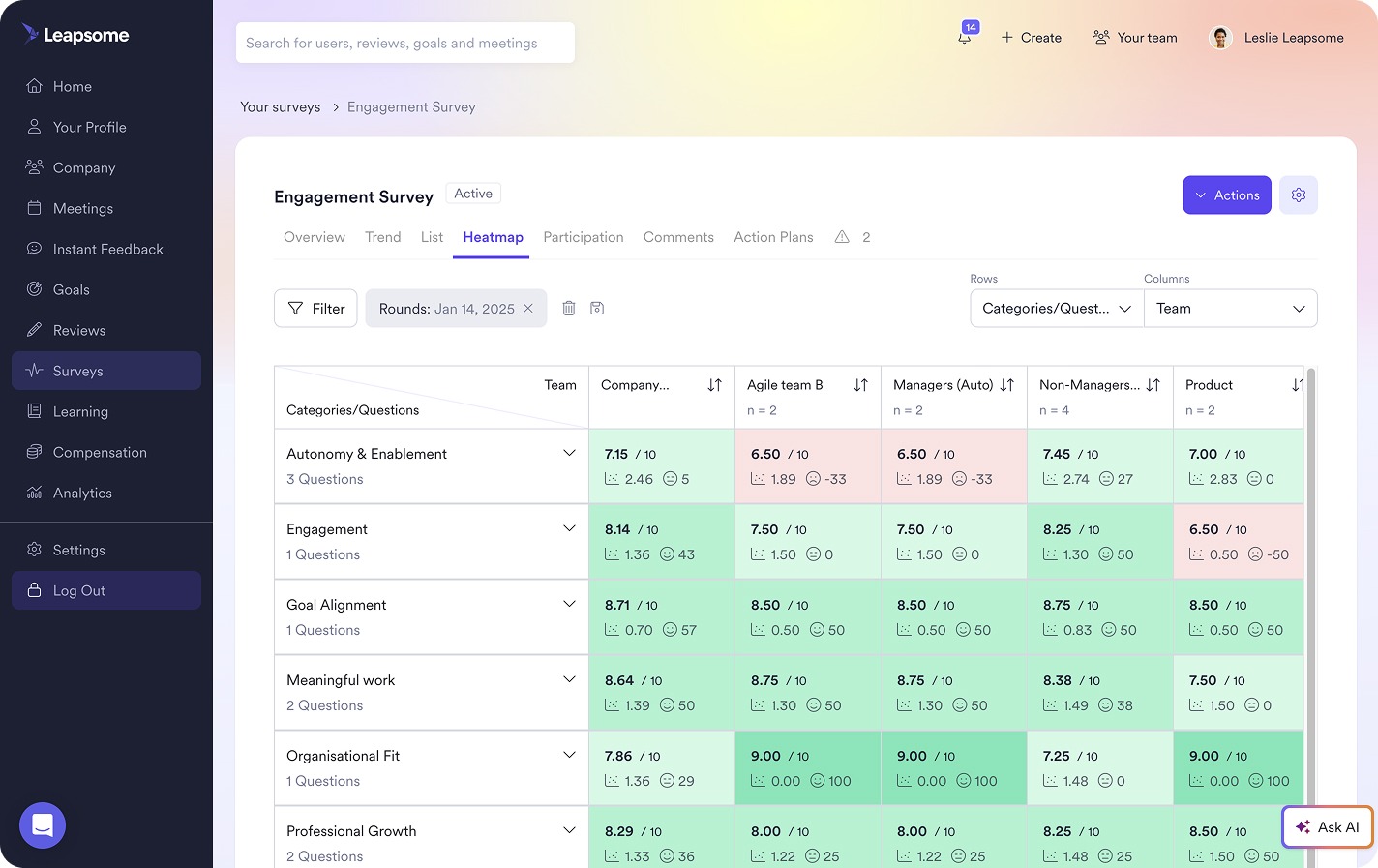
With a connected HR platform like Leapsome, you have the infrastructure to run this workflow consistently. Employee surveys surface sentiment across the organization, while qualitative feedback reveals what drives the results. That context helps you evaluate how your EVP does in action.
🕵️ See where your EVP falls short
Leapsome connects engagement data with employee feedback so HR can understand which EVP commitments need attention and why
👉 Explore Engagement Surveys
How to build or refresh your employee value proposition
Workforce expectations change, so an EVP built during your last hiring push can quickly lose relevance.
Here are the steps you can take to improve your employee value proposition strategy with clear examples.
Gather input directly from employees
“Don’t just rely on a single eNPS question or a once-a-year survey and expect deep insight. You need a rhythm that lets people reflect honestly without survey fatigue, and that starts with building trust in the process. When employees truly believe their feedback is anonymous and acted upon, participation and authenticity skyrocket.”
— Monica Sarkar, Co-Founder, Purple Umbrella
Engagement surveys can show what employees value and where their experience falls short. Pulse checks capture changes sooner, while exit interviews explain why certain issues push people to leave.
Look for specific patterns you can turn into commitments. If employees say meeting-heavy schedules undermine flexible work, your flexibility promise could include protected focus time.
Define what’s true and differentiated
Compare employee feedback with what your organization can deliver consistently. Remove generic claims like “great work culture” if you can’t explain what makes that culture different.
For example, a clothing company that promises better environmental work ethics could require product teams to use recycled materials or design products that last longer. Its impact mission reports could then show employees how much waste those choices prevented.
Reinforce it consistently through managers
“Managers should be the frontline of care, creating safety, connection, and trust. But too often, they’re the frontline of defense, fielding tough news with limited context. Companies need to equip them with the right tools and communities so they can lead with confidence.”
— Luck Dookchitra, VP of People at Leapsome
Gartner found that employees who see transparent decision-making are 4.3 times more likely to trust senior leaders. Managers build that trust by showing how decisions about pay and progression align with your EVP. Without clear criteria, the same proposition can produce a different employee experience across teams.
Give each EVP commitment a manager action. If you promise career growth, provide clear promotion criteria and use development conversations to agree on the employee’s next step.
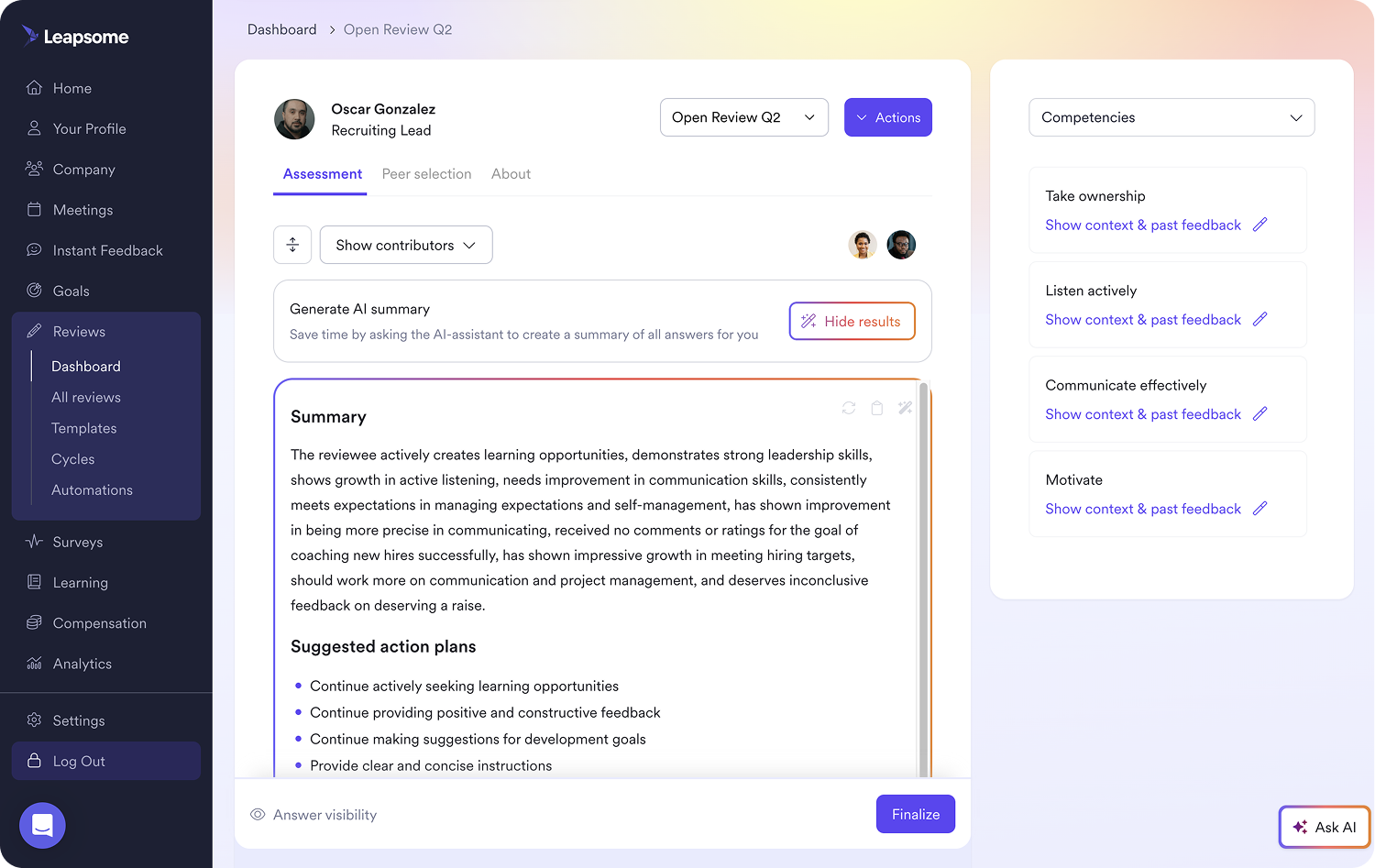
This cycle becomes easier when performance and past feedback live in the same connected HR platform. Leapsome connects both to development conversations, helping managers turn a broad growth promise into a clear next step.
💬 Bring your EVP into everyday work
Leapsome Continuous Feedback gives managers a consistent way to recognize employees and provide feedback that supports your EVP.
👉 Explore Continuous Feedback
Build an EVP that adapts with Leapsome
A polished EVP might attract top talent, but retention depends on what employees experience after hiring. That’s why you should treat your EVP like a promise you need to fulfill every day.
Leapsome connects the full employee lifecycle in one platform, allowing HR to carry each EVP commitment through the complete improvement loop:
- Promise: Bring the EVP into Onboarding and manager Workflows, so employees encounter the commitment beyond the careers page.
- Signal: Use Engagement Surveys to measure employee sentiment. People Analytics adds workforce signals such as retention and internal mobility.
- Diagnose: Segment survey responses by team or manager to locate the gap. Qualitative feedback helps explain what is causing it.
- Act: Continuous Feedback tool helps managers address gaps through recognition and check-ins, while Competency Frameworks support clearer development decisions.
- Remeasure: Repeat the same survey questions during the next cycle and review the related workforce outcomes. This shows if employees’ experience improved.
“With Leapsome, we were able to automate performance reviews, goal setting that was even prior, but now even further and onboarding and offboarding and that together helped us save about 20% of manual effort of our team.” — Weronika Czerny-Nowakowska, Chief Operating Officer, Neurons Lab
🔁 Keep your EVP credible as expectations change
Leapsome connects employee feedback with workforce data to test your EVP now and improve it in the next cycle.
👉 Request a demo
FAQ
What’s the difference between an EVP and employer branding?
The EVP defines what your organization offers employees in exchange for their skills and work. Employer branding communicates that offer and shapes how people perceive your organization as a workplace.

.png)


Entdeckt unsere Plattform für HRIS, Performance und Entwicklung.