HR KPIs: Thinking beyond metrics for stronger decision-making


HR key performance indicators (KPIs) help organizations connect their people strategy to the business outcomes they’re meant to support. Small teams might start by tracking a few metrics, but that list often grows as the company scales. Fuller dashboards look like stronger proof of progress, so when leadership wants evidence that people initiatives are working, this approach seems like it would work.
But a list of KPIs isn’t a strategy. A team can track turnover, engagement, and hiring speed, and still fail to connect raw numbers to the workforce patterns. In those cases, HR spends too much time assembling the pieces and doesn't have time to help employees perform well and stay longer. Considering Deloitte found that employees spend up to 40% of their work day looking for the data necessary to do their jobs, helping HR teams collect and analyze KPI details faster means they can focus on building a better work environment long-term.*
The true value of an HR KPI is how well the team uses the numbers to develop a productive workplace where employees thrive. In this guide, we’ll walk through how to determine which KPIs deserve your attention and how connected people data helps HR turn measurement into meaningful progress.
* Deloitte, 2025
What are HR KPIs and why do they matter?
In human resources, KPIs are metrics that HR teams use to measure progress against people and business priorities. They go a step beyond traditional HR metrics: A metric tracks people data, while a KPI connects that data to a business goal.
Common HR KPI categories include:
- Recruitment KPIs, such as time to hire and interview to offer ratio. These show whether the organization can attract and hire the right people.
- Retention and engagement KPIs, such as average length of employment and employee satisfaction. They help HR identify where employees may feel disconnected and more likely to leave.
- Performance, learning, and development KPIs, such as time to improvement and average learning hours. These KPIs reveal whether employees have the clarity, feedback, and development support they need to perform well.
HR KPIs give organizations a clear way to connect people decisions to business performance. Without them, you risk measuring activity rather than impact.
At the same time, HR KPIs can help you improve the employee experience. When you understand the patterns behind problems like high turnover or low engagement, you can solve fundamental problems in systems employees rely on every day.
Why individual KPIs rarely tell the full story
When HR teams look at how KPIs work together, the data fills in the gaps in your team’s story. Absenteeism, learning participation, and performance scores all say something important, but none of them explain the full employee experience on their own. Connected HR data helps explain what needs to change.
Let’s look at an HR KPI example using turnover. Say a scaling startup finds that their attrition rate has doubled from 6% to 12% in the last year. With that number alone, the HR team can identify that the organization has a serious retention problem. But there are no details to pull about what might be causing it.
That retention issue could start as soon as a new hire’s first day. SHRM found that 69% of employees are more likely to stay with a company for three years if they experience great onboarding, while one in three employees had an underwhelming or terrible onboarding experience, according to Enboarder’s 2024 report. So, by looking at onboarding satisfaction scores and time to productivity, the HR team could identify if their onboarding process is the weak link, and if that’s the culprit, start revamping it for a better experience (and stronger retention).
How to build an HR KPI strategy that drives action
"Talking the language executives talk — in metrics and ROI that resonate — wins business cases for HR teams."
— Katerina Arsova, Head of People and Talent Operations and Partnerships at Leapsome
A strong HR KPI strategy starts with restraint. Treating KPIs as a reporting exercise just buries your HR team in endless spreadsheets and figures, so focus only on metrics that help leadership make better decisions.
Here are a few ways to build a more useful KPI strategy:
- Start with business goals: Choose KPIs that connect to the company’s current priorities, such as improving retention or strengthening manager effectiveness.
- Focus on a small set of high-impact metrics: A focused HR KPI dashboard makes it easier for leadership to prioritize action.
- Combine leading and lagging indicators: Lagging indicators show what has already happened, such as turnover or goal completion. Leading indicators show where risk may be building, such as declining engagement or low feedback frequency.
Three HR KPIs worth tracking
"The most important metric is the performance of the company. Everything else — engagement, sentiment — should serve that."
— Luck Dookchitra, former VP of People and Culture at Leapsome
The most important KPIs show whether people programs are improving the business. These three cut right to the heart of your HR strategy.
1. Employee turnover rate
Employee turnover rate measures the percentage of employees who leave the organization during a specific period.
While turnover rates are one of the clearest signs of workforce stability, the number alone rarely shows everything. A rising turnover rate can point to problems with compensation, workload, or career growth, among myriad other reasons. But HR teams only get closer to the root cause if they can connect turnover data with other metrics across teams and managers.
2. Employee engagement score
"We keep measuring whether people show up or not. We should be measuring what they're doing when they're there. Quantity only measures activity…outcomes should."
— Steve Browne, Chief People Officer at LaRosa's
Employee engagement scores help HR understand how connected employees feel to their work, from their daily tasks to the org’s culture.
Engagement is often one of the earliest indicators of future work performance. For example, Gallup found that top-quartile engaged teams show 81% lower absenteeism than bottom-quartile teams. When engagement drops, decreasing performance and more absences usually follow. That makes engagement KPIs useful flags to steer action before employees start to quit.
Using Leapsome’s recurring engagement surveys and shorter pulse checks, organizations can keep tabs on their employee satisfaction rates. You can customize these surveys to capture important metrics like how likely employees are to recommend the company as a place to work, using employee net promoter score (eNPS), and how satisfied they are with their daily tasks.
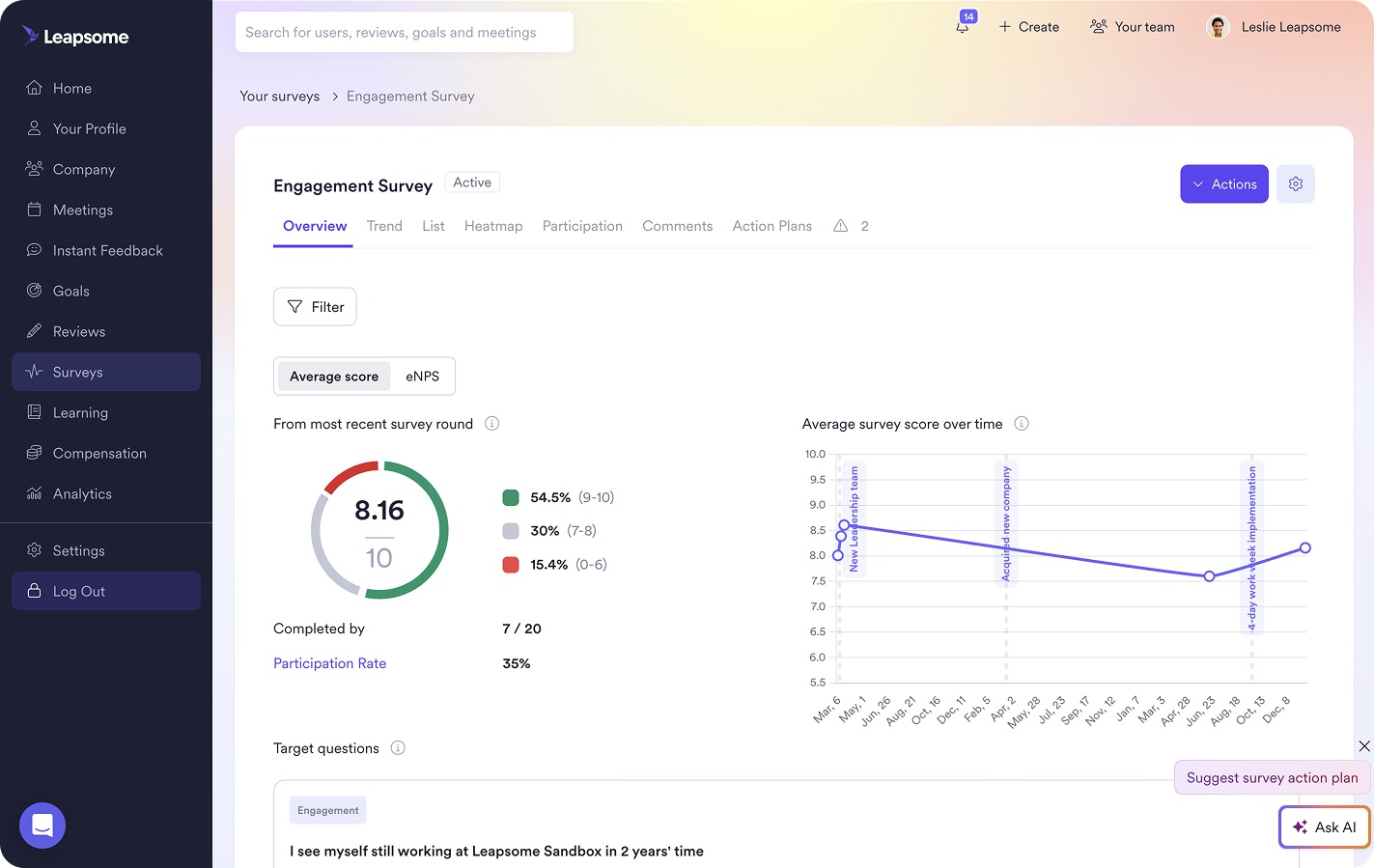
🕵 Track engagement before it becomes a retention problem
Leapsome’s Engagement Surveys feature helps HR teams collect continuous feedback, track engagement trends, and connect employee sentiment with performance and retention insights so you can intervene faster.
👉 Explore Engagement Surveys
3. Goal attainment rate
"Know your outcome goal, measure progress, and keep a dashboard — it keeps people teams focused on strategy, not just daily noise."
— Luck Dookchitra, former VP of People and Culture at Leapsome
Goal attainment rate measures how many goals employees achieved within a defined period. This can include individual goals, but more often refers to team and company-wide goals, especially for HR leaders studying how their people strategy is playing out in practice.
This KPI usually shows whether people understand what the business needs from them and have enough alignment to execute. It’s also connected to other indicators; for example, a McKinsey survey found that 72% of employees said goals are a strong motivator for their performance, which can impact their engagement scores, too.
If goal attainment is low, the issue may lie with unclear priorities or unrealistic planning. When HR teams connect goal data with engagement, feedback, and performance review patterns in one HRIS, the origin of the issues behind those numbers gets much clearer.
Other KPIs HR teams should consider tracking as supporting indicators alongside these three major players include:
- Time to hire
- Cost per hire
- Offer acceptance rate
- Internal mobility rate
- Absenteeism rate
Why HR KPI dashboards often fail
Most HR departments are drowning in isolated workforce data. They track endless KPIs, but those numbers never turn into a clear perspective on what deserves leadership’s attention.
HR KPI dashboards seem like the perfect organizational solution, but they often fall short of a team’s practical needs. They report what changes, not which workforce issue matters most or what action should follow. For example, a dashboard may show slower hiring and lower engagement in the same quarter, but without context, HR still has to decide whether the real priority should be better workforce planning or more manager support.
Here are some of the major reasons solo HR KPI dashboards tend to fail:
- They track too many metrics at once: A large dashboard can make every problem look equally important. HR leaders can prevent this by grouping KPIs around the business priorities leadership cares about, like retention and stronger execution.
- They measure what’s easy to report: Some HR metrics for performance management are easier to collect, but don’t hold up while HR leaders are trying to explain their business impact. For instance, time to hire may show recruiting speed, but not whether the company hired the right person. That’s why HR teams should pressure-test each KPI against a clear organizational decision. If the metric wouldn’t change how the company hires, supports, or retains employees, it probably doesn’t deserve dashboard space.
- They review metrics without defining action: A KPI loses value when no one knows what happens if it changes. Before adding a metric to a dashboard, HR should define who owns it, when it becomes a problem, and what the owner should do when it crosses that line. A useful dashboard focuses HR leaders on where people challenges are affecting business goals and OKRs.
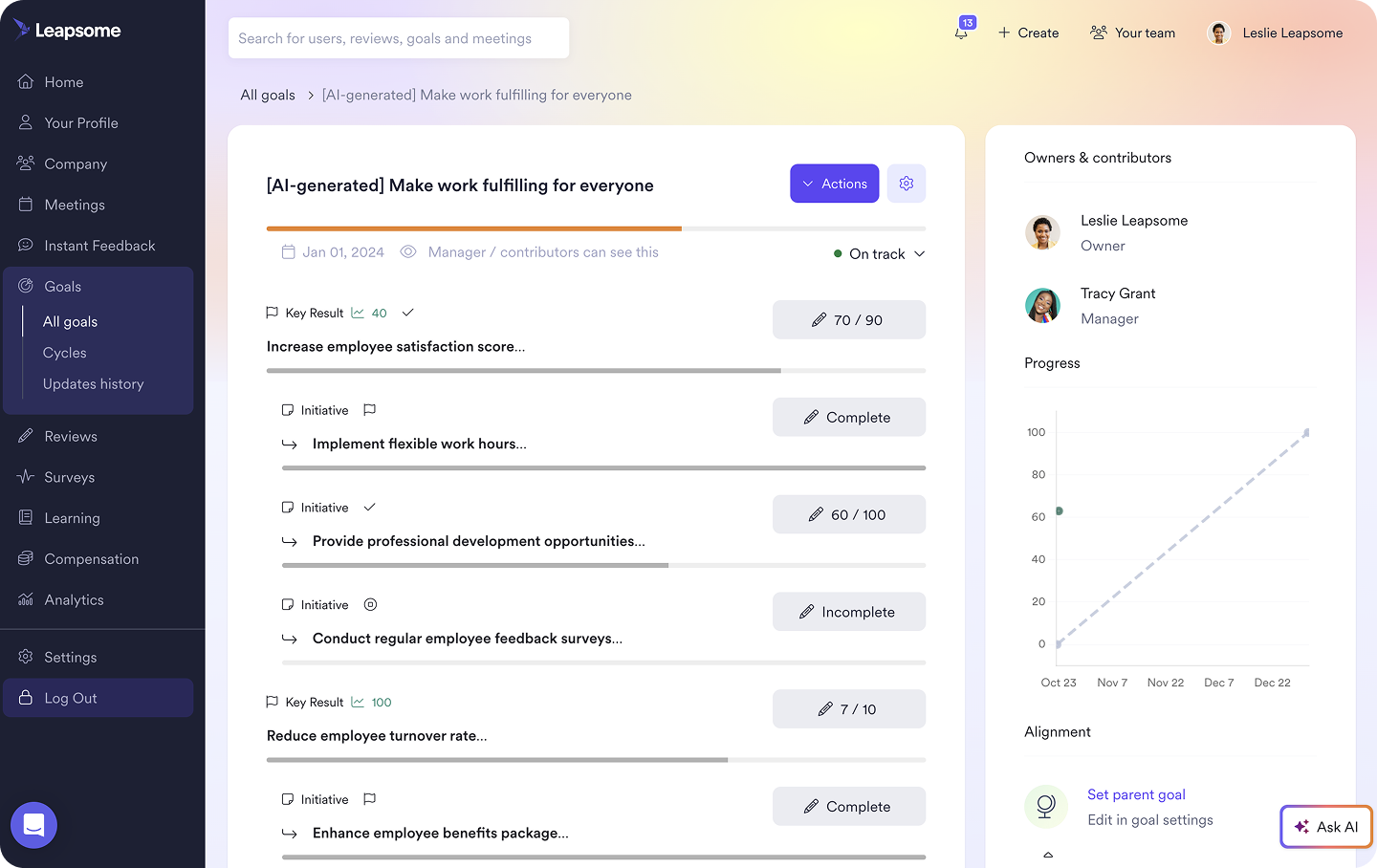
🔗 Connect HR KPIs to company priorities
Leapsome’s Goals and OKRs feature helps HR teams align people initiatives with business objectives so KPI reporting can turn into measurable action.
👉 Explore Goals and OKRs
Turn HR KPIs into action with Leapsome
A dashboard isn’t a good tool just because it has a lot of numbers on it. For HR, KPI analytics only matter when they help leaders understand what’s affecting people, performance, and growth, so they can direct the ship with more confidence.
That connection is hard to accomplish when engagement data sits in one tool, performance reviews are in a forgotten folder, and goals hover over everyone but no one sees how they connect to daily tasks. HR ends up building elaborate, vague dashboards to justify their approaches instead of intentionally curating data that guides better decisions.
Leapsome helps HR teams bring the employee lifecycle into one connected people platform, so KPIs become easier to understand and act on. With Leapsome, teams can:
- Connect people data: Bring goals, feedback, and learning inside one HRIS and people management system.
- Spot patterns earlier: Track metrics across each part of your workplace, so you can see how every team member interacts with and influences their coworkers and the business at large.
- Focus leadership attention: Link workforce insights to company goals, so leaders can prioritize people issues with the biggest business impact.
- Move from reporting to action: Use connected data to improve retention, support employee growth, and build stronger teams.
"We're really focusing on making sure the data we produce is high-quality and consistent across countries. Good data helps us identify pain points early, plan development initiatives, and return to the business with clear, actionable insights." — Victor Tomas, Learning and Development Specialist at Swapfiets
⏳ Stop collecting KPIs. Start acting on them.
Leapsome helps HR teams turn scattered metrics into smarter decisions by linking people data across the employee lifecycle.
👉 Request a demo





.jpg)