The true cost of HR software pricing: Models and hidden fees


Leadership wants HR tech to boost efficiency, and it’s the job of senior HR leaders to find the right fit. If calculating ROI were as easy as comparing vendor quotes, this would be a simple problem. But the true HR software pricing is harder to pin down. Vendors use different packaging, pricing models, and contract structures, so what seems like the most affordable HR software price option might not be the most affordable one in practice.
Budget pressures compound the problem: More than one-third of HR leaders (35%) are working with lower budgets than last year — when nearly half were dealing with cuts already.*
This HR software pricing guide offers a smarter approach. Instead of stopping at the sticker price, it shows you how to convert fuzzy quotes into precise cost estimates that better reflect financial reality.
* Leapsome, 2026
What’s the pricing for HR software?
While HR software prices vary depending on factors like headcount, implementation, and integrations, businesses typically set aside $10–$39 per employee per month (PEPM), according to Capterra research. The overall average budget for these businesses is $17 PEPM.
Here’s an average cost breakdown for the most common HR software types to give you a more focused baseline:
These are general estimates, but what you’ll really pay depends on how each vendor structures its pricing. Let’s compare HR software pricing models:
- Per-employee or per-user pricing: This model charges an annual or monthly subscription fee based on how many employees you have or how many users will interact with the software. It’s easier to compare across vendors because it’s more predictable, scaling with headcount or the number of licensed users. However, costs can rise quickly for growing companies.
- Flat-rate or tiered software package pricing: Some vendors charge a flat fee for the entire software package or for specific tiers. There might be a basic pricing tier that bundles just the most essential HR functions, such as employee document management, applicant tracking, and onboarding new hires. To access payroll processing and compensation management, users may need to purchase elite or enterprise tiers. This model is simple to budget for, but you may end up paying for features you don’t need.
- Modular or quote-based pricing: Pricing depends on which functions you choose, either à la carte or based on a vendor quote tied to your company size. This model makes it easier to align spend with your actual business needs.
While other pay structures aren’t inherently bad, modular pricing can be easier to flex to your needs. If you’re tired of forking over funds for features you know you’ll never use, consider Leapsome.
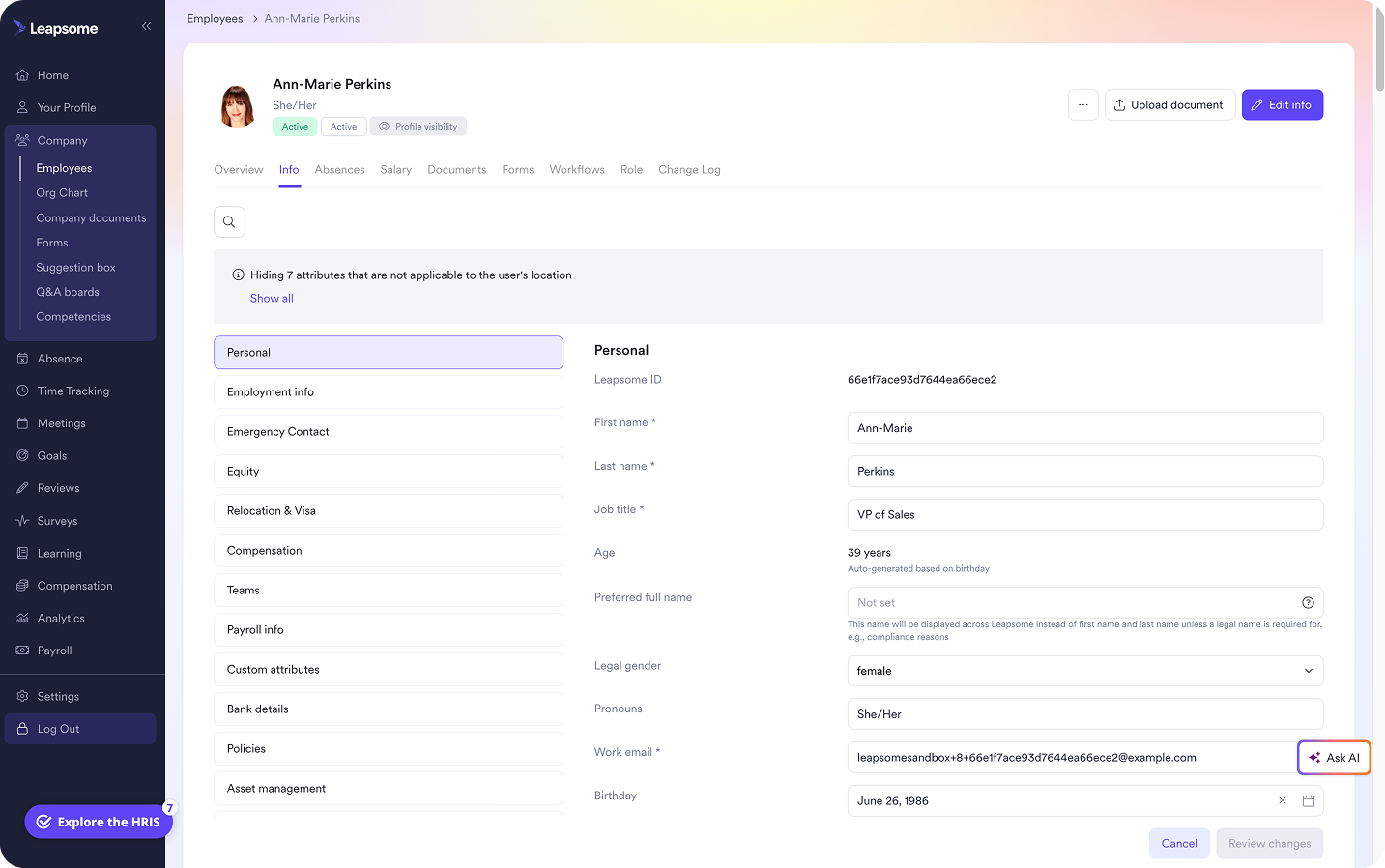
💰 Pay for what you need, not what you don’t
Leapsome’s modular pricing lets you keep costs in check without sacrificing functionality. Create your own connected mix of the exact features you’re looking for.
👉 Explore HRIS software
Converting HR software quotes into true total costs
Finding the best HR software price means looking beyond the advertised tag to work out the total cost of ownership. Pay close attention to these variable cost drivers to compile your shortlist.
Contracted software spend
Contracted spend is everything you commit to paying throughout the contract term. It starts with the subscription itself (including monthly or annual subscription fees or per-employee pricing), contracted headcount or seats, and included functions.
Review contract terms like length and renewal pricing to sharpen your cost estimate. Don’t forget to factor in growth plans. A PEPM that looks good at 20 employees might not seem as appealing at 50.
Before comparing total costs between vendors, normalize each vendor quote to the same assumptions. This way, you’re comparing apples to apples instead of sticker prices that don’t reflect the same scope.
Implementation and adoption
For each software solution, ask vendors what level of implementation support and training is included. Contracted spend doesn’t account for data migration or configuration, nor the internal HR/IT time those tasks require. Even with stellar support, it’s not unusual for teams to spend weeks or more cleaning data and testing configurations. Training managers and employees can also be a long process. This all results in time spent away from usual work.
“It’s one big lift to automate, but every cycle after that becomes faster and easier. Automating the invisible work gives HR leaders back time for culture, strategy, and meaningful connection.”
— Emma Leeds, Founder & CEO at People Function
Change management also has costs that may not be immediately apparent. According to a Sapient Insights Group survey, almost one-fourth (23%) of organizations report that their new HR tech implementations didn’t meet adoption expectations. This means companies are paying for software people aren’t using, and they may end up paying even more for the ongoing training and support to encourage regular use.
Ongoing operating and exit costs
“We were spending way too much time just executing tasks and not focusing on people.”
— Siddharth Dhanuka, Head of Finance & Operations at SQUAKE
Some of the biggest expenses when adopting a new HR system appear after launch. For instance, you may need to integrate your new platform with outside tools like a preferred applicant tracking system or a third-party HR payroll solution. That can be a heavy lift, especially if it requires custom development or maintenance.
The same can be true if you need to add new functions or export data. It all depends on the specific vendor and the level of support they offer.
All in, these factors can make what looks like a favorable headline quote more expensive than you bargained for over a timeline of years.
Try using a simple table to compare costs side by side. Here’s a blank example you can add your details to:
If you’re after something more robust, download this free template, complete with a vendor quote comparison spreadsheet and total cost of ownership calculator.
🧮 Compare quotes in moments
Slot in vendor pricing, implementation costs, and extras to quantify how each candidate stacks up.
👉 Download the template now
How to anticipate hidden costs in HR software
Hidden costs aren’t always sneakily buried in the fine print. More often than not, they appear because different vendor quotes cover different scopes, service levels, and contract conditions.
Follow these best practices to unearth hidden costs before you buy.
Put quotes in the right context
To avoid misleading evaluations, compare identical data points across vendors to normalize quotes to the same baseline. Cover:
- People and scope: Headcount, modules, regions/entities.
- Service: Implementation, integration, general support
- Commercial terms: Contract length, billing cadence, renewal assumptions.
Map every cost from setup forward
Stick to a straightforward procurement checklist to account not just for initial setup costs, but also for expenses that only show up later. Ask vendors about:
- Upfront costs: Setup, migration, training.
- Recurring and scaling costs: Add-ons, support, integrations, headcount growth.
- Contract and exit costs: Minimum seats, renewal terms, cancellation fees, data export.
Tally the costs of juggling multiple tools
“If your HR systems don’t really talk to each other… You kind of have to pull this from your HRIS, this from your performance review, this from payroll… I think the trails break down a little bit.”
— Sammie Masley, People Partner at Leapsome
Total cost of ownership should also reflect the cost of maintaining multiple HR systems at once. Using your own company-specific inputs, consider:
- Overlapping software subscriptions: Think about both the tools the new software would replace and the features you’d be paying for twice.
- Integration and admin work: Connecting outside tools can be a significant time sink.
- Duplicated reporting: Reentering and reconciling data between products not only wastes time, but can also lead to expensive errors.
“On the C-level, I learned to doubt people data because it arrived late and conflicted across files. Then, sitting in HR, I felt the pain from the inside and saw how much time went into rebuilding the same reports. Centralizing restores trust and your calendar.” — Florian Klages, Managing Partner at torq. partners
These costs can quickly get out of hand if you’re working with a fragmented HR stack. That’s why Leapsome brings everything you need under one interconnected roof.
🔗 Stop pulling your hair out over disconnected tools
Keep performance management, engagement surveys, and goals in a single unified platform to streamline your HR stack.
👉 Explore HRIS and people enablement
Leapsome: Modular HR software built for predictable growth
“Seventy-five percent of the company spend is on salaries. If that’s not effectively spent, you’re throwing money away. HR exists to make sure it’s invested wisely.” — Melanie Naranjo, Chief People Officer at Ethena
Leadership wants senior HR managers to find a solution with the highest ROI in efficiency and cost savings, while keeping software spend controlled, justifying the outlay, and avoiding tools likely to increase admin work and fragmented data as the organization scales.
For many teams, the right answer isn’t a more bare-bones HR solution, but a modular and connected system designed to grow with you. That’s Leapsome in a nutshell. Teams can get everything they need without shelling out for what they don’t, including:
- Core HRIS features and workforce management functions like employee records, absence management, and time tracking that feed directly into advanced analytics dashboards and automated workflows.
- Custom performance reviews and engagement surveys to understand what’s working and who might need extra support.
- Targeted learning programs paired with goal setting and tracking to bridge skill gaps.
“It’s been cost-effective, covers everything from performance reviews to surveys.” — Steve Hoffman, Chief People Officer at Mark43
💸 Stop paying for the kitchen sink when you only need the faucet
Pick and pay for the HR functions you need today, and connect more as your organization grows.
👉 Request a demo
FAQ
Does HR software pricing usually include implementation?
It depends on the vendor. There are three main areas where vendor quotes may leave out costs: implementation support or training, data migration or configuration, and custom integrations or premium support work billed separately from the base price.



.webp)