Types of HR software: How to spot gaps and overlap<


There are many types of HR software. Some manage employee records and payroll, while others support recruitment or learning.
Most companies don’t choose their full HR tech stack all at once. They add tools and platforms as new needs arise, which can feel like an efficient way to support growth. However, while organizations use an average of 26 pieces of HR software, half of those perform overlapping functions.* That means HR teams may pay for the same capabilities twice while often manually maintaining employee data across disconnected systems.
This guide explains what each type of HR system does and how they overlap. It will help you find gaps in your current stack and decide whether to add a new tool, improve an integration, or consolidate.
* SHRM, 2025
Core types of HR software and where they overlap
HR software gives you a central place to manage a specific people process. These core HR software examples show the main job each system performs and where they overlap:
- Human resources information system (HRIS): An HRIS stores employee records and supports workflows such as onboarding or attendance tracking.
- Payroll software: Payroll systems calculate employee pay and prepare payments. They rely on accurate compensation data from your HRIS.
- Applicant tracking system (ATS): An ATS manages the hiring process from job posting to recruiting. Its data overlaps with your HRIS when a candidate becomes an employee.
- Learning management system (LMS): An LMS delivers training and tracks completion. It may connect with performance management software when a review identifies an employee development need.
- Performance and engagement software: Performance tools manage goals and reviews. Engagement tools collect employee feedback and help you understand workplace sentiment.
- Human capital management (HCM): HCM supports broader workforce management, often combining core employee administration with talent acquisition. Its scope usually overlaps with several specialist tools.
These software labels describe each system’s main purpose, but one human resource management process may involve several tools. Consider a salary increase approved during a performance review, for example. The HRIS must record that change, and the payroll system must use the new amount.
As your company grows, duplicate software features matter less than disconnected records, which often create more admin work for HR.
How to spot HR tech debt in your current stack
HR tech debt is the friction created by missing capabilities or systems that don’t share data. It also builds when one HR process is split across too many tools.
Your tool count says little about HR maturity if your team still needs to connect features manually. A Gartner survey found that only 35% of HR leaders believe their approach to technology supports business objectives.
HR tech debt usually appears in four forms.
Admin debt keeps HR doing work software should handle
Admin debt is repetitive work and processes that eat up your time. Deloitte reports that HR teams often spend up to 57% of their work hours on administrative tasks.
For example, when a candidate accepts a job offer, HR may need to reenter their personal details and role information in the HRIS. And then they need to update that info in payroll. Each update seems minor until hiring volume increases or someone enters the wrong information, creating a backlog for a host of processes.
To assess admin debt, track how often HR repeats a task and how much time it takes. Even two minutes here or there can add up quickly for enterprise teams.
Data debt creates competing employee records
Data debt develops when systems track information inconsistently or make it difficult to combine records. For example, the HRIS may show an employee’s new salary after a promotion while payroll continues issuing paychecks with their old wages.
HR then has to compare the records before confirming what the employee should be paid.
“Many HR teams still struggle with the basics, too many disconnected tools, limited insights. That’s why we built a truly people-first HRIS that unifies all employee data into one source of truth.”
— Suraj Paneru, Customer Success Coach, Leapsome
Identify which discrepancies affect the most people and what could happen if HR misses them. Prioritize data gaps that could lead to incorrect pay or create compliance risk.
<h3>Experience debt makes people bridge disconnected processes</h3>
“Managers shouldn’t email HR to ask who’s on leave or what a team’s balances are; they should see it live. The moment people self-serve, interruptions drop and decisions speed up. That’s the point of a single source of truth.”
— Carolin Leidel, Consultant, torq.partners
Experience debt builds when employees and managers have to switch between disconnected tools to complete one HR process.
Let’s say a manager identifies a development need during a review. They must then open a separate learning system and assign relevant training manually. Then, the employee has to move between one tool for the feedback and another for the training. If the manager misses that handoff, the employee receives the feedback but misses the training.
Assess how many people encounter the broken handoff and how often it interrupts their work. A handoff that affects every review cycle and repeatedly delays assigned training should rank highly in your audit.
Decision debt keeps useful data apart
Decision debt prevents HR from answering important workforce questions with existing data. You may see engagement scores in one platform and turnover data in another. Without a reliable connection, you can’t examine whether low engagement is contributing to attrition in a specific team.
This leaves HR rebuilding reports in spreadsheets or presenting leadership with partial answers. The data exists, but teams can’t visualize it.
“On the C-level, I learned to doubt people data because it arrived late and conflicted across files. Then, sitting in HR, I felt the pain from the inside and saw how much time went into rebuilding the same reports. Centralizing restores trust and your calendar.”
— Florian Klages, Managing Partner, torq.partners
List the workforce questions HR can’t answer without manual analysis. Prioritize the ones that influence leadership decisions or prevent you from acting on a known people problem.
Once you understand the source of the debt, you can:
- Automate: Use the current system to handle a task that HR completes manually.
- Integrate: Connect tools when each serves a clear purpose, but information must move between them.
- Consolidate: Replace tools when their overlapping capabilities create unnecessary work or expense.
- Add a capability: Introduce software when an important process has no suitable system to support it.
If employee records sit at the center of several problems, create one reliable source of people data with a centralized HRIS like Leapsome so other tools can sync the same information.
“We wanted to build an HR tool that grows with you, scales with you, and becomes your strategic partner every time you’re growing your organization.”
— Suraj Paneru, Customer Success Coach, Leapsome
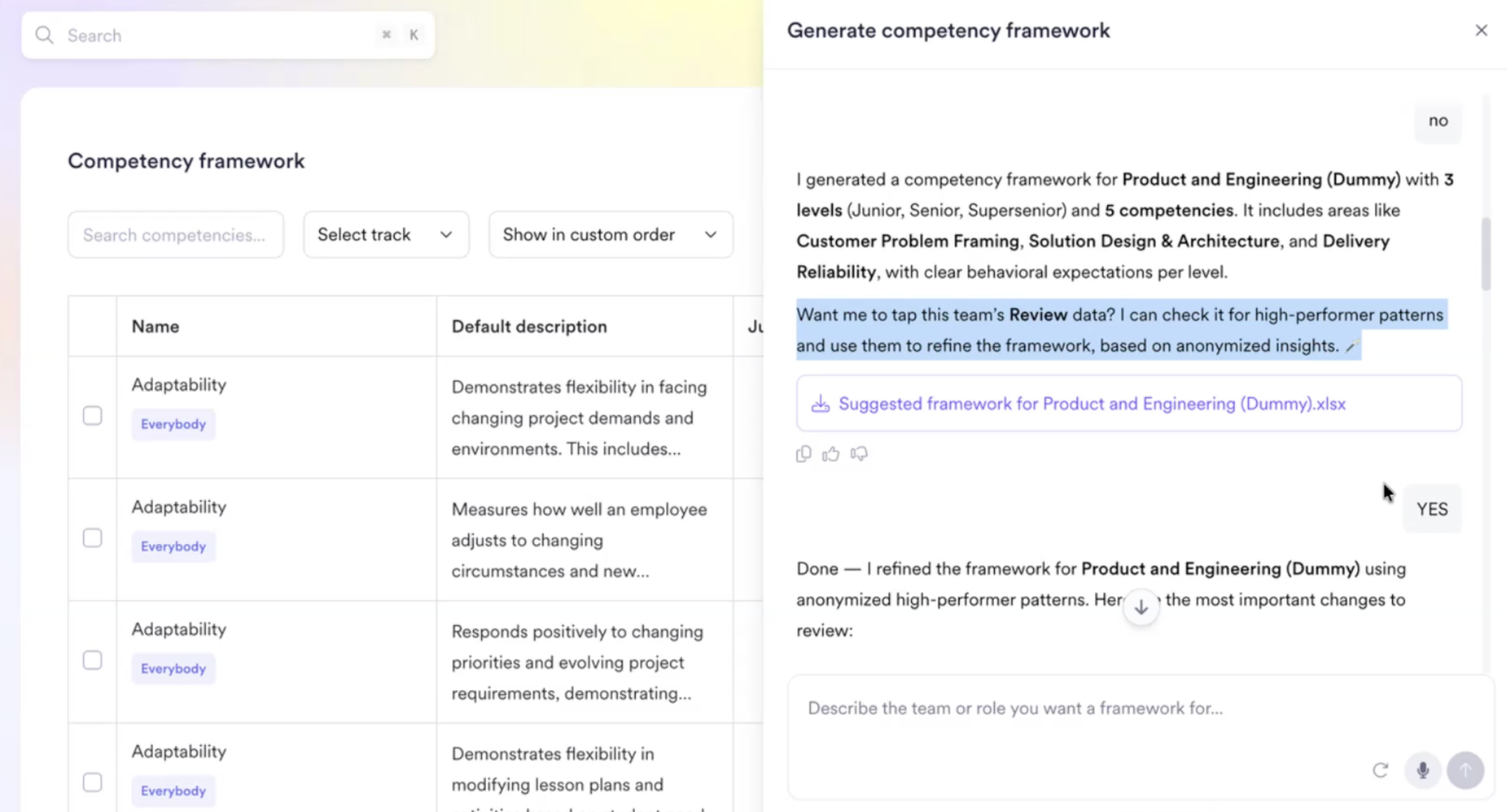
🏗️ Build your HR processes on reliable people data
Leapsome HRIS ensures every connected tool and workflow has access to the same up-to-date employee records.
👉 Explore HRIS
How to evaluate: Separate tools vs. one platform
Choosing between separate HR software or tools and one comprehensive HR platform depends on the complexity of your processes and the work required to keep the stack running. Compare both options against five practical criteria:
- Functional depth: Can the platform support the full process, or would HR lose a critical capability?
- Data sync: What information must move between systems, and how will you catch failed updates?
- Contract costs: What will you pay across every tool and renewal?
- Maintenance: How much time goes into managing permissions or troubleshooting connections?
- Reporting: Can you answer key workforce questions without exporting and reconciling data?
Separate tools make sense when a process needs specialist functionality, such as technical candidate screening or complex multi-country payroll.
A comprehensive platform often works better for organizations with fewer than 500 to 1,000 employees and a lean HR team. One platform can reduce handoffs and give reporting a consistent source of employee data. Company size is only a guide, though. A smaller organization with complex payroll requirements may still need a specialist tool.
“Without a single, reliable data set, AI is just a buzzword. Put your people data in one place, keep it accurate, and only then will AI deliver value on top.”
— Florian Klages, Managing Partner, torq.partners
Run a quick stack audit today:
- List every HR tool and name its owner.
- Flag information entered in more than one system.
- Review any tool without a clear owner or distinct purpose.
If your specialist tools still earn their place, strong integrations become essential. Leapsome integrations connect HR tools to centralized people data, reducing manual updates and inconsistent records.
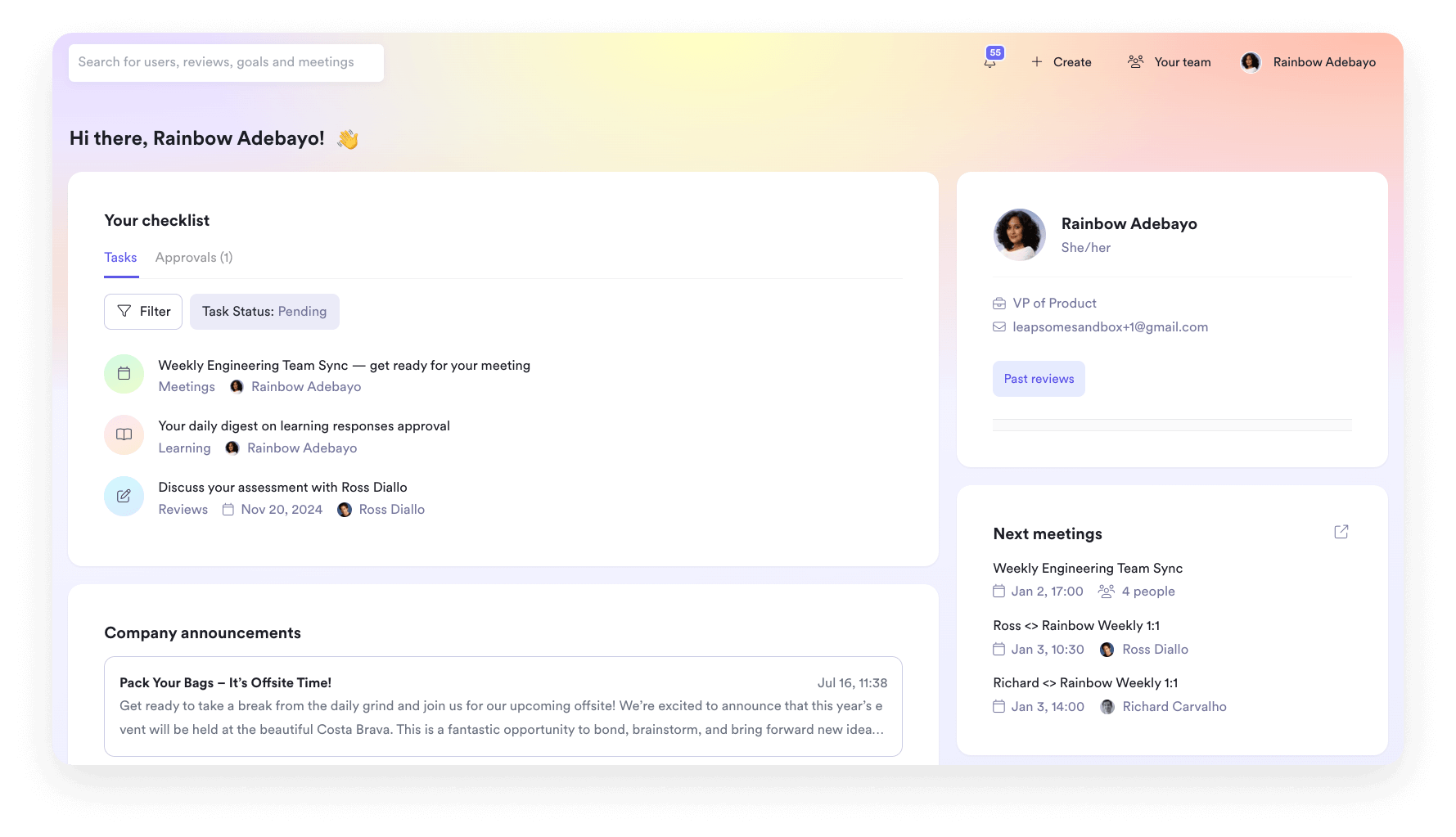
🔗 Keep specialist tools without fragmenting your HR data
Leapsome Integrations connect the systems your business needs while keeping employee records consistent.
👉 Explore Integrations
See how Leapsome unifies your HR stack
A strong HR stack lets information move through the employee lifecycle. Each tool should solve a clear problem and connect with the processes around it. When that connection breaks, your organization is left to pick up the pieces. Employees need to navigate multiple systems while leadership sorts through conflicting people data and reports.
Leapsome brings core HR and people enablement into one connected platform. With Leapsome, teams can:
- Maintain one source of employee data: Update Employee Records once and use current information across HR workflows.
- Connect performance with growth: Use Performance Reviews to identify development needs and connect them with relevant Learning paths.
- Add context to engagement data: Engagement Surveys feed into People Analytics, helping you compare sentiment across teams and track changes over time.
- Connect specialist software: Sync the tools your organization needs through Integrations.
“Employees can now find everything in one place: their data, absences, goals, and reviews. I don’t have to explain which tool to use for what. It’s all in Leapsome.” — Merilyn L, Senior People Operations Specialist, Bob W.
🧩 Build a connected HR stack around your people
Leapsome brings employee data and people processes into one platform that can support your organization as it grows.
👉 Request a demo
FAQ
What’s the difference between HRIS, HRMS, and HCM?
An HRIS stores employee data and supports core HR administration. An HRMS usually adds operational features, such as payroll or time tracking. HCM connects HR with talent development and workforce planning. Vendors often use these terms for types of human resource systems interchangeably, so you should always look at a capability list when picking software for your team.

.png)


Entdeckt unsere Plattform für HRIS, Performance und Entwicklung.