Interview questions to ask candidates: Strategic ways to reveal better hiring evidence</h1>


Choosing the right interview questions to ask candidates starts with understanding what the role requires. Instead of just keeping the conversation flowing, questions should help you gather evidence of relevant skills by asking potential new hires to explain how they’ve applied them.
The challenge is getting every hiring manager to assess that evidence consistently. In SHRM’s research, 25% of HR respondents at organizations using skills-first hiring cited a barrier of inconsistent hiring practices across teams.*
That inconsistency often begins with different expectations. One manager may hear initiative in a candidate’s answer, while another hears someone who should have consulted their team. Agreeing on the competencies the role requires first gives everyone a clearer basis for judgment.
This guide explores strategic interview questions to ask candidates and shows how to connect the answers to shared hiring criteria.
* SHRM, 2026
What are the best interview questions to ask candidates?
“If the people you hire aren’t aligned, you’ll constantly play catch-up. Use tough interview questions to test alignment and maturity early.”
— Melanie Naranjo, Chief People Officer, Ethena
The best questions help the interview panel assess the capabilities the role requires beyond the information from a candidate's resume.
Instead of asking all the examples, use the categories below to choose questions that address your hiring criteria.
Questions about motivation and career goals
These questions help you understand what candidates want from the opportunity and how closely that matches the work you can offer. Look for specific expectations you can compare with the role’s responsibilities and growth opportunities rather than enthusiasm for your employer brand alone.
- What attracted you to this role specifically?
- What accomplishments are you hoping your next role gives you that your previous one didn’t?
- What are you hoping to learn or develop in your next role?
Behavioral and problem-solving questions
Behavioral questions ask candidates to explain how they handled past situations. Choose examples that reflect challenges they would encounter in their role, then listen for the self-awareness behind their actions.
- Tell me about a time you had to solve a difficult problem with incomplete information. How did you decide how to proceed?
- Tell me about a decision you made that didn’t produce the result you expected. How did you respond?
- Describe a time you had to learn something new quickly. How did you check that you could apply it correctly?
“The key in behavioral interviewing is that it has to be structured, [with] set questions that are delivered to every candidate in the same wording, the same order and scored in the same way.” — Mark Stewart, industrial psychologist and HR consultant, Co Director at ESRC Research Centre
Collaboration and communication questions
Focus team dynamic questions on culture fit and the interactions the job requires. For someone working across departments, you might assess how they explain competing needs and reach agreement with colleagues.
- Tell me about a disagreement with a colleague. How did you handle it?
- Tell me about a time you needed support from someone who initially disagreed with your proposal. How did you approach the conversation?
- Describe a time you gave difficult feedback to a coworker. What happened afterward?
Accountability, adaptability, and growth questions
“Ask what makes someone feel undervalued or how they handled feedback—they reveal how well they’ll handle change and business realities.”
— Melanie Naranjo, Chief People Officer, Ethena
This group of questions explores how candidates respond when their work needs to change. Look for examples of what they did afterward, so you can assess how reflection influenced their behavior.
- Tell me about a commitment you couldn’t meet. How did you handle it with the people depending on you?
- Tell me about a piece of difficult feedback you received. What did you do differently after?
- Describe a time your priorities changed unexpectedly. How did you balance new and previous expectations?
To use all of these questions consistently, managers need to prepare with the interview guide and evaluation criteria in one place. Platforms like Leapsome let you include questions and scoring guidance in interview templates, then link them to shared feedback forms.
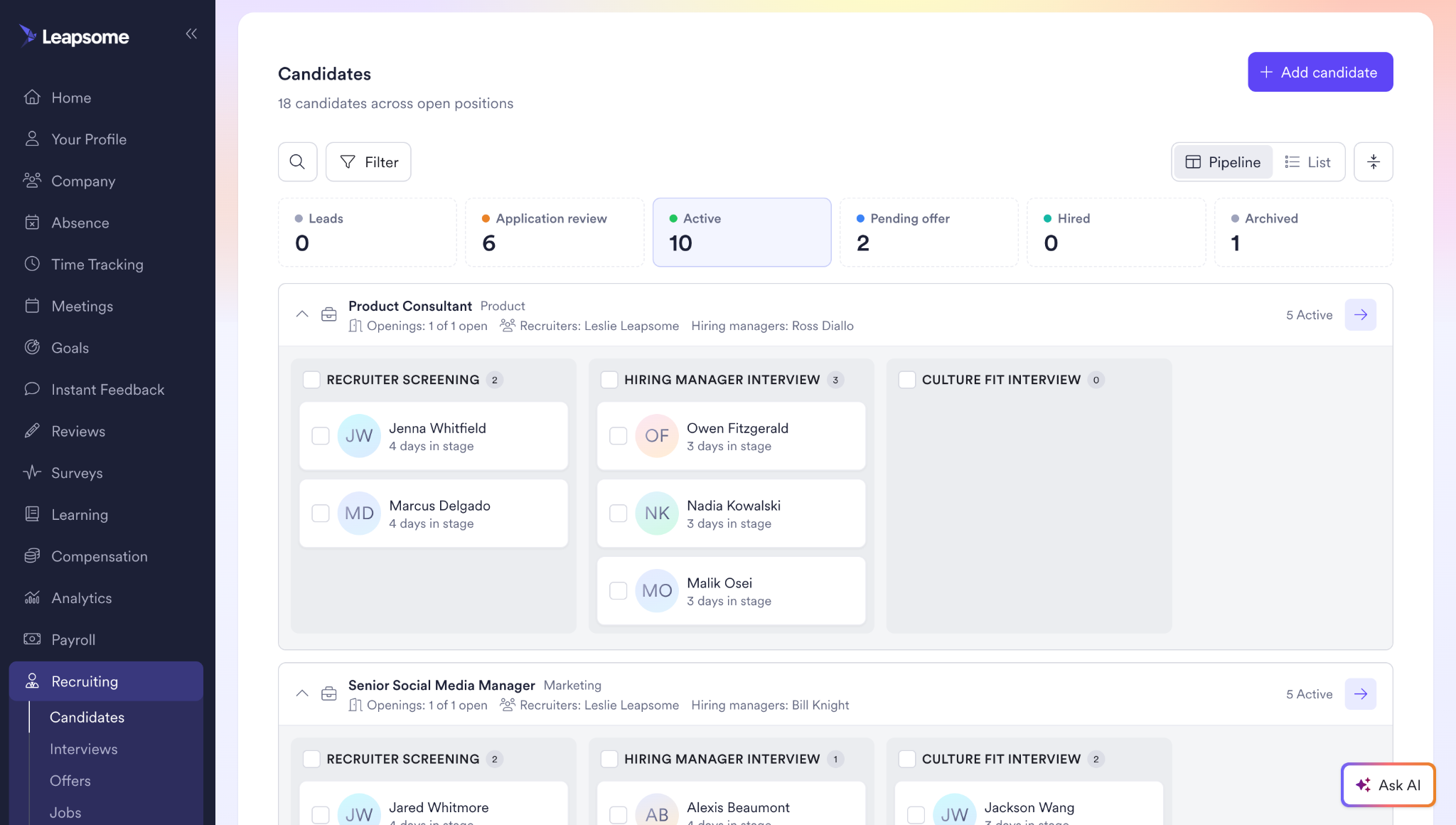
🤝 Keep interview questions consistent across your team
Leapsome Recruiting helps every interviewer ask questions that assess the same role requirements.
👉 Explore Recruiting
What makes an interview question strategic?
“HR often gets forgotten when it comes to strategic objectives, yet we’re just as critical to the business outcomes as any other function. The first step is defining exactly what we want to achieve with our people strategy, then everything else should ladder up to those measurable goals.”
— Monica Sarkar, Co-Founder, Purple Umbrella
A question becomes deliberate when you know what you need to learn from it and how that information informs your hiring decision. Before adding a question to your interview guide, use these checks to decide if it’s strategic:
- Clear connection to a defined capability: The question should replace hypotheticals with specific expectations. For a project manager, that might mean spotting deadline conflicts early and negotiating priorities with the people involved.
- Invitation to provide clear examples: Open ended questions allow candidates to explain their actions and reasoning. “Are you good at managing competing priorities?” invites a yes. “Tell me about a time when several important deadlines competed for your attention. How did you decide what came first?” gives you problem solving skills to examine.
- Room for useful follow-ups: The question should let you explore the candidate’s decisions further. For instance, “What happened to the work you postponed?” helps you understand how they handled the consequences.
- Basis for consistent comparison: When questions are properly targeted and intentional, each answer should help interviewers assess every candidate against the same standards.
Turn job interview questions into evidence: A practical question-to-criteria framework
Once you have a list of potential inquiries and you understand what strategic questioning means, tailor them further on what successful performance in that role requires.
Broad expectations such as “takes ownership” leave too much open to interpretation. For one manager, ownership means making decisions independently. For another, it means knowing when to involve teammates.
Highlight the behavior the role requires, then use this framework to connect your questions to that expectation:
- Criterion: Name the capability you need to assess and describe how someone would demonstrate it in this role.
- Question: Choose a prompt that allows candidates to demonstrate that capability through a work environment example or scenario.
- Evidence: Agree on what interviewers should look for and what would indicate that the candidate meets the required standard.
- Follow-up: Prepare questions that clarify missing details.
If you’re assessing openness to feedback, for example, here’s how a question-to-criteria framework might work:
Test how the framework translates to scores before the interviews begin. Ask managers to rate a sample answer and explain their scores, then resolve any differences in what they expect before they assess real candidates.
After each interview, have interviewers record the evidence behind their scores. If an answer leaves a gap, use a follow-up to clarify it instead of assigning an automatic low rating.
Carry the same criteria into onboarding. For openness to feedback, the manager could agree on an improvement with the new hire, then review how they applied feedback at their next 1:1. With connected HRIS platforms like Leapsome, you can define these expectations by role and seniority level and give managers a shared standard for hiring and later development.
“Competency frameworks are not just checklists, they’re roadmaps for growth and accountability. They help managers coach more effectively and give employees a clear picture of how to succeed at every level. When expectations are written down, everyone understands what great looks like.”
— Monica Sarkar, Co-Founder, Purple Umbrella
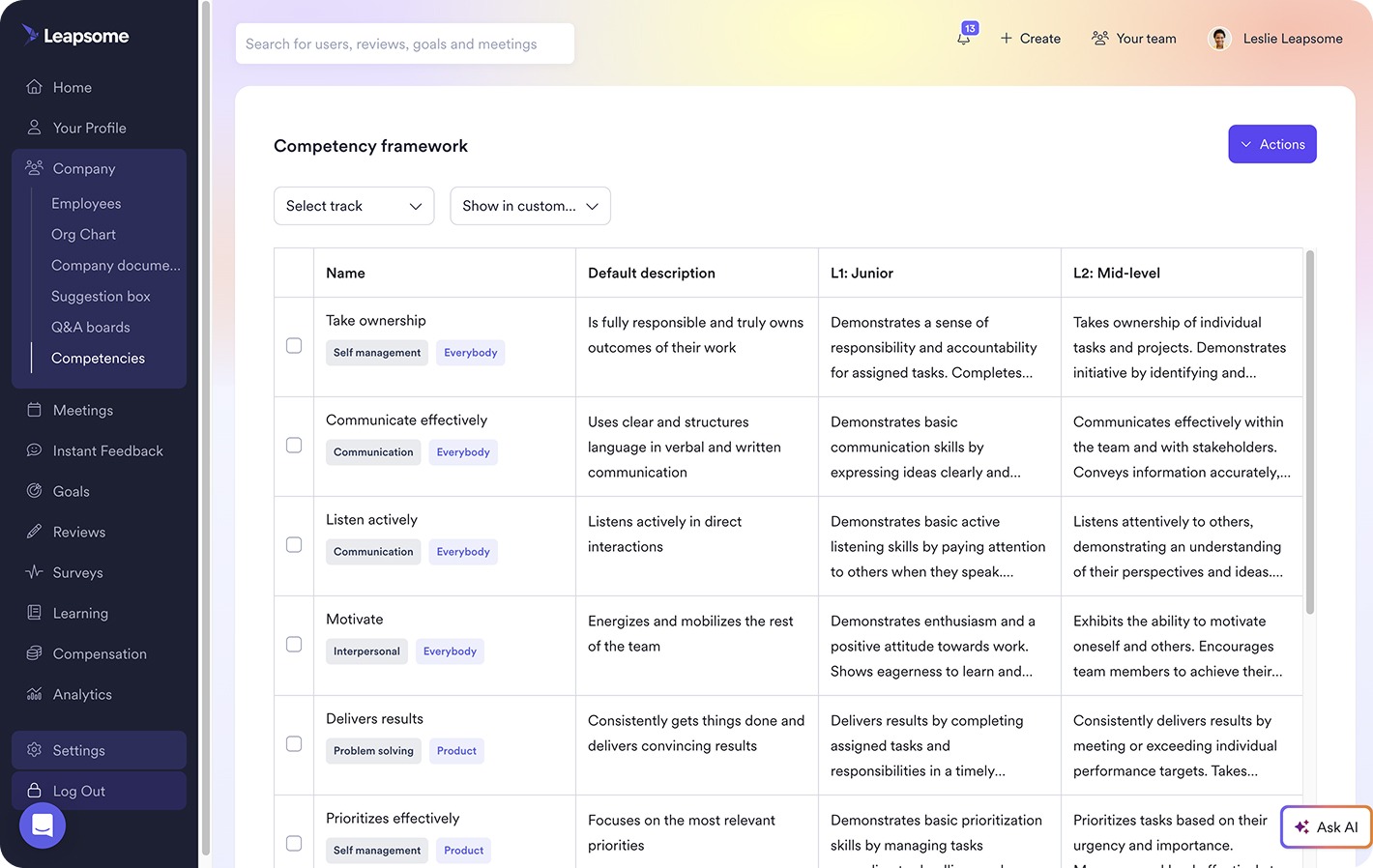
🌱 Carry hiring expectations into employee development
Leapsome’s Competencies helps you define what good performance looks like at each role and level, so managers use consistent standards throughout the employee lifecycle.
👉 Explore Competencies
How Leapsome helps HR teams create more consistent hiring and employee experiences
Even with a list of good interview questions to ask candidates, a lean HR team can’t manually carry the findings from every interview into onboarding and development. Managers need a way to use the same role expectations throughout every process.
When interview feedback stays in a recruiting tool, and the onboarding checklist lives in a separate platform, managers easily lose sight of why they hired someone.
Leapsome helps connect those expectations across the employee lifecycle with:
- Competencies: Define what good performance looks like for each role and seniority level, giving managers clear criteria to use across people decisions.
- Recruiting: Bring interview questions and evaluation forms together so hiring teams assess candidates against shared expectations.
- Pre-boarding and Onboarding: Connect Competencies and Recruiting to structured onboarding workflows that help new hires understand their responsibilities and prepare for the work ahead.
- Performance Reviews: Assess employees against relevant competencies using evidence from their work to discuss career trajectory.
- Goals and OKRs: Turn expectations into specific goals and support employees with learning paths linked to the capabilities they need to develop.
“We were able to include everything we wanted into our performance reviews, such as our structure, questions, response formats, scale, and our value and competence model. It works just great!” — Marie Richter, VP People | Billie
📎 Connect desired capabilities to employee growth
Leapsome helps your managers carry clear expectations from interviews into performance and development.
👉 Request a demo
FAQ
What are some unique interview questions to ask candidates to evaluate them better?
Unique strategic interview questions should be open, invite specific answers, and allow for deep follow-ups. Here are a few examples:
- What would you do differently if you started your last project again?
- Tell me about a time you challenged an established way of working.
- What would you need to know before making your first decision in this role?