Global HRIS systems: Top options and choosing the right fit

.png)
International organizations need a way to keep their data consistent and tightly linked with core HR functions. Otherwise, they risk fragmented processes that won’t hold up as the company grows. Global human resources information systems (HRIS) solve this by centralizing employee data and HR processes in one place.
But not all HRIS software is built alike. Smooth international growth needs consistent data and core processes. But you can’t copy/paste your home practices into every region you expand to. Some companies try to manage by juggling a grab bag of tools for each locale. Well over half (62%) of organizations use two to four paid HR solutions, and 17% use five to seven.*
A better approach is using a single global HRIS system that lets teams standardize what works everywhere and localize what doesn’t.
This guide explains what global HRIS systems are, what to evaluate when shopping around, and how to decide which processes to standardize and which to adapt. By the end, you’ll have a solid starting point for making a smart choice, whether you’re a lean HR team on a budget or a larger organization with more resources.
* HR.com, 2025
What are global HRIS systems?
A global HRIS system is an HR software platform that helps international organizations manage employee data and run core HR processes, such as:
- Global payroll processing
- Benefits administration
- Time and attendance tracking
- Employee self-service portals
- Localization support
- Workforce management and reporting
Traditional HRIS platforms focus on organizations that operate in one country. But global HRIS software handles the complex compliance and localization needs of international teams.
A Gartner survey found that combining human judgment with digital tools to create higher-impact work can increase the business value of HR tech by up to 54%. Here are some of the specific benefits of global HRIS systems that maximize business value for international teams:
- Centralizing data and reporting: Keep employee records current, accurate, and in the same place for your entire global workforce. Spot local and company-wide trends, then pull cross-region reports to confirm them.
- Balancing global consistency with local flexibility: Standardize the HR processes that should be the same everywhere, such as reporting and analytics. Localize what should be tailored to each region, like onboarding programs and feedback styles. And do it all without implementing a separate HRIS for each jurisdiction.
- Cutting down on busywork: Reduce duplicate entry and manual reconciliation, which often appear when teams rely on scattered tools.
Leapsome gives HR teams all this and more. Configure employee profiles, manage role-based permissions for your entire international team, and keep it all in sync 24/7.
“We’re really focusing on making sure the data we produce is high-quality and consistent across countries. Good data helps us identify pain points early, plan development initiatives, and return to the business with clear, actionable insights.”
— Victor Tomas, Learning & Development Specialist, Swapfiets
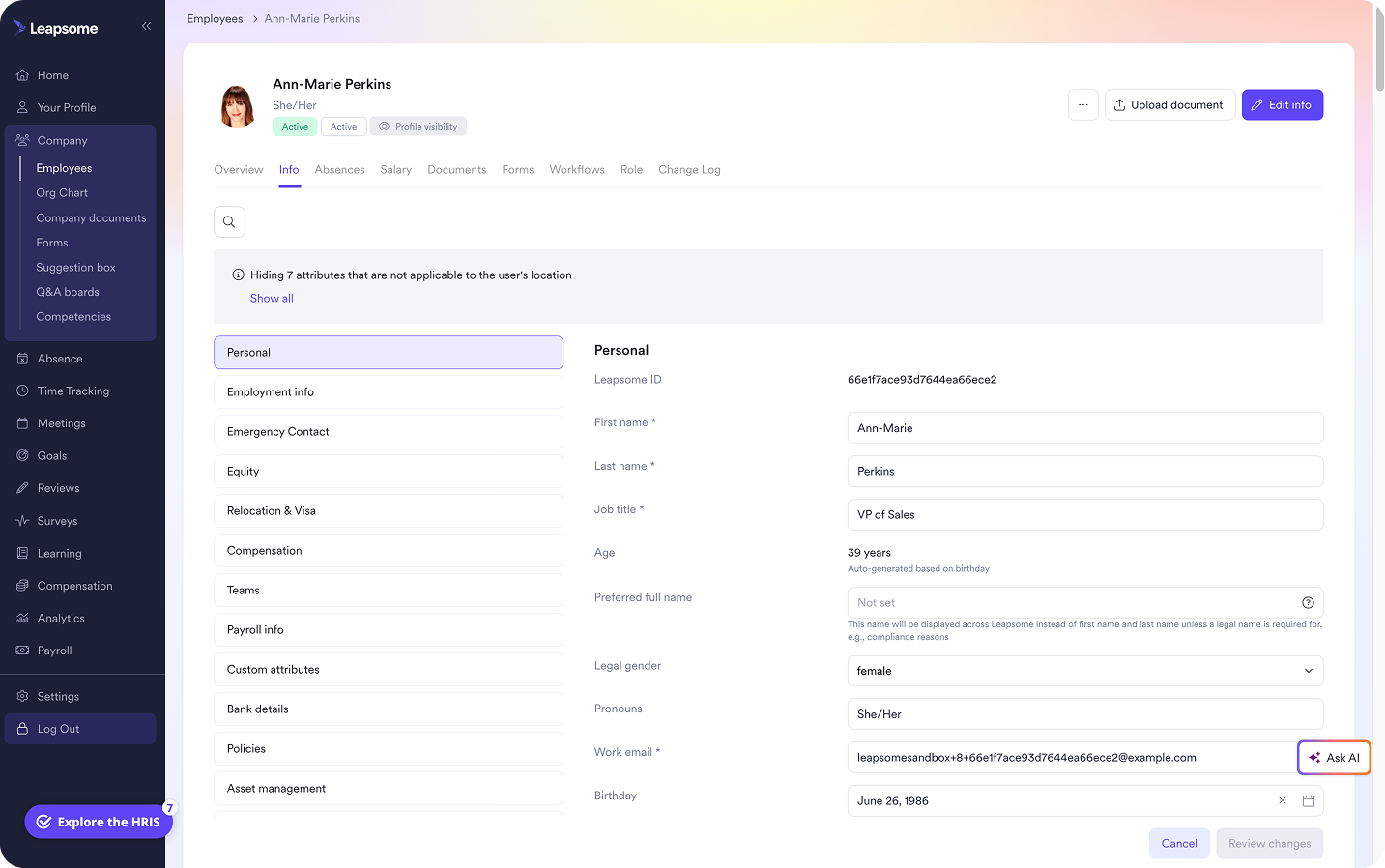
🧵 Stitch employee data back together
Replace scattered tools and spreadsheets with a single source of truth that never goes stale and nips time-consuming manual work in the bud.
👉 Explore Employee Records
What are the top three HRIS systems?
“Look for one platform that covers your key needs and integrates with your stack. Don’t scatter data across 10 or 20 disconnected tools.”
— Katerina Arsova, Head of People & Talent Operations & Partnerships, Leapsome
Here’s a list of HRIS systems that lead the pack in today’s market:
- Leapsome: A popular HRIS system that links centralized employee data to a full suite of HR functions, from performance management to engagement surveys. As an AI-native platform, Leapsome supports smarter workforce insights and more efficient review cycles while cutting down on routine admin work.
- Rippling: A platform that offers core HR functions like payroll processing, benefits administration, and IT management. It can automatically localize onboarding flows and supports operations in more than 185 countries and 50 currencies.
- BambooHR: A cloud-based HRIS built for small and mid-sized businesses. It offers a simple interface and HR functions to help teams organize employee data without heavy configuration.
Fit over features: What to look for in a global HRIS system
“Stakeholders often worry, ‘Will others see the wrong things?’ Modern HRIS permissioning answers that. Managers see their directs, Finance sees cost data, employees see their own records and nothing more.
— Carolin Leidel, Consultant, torq. partners
The best HRIS system isn’t the one with the longest list of features. It’s the one that fits your workforce, operating model, and the countries you operate. While exploring your global HRIS options, pay attention to these key areas:
- Data, reporting, and permissions: International teams need a single, reliable home for their data. Without one, information falls out of sync, and finding the details you need becomes a chore. Businesses also need to visualize and analyze their data to identify bottlenecks and improve their HR processes.
- Localization, flexibility, and scalability: Your chosen HRIS should support your current workforce while leaving room for growth in team size and geographic reach. Look for flexible customization options and built-in compliance workflows for different jurisdictions.
- Automation, integrations, and employee experience: HR automation tools keep you from getting mired in tedious admin work as your company expands. Ensuring the HRIS integrates well with your other tools further lightens the load. These benefits create a streamlined employee experience with fewer logins and less repeat paperwork.
Leapsome connects these functions to the data they rely on so nothing works in a vacuum.
“It’s one big lift to automate, but every cycle after that becomes faster and easier. Automating the invisible work gives HR leaders back time for culture, strategy, and meaningful connection.” — Emma Leeds, Founder, CEO & Chief People Consultant, People Function
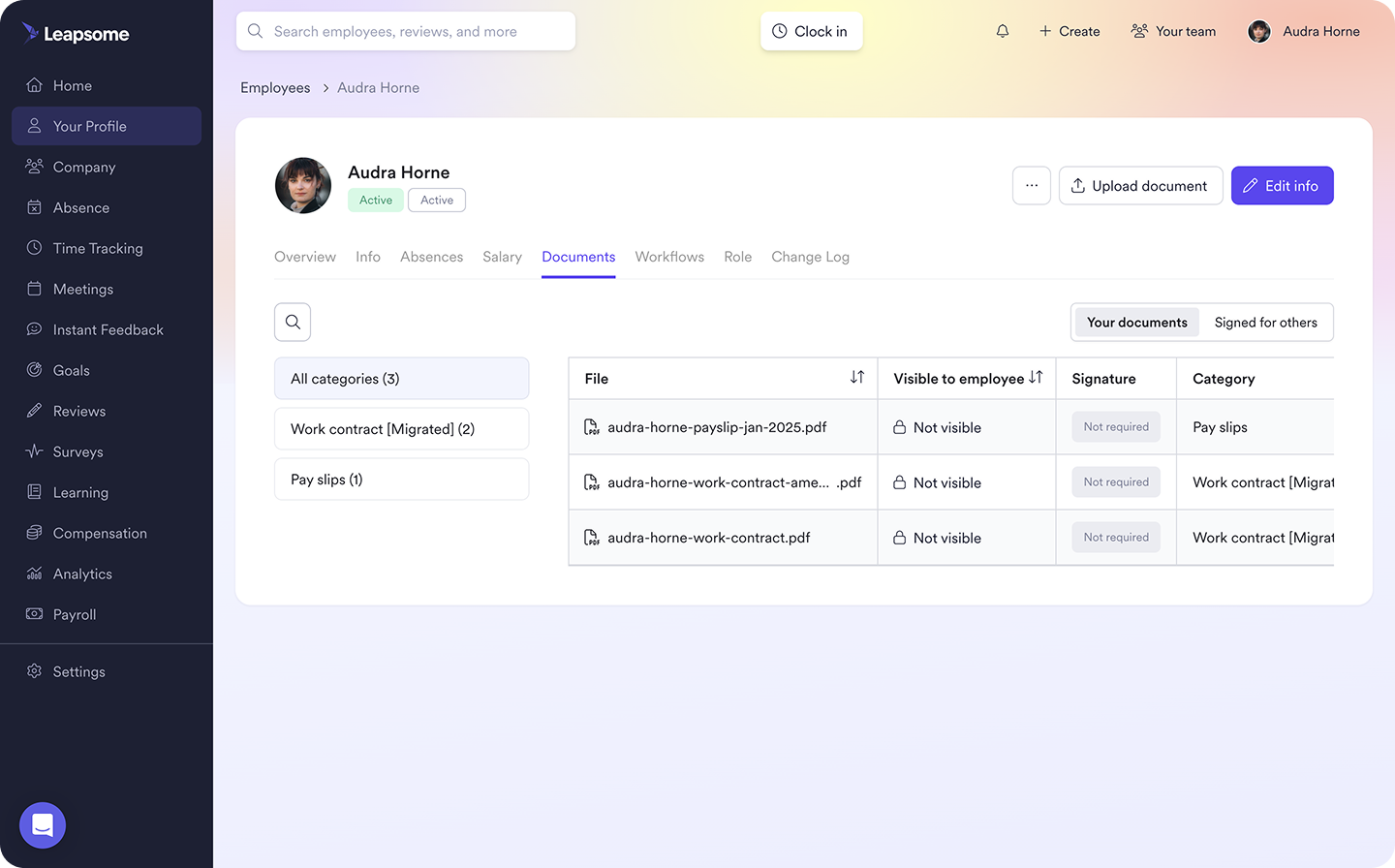
🌐 One HRIS for every region
Centralize employee data in one place, automate compliance workflows for each region you operate in, and pull tailored workforce reports in a few clicks.
👉 Explore HRIS
To standardize or not to standardize? How to decide
Atlas HXM reports nearly half (49%) of organizations with an international workforce find managing cross-border operational complexity very or extremely challenging. In many cases, the problem is applying the same HR system that works at your flagship location to other regions.
Excessive localization fragments data and HR functions, while excessive standardization creates rigid workflows. These problems keep global organizations from adapting to local on-the-ground realities.
Here’s how to group HR processes based on global alignment, local variation, or a mix of both.
- Standardize globally: Processes that need to be consistent to keep data reliable and comparable across locations, such as permissions and the structure of employee data.
- Keep locally flexible: Processes regulated by local labor laws or influenced by cultural norms. Examples include time off policies and benefit packages.
- Use a hybrid approach: Processes that mix the best of both worlds. For example, performance reviews might use consistent templates while leaving room for culturally appropriate feedback styles.
HR leaders should define these criteria before choosing a platform. A hasty choice can force your operating model to fit the software instead of the other way around.
Put global expansion on a firm HR foundation with Leapsome
As organizations cross borders, HR teams often get stuck reconciling employee data from a patchwork of platforms and redoing admin work that didn’t stick the first time. This is inefficient and makes it harder to maintain consistent people practices.
Centralizing records is the first step toward taming this complexity, but it’s not enough. The data also needs to connect seamlessly to the everyday HR processes that cultivate a high-performing and highly engaged workforce.
Leapsome combines configurable employee records with connected people processes like:
- Performance management: Run automated performance review cycles with customizable rules. Draw on insights from past performance, goal progress, and time-tracking data so reviews rely on real numbers instead of managers’ memories.
- Employee engagement: Launch engagement surveys in minutes to catch downtrends early, before issues escalate.
- Learning: Choose a premade course from Leapsome’s curated content library or use AI to build an entire learning path just by describing what you need. Multilingual support means your whole team is covered, no matter where they log in.
This combination helps build a shared HR foundation while keeping local processes flexible. HR goes from an administrative unit to an engine for boosting performance, engagement, and development. Global HR teams can make a bigger impact and prove it without piling on more platforms.
“Employees can now find everything in one place — their data, absences, goals, and reviews. I don’t have to explain which tool to use for what. It’s all in Leapsome.” — Merilyn L., Senior People Operations Specialist | Bob W
🌍 Global reach with local context
Centralize employee data and hook it up directly to everyday workflows to maintain consistency and visibility across standardized and localized HR processes alike.
👉 Request a demo
FAQ
What are HRIS software systems?
HRIS software systems centralize employee data and streamline HR tasks like payroll processing and benefits administration. Global HRIS software offers the same capabilities while adding support for multi-country compliance and localization.

.png)


Entdeckt unsere Plattform für HRIS, Performance und Entwicklung.