PEO vs. HRIS: Picking your HR growth engine


Some HR support models have a short shelf life. What worked fine during the startup phase can create a lot of frustration as teams struggle to hit their next growth target. In fact, Gartner data shows that many organizations get stuck relying on inefficient tech stacks, with just 24% of HR leaders claiming they’re getting the most value from their approach to HR technology.*
When companies feel the pressure to update their HR systems, one early choice they’re presented with is outsourcing functions (especially through a PEO) or upskilling with an HRIS. Choosing between these options hinges on how much control you want to maintain and how you plan to scale your HR team. However, this isn’t always a binary “PEO vs. HRIS” choice. There may be times when using both models supports your operations today while prepping internal teams for greater self-sufficiency.
In this guide, we’ll walk through the benefits and drawbacks of PEO and HRIS models of support, and explore how to stay strategic and operationally ready to pivot with both.
* Gartner, 2024
What’s PEO in HR, and how is it different from an HRIS?
PEOs and HRIS tools take very different approaches to achieving the same goal: Supporting your HR operations. While PEOs outsource HR chores to external experts, an HRIS gives your team more visibility and structured tools to tackle HR tasks:
- Professional Employer Organization (PEO): PEOs are outsourced partners that handle core HR processes on your behalf, including payroll processing, benefits administration, and tax filing. While there are a few kinds of organizations like PEOs, a defining trait is that they use a co-employment model, meaning they share employment responsibilities with your organization while you retain control over employees’ day-to-day experiences.
- Human Resource Information System (HRIS): An HRIS is a kind of software that hosts all of your employee data. It’s easier to see and use people analytics across the employee lifecycle with all this information in one place, so teams can manage their HR processes more efficiently and with stronger connected data insights.
Neither of these options are inherently “better” than the other. While one may seem more appealing for your team, PEOs and HRIS tools both have strengths and weaknesses that make the best choice dependent on your current needs and how much autonomy you’re ready to keep in-house.
How PEOs and HRIS tools function at a glance
PEOs and HRIS platforms tackle similar core HR operations, but the former takes these duties off your plate while the latter gives you better management tools for them.
Here’s a quick summary to help you compare PEOs with HRIS tools.
What are the biggest differences between a PEO and an HRIS?
“A unified HRIS is designed to ‘lighten the admin load’ so lean teams can move from being gatekeepers to strategic enablers.”
— Leapsome 2026 Workforce Trends Report
PEOs take on your administrative heavy lifting, while an HRIS gives you tools to better manage HR workflows. This central difference can make PEOs more appealing to startups and small businesses, but using both methods in the early stages is a powerful strategy to avoid forming external dependencies.
Outsourcing your HR functions can lead to information gaps that slow down your business strategy. Adding an HRIS like Leapsome keeps valuable engagement and compensation information in-house so you can build data-driven strategies without waiting for a response from your PEO representative. Plus, Leapsome’s AI-powered recommendations mean your teams can spot those trends, then analyze and deliver timely responses to act on them.
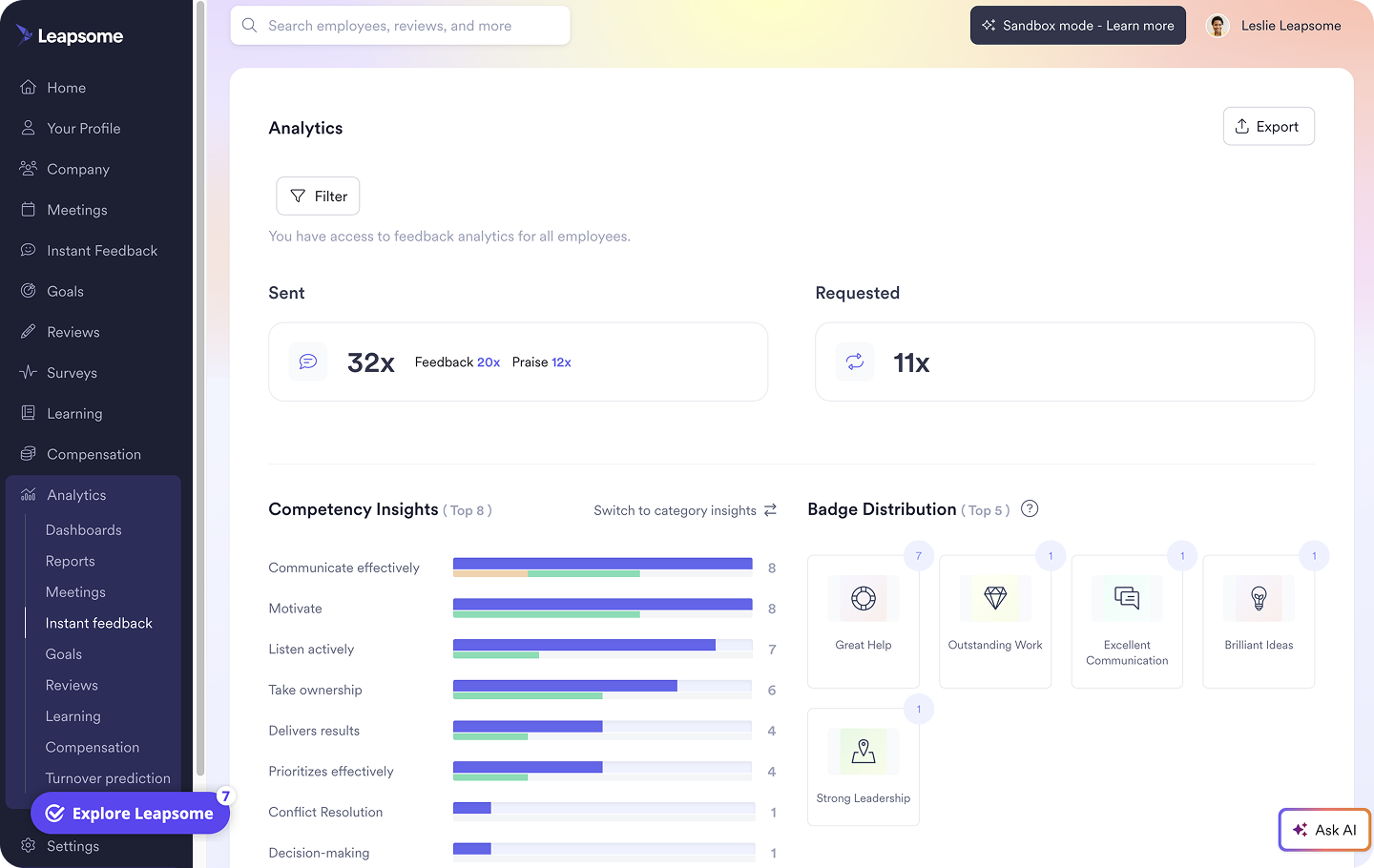
🔍 Discover better insights using data you already have
Move beyond outsourced reports with Leapsome’s centralized analytics for real-time readings on all aspects of the employee lifecycle.
👉 Explore People Analytics
There are a few major operational differences between PEOs and HRIS tools.
Ownership and control of people data
With a PEO, employee and payroll data sits in the provider’s systems. HR teams get access to reports, but there’s no room for customization, and any visibility is limited by the partner’s processes.
An HRIS, on the other hand, keeps you in the driver’s seat. Rather than dealing with a predefined reporting structure or waiting to get access to your employee data, your HR teams have a real-time, centralized source of truth they can use to customize strategies that speak to the present moment.
Cost structure
The most common PEO payment structure is ongoing service fees tied to your headcount or a percentage of gross payroll. These prices also vary based on which tools you’ll need — benefits and workers’ comp sometimes cost extra.
HRIS providers tend to use software subscription models that vary in price depending on the features you want and/or your headcount. However, HRIS programs are typically less expensive than PEOs across the board.
Flexibility and customization
Since PEOs use standardized processes across many clients, they’re known for their consistency. Their staff has experts in fields your team may not, which can improve compliance with complex local laws (especially if you have team members in different countries). The downside is that this well-defined structure can become rigid as organizations crave greater customization and data insights.
On the opposite end of the spectrum, HRIS platforms are designed to be highly configurable. Organizations have the freedom to set their permissions, reporting structures, and planning programs, for example. The greater flexibility an HRIS provides becomes significant in more mature growth stages, as HR takes on more strategic initiatives for long-term business growth.
A decision framework for HR leaders: Choosing between a PEO and an HRIS
“HR shouldn’t just support business decisions — you’re shaping them. You have to think like a profit center, not an administrative silo.”
— Anita Anthonj, Founder and CEO of Talaera
At its core, the decision between an HRIS versus a PEO comes down to organizational readiness. Are you in a position to build more internal structure and ownership over your HR processes, or do you need to offload that HR complexity right now? It doesn’t have to be a decision you stick with forever, but answering a few questions can help clear up which choice is better for your organization at this moment.
Headcount and growth trajectory
Diagnostic question: Is the organization growing fast enough that HR complexity will increase significantly in the next 12–24 months?
The smaller your company, the more you’ll benefit from the structure a PEO provides. It’s just more practical to work with a PEO that already has the connections for bundled services while your headcount is low and the cost isn’t as prohibitive. But as your company grows and you start to feel the restrictions of PEOs, you should reevaluate whether it’s worth the expense.
For example, a 30-person startup might want to use a PEO to handle payroll and benefits administration because it can offer employees stronger insurance options. Once that company crests above 100 employees, with multiple teams and managers in each department, managing tasks like performance reviews and compensation planning will likely become more challenging to handle with a PEO alone. An HRIS can be particularly useful from that middle growth period onward, as it becomes your organization’s central source of truth.
Internal HR capacity
“We were spending way too much time just executing tasks and not focusing on people.”
— Siddharth Dhanuka, Head of Finance and Operations at SQUAKE
Diagnostic question: Does HR currently have the bandwidth and expertise to own payroll, compliance, and people operations internally?
A PEO handles many necessary processes that would otherwise hold lean teams back from hitting their scalability milestones. Once companies establish their market presence, leaders may want in-house HR to analyze organizational data a PEO would hold onto (like attendance records and gross wages) to build a stronger business strategy, which is when an HRIS makes more sense.
For example, if your small company has one HR generalist who’s managing multiple tasks like payroll coordination and benefits questions, it’s probably better to work with a PEO. As you build an internal team with more HR experts, you’re in a more confident position to take on this work in-house with an HRIS.
Data and reporting needs
Diagnostic question: Is leadership regularly requesting information about people analytics, workforce reporting, or performance visibility?
When leadership teams start asking bigger questions that PEO reports don’t satisfy, it’s a sign that data availability needs a refresh. A centralized HRIS can consolidate data to quickly provide the answers leadership needs to keep the organization scaling smoothly.
For instance, stakeholders who are satisfied with payroll summaries, headcount reports, and compliance documentation will get everything they need from a PEO partnership. An HRIS becomes more valuable when leaders start wondering about team turnover, engagement scores, or any other issues that need more nuanced people operations data.
PEO or not, Leapsome powers up your people ops
While outsourcing has its strategic advantages during some stages of organizational growth, the benefits PEOs offer today can turn into liabilities down the line. You’ll need access to all your data, past and present, to run the kinds of analyses that drive strong long-term growth, after all.
Wherever your organization is in its scaling journey, Leapsome’s HRIS can smooth transitions by unifying any fragmented data and processes. Our all-in-one modular HR platform stores all your people analytics, from onboarding through development, in one place for accurate and insightful tracking. Whether you integrate Leapsome with your PEO or use it as a standalone solution, you’ll get real-time visibility into your people operations.
“Employees can now find everything in one place — their data, absences, goals, and reviews. I don’t have to explain which tool to use for what. It’s all in Leapsome.” — Merilyn L., Senior People Operations Specialist at Bob W
👀 Free HR teams from data blind spots
Leapsome’s centralized HRIS and people management platform gives you full visibility on engagement, development, and performance, with or without an outsourced partner.
👉 Request a demo
FAQ
What’s the best PEO for a small business?
The right PEO for your small business depends on your needs and budget. However, strong candidates should have features like responsive customer service, extensive benefits packages, and multi-state compliance.
Will an HRIS be a less expensive solution than a PEO in the long run?
Yes, an HRIS is generally the more affordable option, but it’s not a one-for-one replacement. HRIS platforms help HR teams manage tasks, but they can’t do any HR tasks for you. Using an HRIS means you’ll still be responsible for taking on these responsibilities, versus outsourcing to a third party PEO, so consider your growth rate and how much it will cost to hire new HR team members, too.

.png)


Entdeckt unsere Plattform für HRIS, Performance und Entwicklung.