Furlough vs. layoff: Safeguarding the employee experience


In 2025, employers in the United States announced more than 1.2 million job cuts, the highest annual total since 2020 and a 58% increase from the previous year.* When this kind of economic pressure hits, HR leaders are more likely to be put in the difficult position of guiding employees through furloughs or layoffs.
Both furloughs and layoffs can reduce the size of your workforce and corresponding costs, but neither are just a financial decision. Poor execution can turn an immediate cost cut into a bigger retention issue, as the choice shapes how affected employees experience the company and whether remaining teams continue to trust leadership.
This guide explains how to decide between a furlough versus a layoff, when each approach makes sense, and how HR can protect employee confidence that the organization still has their back throughout the change.
* Challenger, Gray & Christmas, 2026
Furlough vs. layoff: Key differences
A furlough and a layoff both reduce workforce size, but only one preserves an employment relationship during the process. That difference changes what employees can expect and what the business has to rebuild later.
What does “furlough” mean?
A furlough temporarily reduces an employee’s working hours or pauses their work without ending their employment. Organizations typically use furloughs during a seasonal slowdown or a short-term funding gap when leaders expect workload and budgets to rebound quickly.
How a furlough works in practice depends on employee classification. During a furlough, employers can reduce non-exempt employees’ hours and pay them for the time they work. But the Fair Labor Standards Act (FLSA) applies different rules to most exempt employees. Under its salary-basis requirements, an exempt employee can’t work during unpaid furlough time.
Everyone stays on the company’s records during the furlough, and some employers may continue benefits depending on company policy and plan terms.
What does “laid off” mean?
When a restructure changes workforce needs or the market takes a turn for the worst, HR leaders turn to layoffs. In fact, SHRM’s 2025 pulse survey found that more than one in seven HR professionals had seen their organization conduct a reduction in workforce (RIF) — a more permanent role elimination — during the previous 30 days.
Unlike a furlough, a layoff ends the employment relationship entirely, regardless of performance. Regular pay stops, while benefits change according to company policy and applicable law. Employees may qualify for unemployment benefits or receive severance, again depending on company policy.
For the business, layoffs create a more permanent cost reduction. However, they also cut skills and institutional knowledge that can be expensive to rebuild (if possible) when conditions improve, and can hurt remaining employees’ morale.
Differences between furloughs and layoffs at a glance
Here’s what makes furloughs and layoffs different.
| Factor | Furlough | Layoff |
|---|---|---|
| Employment status | The employee remains employed. | The employment relationship ends. |
| Compensation and benefits | Pay decreases or pauses. Some benefits may continue. | Pay ends. Benefits typically don't continue, unless mandated by specific company policies or local laws. |
| Expected duration | Temporary, but the timeline can change. | Usually permanent. |
| Return expectations | The employer generally expects the employee to resume work after a set amount of time. | The employer makes no commitment to rehire the employee. |
Furloughs vs. layoffs: Which is better for your business?
Choosing a furlough simply because it sounds less harsh doesn’t help anyone in the long run. If you can’t explain when you’ll review the decision or what would bring employees back, you risk keeping people in employment limbo and tanking employee sentiment.
What to evaluate while planning a reduction strategy
Before you compare the immediate savings of a furlough versus a layoff, test each option against your recovery plan and the cost of losing key talent. Here are a few other key factors to consider:
- Expected duration of the downturn: A furlough makes sense when a disruption has a realistic end point, like a delayed bill preventing the release of federal funds necessary to make payroll. Set a review date and define what has to change before employees return. If you can’t do either, a layoff gives employees a harsher, but more honest, outcome.
- Critical skills and talent needs: Identify which capabilities the business will need to recover before you cut roles in case no one comes back. SHRM estimates that replacing an employee can cost up to 200% of their annual salary, so while a furlough can preserve the employment relationship, it can’t stop talent from accepting more stable work elsewhere.
- Legal and operational implications: First, check whether the U.S. Worker Adjustment and Retraining Notification (WARN) Act requires you give 60 days’ notice. The act usually applies to employers with 100 or more employees during qualifying site closings or mass layoffs, and when a furlough lasts longer than six months. Then, review how the decision affects health coverage, since layoffs and hour reductions can trigger COBRA coverage requirements. Before you finalize the plan, double check that your selection criteria doesn’t affect any protected group unfairly. State notice and final paycheck rules add more requirements, so involve an employment attorney early to make sure you’re staying fully compliant the whole time.
How to protect employee trust after a furlough or layoff with effective communication
"Treat people like smart adults. Don't try and gaslight them into thinking this is actually good."
— Melanie Naranjo, Chief People Officer at Ethena
The staffing decision might end when leaders approve the plan, but the employee experience doesn’t start until you break the news.
Employees need an honest explanation when they unexpectedly face lost income, missing benefits, and an unexpected job search. Clear communication from leadership can keep confusion from making their experience worse.
Here’s how to communicate the decision clearly and responsibly.
Give people the full context
"People just need context — we jump to execution instead of taking time to talk through the 'why.'"
— Steve Browne, Chief People Officer at LaRosa's, Inc.
Explain what caused the decision, and leaders should explain directly to employees why they chose a furlough or layoff. Taking ownership over the decision communicates your values and shows you understand the impact this has on employees as individuals.
Then, give employees firm transition dates whenever possible. Employees need to know how long the furlough is and when they’ll return to office (or when you’ll reassess plans), and laid-off workers need a clear transition timeline.
Prepare managers before the announcement
Employees will bring their questions to the person they trust most, and that’s typically their manager. “HR will follow up” can’t become the default response and risk questions slipping through the cracks. Give managers approved answers and a clear escalation path, or use Leapsome’s Meeting tools to schedule individual conversations soon after the announcement.
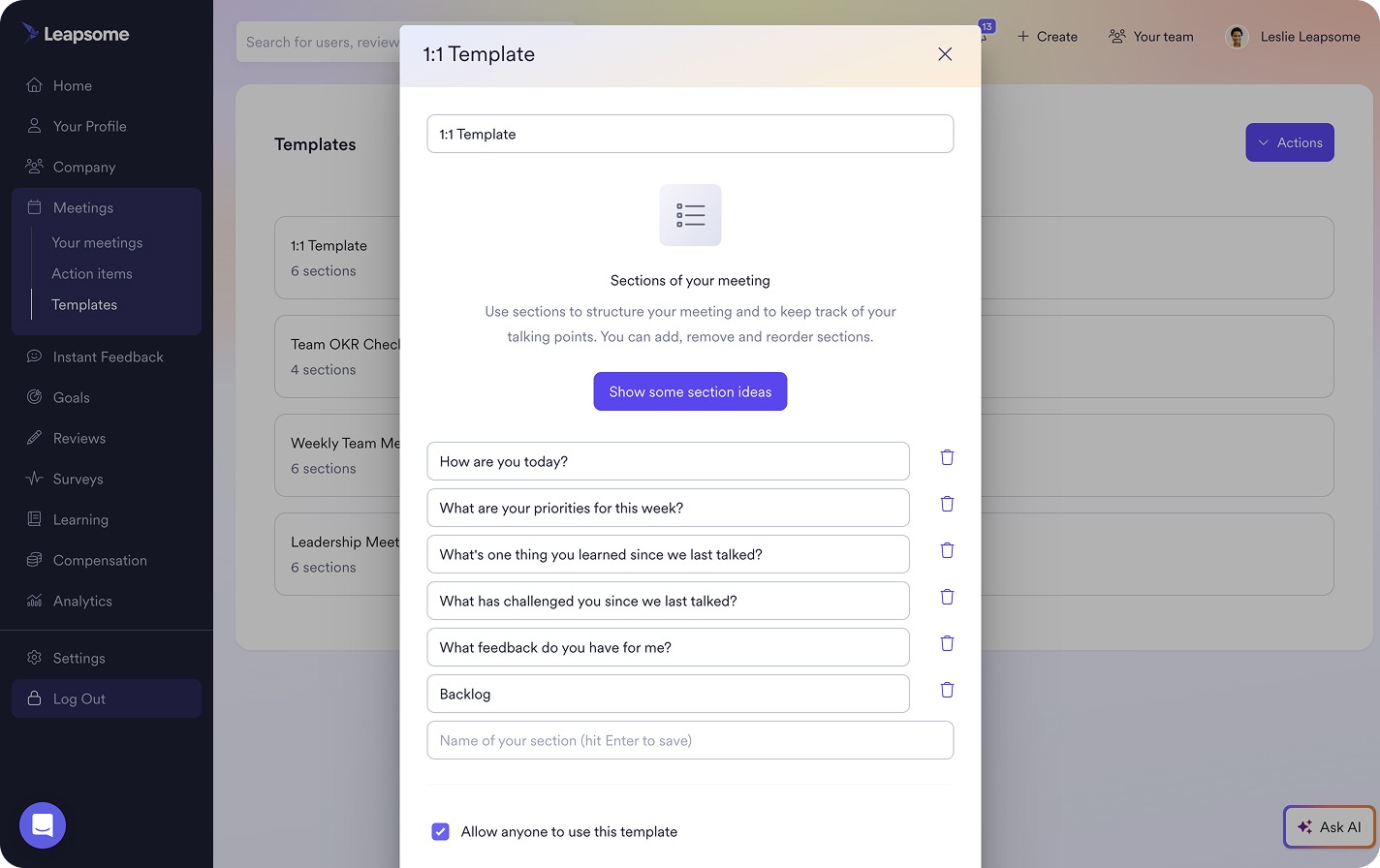
🦺 Create a safe space for hard conversations
Leapsome’s Meetings feature helps managers communicate decisions and understand employees’ concerns and opinions, so everyone can get the information they need.
👉 Explore Meetings
Make employee support concrete
For employees who are laid off, explain final pay dates and benefit continuation in plain language. Cover severance pay or career support separately so as to not cross wires.
During a furlough, clarify benefit changes and work restrictions as relevant. Update the employee records so HR and managers have a single source of reliable information.
How HR can lead organizational recovery after a furlough or layoff
"Managers can't fix everything, but they can create calm. It's about showing care, being transparent, and helping people focus on what they can control."
— Anja Schauer, Global Head of Customer Success at Leapsome
Employees judge a reduction decision by the way leaders handle it. Clear criteria and respectful communication show that leadership made a difficult choice carefully; vague explanations or uneven treatment make the process feel arbitrary or driven by profit rather than people.
Remaining employees then reassess whether the organization still deserves their commitment. Once confidence in leadership drops, employees protect themselves before they protect the business. They contribute less, question management more, and are easier to lose.
HR teams can’t prevent every negative reaction (and you can expect sour feelings any time you have to lay off employees), but they can stop confidence dips from becoming disengagement or rising turnover rates by focusing on these tasks during a tough transition:
- Helping managers reset workloads and priorities: After roles disappear or hours change, teams need clarity on how to keep getting the job done well at a lower capacity. Give managers authority to adjust goals rather than expecting fewer people to maintain the same output.
- Keeping development and engagement visible: Don’t pause development conversations because the organization is going through a difficult period. Gallup found that organizations investing in employee development are twice as likely to retain employees, so continue performance check-ins and show employees there’s a future for them with your organization after the workforce reduction.
- Monitoring employee sentiment: Gallup found that employees whose manager is always willing to hear work-related problems are 4.2 times more likely to strongly trust organizational leadership. Run short pulse surveys like Leapsome’s Engagement Surveys at regular intervals after the announcement to see where trust has declined, and use the results to spot opportunities to build it back up.
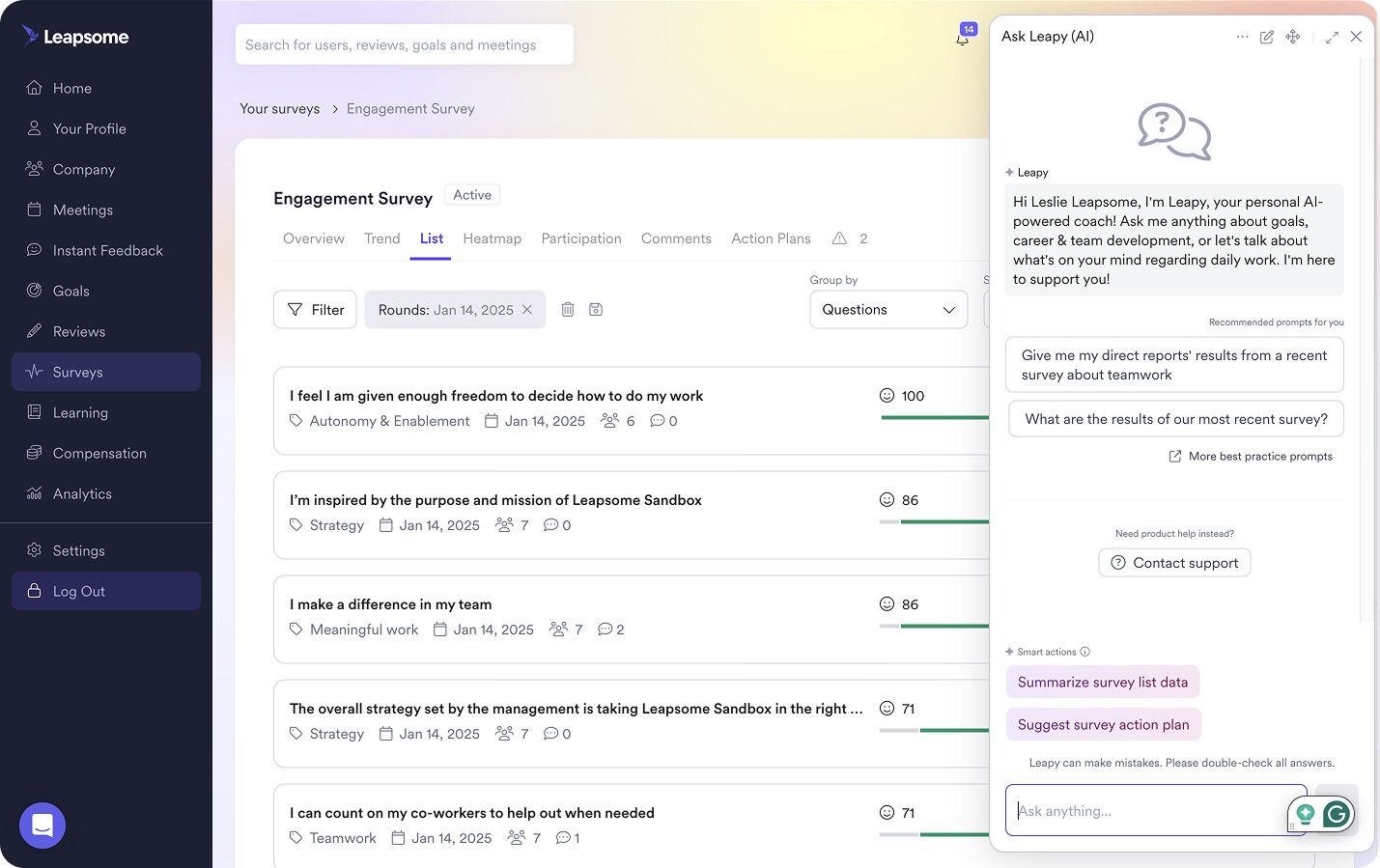
🏗️ See where trust needs rebuilding
Leapsome’s Engagement Surveys feature helps HR understand how teams respond to change and plan targeted follow-up.
👉 Explore Engagement Surveys
"Stop treating listening like a one-off. Create a reliable cadence that blends sentiment and demographics, so leaders get clarity on where to focus and managers can act with confidence." — Craig Forman, Founder and Principal Consultant at CultureC Consulting
Navigate workforce challenges with confidence through Leapsome
A furlough or layoff may ease immediate financial pressure, but treating it as a one-off budget fix creates a bigger people problem. Leadership has to prove it hasn’t disappeared after making the difficult termination decision to keep confidence from swaying for the employees who stay.
Leapsome gives HR teams one connected system to guide the organization through challenges in the following ways:
- See where trust is softening: AI-powered Engagement Surveys and sentiment analysis show how employees respond to the change and give HR teams insights into how they could be better supported.
- Help managers lead the recovery: 1:1 meetings give managers a consistent space to hear their direct reports’ concerns and keep them in the loop about next steps.
- Turn people data into focused action: Performance insights help HR teams spot emerging problems and direct support where employees need it most.
"A big part of our people work happens through Leapsome — we have many manager touch points there, such as pulse surveys where managers gain a good overview over their team's mood and health. We also have a yearly talent assessment cycle, with performance reviews and career development conversations tracked through Leapsome. Managers prepare these meetings through the Meetings function, set up developmental goals, and track them over the quarter." — Eva Gallee, Senior People Business Partner at ProGlove
⚓ Steady the organization through change
Leapsome helps HR understand what teams need and take focused action during workforce transitions.
👉 Request a demo
FAQ
How long is a furlough?
It depends. Some furloughs only reduce a non-salaried employee’s hours. Others can keep whole teams out of work for months. Most of the time, furloughs last from one to four weeks for short-term cash-flow gaps, or one to three months for labor disruptions or organizational restructuring.
If leadership expects the furlough to last for more than six months, the federal WARN Act may require 60 days’ advance notice. The Act applies to employers that meet either of two thresholds: 100 or more full-time employees, or 100 or more employees (including part-time staff) who together work at least 4,000 hours per week, excluding overtime. Anything longer than a year is bad people practice and typically soft-launches a layoff.
These rules can vary by region. In California, for instance, the Division of Labor Standards Enforcement has issued guidance suggesting that a furlough without a specific return-to-work date within the same pay period may trigger final pay obligations, as if the employee had been terminated. According to research from employment firm O’Melveny, these opinion letters aren’t binding on courts, which treat them as persuasive at most. So treat this as a flag to check your own state’s rules rather than a hard-and-fast line.

%20(1).jpg)



.jpg)