How to write a code of conduct: Template and implementation guide

.jpg)
Disclaimer: This content is for general informational purposes only and does not constitute legal advice. Leapsome does not guarantee legal compliance and cannot confirm how specific situations would be assessed in court. If you're unsure how the requirements apply to your organization, please consult qualified legal counsel.
In 2025, reports of workplace misconduct and harassment surged, with 55% of employees recounting experiencing or witnessing misconduct compared to 41% in 2024.* The same study found that misconduct cases are getting more complicated, and consequently more difficult to resolve.
To address the problems of an increasingly hostile workplace, many organizations reach for a code of conduct: a foundational workplace policy defining behavioral expectations, ethical standards, and cultural values. Teams often look for a code of conduct template to create or update their policy — and that’s a great place to start. But a template alone won’t nudge behavior in the right direction.
The most effective codes of conduct are behavioral frameworks that give organizations the consistency, trust, and alignment they need to model appropriate workplace behavior and protect company culture as they grow. This article pairs a practical code of conduct template with a guide to adopting this approach so it holds up long after employees sign the form.
* HR Acuity, 2026
What’s a code of conduct?
“Everything starts with guiding values. If people aren’t aligned to the company’s core values, collaboration gets confusing no matter how good your documentation is.”
— Noelle Pittock, Senior Director, Onboarding Operations and Business Operations at Remote
A code of conduct is a collection of rules and ethical guidelines designed to establish what safe, appropriate daily conduct is for employees. You’ll often find these guidelines laid out in the employee handbook alongside other company policies and procedures.
Codes of conduct express cultural values, but their main purpose is setting clear and practical behavioral expectations. Some of these might be obvious — think “treat your colleagues with respect” or “don’t engage in discrimination” — while others are more nuanced, like when to decline a gift from a vendor or how to flag a potential conflict of interest.
Why every organization needs a code of conduct
A code of conduct is indispensable for organizations of all sizes, because it:
- Clarifies expectations: Employees don’t have to guess what’s expected of them in the workplace. If they’re unsure, all they have to do is break out the code of conduct.
- Promotes fairness and consistency: A code of conduct with defined standards and disciplinary actions for violations is easier to consistently enforce than vague, informal etiquette rules. Everyone knows what’s expected of them and what happens when misconduct occurs.
- Shores up a company’s compliance defenses: A code of conduct gives HR teams a paper trail to point to if disputes arise. Without one, enforcement decisions are harder to justify and can end up looking arbitrary — or worse, discriminatory.
Company code of conduct policy template
📋 Stop staring at an empty page
Use our free template as a customizable launchpad to get your code of conduct up and running.
👉 Download the template now
What does a company code of ethics template include?
A workable employee code of conduct template (like ours) covers the following:
- Company values and expected workplace behavior: A straightforward statement of the organization’s core values and how they translate into specific behavioral expectations.
- Ethics, compliance, and employee responsibilities: Guidance on how to ethically approach everyday responsibilities, like maintaining confidentiality and navigating conflicts of interest.
- Reporting concerns and policy enforcement: An explanation of how employees can air issues and what disciplinary actions to expect if the code is breached.
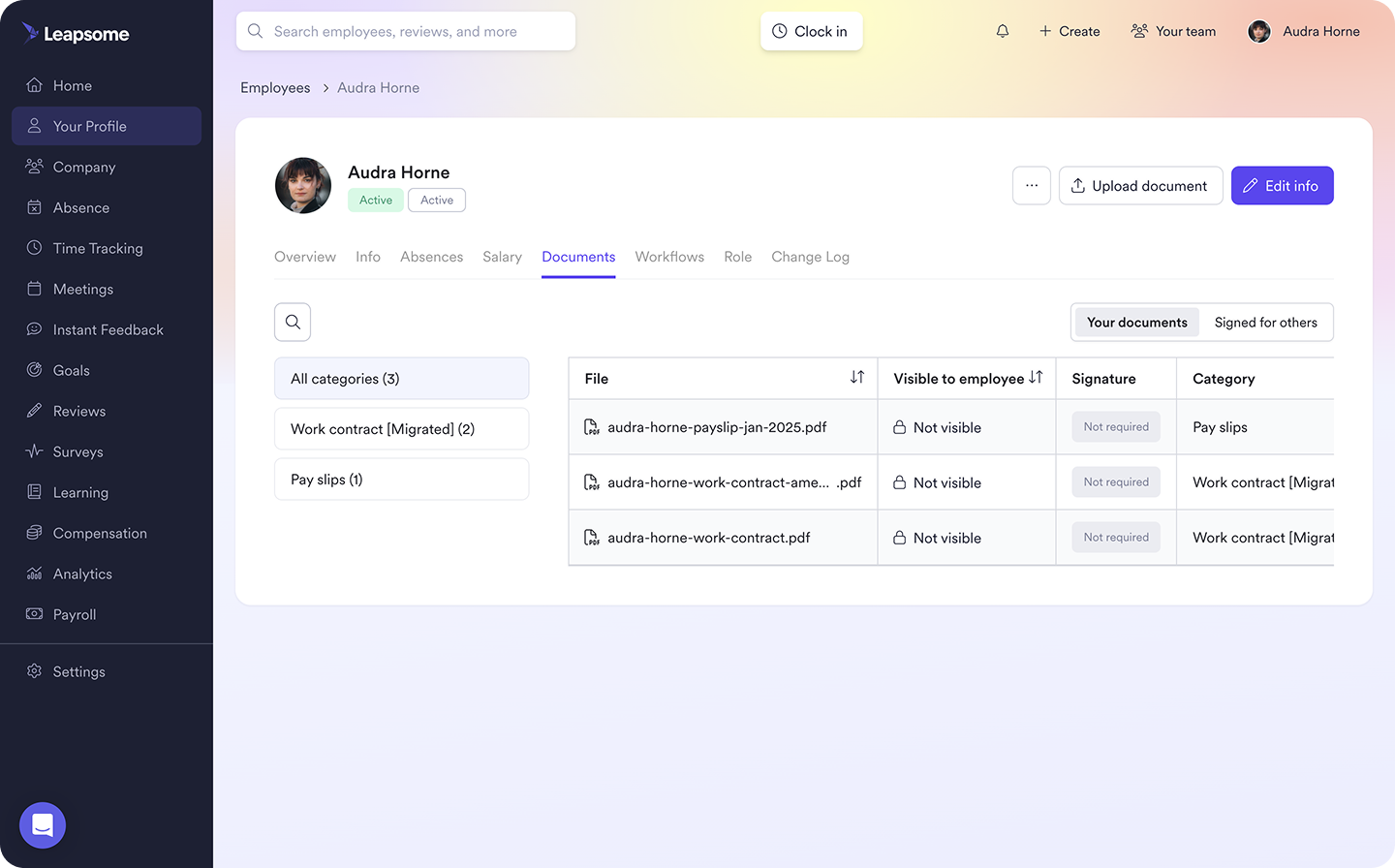
No matter what it covers, a code of conduct is only as good as employees’ ability to acknowledge it and put it into practice. Leapsome’s Documents & E-Signatures is built for exactly that. By keeping documents available and viewable through each employee’s profile, they can revisit the code of conduct whenever they have questions and use it as a living document for guidance throughout their time with your organization.
✍️ Stop chasing down signatures
Leapsome helps HR teams electronically circulate policies and gather acknowledgments for new and updated policies, while recording everything with a secure paper trail.
👉 Explore Documents & E-Signatures
Making it stick: How to convert codes into everyday behavior
“Don’t defend. Discuss. Give people behaviors that are allowed within your culture… If somebody doesn’t want to follow the culture you’re choosing to have, it’s okay that they find one that fits them.”
— Steve Browne, Chief People Officer at LaRosa’s
Knowing how to write a code of conduct that changes company culture for the better means understanding how to translate broad principles into a functional decision-making framework. Most companies agree that instilling values like respect, integrity, and accountability is worthwhile. But these abstract terms can mean different things to different people, which leads to mixed signals when they’re not explicitly defined.
It’s common for organizations to struggle with creating an actionable code of conduct. In a 2025 Traliant survey of more than one thousand workers, 57% of employees reported witnessing behavior that may have violated their company’s code of conduct, but 39% of them didn’t report it.
The solution is turning values into clear behavioral expectations. For example:
- Respect means giving constructive feedback and fostering an environment where diverse perspectives aren’t just tolerated, but valued.
- Integrity means reporting concerns when something feels wrong, even when it’s easier not to.
- Accountability means following through on commitments and holding others to the same standard. An accountable company culture also means employees readily accept responsibility when they make a mistake.
When it’s clear how conduct expectations apply to actual situations employees might run into, they’re more likely to stick to those expectations. It’s also important for leadership to set an example by actually walking the walk.
As Gallup shared in 2025, “When people lose trust in leaders, their decisions are informed by suspicion and their actions by self-interest. Businesses become more vulnerable as fewer employees are motivated to act for the greater good.”
Signs your code of conduct isn’t working in practice
Here are the signs your code of conduct has become a sign-and-forget exercise instead of a hands-on decision-making framework, and what you can do to solve the problem:
- Employees can’t explain what’s expected of them: If employees can’t describe your code of conduct’s core expectations in their own words, they may not understand them well enough to apply those expectations to their work. You can cement the policies by reinforcing them through explicit links to real-world scenarios.
- Policies are only referenced post-incident: If you only break out the code of conduct after an incident has occurred, you’re using it as a safety net instead of a proactive driver of appropriate behavior. Instead, turn it into a constant touchstone by referring to it in everyday moments like performance conversations and development exercises.
- Managers enforce standards inconsistently: Few things destroy employees’ faith in a code of conduct than unequal application of it. To avoid inconsistent enforcement that makes employees feel unfairly treated, provide managers with hands-on training sessions on reducing bias and applying guidelines to real-world situations.
“Half of organizations still don’t have policies guiding how employees use generative AI. The smart ones will start with policy, follow with training, and then create space for people to play.”
— Jonathan Passmore, SVP of Ezra (Adecco Group), Professor of Coaching and Behavioral Change at Henley Business School
Inconsistent enforcement is bad enough, but it’s even worse when incidents don’t get reported in the first place. One of the biggest barriers to strong reporting numbers is fear of retaliation. Employees who know they have the option to flag incidents anonymously are 1.8 times more likely to report, according to HR Acuity.
Leapsome offers full confidentiality that empowers employees to call out bad behavior without worrying about getting into hot water. This tip line is accessible in the same place they can find the code of conduct itself and reference development conversations, so employees can feel more confident about being a positive influence on company culture.
📢 Incident reporting that’s confidential by design
Build a culture of transparency and accountability by giving employees an anonymous self-service pathway to report concerns through Leapsome.
👉 Explore Whistleblowing
Build and embed an effective code of conduct with Leapsome
HR leaders often struggle against an interrelated set of challenges. Employees sign a document and immediately forget about it, and managers apply standards based on their own subjective interpretations and values. These cracks lead to conduct expectations losing their link to ongoing development and performance conversations, especially when policy documents live in different places across disconnected programs.
Consistency problems compound as organizations grow, making it tougher to maintain a healthy work culture. Leapsome helps HR professionals get to the root of the issue by linking everything in one platform. Teams can embed and regularly return to conduct expectations throughout the employee lifecycle, using:
- Documents & E-Signatures: HR teams can distribute policies and track acknowledgments with minimal friction, so they know everyone’s up to date on expectations.
- Preboarding & Onboarding: New hires get acquainted with company values and behavioral expectations starting with their first day.
- Performance Reviews, Competencies, Instant Feedback, and Learning: Together, this suite of tools helps organizations continuously reinforce expected behaviors, keeping them visible and top-of-mind long after onboarding is over.
Unlike standalone policy templates, Leapsome connects employee development to the broader culture and performance in a single integrated people platform. With Leapsome, HR teams get the infrastructure necessary to move codes of conduct past basic compliance. Through consistent practice, reinforcement, and measurement, your team can actively enshrine company values in daily actions.
“With Leapsome, we’ve seen some amazing improvements. The initiatives we identified from the survey results decreased our turnover by 12.2%, increased our survey participation rate to 82%, and it made people more productive and excited to come to the office. Listening and transparency is a part of our culture now.” — Natasa Kovacevic, People and Culture Manager at Eurowings Digital
🗂️Make your code of conduct stick
Leapsome connects everything related to employee conduct, from document management to performance reviews, in a self-reinforcing feedback loop, to help your code of conduct actively influence a safer working culture.
👉 Request a demo
FAQ
What’s a sample code of conduct for employees?
Microsoft’s Trust Code is a standout employee code of conduct example because it comes complete with a guide on how to use the code to make better decisions. Another strong example is Intel’s code of conduct, which offers a series of questions employees can ask themselves to determine whether a decision is ethical. Our template puts these lessons to use, reinforcing that codes of conduct are practical documents employees should use to guide their actions at work.

.png)


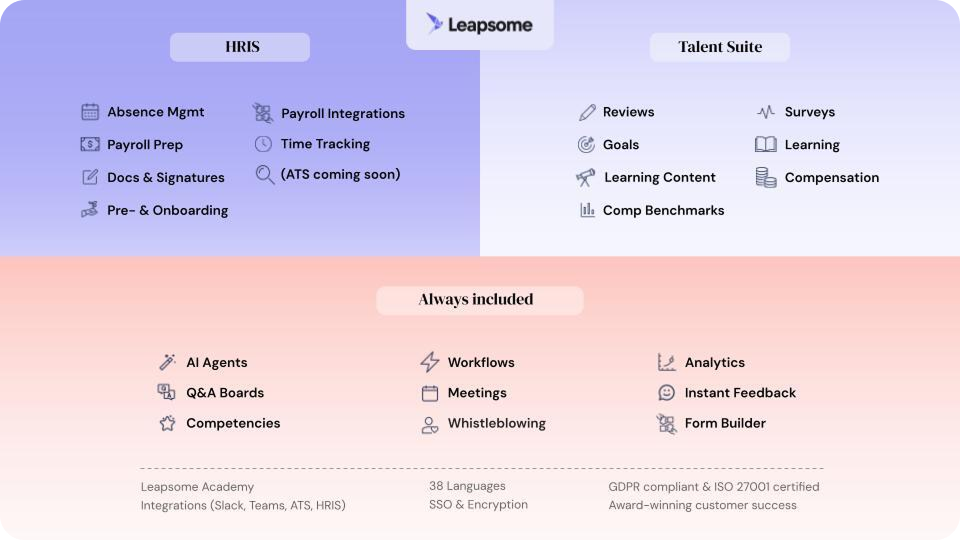
Entdeckt unsere Plattform für HRIS, Performance und Entwicklung.