How to create an employee handbook your company won’t outgrow


We’re betting you’ve watched it happen — as the business expands, documentation falls apart. It’s hard to find the time to tackle daily issues and keep pace with shifting policies and new regulations. That’s even more true if your company operates across international borders or employs a remote workforce.
You can’t ignore incomplete and outdated documentation, though, since it contributes to communication gaps that directly affect organizational performance. Only 46% of employees clearly understand their roles at work, and your workplace likely isn’t the exception here.* But outlining expectations in a central resource goes a long way toward addressing that problem and improving engagement.
This guide is for savvy HR leaders who need quick, effective tips on how to create an employee handbook that’s clear but flexible. By the end, you’ll know how to keep up with organizational changes and stay compliant with employment laws.
*Gallup, 2024
Getting the basics out of the way: What’s an employee handbook?
An employee handbook does three main things: It supports compliance, communicates expectations, and guides employee behavior. A comprehensive handbook lays out information about company culture and values, along with policies like codes of conduct, employee benefits, and disciplinary actions.
How staff handbooks benefit your organization (beyond the obvious)
A well-designed HR employee handbook does more than tell people what they can wear and how to book vacations. It provides:
- Legal protection and risk mitigation: Employee manuals help organizations steer clear of compliance errors and wrongful termination lawsuits, by codifying accommodations, absence management, and harassment and discrimination policies.
- Operational consistency: Clear company policies provide actionable frameworks managers can look to, cutting down on disjointed and subjective decision-making.
- Scalable governance: Handbooks smooth the way for expanding across new regions — decision-makers have a straightforward guide to rely on no matter where they do business.
- A single source of truth: Centralizing policies makes accessing that information quick and easy. HR managers can pull specific guidelines in seconds and generate up-to-the-minute reports for auditors and investors.
- Smoother onboarding: A strong employee handbook is invaluable as a launchpad for onboarding new employees, since it gives them a way to learn fast and find answers independently.
How to write an employee handbook: A seven-step framework for busy HR leaders
Building a comprehensive employee handbook isn’t optional — it’s how you formalize and communicate company policies. Just remember that your handbook is no good if it’s abstract and not actionable. The goal is to present information in a way that guides real decision-making and incident resolutions.
Here’s how to create an employee handbook that actually makes a difference, whether you’re starting from scratch or want to revamp existing documentation.
1. Start with a clear vision and get the right people involved
Be specific about what you want to accomplish with your employee handbook, so you can mark out a clear path and avoid scope creep. Without a strong vision from the start, it’s easy for your handbook to become a mess of overlapping policies and unhelpful noise.
Some of the most common reasons for creating or updating an employee handbook are to:
- Align with changes in legislation
- Rein in inconsistent enforcement methods by individual managers
- Support expansion into new regions
- Better support your new hires
Make a list of your specific goals, and consider how they’ll affect the handbook’s structure and content. For example, if your organization has branches in multiple countries and struggles to keep operations consistent, you’ll need to decide whether to implement a single company-wide handbook or tailor the same core policies for each location (we recommend the latter).
“Culture and context differ. The key is clarity: Set expectations, be honest about the why, and keep evaluating if it still works.”
– Luck Dookchitra, former VP of People & Culture at Leapsome
You’ll also need to define who owns which tasks, and codify how various teams will address oversight and carry out approval workflows. HR can handle performance review procedures and action guidelines for promoting employees, but you’ll probably want legal to step in and define consequences for discrimination and harassment cases.
“At first no one knew what success looked like. We defined performance levels and documented expectations — then motivation skyrocketed, because people finally knew what winning meant.”
– Noelle Pittock, Senior Director at Remote, for Leapsome
2. Gather all the latest legal and compliance requirements
Legal compliance should always be top of mind, but accounting for this can be the most challenging part of building your handbook. One Brightmine survey found that 71% of companies struggle to keep employee handbooks compliant with federal legislation, and more than half have difficulty complying with local laws. Sound familiar?
The good news is that taking the time to lay the groundwork carefully makes compliance much easier down the line. In the United States, this means meeting a long list of requirements, such as at-will statements and state-by-state leave laws. In the E.U., you’ll need to navigate other challenges like works councils and robust termination protections.
The rise in remote work complicates the regulatory landscape further. Managing international teams means accounting for overlapping legal frameworks, either in the same document or across branch-specific handbooks.
3. Take a metaphorical magnifying glass to your existing policies
Track down every company policy you have now, and we mean all of them: the ones that are written down and the ones (almost) everyone knows about but never made it into a doc. This includes:
- Offer letters
- Employment contracts
- Employee benefits guides
- Onboarding materials
Then carefully review each one, bringing in help from other departments if needed. For anything you find that’s unclear, talk it out until everyone’s on the same page. You should also compare all this material to the regulations you researched in the previous step, and identify compliance-related information that must be updated or added.
4. Break the handbook into sections so it’s easier to deal with
Throwing all your ideas into a PDF and calling it a day leads to a whole new set of fun-to-resolve issues. It’s time-consuming to find and update the right section in one giant handbook, then make sure everyone sees the new information. Plus, different managers can end up using various versions of the doc, leading to inconsistent enforcement.
Instead, split your employee handbook into modular components so it’s easier to manage. You can achieve this by:
- Distinguishing organization-wide policies from region-specific guidelines
- Separating rules from implementation procedures
- Giving each section a defined owner and update schedule
- Marking all iterations with version numbers and “last updated on” dates
5. Tap into expert knowledge for the stuff HR struggles with
Once you have a draft of your handbook, bring in domain experts to make sure everything’s aboveboard. That usually starts with having legal review sensitive policies about employment, termination, discrimination, and data privacy. You know what should ideally happen, but they know what will actually put the business in hot water.
After that, share the draft with managers and key decision-makers to get as many eyes on the handbook as possible. They can point out where policies are incomplete or confusing, especially if your eyes have already glazed over from staring at the same paragraphs week after week.
6. Get the word out and make sure people actually read the handbook
You’ll probably want to send the handbook by email, but give it a permanent home in your shared company workspace, too. All employees should know where the handbook is and how to easily access the most recent docs.
It’s also smart to set up a simple but formal acknowledgment process for each team member, to record that they’ve read and understood the new handbook. This creates a paper trail you can rely on for dispute resolution and outside audits.
Then, whenever you make substantive updates to the handbook (don’t bug people when you fix a typo, naturally), let team members know what’s changed and who they can go to with questions or concerns.
7. Treat your employee handbook as a living, almost-breathing document
At some point, you have to stop helicopter parenting and let your employee handbook leave home. Of course, no policy is flawless; in fact, for that same Brightmine survey, ~60% of respondents reported that their handbooks contained errors. While the above steps should shore up a lot of weak points, your employee handbook won’t be perfect on the first try, so it shouldn’t be set in stone.
HR and managers alike need to regularly look out for mistakes and misunderstandings, then be ready to actually correct them. To create a structured review process, decide on a schedule (i.e., quarterly) and identify which growth milestones and events, such as changes in legislation, will automatically trigger reviews or ownership adjustments.
How to write an employee handbook
A seven-step framework for HR leaders
Set a clear vision & assemble your team
Define goals, assign ownership, and set up approval workflows
Gather legal & compliance requirements
Research federal, local, and international laws relevant to your workforce
Audit your existing policies
Review all current docs — written and unwritten — for gaps and conflicts
Break it into modular sections
Separate global from regional, assign owners, and version each section
Tap into expert knowledge
Have legal review sensitive policies, then get sign-off from key stakeholders
Distribute & get acknowledgement
Share widely, record sign-offs, and notify staff of any updates
Treat it as a living document
Schedule regular reviews and trigger updates on legislation changes
What your employee manual needs to be genuinely useful
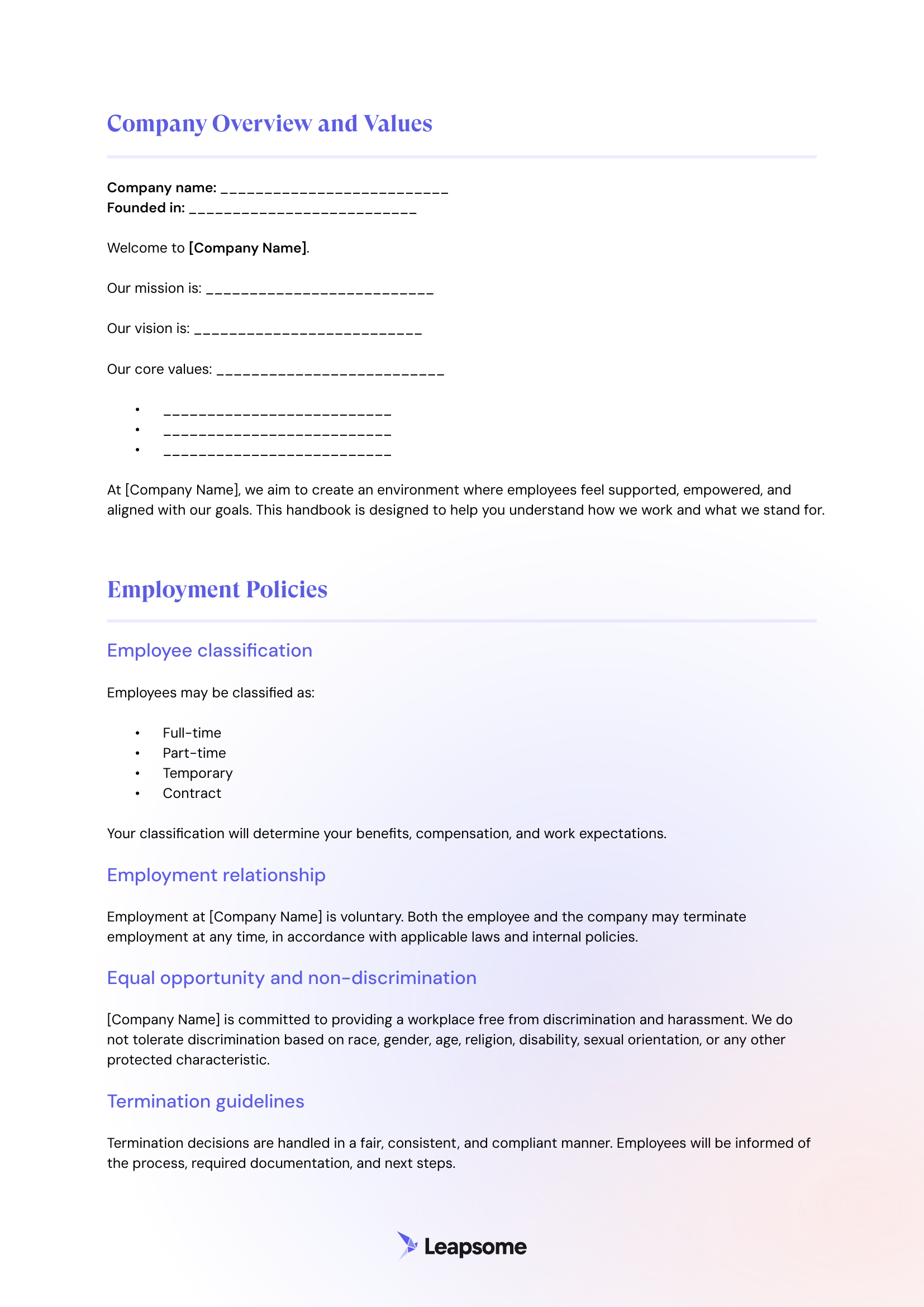
No two employee handbooks are the same, and we can’t tell you what matters to your business and team. But at a minimum, your doc needs to cover these core areas.
What the company cares about: Overview and values
Building your own employee handbook template isn’t an exact science, but putting your mission and values on paper gives you a firm foundation. This section often kicks off employee manuals, so it’s one of the first things new hires see. In other words, your overview is a chance to make a good first impression by clearly communicating the company’s personality and goals.
The fundamentals: Employment policies
Explain employee rights and obligations in simple terms, including employee classification, termination procedures, and anti-discrimination protections. If your organization does business in multiple states or countries, tailor this section for each jurisdiction.
What team members really care about: Compensation and benefits guidelines
Go over pay practices and explain how the company makes compensation decisions, keeping this information as transparent as possible to build trust and avoid misunderstandings. Outline benefits, such as healthcare and retirement plans, in plenty of detail, then link out to more documentation (for example, info on plans from the health insurance provider).
This is also the place to define how leave works at your organization, including the types and amounts employees are entitled to and how to request time off. States and countries have different legislation governing leave, so again, you’ll probably need to tailor this section for each branch.
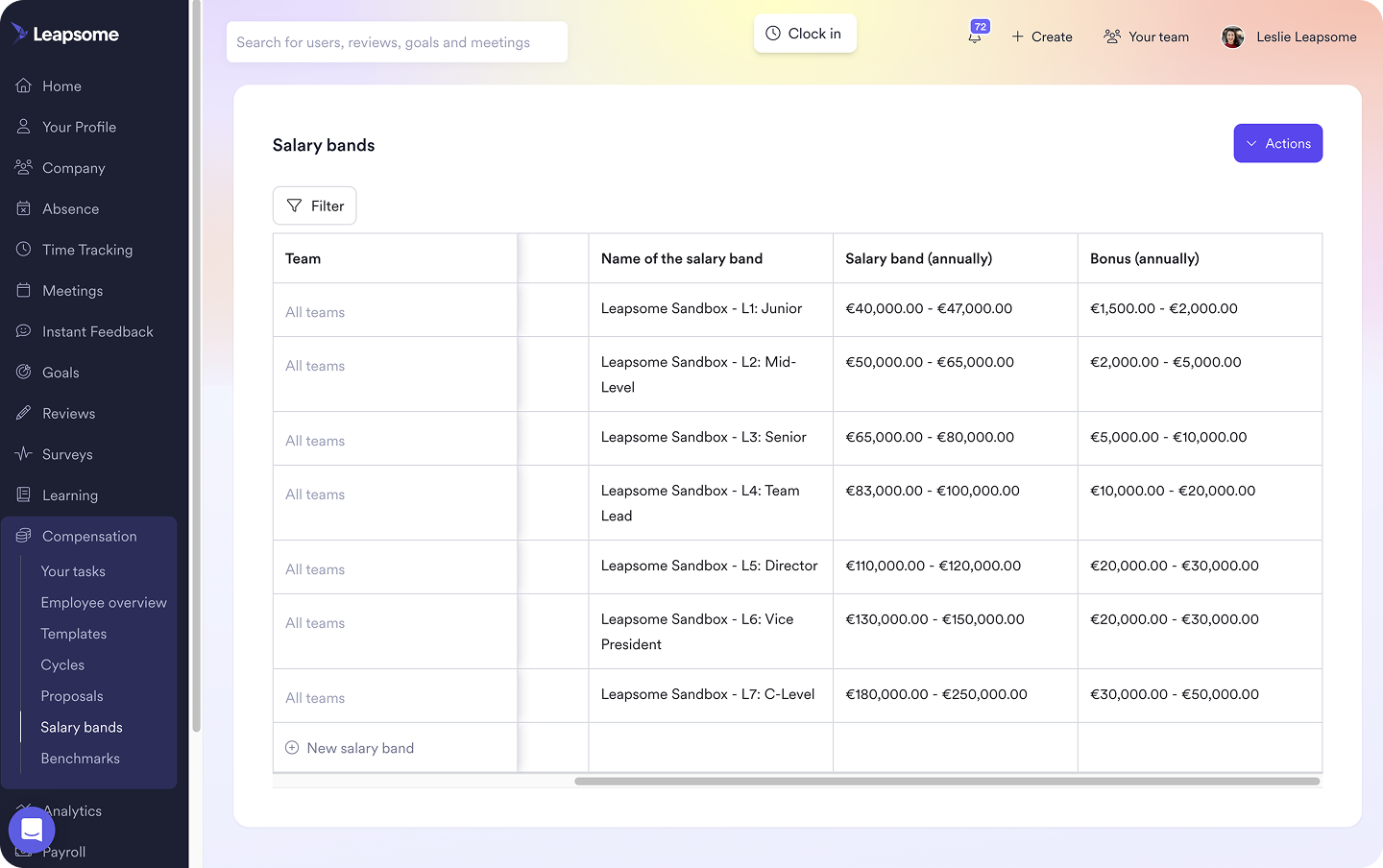
💰 Standardize pay and benefits organization-wide
Automate compensation and benefits-focused workflows, and get customizable templates to help you make fair and transparent pay decisions that align with your employee handbook.
👉 Learn more about Leapsome’s Compensation Management features
The serious stuff: Workplace conduct and behavior expectations
Employees should never feel unsafe at work. That’s obvious, but we don’t have to tell you how difficult it is to achieve. To give you a leg up, your employee handbook should include a code of conduct that governs anti-discrimination and anti-harassment policies, and it needs to lay out ethical expectations for every member of the team.
Other must-cover topics: Health, safety, and security regulations
Physical safety is just as important as psychological well-being — and the consequences of an unsafe workplace can be pretty dire. So outline general and industry-specific safety requirements for protecting team members from harm.
Don’t forget about procedures for keeping data and devices secure, such as:
- Two-factor authentication protocols
- Guidelines for VPN use
- Instructions for reporting lost or stolen company equipment
- Rules about handling and storing sensitive data
- Equipment return and data deletion policies during offboarding
👷 Don’t make writing your employee handbook harder than it needs to be
Putting together a comprehensive guide takes a lot of work, so we’ve created a company handbook template to help you keep track of everything.
👉 Download the template now
Employee handbooks in action: A quick case study from the inside
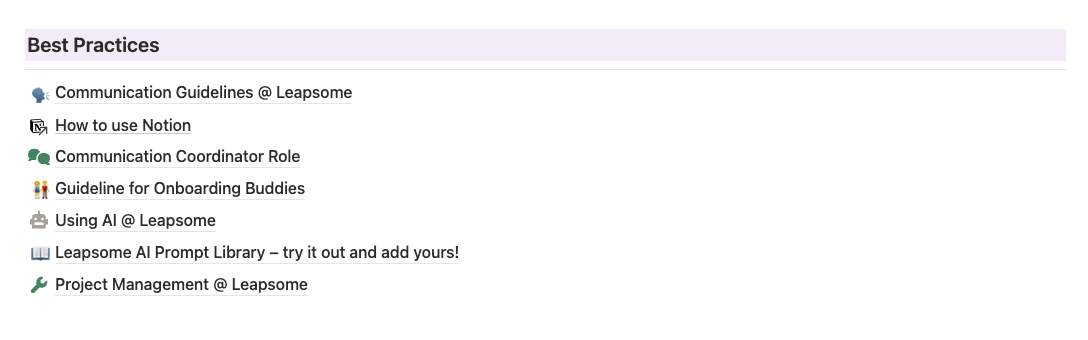
Great HR teams learn from what already works, instead of wasting time trying to reinvent the wheel. So let’s look at an example of an effective employee handbook, one that’s very familiar to us here at Leapsome.
Our (not to brag) comprehensive employee guide covers a wide range of topics, including communication guidelines, tooling tutorials, and role breakdowns for individual positions. We divided our handbook into modular sections, such as “Best Practices” and “Workplace & Well-Being,” for painless navigation and smooth updates.
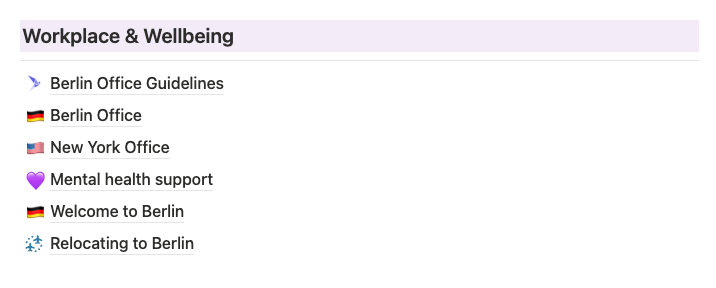
Along with big-picture guidelines, such as our structured onboarding process, we added in components that are specific to our company’s goals and vision. To give an example, we’re an AI-forward organization and we care about using that technology safely and effectively. That’s why we have a dedicated section on the responsible use of AI.
How to make employee handbook management (as) painless (as possible)
Once your handbook is out in the wild, these best practices will help you swiftly adapt to changes:
- Leverage automation: Using HR software with robust automation capabilities reduces the risk of errors, and it helps you keep your handbook up to date without adding to your administrative burden.
- Align policies with real people data: Data-driven policymaking trumps going with your gut, so look at team-wide performance history and engagement trends to inform your choices.
- Centralize documentation: If all your information is scattered across different employee files and drives, even small changes can spiral. When everything is stored together and clearly organized, it’s simpler to make tweaks and ensure that all team members are up to date.
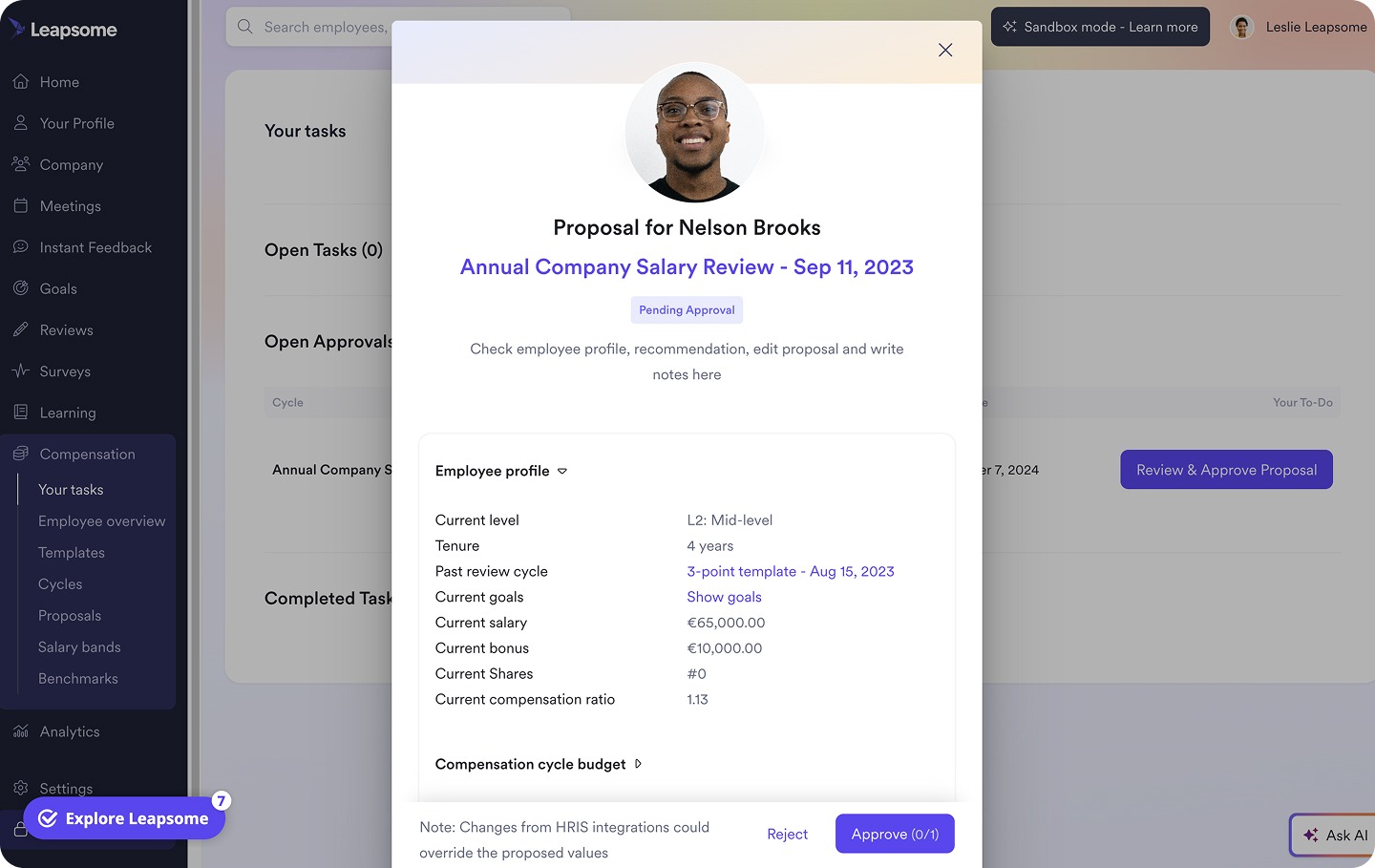
📝 Centralize your data and connect the dots
Leapsome provides a single source of truth for employee records — that means you’ll never have to stitch together handbook sections from five different spreadsheets again.
👉 Explore Leapsome’s Employee Records
How HR software supports employee handbook management
If you want to go the extra mile for your organization, using a human resources information system (HRIS) makes employee handbook maintenance much simpler. By centralizing documentation, linking policies to data and insights, and connecting the employee lifecycle from hiring to offboarding, you create a living digital system that almost runs on autopilot. This can positively impact compliance and security, while saving your team a lot of time.
Give your employee handbook a boost with Leapsome
Strong employee handbooks clarify unwritten rules and align teams around values and expectations, which in turn leads to tangible organizational benefits. Just remember that if you want your handbook to serve as a solid foundation, the way you create and update it is just as important as the content.
Leapsome’s AI-driven HRIS sets your employee handbook on a firm digital footing, with a minimum of extra friction. Our platform keeps all your company documentation and people data in one secure location for full integration and instant access. All you need is a few clicks to adapt to changing legislation and generate workforce insights that align your handbook with company values.
“One of the biggest impacts Leapsome has had for us is creating transparency around goals. Staff are very clear on what’s expected of them.” – Amita Rao, Director of Talent Management at Orbis
✅ Make sure your HR software reflects and enforces your employee handbook
Leverage Leapsome’s automated workflows and unified data storage for staff handbook management that practically runs itself.
👉 Request a demo
FAQ
How do I create an employee handbook?
To build a robust employee handbook, start by collecting all your current documentation, researching employment and compliance regulations, and talking with the whole team about what to include. Then draft your handbook, divide it into clear sections, review it carefully, and decide on a process for updating it regularly.
What are the features of a good employee handbook for small businesses?
As a small business, you should keep your employee handbook flexible so it’s easier to adapt as you grow and evolve. Make sure it contains all the details about employment policies, compensation and benefits, health and safety guidelines, and security requirements. Your handbook should also lay out clear ownership and structured approval processes.






.jpg)