HR policy management: 6 policy examples and the PAOS framework
.png)

HR policies outline workplace rules and expectations, encompassing remote work standards and harassment protocols. They protect both employees and organizations from legal risk, inconsistent treatment, and compliance failures.
But writing policies is the easy part. Managing them across a distributed workforce, proving adoption, and keeping everyone on the latest version is where most HR teams struggle. In fact, 46% of HR leaders worry about regulatory compliance when implementing workplace changes.*
Without a concrete system, the compliance consequences stack up fast. Auditors ask for distribution logs, and you have forwarded email threads. A harassment claim surfaces, and you can't prove that the manager completed the required training. A data breach occurred, and the security policy employees had signed was two versions out of date.
So you can fully address those risks, we will explain:
- Six high-impact policy examples
- The PAOS (Policy-to-Adoption Operating System) framework for managing policies from distribution to adoption
- The KPIs that prove compliance when auditors ask
🔒 Centralize your HR policies with confidence
Store, distribute, and track policy acknowledgements across your global workforce with our HRIS.
👉 Explore Leapsome HRIS
*Leapsome 2025 HR Insights report
6 HR policies and procedures examples that benefit most from the framework
Some policies sit in a handbook gathering dust, while others require active governance because they carry legal weight, change frequently, or need different versions across locations.
Any policy benefits from clear distribution and tracked acknowledgements. However, certain policies demand tighter controls because the stakes are higher, from potential regulatory penalties and legal exposure to employee safety risks.
These are the policies where you need to prove that employees have understood:
- What the policy covers — the core rules and expectations
- Which updates require immediate re-acknowledgement — when employees must sign off again after changes
- Where localization or role-based redactions apply — to protect both the organization and employees
The six policies below represent common examples where structured HR policy management pays off. With each one, we explain what to include, how acknowledgement works, and where localization or redactions apply.
1. Remote/hybrid work policy
Your remote work policy should clarify who's eligible (based on role, location, and manager approval), outline equipment and workspace requirements, and set expectations for availability and communication.
For hybrid teams, you'll also want to specify in-office requirements, like which days or how many days per week employees need to be on-site.
Everyone needs to acknowledge your remote work policy when they start or when their work arrangement changes. If you update core requirements (like new collaboration tools, adjusted in-office expectations, or equipment stipends), trigger re-acknowledgement within seven days.
Keep in mind that equipment allowances, tax implications, and working hour expectations often vary by country, so you may need separate policy versions for different locations and track acknowledgements per locale to stay compliant with local labor laws.
📚 Connect policy updates to instant training
Automatically assign learning modules when policies change so compliance and capability happen together.
👉 Explore Leapsome Learning
2. Code of conduct
Your code of conduct should cover the behavioral standards that define how people work together, including:
- Respectful communication: appropriate language, tone, and how disagreements are handled
- Discrimination and harassment prevention: zero tolerance policies and protected characteristics
- Integrity and conflicts of interest: disclosure requirements and ethical decision-making
- Appropriate conduct: dress code, social media use, and workplace behavior expectations
- Company resource usage: equipment, data, and time management
- Clear reporting channels: manager, HR, and anonymous hotline options
- Investigation procedures: timelines for HR response and how long investigations typically take
- Escalation paths: when to involve legal counsel or external investigators for senior leader cases
Then, when a violation is identified, HR investigates, determines the best course of action, and logs the outcome, ensuring that any sensitive investigation steps are redacted from the general employee view to protect confidentiality.
Your code should encompass behavioral standards such as respect, integrity, conflicts of interest, and the appropriate use of company resources.
At the same time, be sure to feature [Makes more sense to have a list here instead covering the usual things a code of conduct covers (type of communication, discrimination prevention, use of swear words, inappropriate conduct etc. )]:
- Clear reporting channels: such as manager, HR, and an anonymous hotline
- Investigation flow with timelines: including how quickly HR responds and how long investigations typically take
- Escalation paths: for example, when to involve legal counsel or external investigators for senior leader cases
Then, when a violation is identified, HR investigates, determines the best course of action, and logs the outcome, ensuring that any sensitive investigation steps are redacted from the general employee view to protect confidentiality.
Before rolling out your code of conduct, align with key stakeholders to ensure everyone agrees on the standards. This typically means involving founders or leadership to confirm cultural expectations, legal counsel to verify compliance requirements, and department heads who'll enforce the policy day-to-day.
Core standards usually stay consistent across locations, though you may need to adapt examples and reporting channels for local context based on cultural norms and legal requirements in each region.
3. Data privacy & security
Your data privacy policy needs to spell out how you handle personally identifiable information (PII), including access control requirements like:
- Role-based permissions: who can access what data based on their role
- Password standards: complexity requirements and rotation schedules
- Multi-factor authentication (MFA): required for accessing sensitive systems
Make sure to check local data protection laws in each region where you operate, as requirements vary significantly by jurisdiction.
You'll also want breach reporting windows (internal notification within 24 hours, regulatory notification per local law) and data retention schedules. Your policy should specify what constitutes a breach and who employees should contact immediately.
For example, unauthorized access to employee records constitutes a breach, as does the accidental exposure of customer data through misconfigured cloud storage.
Keep in mind that the General Data Protection Regulation (GDPR), the California Consumer Privacy Act (CCPA), and other privacy regimes require jurisdiction-specific language on lawful basis, data subject rights, and breach timelines. This means you'll need to track acknowledgements per locale and maintain an evidence pack showing who acknowledged which version when, so you can prove compliance in each jurisdiction where you operate.
4. Whistleblowing
Whistleblowing policies protect employees who report misconduct, illegal activity, or ethical violations within your organization. Your policy should outline the categories of protected disclosures and clearly explain how employees can safely report concerns.
Four key elements to include are:
- Protected disclosure categories: financial misconduct, safety violations, discrimination, and retaliation
- Anonymity guarantees: with anti-retaliation commitments and consequences for violators
- Multiple reporting channels: internal hotline and regulatory bodies, where applicable
- Investigation timelines: with feedback loops so reporters know what to expect
When an employee submits a concern through your designated channel, HR or legal reviews it within a specified timeframe, assigns an investigator, conducts the inquiry, documents the findings, and determines the action. The reporter receives acknowledgement and an outcome summary within defined windows.
As you might expect, different regions have different legal requirements. For example, the EU Whistleblowing Directive, UK PIDA (Public Interest Disclosure Act), and US SOX (Sarbanes-Oxley Act) all have different disclosure categories and protection standards. So, you'll need jurisdiction-specific variants and should train local HR teams on procedural differences.
In view of the heightened sensitivity of whistleblowing, with both corporate and individual risks at stake, we offer a dedicated solution. Leapsome Whistleblowing connects to your HRIS so cases can be anonymously reported and discussed, with designated owners following up within a secure environment.
🛡️ Handle sensitive reports with complete confidentiality
Leapsome Whistleblowing integrates with your HRIS for anonymous, secure case management.
👉 Learn about Leapsome Whistleblowing
5. Anti-harassment & discrimination
Your anti-harassment policy needs clear definitions of harassment, including sexual harassment, bullying, and discrimination based on protected characteristics (i.e., legally defined categories like race, gender, age, disability, religion, or sexual orientation).
Beyond definitions, spell out:
- Prohibited behaviors with concrete examples: unwelcome comments about appearance, offensive jokes, exclusion from meetings based on identity, retaliation against complainants
- Reporting obligations: for witnesses and managers (who must escalate immediately)
- Investigation procedures: with expected timelines
- Corrective actions: ranging from coaching to termination
- Mandatory training cadence: and how this connects to your broader DEIB commitments
Whenever someone files a complaint, HR needs to launch an immediate investigation. In most cases, the matter will remain internal, but if the complaint involves a senior leader, you may need to involve an external investigator to avoid conflicts of interest.
It’s important to note that no managers should never investigate their own teams,to avoid the potential for a conflict of interest. Also, while everyone should complete training upon hire, managers and leadership should receive additional training on their response obligations, like when to escalate and how to support team members who report concerns.
As with the other policies we've covered, updates need to trigger re-acknowledgement. Leapsome's modern HRIS system tracks policy acknowledgements, and people analytics and insights dashboards help you identify who's signed off and spot gaps before they become compliance issues.
6. Performance & feedback
Your performance policy should clearly outline review cadences (such as annual, semi-annual, or continuous), document expectations for both managers and employees, and explain how feedback is linked to development plans.
You'll also need to define the consequences for non-participation, as performance data informs compensation and promotion decisions. Clarify confidentiality too, since who sees numerical ratings versus narrative comments matters to employees and can affect their level of participation.
In practice, managers and employees should complete reviews according to the agreed schedule, document conversations in the system, and link feedback to development actions using your performance management tools. They can then revisit progress in 1:1 meetings while HR monitors completion rates and escalates overdue reviews.
👀 Pro tip:
With Leapsome, you can automatically pull in performance context during reviews.
When managers write assessments, they’ll see the employee's goal progress, instant feedback, and praise received during the review period, as well as notes from past 1:1s, all in one interface.
Managers can then utilize Leapsome AI Recommendations to transform bullet points into constructive comments and recommend actionable steps, ensuring feedback naturally aligns with relevant, achievable development goals.
This means managers can easily deliver evidence-backed reviews without jumping between systems, with every review tied directly to development conversations that happen throughout the year.
⚡ Turn feedback into development with context-rich reviews
Pull in goal progress, 1:1 notes, and instant feedback automatically during performance reviews.
👉 Explore Reviews
Operationalize HR policy management with the PAOS framework
Lists of policies don't prove anything in an audit. What auditors want is evidence that policies reached employees, that employees understood and acknowledged them, and that you can trace every update back to a triggering event with timestamps.
The PAOS framework (Policy-to-Adoption Operating System) transforms policy management into a measurable, auditable loop comprising four interconnected steps, which we outline below.
Also covered is a 10-point checklist to review the readiness of your existing processes for policy management, followed by the KPIs to track with suggested benchmarks.
Run the PAOS model to operationalize hr policy management
The PAOS loop has four steps that repeat every time a policy launches or updates:
- Acknowledge: Employees receive the policy with ID-verified e-signature and read-rate targets (for example, 90% within 14 days for standard policies, 100% within 7 days for high-risk updates). The system tracks who opened it, reading time, and training completion.
- Assure: Export an evidence pack with version history, approver timestamps, distribution lists, and acknowledgement logs. This pack lives in your centralized repository for audits, regulatory reviews, or legal discovery.
- Adapt: Regulatory triggers automatically assign an owner, set an SLA, and queue re-attestation workflows. For example, according to the EU AI Act timeline, GPAI (General-Purpose AI) obligations start on August 2, 2025, triggering update windows and re-attestation for affected employees.
- Amplify: Engagement analytics show read rates by team, region, and manager. Role-based access ensures employees see only what's relevant. Automated reminders escalate to managers when teams fall behind, and localization workflows track acknowledgments per locale.
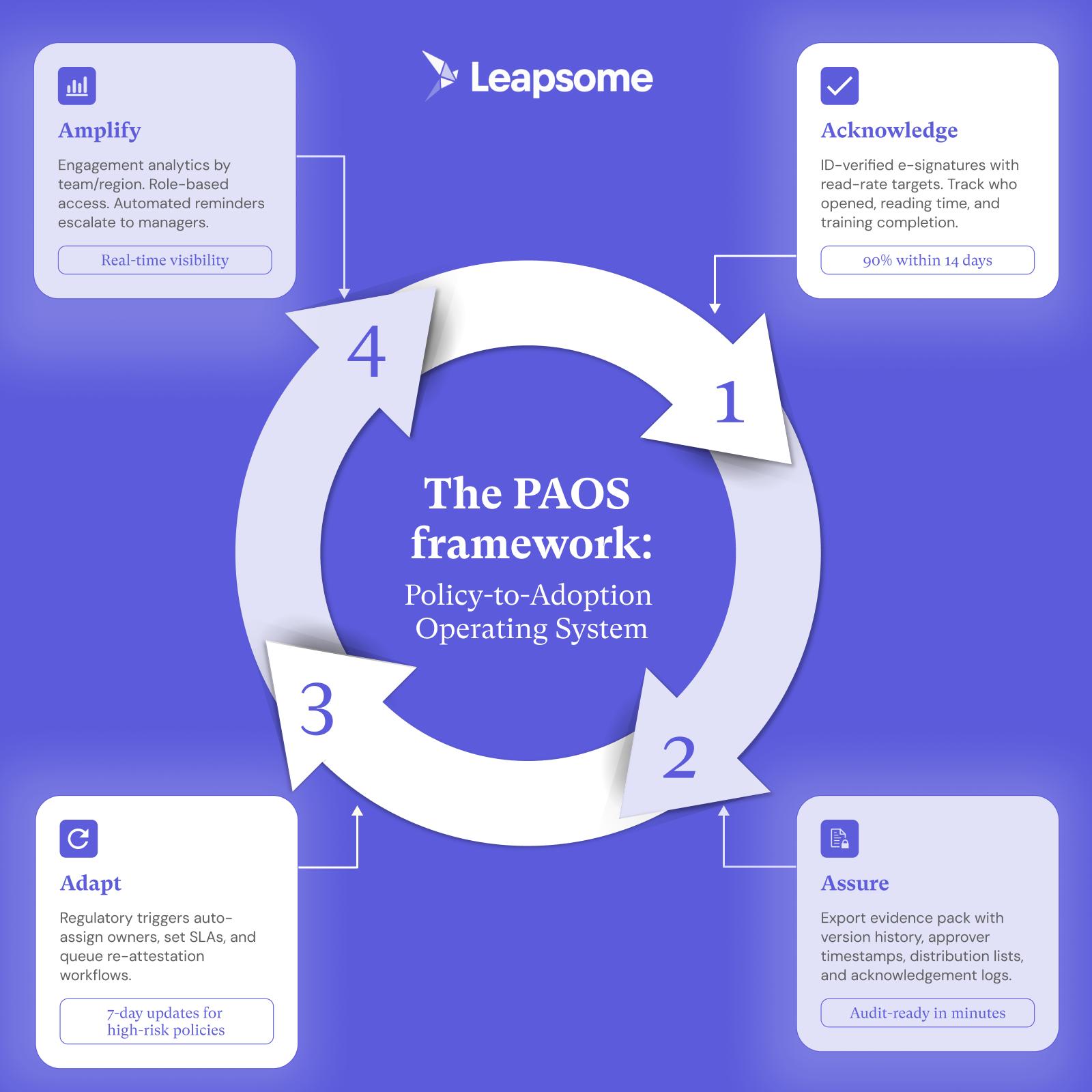
An all-in-one people enablement solution like Leapsome can connect these four steps in one system, so distribution, acknowledgements, training, and reporting happen without manual handoffs.
Set operational KPIs and an evidence pack your auditors will accept
Set concrete targets you can easily measure to highlight what needs improvement and show what you’ve changed.
Suggested benchmarks you can tailor for your operations:
- At least 90% acknowledgements within 14 days for standard policies
- 100% re-attestation within 7 days of material updates to high-risk policies
- No more than 5% overdue after two automated reminders
- Manager review within 48 hours when their team's acknowledgement rate drops below 80% on day 10
When auditors or regulators ask for proof of compliance, you need a complete evidence pack. This is a single exportable file that documents your entire policy lifecycle. Here’s what to include:
- Differences: side-by-side comparison of policy versions
- Approver timestamps: names and dates for legal, HR leadership, and stakeholders
- Distribution list: everyone who received the policy, segmented by role and location
- Acknowledgement log: who signed, when, IP address or device ID, and training completion status
Bringing HR policy management into one platform
What proves effective HR policy management is a consolidated system that tracks distribution, measures acknowledgements, and adapts to regulatory changes without manual work.
The PAOS framework provides you with this system, allowing you to establish clear targets as you set role-based access and track per-locale sign-offs for global teams.
Then you can utilize an all-in-one HR platform to consolidate policy distribution, acknowledgments, training, and analytics, enabling you to demonstrate adoption with audit-ready evidence that's readily available whenever needed.
🚀 Prove policy adoption
Bring policy management, training, and analytics together in one platform that scales with your team.
👉 Book a demo
FAQs about HR policy management
How do role-based access and redactions work for sensitive HR procedures?
Role-based access controls which employees to see specific policy sections based on their role. For example, investigation procedures or compensation bands stay hidden from general staff but are visible to HR and legal teams.
Redactions protect confidentiality while maintaining findability and access. Your policy governance system tracks version history so you can prove who saw what and when, creating an audit trail for sensitive content.
How can training integration improve policy adoption and re-attestation rates?
Training integration ties policy updates directly to mandatory courses. When a security policy changes, affected employees automatically get assigned relevant training modules before they can acknowledge the update.
This approach improves employee attestation rates because people learn new requirements instead of just signing. Throughout the policy lifecycle, linking acknowledgements to training completion ensures comprehension, not just compliance.
How to set SLAs for policy approvals, distribution, and re-attestation?
Set SLAs based on risk level. Standard policies might allow 14 days for policy distribution and acknowledgement, while high-risk updates require 7-day turnarounds.
For the full policy lifecycle, assign clear owners and deadlines, for example, Legal approval within 48 hours, distribution within 24 hours of approval, and policy acknowledgement tracked by manager dashboards.
Sam Abrahams


.jpg)


.jpg)