Recruitment metrics: What to track + how to measure success


Recruitment metrics show how efficiently you fill open roles and if the people you hire succeed once they join. The first part is easier to report. By the time a candidate accepts, you know how long the search took. It takes longer to see whether the new hire meets your expectations, and that information often sits outside the recruiting system.
Only 20% of organizations track quality-of-hire metrics, according to a 2025 SHRM survey.* The small percentage leaves HR with less evidence to decide which hiring practices to keep as hiring volume grows.
This guide covers key recruitment metrics and how to choose the ones that’ll help you spot hiring bottlenecks and new hire performance.
* SHRM, 2025
What are recruitment metrics and why do they matter?
“Engagement scores and trust metrics are signals, not goals. If a metric isn’t influencing business results, drop it and focus on what does.”
— Melanie Naranjo, Chief People Officer at Ethena
Recruitment metrics are figures HR teams use to understand what happens during and after hiring. They’re generally (but not always) numbers that help you decide where to make changes in your hiring process, and include measures like cost per hire and candidate net promoter score (cNPS). For instance, long waits between interviews can show that hiring stalls, so candidates need quicker updates.
A recruitment KPI is a kind of metric that judges progress toward a specific hiring goal. Offer acceptance rate is a recruiting metric, for example. But if your goal is to raise acceptance rates to 80% this quarter, it becomes a recruitment KPI.
Six recruitment metrics to track
“Develop metrics that directly link to business outcomes and present them in a format the business understands.”
— Katerina Arsova, former Head of People and Talent Operations and Partnerships at Leapsome
Instead of adding a number to your recruitment metrics dashboard just to make it look fuller, clearly identify the decision it will guide. If it doesn’t have a measurable impact on your recruiting process, it doesn’t belong on your list.
These six metrics can help you decide where to improve the recruiting process and which practices to keep based on new employees’ performance and tenure.
1. Time to hire
Time to hire measures how many days pass between a candidate entering your hiring pipeline and accepting your offer letter. For instance, if a candidate applies on May 1 and accepts on May 21, time to hire is 20 days.
If searches for the same role start taking longer, look at where the extra days accumulate before changing your process. Candidates might wait a week for a panel interview because the interviewers are rarely free at the same time, so ask each member to block a shared slot before screening begins. Or, if the delay comes after the final interview because no one knows who approves salary exceptions, identify the approver before you open the role.
2. Cost per hire
Cost per hire shows what you spend to make the average hire. It includes internal costs, such as recruiter time, and external costs, such as agency fees.
For example, if you spend $18,000 in agency fees, $4,000 in hiring leader pay, and $2,000 in other employee time (for a total of $24,000) to make eight hires, your cost per hire is $3,000.
Use cost per hire to decide when agency support is worth the financial investment. For similar roles, compare what it costs to hire through an agency with what it costs your team to fill the role directly. If your team can recruit at a lower cost, reserve agency support for searches where you struggle to reach qualified candidates.
3. Source of hire
Source of hire points to where the people you hire first enter your pipeline. A channel can bring in a few applicants and still be a productive hiring resource. In 2025, for instance, a little more than 10% of SHRM’s employee referrals became candidates, but about 50% of those referrals were hired.
To decide which paths to invest in, compare hires from different sources within similar roles. A channel that accounts for fewer hires may still be worth funding if those employees consistently meet their early performance goals.
4. Offer acceptance rate
Acceptance rate shows the share of candidates who accepted offers from your team. If you make 20 offers and 15 candidates accept, your rate is 75%.
When acceptance rates drop for a particular role, review the reasons candidates give for declining. If they, for example, repeatedly cite pay, revisit the salary range before opening the next search.
5. Quality of hire
This quality metric measures how well new employees meet the expectations you hired them to deliver. This starts with some definitions, according to Gartner: Specify what high-performing team members are already doing in their roles, and label what it looks like for an individual to support their team and the organization as a whole.
One way to track quality of hire is to check how many of your new hires meet role-specific milestones at a set point. If eight of 10 new account managers can run a client handover independently by day 90, 80% met that milestone. But if several hires miss the same milestone, it’s a sign you should review how you assessed that skill in interviews and what training employees received during onboarding.
6. New hire retention
New hire retention tracks how many employees are still with you at a set point after starting. If 18 out of 20 hires from a given group are still employed at the six-month mark, retention for that group is 90%. Make sure your set point is far enough out to account for any post-onboarding resignations, but not far enough out that non-recruitment factors like company culture and growth potential play a bigger role than how the employee started.
If there’s a particular point in the onboarding process (or after) where early exits cluster, look at onboarding feedback and exit reasons to decide where to investigate.
📊 Follow candidates from application to performance review
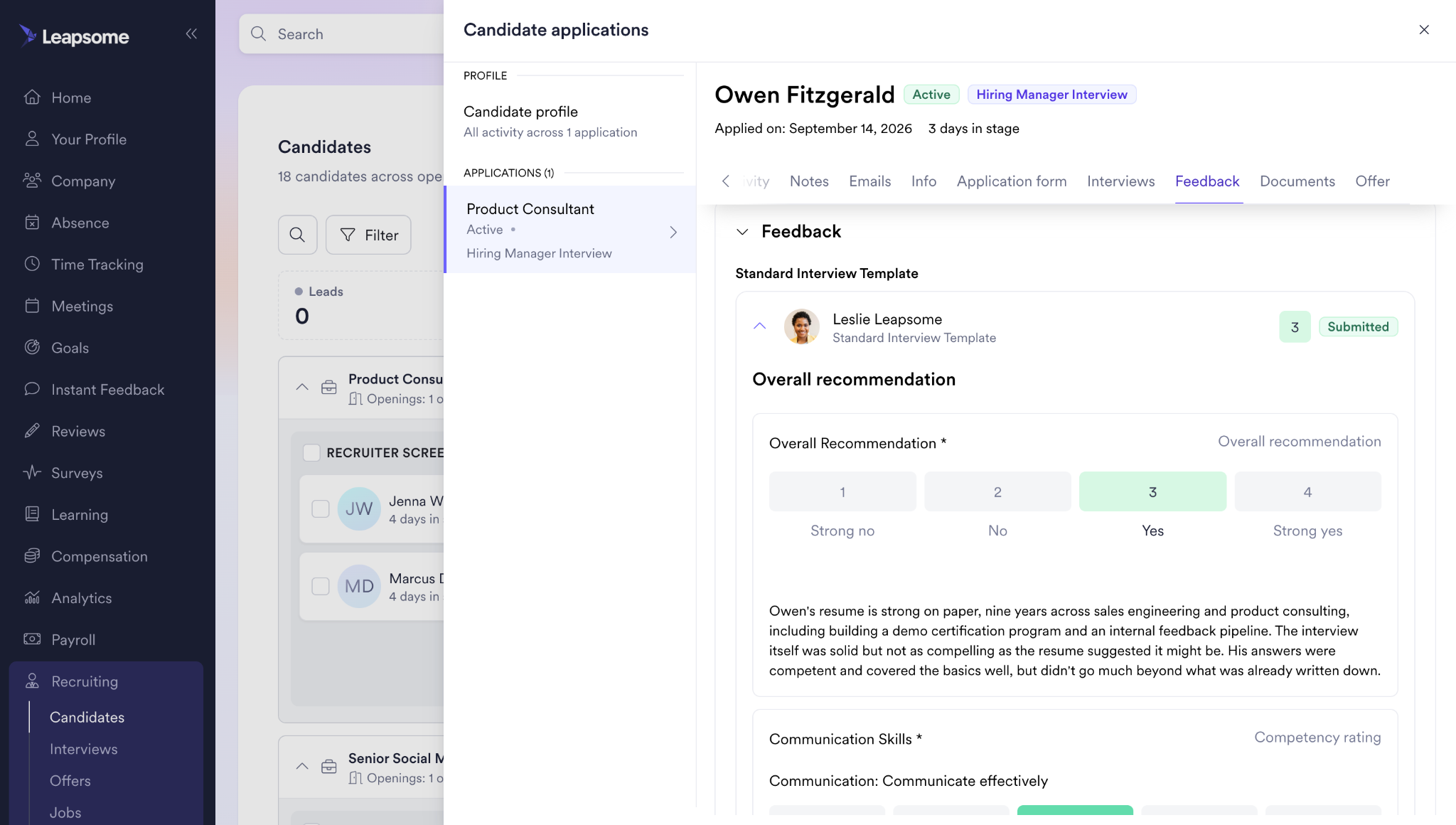
Leapsome Recruitment shows funnel conversion and how long it takes to hire. It also gives you analytics on sourcing performance and quality of hire, so you can see how your decisions play out on the job.
👉 Explore Recruitment
How to choose the right recruitment metrics
“If the people you hire aren’t aligned, you’ll constantly play catch-up. Use tough interview questions to test alignment and maturity early.” — Melanie Naranjo, Chief People Officer at Ethena
Your team can make what it thinks are all the right moves for recruitment, like cutting time to hire and spending less per hire, but still fall short of a better recruitment practice. To see the full effect of a change, choose a metric that shows what happened during hiring and, where relevant, a second one that shows what happened on the job.
Here are a few questions to help you pin down which metrics will reveal the most for your team.
Are we hiring efficiently?
If departments carry vacancies for months, start with HR’s time to fill. If it takes weeks of interviewing to get candidates for those roles, add the days spent at each stage and the cost to hire.
After shortening the process, compare how often new hires in the same role meet their 90-day goals. That gives you evidence for deciding if the shorter process is worth keeping, or if you’re missing better fits you might’ve found with one more technical test.
Where are we losing candidates?
Use stage conversion rates to see where fewer candidates move forward, then check how many withdrew and how many your team rejected per step. This way, it might be easier to spot stages that may be asking too much of candidates. After all, SHRM found that 36% of respondents said they’d dropped out of the running because they felt they were being asked to jump through hoops.
This question goes hand in hand with hiring efficiency. If candidates regularly withdraw when you invite them to a fourth interview, compare scorecards from the third and fourth rounds. You may find they both assess the same skills. In that case, combine them and see if more qualified candidates make it from the third interview to a hiring decision in the next search for that role.
Are new hires getting the support they need?
Read new hire retention rates alongside onboarding feedback. If employees who quit quickly describe responsibilities that differ from what they heard in interviews, review how recruiters and hiring managers explain the role. Go over your current onboarding process if they didn’t feel they had the tools for the role, and look at your onboarding handoff if they understood the role but spent their first weeks waiting for training.
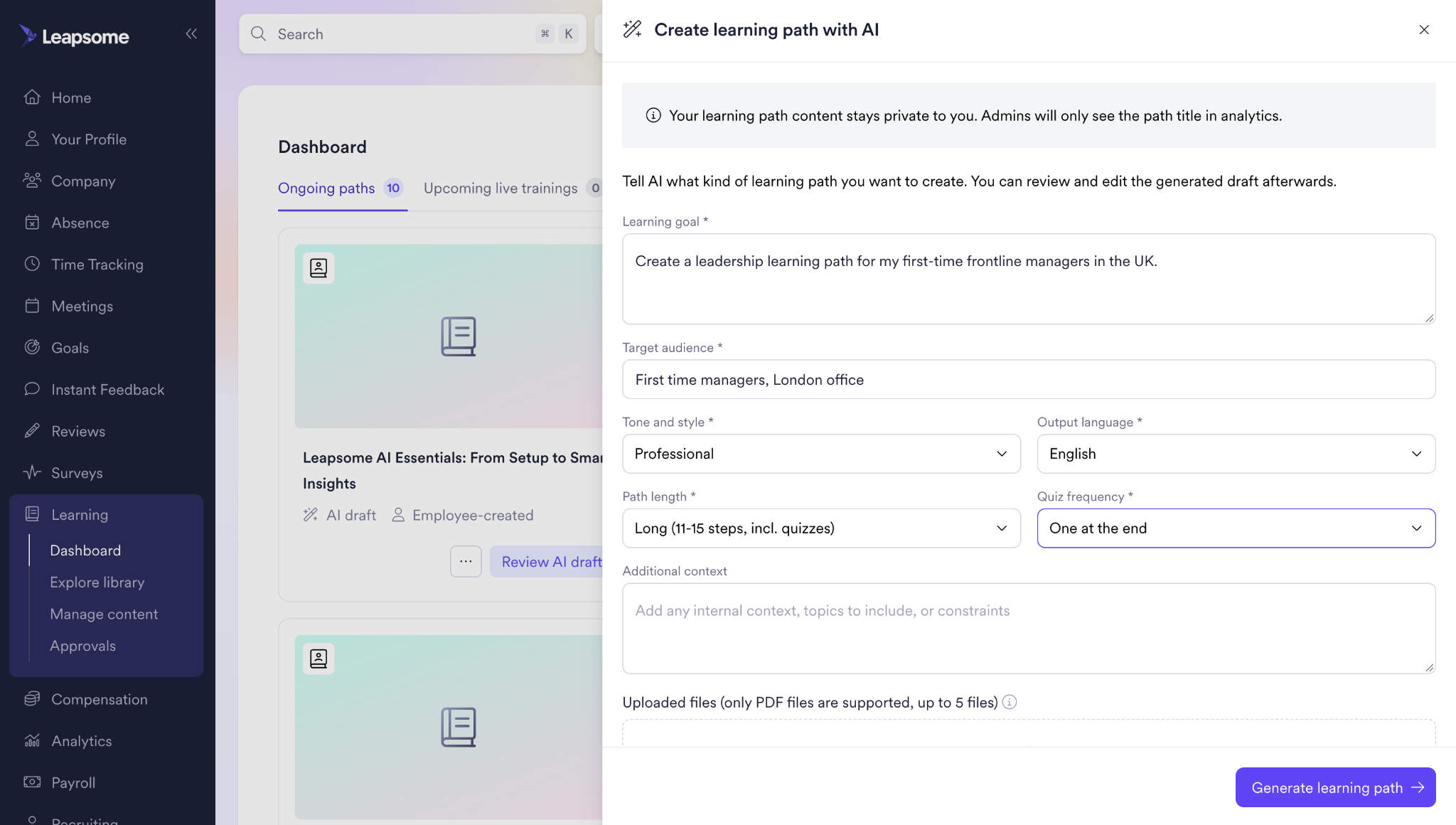
🏗️ Set new hires up for success
Use Leapsome Preboarding and Onboarding to give new hires a clear plan for their first week, then use Workflows to connect their existing skillsets to learning paths that will help them grow into the role.
👉 Explore Preboarding and Onboarding
Connect recruitment data with employee outcomes using Leapsome
When candidate records live in your recruiting system and early performance is tracked elsewhere, answering a simple question about recruitment success metrics can mean chasing down feedback for days. An efficient HR team with the right tools doesn’t have to manually search for data every time someone asks for it.
Leapsome brings recruiting and core HR into the same AI-powered people platform as onboarding and talent management. With Leapsome, teams can follow a candidate from applicant to employee with:
- Recruitment: Review where candidates drop out and how long it takes to hire, with analytics that cover source performance and quality of hire.
- Preboarding and Onboarding: Track onboarding tasks so you can see what support new hires received in their first weeks.
- Performance Reviews: Document how new employees are progressing against role expectations and where they need more development.
- Engagement Surveys: Gather feedback on the new hire experience, including how clearly employees understood their role and how prepared they felt to do it.
Leapsome’s six-month Agentic HR Accelerator Program helps HR leaders build an agentic team and lead their organization’s transition to AI. The first class starts in January 2027, and if you sign up by December 31, 2026, you can get the program and Leapsome’s Agentic HRIS Foundation tier at no cost (talent modules sold separately).
“With Leapsome, we were able to automate performance reviews, further automate goal setting, and automate onboarding and offboarding. And that, together, helped us save about 20% of the manual effort of our team.” — Weronika Czerny-Nowakowska, Chief Operating Officer at Neurons Lab
🧭 Let new hires’ performance guide your future plans
See how Leapsome connects recruiting with long-term employee performance, and learn how to get ahead with the Agentic HR Accelerator Program.
👉 Request a demo
FAQ
How do you calculate the most common recruitment metrics?
Many common recruitment metrics aren’t really calculations. You’ll need to collect data, like where your hires are coming from and how many successful candidates accepted their offers, but it doesn’t usually require any math.
Average time to hire is one exception. To calculate it, use this formula:
Time to hire = Offer acceptance date – Date the candidate entered the pipeline
You can then average that number across the same role, department, or hiring spree to get an average. For example, if it took 15, 20, and 25 days to get three acceptances in the same window, the average time to hire was 20 days.
Leapsome Team