Interview scorecards: How to structure and improve hiring decisions


Hiring tends to happen when you’re already busy, which can make it a real challenge to keep decisions consistent. An interview scorecard helps hiring teams evaluate candidates against predetermined, job-relevant criteria, then document the evidence behind each rating.
Yet an analysis by Metaview of over five million candidate interviews found that only 31.2% had scorecards attached.* That means many teams end up chasing down feedback and piecing together interviewers’ impressions for more than two-thirds of candidates.
Of course, even completed scorecards can leave questions unanswered. One manager might give a candidate high marks for communication because they speak confidently. Another might reserve the same rating for someone who explains complex information clearly. That’s why hiring teams need to agree on what a role requires before meeting candidates.
This guide explains how interview scorecards work, then provides a free interview scorecard template and examples you can learn from. By the end, you’ll know how to define criteria that support hiring decisions and remain useful once a new team member joins.
*Metaview, 2026
What’s an interview scorecard, and what should it include?
An interview scorecard is a framework for assessing candidates against agreed-upon criteria and recording the evidence behind each evaluation.
To keep the hiring process consistent, it’s best to use an interview scorecard form template with clear criteria for each role. This helps reduce unconscious bias and makes feedback easier to compare. And it gives your hiring team specific points to discuss when opinions clash.
Let’s look at some components to include in your job interview scorecard template.
Role-specific competencies and criteria
“Competency frameworks aren’t just checklists; they’re roadmaps for growth and accountability. They help managers coach more effectively and give employees a clear picture of how to succeed at every level. When expectations are written down, everyone understands what great looks like.”
– Monica Sarkar, Co-Founder at Purple Umbrella
For each role, start with the work the person will own, then identify the skills and behaviors they’ll need. Clear focus makes it simpler to compare candidates, so select four to six criteria that directly affect success in the role.
When hiring a customer success manager, for example, a vague expectation like “handles difficult customer conversations” can be broken down into role-specific competencies. Those might include spotting the customer’s concern, explaining available options, agreeing on realistic next steps, and following up regularly.
A centralized platform like Leapsome can help your team define expectations before interviews begin, then use them later in reviews and development. This gives all managers a consistent reference after hiring concludes.
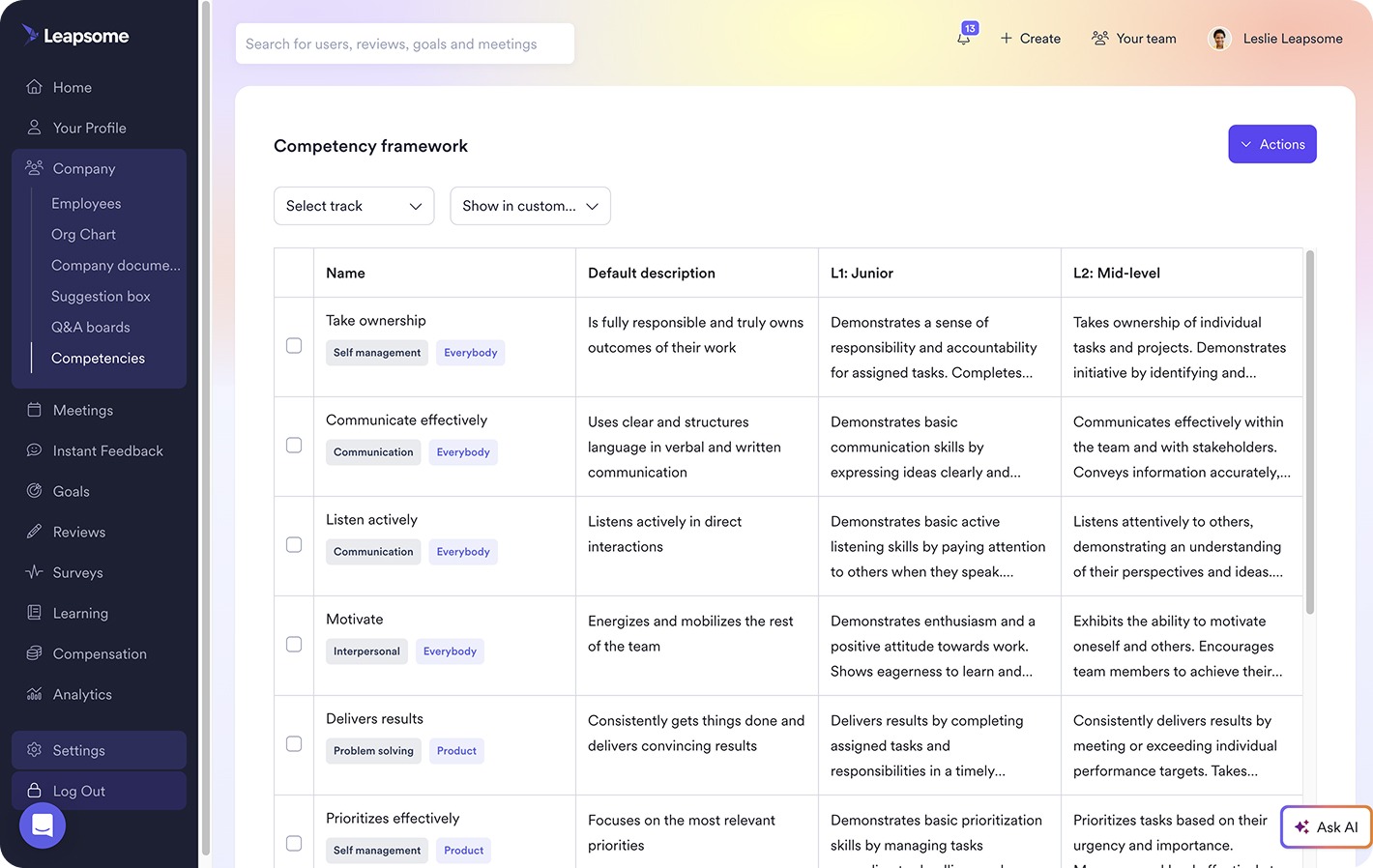
🧭 Guide managers with shared expectations for each role
Leapsome’s Competencies help you define skills by team and seniority level, so managers and employees understand what strong performance requires.
👉 Explore Competencies
A simple, consistent rating scale
Use a simple scale for your scorecard ratings, and describe what each number means. A four-point scale could span from “doesn’t meet the requirement” to “exceeds the requirement,” with a separate “not assessed” option that triggers follow-up interview questions.
It’s also a good idea to add criterion-specific examples, helping interviewers distinguish between ratings. For instance, when a candidate needs to show how they handle difficult customer conversations, meeting the requirement might mean explaining how they resolved a complaint independently. To exceed the criterion, they might also need experience identifying and addressing recurring problems behind similar complaints.
Evidence and interviewer notes
“Ask what makes someone feel undervalued or how they handled feedback — they reveal how well they’ll handle change and business realities.”
– Melanie Naranjo, Chief People Officer at Ethena
Numbers can’t offer a full picture, so give interviewers space to record what each candidate said or demonstrated in more detail. But encourage them (with examples as needed) to avoid vague statements like “Good cultural fit.” A useful interview note on customer support skills might identify a specific situation the candidate brought up, then elaborate concisely on their actions and the outcome.
📋 Give interviewers a shared way to evaluate candidates
We’ve put together a free job interview scorecard template, where your team can define role-specific criteria and record the evidence behind each rating.
👉 Download the template now
Interview scorecard examples and how to use them
“If the people you hire aren’t aligned, you’ll constantly have to play catch-up. Use tough interview questions to test alignment and maturity early.” – Melanie Naranjo, Chief People Officer at Ethena
Adapt each scorecard to what the interview is designed to assess. A recruiter screening call may simply establish whether an applicant meets essential requirements, while a later work sample could test how they apply their expertise.
Here are a few examples of what you might build targeted scorecards around:
- Skill-based interview scorecard for a data analyst: Assess whether the candidate can select an appropriate method and check data quality, then explain the business implications of their findings. A short work sample lets interviewers record how the candidate approaches the task and handles questions about their choices.
- Leadership interview scorecard for a manager: Evaluate how the candidate allocates work and addresses underperformance. Ask for a specific management decision, ideally one affected by competing priorities, then find out what options the candidate considered and what the ultimate outcome was.
- Behavioral interview scorecard for a project coordinator: Rate how well the candidate responds to changing deadlines and dependencies. Ask about a project that went off track, including when the candidate flagged the risk and how they renegotiated commitments. Record both the candidate’s problem-solving actions and the reasoning behind them.
Each scorecard should have a specific set of questions and a clear rating scale. And interviewers should submit their ratings independently, before they see colleagues’ feedback.
During the debrief, start with key differences that could affect the hiring decision. If one interviewer rates prioritization highly and another identifies a concern, examine the examples each heard and consider whether the interviewers applied the same standard.
Building an interview scorecard that stays relevant after the hire: Three steps
“At first, no one knew what success looked like. We defined performance levels and documented expectations — then motivation skyrocketed because people finally knew what winning meant.”
– Noelle Pittock, Senior Director of Onboarding and Business Operations at Remote
HR needs to connect what interviewers assess with what managers expect after hiring. Creating a great candidate interview scorecard is less about having endless pages to fill out, and more about aligning the interview conversation with actual role expectations.
Here’s how to adjust a candidate interview scorecard template so it stays relevant throughout the employee lifecycle.
1. Start with what success in the role looks like
Have the hiring team define the work the new employee should own within six months. A people operations hire, for example, might need to run onboarding independently while keeping employee records accurate as headcount grows.
Then, use those core responsibilities to choose four to six assessment criteria. Agree on which requirements and technical skills candidates must meet when they join, and what capabilities the company can help them develop over time.
2. Turn vague qualities into observable evidence
“Strengthening relationships and enabling managers to understand their teams is critical. We don’t look at domain expertise alone — leadership capabilities matter more. You can be the best specialist, but that doesn’t mean you can lead people or understand their needs.”
– Michael Latzik, Country Manager Germany at Deel
Replace vague statements like “leadership potential” with clear actions the role requires. For someone who will lead a growing team, that might mean delegating responsibilities and helping colleagues handle unfamiliar work.
After that, describe what different levels of proficiency look like. Someone who delegates routine tasks demonstrates a different level of skill from someone who can give colleagues ownership over complex work (with appropriate support).
3. Carry useful hiring criteria into the employee experience
Gallup found that only 49% of employees were confident they knew what their employers expected of them. This gap is why managers need to connect hiring expectations to daily work from the start.
After you send an offer letter, the recruiter and the incoming employee’s manager should review the hiring criteria together. The manager can explain how the scorecard criteria will apply to the employee’s work, then decide on early goals and predict where they’ll need support.
Leapsome gives your team a central place to define these competency expectations and connect them with preboarding and onboarding. Managers can assign relevant learning plans, helping new employees build the skills they’ll need to perform at their best.
🌱 Help new hires grow with clear expectations
Leapsome Preboarding and Onboarding tools help managers organize role-specific tasks and learning throughout the employee lifecycle.
👉 Learn about Preboarding and Onboarding
Connect structured hiring with performance using Leapsome
As hiring grows, your lean HR team can’t personally make sure every interviewer applies the agreed-upon criteria. That’s why managers need shared expectations they can use independently. But if those expectations live in separate recruiting and performance tools, HR still has to carry them between processes or risk losing them after an offer.
Leapsome’s all-in-one HRIS and people management platform helps teams maintain that connection with:
- Recruiting: Build interview scorecards using competencies from your Leapsome framework. You can hide other interviewers’ feedback until they submit their own assessments.
- Competencies: Define expectations by team and seniority level, giving managers a shared reference for hiring and employee development.
- Preboarding and Onboarding: Organize role-specific tasks and learning, so new employees prepare for the responsibilities discussed during hiring.
- Reviews and Goals: Use competencies in performance assessments, and set development goals based on the skills employees need to strengthen.
Connecting these practices can also give HR a stronger foundation for introducing AI into people processes. Leapsome’s six-month Agentic HR Accelerator Program helps teams lead their companies’ AI transitions through guided, practical use cases.
The first cohort starts in January 2027. Customers who sign up by December 31, 2026 receive both the program and Leapsome’s Agentic HRIS Foundation at no cost.
“Ahead of implementing Leapsome, we had lots of different ways of managing the review process across the organization. Not only did we want to create one global approach to managing the review cycle consistently, but we also wanted a tool that supported our managers in having genuine conversations with their people.”
– Holly Smith, Culture and Employee Experience Manager at ComplyAdvantage
🔁 Carry clear hiring expectations into the employee lifecycle
Leapsome connects hiring criteria with performance and development, helping managers build on the expectations that shaped their hiring decisions.
👉 Request a demo
FAQ
What are common interview scorecard mistakes to avoid?
When you use interview scorecards to make hiring decisions, avoid changing criteria midway through or assigning ratings without supporting evidence. Have interviewers submit feedback before seeing colleagues’ assessments, and discuss gaps in essential requirements before making decisions.
Leapsome Team