9 best HR AI tools: How to choose AI that uplifts HR work

.png)
Although 77% of HR leaders are planning to ramp up AI usage,* identifying which tools and use cases add value can feel daunting.
As part of an intentional HR strategy, the right AI-powered tools create meaningful capacity and improve human decisions. But for AI tools to be effective in practice, HR teams need to address the risks of tool spread and data insecurity.
Here we’ll cover HR AI tools that have the potential to cut routine tasks and enable strategic people work — without resulting in unnecessary risks and complexity.
*Paylocity, 2026
What are AI tools for HR and how can HR teams use them?
“AI should be a copilot, not an autopilot. Let it handle the heavy lifting, so you can show up more human, more present, and more precise where it matters.”
— Luck Dookchitra, VP, People & Culture, Leapsome
AI HR tools are software that use artificial intelligence to improve the speed and quality of HR work. They’re designed to improve outcomes across the employee lifecycle by automating tasks and capturing and analyzing people data. AI systems touch almost every area of human resources, including:
- Recruiting and hiring
- Employee engagement and support
- HR operations and automation
- Performance management
- People analytics and workforce planning
Unlike general-purpose artificial intelligence, AI HR software has department-specific features, such as resume screening and personalized learning paths. Typically, these tools also plug into HRIS ecosystems and provide compliance guardrails.
Keep in mind that not all AI HR platforms were built specifically for human resources. Tools like ChatGPT and Zapier have broad uses but can still deliver value to HR teams.
While AI-powered tools can directly reduce HR workloads, they also have the indirect advantage of freeing up time. With less on their plates, HR teams can devote effort to human-first initiatives like building company culture and nurturing career development.
What should you look for when choosing HR AI tools?
It’s easy to get caught up browsing AI capabilities. But the truth is that AI in human resources is most valuable when it focuses on outcomes, not a long checklist of features.
Further, choosing AI tools should involve the larger company, since people data, performance, and security are often defined at the organizational level. Be sure to loop in stakeholders across your company to ensure AI-powered features fit your tech stack and business goals.
Here’s how to figure out which functions fit your needs:
- Start with the problem and expected value: Identify which core HR tasks involve high-friction, repeatable work or where AI has the potential to make quality improvements. For instance, updating employee data across systems is time-consuming and error-prone, so it fits both criteria.
- Assess privacy, security, and human oversight: Managing and auditing AI results can be time-consuming, especially in a compliance-heavy field like HR. Consider the level of oversight each tool requires and the privacy and security safeguards it has in place.
- Evaluate context and integration: Delve into which employee data it manages and what platforms it connects to. The best artificial intelligence in HR integrates with your greater HRIS, data streams, and workflows to create unified operations.
Connected data is the foundation for smooth, accurate workflows, and platforms like Leapsome keep employee context in sync. Bring all your data together, from personal information and role details to compensation and job history.
“Without a single, reliable data set, AI is just a buzzword. Put your people data in one place, keep it accurate, and only then will AI deliver value on top.”
— Florian Klages, Managing Partner, torq. partners
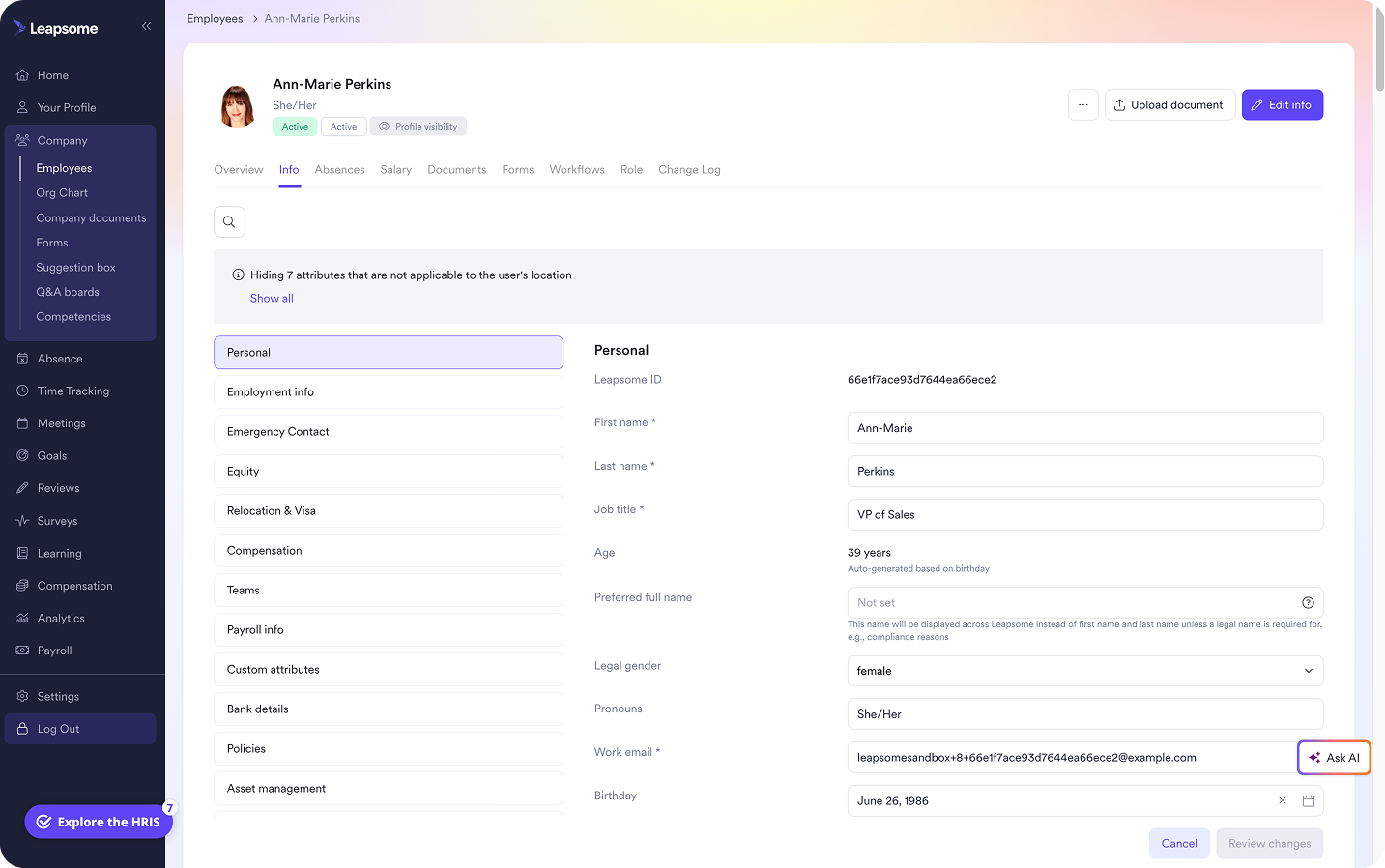
🗂️ Clean up the employee data that powers AI
A strong data foundation helps your HR AI tools generate accurate, reliable recommendations. Leapsome centralizes your employee data for up-to-date and connected HR workflows that better inform your people insights.
👉 Set up Employee Records.
Leading AI tools for HR teams
“Everyone feels behind on AI, not just HR. Start with planning. Set guardrails, decide what problems you’re solving, and define how people should use the time they save. We need structure before speed.” — Luck Dookchitra, VP, People & Culture, Leapsome
Here we’ll look at top HR tools that go beyond entry-level AI use and center human judgment on your HR team.
AI tools for employee engagement and performance
Designing the employee experience is often a matter of human-first strategy, but AI for HR can help with analysis and personalization.
For example, AI can evaluate surveys, feedback, and workplace sentiment, as well as provide predictive metrics on employee burnout or retention. AI-backed goal setting and career path design can also give every professional custom, ongoing support.
Here are a few platforms that fit these applications:
- Leapsome: Use people-first AI agents to analyze survey sentiment, summarize feedback, and make actionable recommendations.
- Lattice: Track morale and themes across surveys and onboarding sequences. Create action plans that make sense for every individual.
- Culture Amp: Evaluate survey and performance review data with AI, then tailor action plans to coach employees.
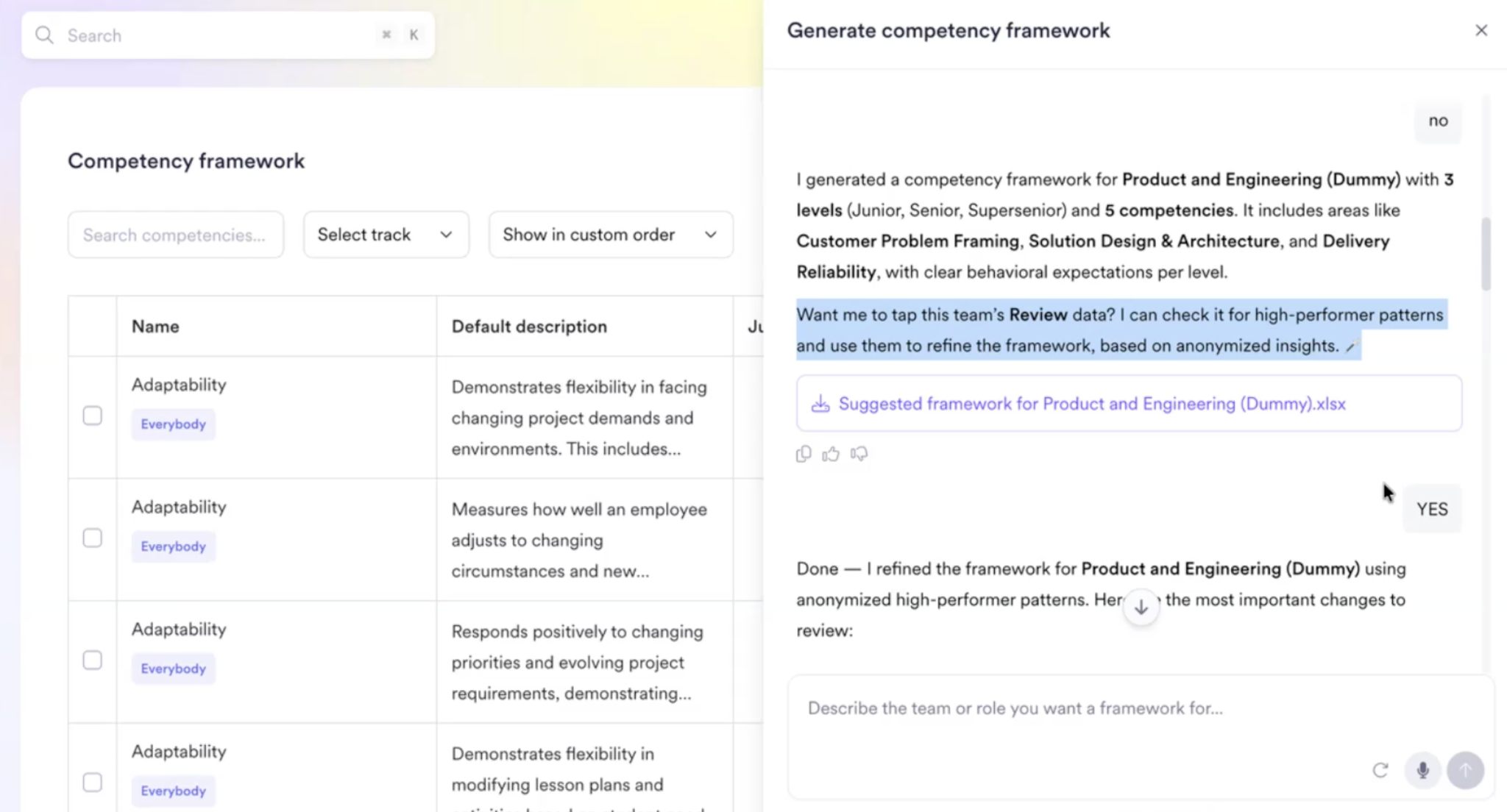
👤 Add an AI member to your lean HR team
Leapsome’s AI Agents support your team in surfacing insights related to surveys, feedback, and culture trends, letting you turn raw data into real next steps.
👉 Implement AI Agents
AI tools for recruiting and talent acquisition
AI HR and recruitment tools are aimed at reducing admin work when managing candidates. These platforms often automate talent outreach, resume screening, and candidate follow-up.
Here are a few tools that stand out:
- Paradox: Validate minimum requirements and instantly qualify or disqualify candidates. For new hires, generate offers and automate onboarding.
- Eightfold AI: Source top talent, run video interviews, and automate candidate evaluation.
- HireVue: Conduct one-way interviews and rank candidates based on keyword-driven verbal scoring.
AI tools for HR productivity and automation
HR AI tools for automation complete routine tasks for you, from handling leave requests to drafting job descriptions. They may also include self-service AI chatbots, which reduce admin when employees want to check benefits, personal data, and company policies.
Here are a few platforms to consider:
- ChatGPT: Draft job descriptions, interview questions, and training materials quickly.
- Microsoft Copilot: Generate content like job descriptions and emails, and automate workflows for requesting leave and updating employee data.
- Zapier: Create an AI-powered HR helpdesk, sync employee data across systems, and connect various HRIS tools.
Where should HR actually use AI? Value vs. risk framework
Just because it’s technically possible to automate an HR process doesn’t mean it’s the right choice. Decisions in HR have real impacts on people’s careers, and AI use cases should be carefully evaluated within this human-first context.
According to The World Economic Forum, HR pros using AI tools tend to fall into two categories: those who accept AI suggestions without question and those who distrust and fear AI systems. The right path isn’t either of those directions. Future HR teams need AI tools that automate tedious work and the confidence to know when to exercise human judgment.
SHRM agrees that AI is a tool to make human work stronger, so it needs a human team to review and validate every result. AI processes data at a scale people can’t, but humans add factors AI can’t manage: Compassion, context, and understanding.
To pinpoint where to use AI for HR, weigh the risks and the level of human oversight required to monitor it. While saving time in HR is an important goal, it can’t come at the expense of leaked employee data or errors that reduce brand reputation.
Here’s a simple framework to help your HR team evaluate the potential value versus risk level of AI tools:
- High value, lower risk AI: Communications, such as summarizing survey comments, drafting HR handbooks, and providing a self-service chatbot
- High value, higher risk AI: People decisions, such as resume screening, performance monitoring, and predictive workforce analytics
- Lower value, lower risk AI: Basic administration, including formatting documents, scheduling meetings, and drafting emails
- Lower value, higher risk AI: People decisions with minimal business benefit, such as video interview analysis and automated performance scoring
The best HR AI tool isn’t the one that can do the most. It’s the one you trust to improve work on your HR team — without putting your people decisions, data privacy, or tool efficiency at risk.
Use Leapsome AI to create more capacity for people, not complexity
“AI will free us from repetition and give us the choice to do what’s meaningful. The question isn’t whether technology makes us more human, it’s whether we use it to do so.”
— Cassie Kozyrkov, CEO, Kozyr; formerly Chief Decision Scientist at Google
HR teams have high expectations: Manage heart-driven people work alongside technical processes. The best tools enable the first by optimizing the second. HR AI platforms should support employee experience, development, and performance without more processes and systems to juggle.
Leapsome fits this need. Our all-in-one HRIS platform collects the meaningful insights HR teams need to help their people flourish. Leapsome can help:
- Tailor employee reviews: Performance Reviews unify your notes and feedback into thoughtful, personalized employee reviews.
- Measure company pulse: Engagement Surveys capture and summarize results to surface engagement trends.
- Personalize objectives: Goals and OKRs let you tailor milestones, timelines, and goals trees for every individual and team.
- Enable employee growth: Learning and Competencies help you build career paths and knowledge frameworks to improve core skills.
- Provide real-time help: AI agents explain company policies, answer everyday questions, and offer onboarding support.
With Leapsome’s AI-powered ecosystem, you can analyze data and reduce repetitive work while maintaining strong human oversight that keeps your culture people-first.
"Employees can now find everything in one place — their data, absences, goals, and reviews. I don't have to explain which tool to use for what. It's all in Leapsome." — Merilyn L., Senior People Operations Specialist, Bob W
🔁 Stay people-first as you harness AI
Instead of providing an endless feature checklist, Leapsome focuses on the people and workflow context that achieves meaningful outcomes. Use AI where it makes a difference, whether you’re looking to improve engagement, performance, or learning.
👉 Request a demo
FAQ
What are examples of artificial intelligence in HR?
AI tools for human resources can range from drafting job descriptions to running a helpdesk. Often, these tools relate to key areas such as recruitment, employee engagement, and HR automation. HR teams may also adopt general-purpose generative AI tools for content creation.

.png)


Entdeckt unsere Plattform für HRIS, Performance und Entwicklung.