Writing professional rejection letters: Guide + free templates


A rejection letter gives a candidate a clear answer about their application. That doesn’t mean your HR team has to draft an elaborate response for every applicant.
Your response should reflect the time and effort you asked candidates to invest. Someone who submitted a resume but didn’t make it past the filter needs a clear, timely response more than details about why. But someone who made it to the final round deserves a more personal message.
Post-interview feedback can preserve the potential for future relationships, as 79% of candidates surveyed by Greenhouse said they would reapply if they received feedback after an interview but weren’t offered the job.*
A lean HR team needs reusable rejection letters and email templates, along with a practical approach to matching your response to the candidate’s investment. In this article, we’ll give you six to use and provide some questions to guide you toward an efficient but respectful response.
* Greenhouse, 2024
What’s a rejection letter and why does it matter?
“Credibility comes with behavior. People are looking for tone, authenticity, approachability.”
— Steve Browne, Chief People Officer, LaRosa’s.
A job rejection letter informs a candidate that they won’t be moving forward in your hiring process. Even though most companies today deliver the news via email rather than physical letters, you’ll still provide a written, formal notification. A rejection message serves the same purpose, but usually comes in the form of a shorter, and sometimes automated, notification through a recruiting platform.
Clear and timely rejection communication lets candidates stop waiting for your decision and focus on other opportunities. It also helps your hiring team maintain good relationships with promising candidates for future talent management cycles.
How you handle giving rejections puts your stated people values and company culture into practice. If you promise to respect people’s time, that commitment should extend to someone you’ve decided against hiring. An unexplained silence after several interviews gives that person a good reason to question what working for your company would be like, and a poor experience they may share with others.
How to write a professional rejection letter + templates
“If it’s your decision, you should be the one who communicates it. Plain and simple.”
— Melanie Naranjo, Chief People Officer at Ethena
The language you use in the rejection letter doesn’t have to be elaborate to be respectful. Once you have a final hiring decision, focus on what the rejectee needs to hear:
- Make the decision clear: Within the first few sentences, state that you won’t be progressing with their application.
- Recognize the effort they invested: If they prepared a presentation or participated in multiple interview panels, thank them for their time/effort.
- Personalize the message: Reference something relevant from the interview in your reasoning, and avoid exaggerated praise that might make the rejection harder to understand.
- Be honest about further contact: Offer feedback only if someone on your team has the capacity for it, and don’t promise to contact them about future vacancies unless you genuinely intend to do so.
Here are a few rejection letters and email templates you can tailor to suit the candidate and the step they reached in your recruitment process.
General rejection letter after an application
If you haven’t interviewed the candidate, a brief acknowledgement and clear decision is usually enough.
Subject: [Job title] at [Company name] application decision
Dear [Candidate name],
Thank you for applying for the [Job title] position at [Company name].
After reviewing your application, we’ve decided not to progress to the interview stage at this time.
We appreciate your interest in joining our team and wish you well in your job search.
Best regards,
[Sender name]
[Job title]
[Company name]
Rejection letter after an interview
When the candidate has spent time preparing and speaking with your team, you’ll have more context and can make your response more personal. Thank them for that time and refer to something genuine you discussed.
Rejection letter template after an interview
Subject: Your interview at [Company name]
Dear [Candidate name],
Thank you for meeting with us to discuss the [Job title] position at [Company name]. We appreciated learning about [specific project, experience, or example you discussed].
However, we have decided not to move forward with your application for this role.
Thank you for the time you spent speaking with our team. We wish you well with your next opportunity.
Warm regards,
[Sender name]
[Job title]
[Company name]
Rejection email template after interview
Subject: An update following your [Job title] interview
Hi [Candidate name],
Thank you for speaking with us about the [Job title] role. We appreciated hearing how you [specific example or experience you discussed].
We’ve now completed our interview review and won’t be progressing your application at this time.
Thank you for the time you invested in meeting our team.
Best,
[Sender name]
Rejection letter with constructive feedback
After several interviews or a trial assignment, a candidate may want to understand exactly why you didn’t select them. When you can give constructive feedback, connect it to a specific role requirement and explain what their response needed to demonstrate. This gives them a specific skill or process to work on, which can help them grow in their field no matter where they end up.
Rejection letter template with constructive feedback
Subject: [Job title] application decision
Date: [Date]
Dear [Candidate name],
Thank you for the time you invested in [interview stages, assignments, etc.] for the [Job title] position at [Company name].
After reviewing your [interviews/assignments], we have decided not to offer you the role.
We wanted to share feedback on [specific role requirement]. Your [answer or work sample] demonstrated [specific strength]. However, it didn’t show [specific evidence needed for the role]. To strengthen a similar response, we might encourage you to [concrete suggestion].
We appreciate all the preparation and effort you put into the process and wish you the best of luck in your search.
Kind regards,
[Sender name]
[Job title]
[Company name]
Rejection email template with constructive feedback
Subject: Your [Job title] application decision and feedback
Hi [Candidate name],
Thank you for [specific interview or assignment contribution]. We’ve completed our review and won’t be offering you the [Job title] role.
To share some feedback, your [answer or assignment] showed [specific strength]. For this role, we also needed evidence of [job-related requirement], which wasn’t clear in [specific answer or work sample]. A useful next step would be to [practical example].
Thank you again for the time you spent with us.
Best,
[Sender name]
A truly personalized message comes from accessible interview information. If the hiring manager has to chase team members for notes after every decision, personalization becomes another admin task that delays a response. That’s why it’s better to rely on a people and talent management platform like Leapsome that connects candidate pipelines and structured interview feedback, so your hiring teams have context on hand they can use when breaking the news.
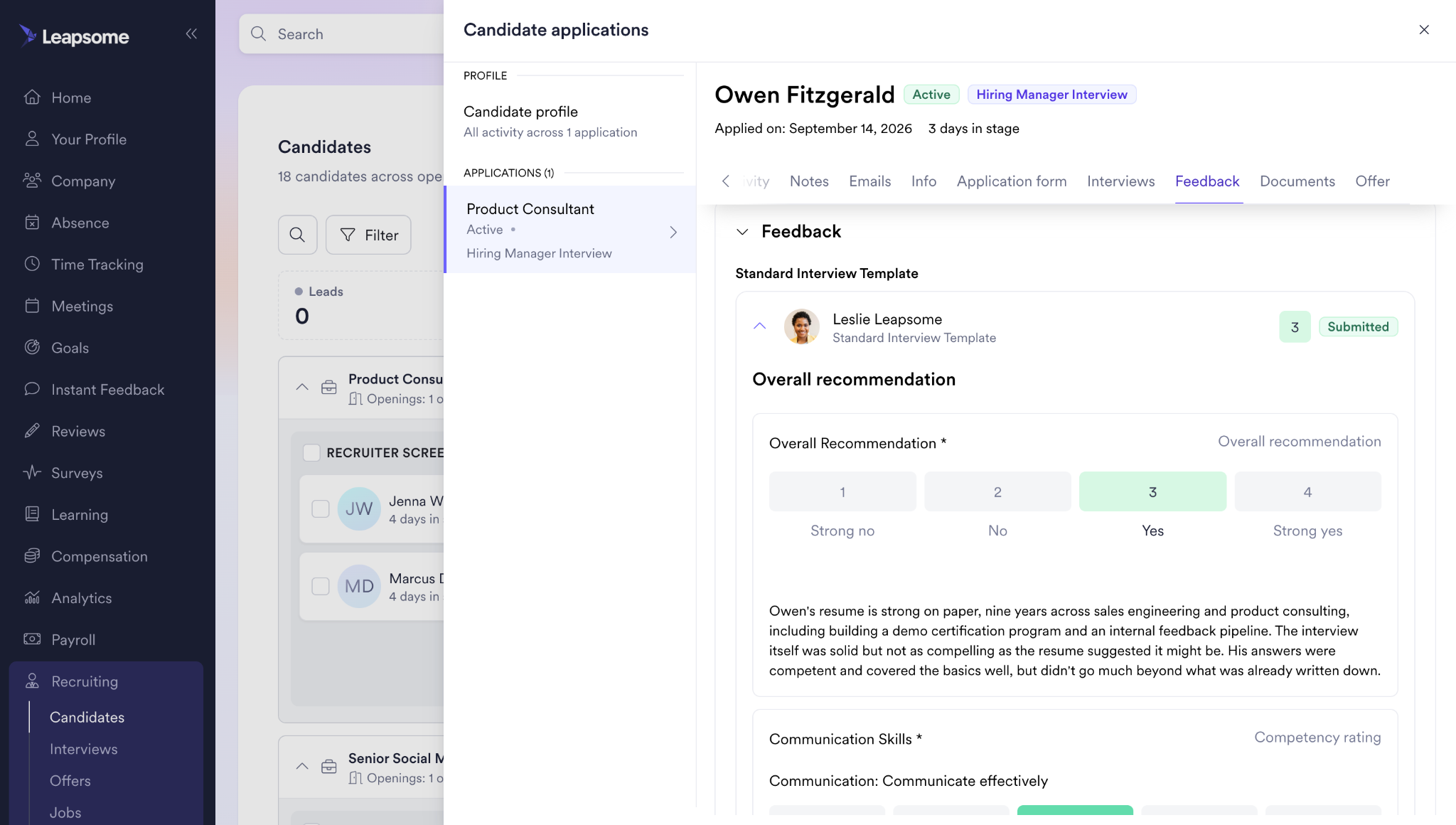
🤝 Support thoughtful responses at every hiring stage
Leapsome Recruitment keeps candidate information and interview feedback in one place, so hiring teams can respond promptly with a message that reflects each candidate’s efforts.
👉 Explore Recruitment
Match the rejection to the candidate’s investment
“As leaders we have to challenge our own perspectives. The way I communicate isn’t always right for the audience — it’s on me to learn what lands and adapt.”
— Noelle Pittock, Senior Director, Onboarding Operations and Business Operations at Remote
A standard job rejection email may be respectful enough after an online application. But if you send that same form rejection after several interviews, it can make a candidate feel their effort went unnoticed. Agree on what your team will provide at each stage, like these examples:
- Application only: Use a concise template that confirms the decision promptly.
- Screening call: Add a polite acknowledgement of the conversation, so the response reflects the contact you’ve already had.
- Interview: Reference a relevant detail and, if your team has capacity, provide light feedback.
- Final stage or work assignment: Have the lead recruiter or hiring manager contact the candidate personally. Consider giving specific, role-relevant feedback, particularly when you asked them to complete substantial work.
Put these standards into practice by assigning who sends each response and when. Then, make it easier for everyone to take charge of that task with an accessible instant feedback system like Leapsome.
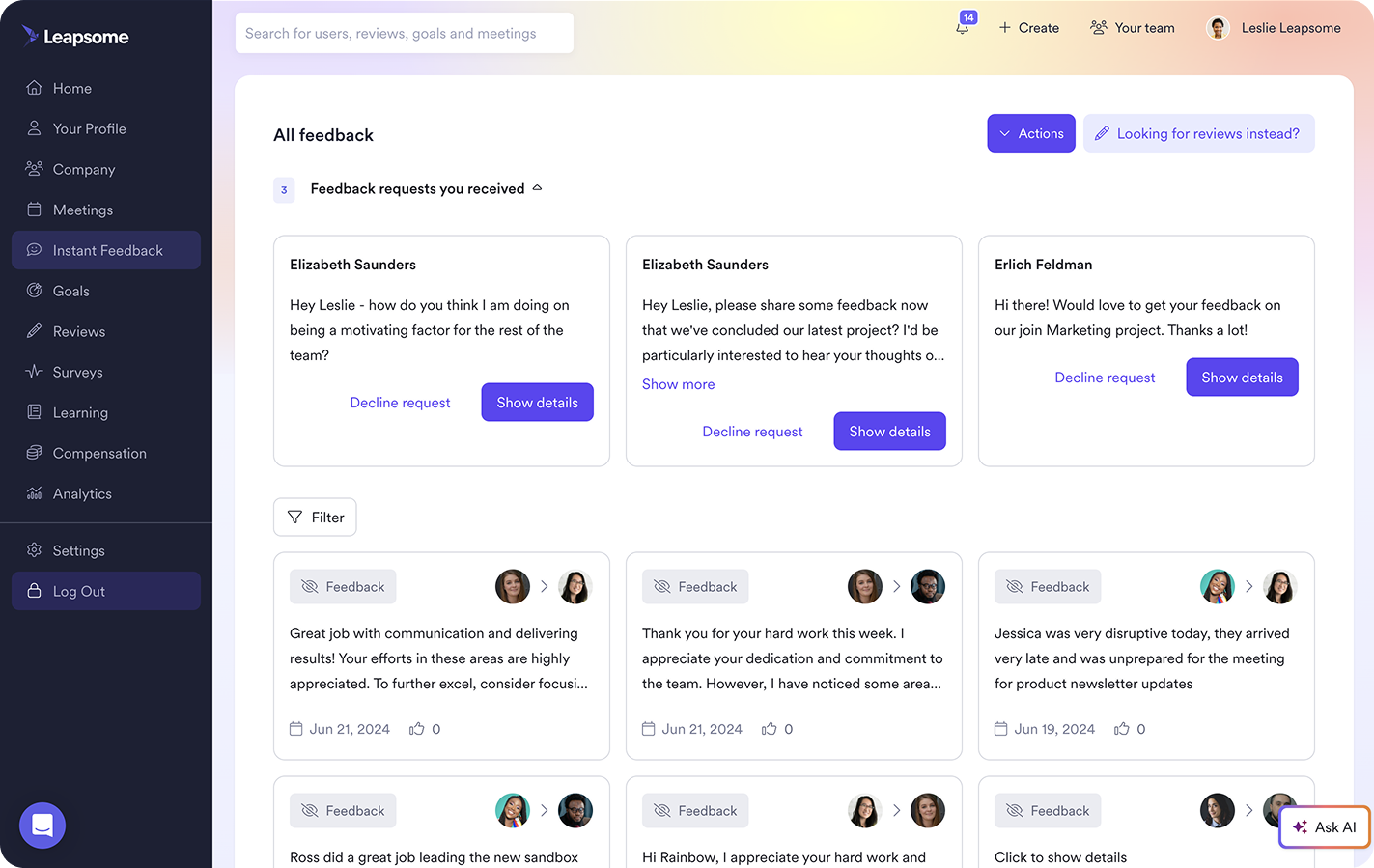
💬 Build a culture of constructive feedback
Leapsome’s Continuous Feedback feature helps teams bring specific, actionable feedback into every interaction.
👉Explore Continuous Feedback
Create a more consistent candidate experience with Leapsome
A thoughtful rejection process relies on respect, from language to follow through. But when the same lean HR team also manages onboarding and ongoing employee needs, how you follow up can shift to the bottom of a busy workweek.
Leapsome helps people teams manage their work through the talent lifecycle (and beyond):
- Recruitment: Candidate pipelines and structured interview feedback give hiring teams the information they need to communicate decisions.
- Connected HR and talent management: Core HR insights connect with engagement, development, and feedback, reducing the handoffs HR and leaders have to coordinate across separate tools.
- AI agents with human oversight: Agents support routine administration while people stay in control of consequential decisions.
For teams ready to build on that foundation, Leapsome’s six-month Agentic HR Accelerator Program helps HR leaders build their own agentic team to lead their organization’s AI transition. Customers who sign up for the program by December 31, 2026 will receive that training at no cost, as well as Leapsome Agentic HRIS Foundation free for the duration of their contract (other modules sold separately).
“Leapsome is very user-friendly — both for HR and for our employees. It gave us the flexibility to implement our specific feedback process, and it has reduced a lot of the manual work we would have had to do.” — Nina Thiessen, Head of Talent Acquisition and HR Management at EGYM
🌱Give your HR team more room for people decisions
Leapsome’s connected HRIS and Agentic HR Accelerator Program can help your team reduce repetitive work while keeping people involved where their judgment matters.
👉Request a demo
FAQ
How can a rejection letter support your employer brand?
By following through quickly and with care, you can put your company’s stated values into practice. A tactful rejection with a sincere thank-you shows respect for the candidate’s effort. Extra encouragement is optional, and you should only include it if you have details to back it up.