Compensation philosophy: Why it matters and how to build one that works

.jpg)
Disclaimer: This content is for general informational purposes only and does not constitute legal advice. Leapsome does not guarantee legal compliance and cannot confirm how specific situations would be assessed in court. If you're unsure how the requirements apply to your organization, please consult qualified legal counsel.
As organizations scale, ad-hoc compensation decisions based on judgment and precedent start to fall apart. Offers become inconsistent across teams, and pay transparency falls by the wayside.
After a while, employees can’t wrap their heads around how raises work, while leadership struggles to find answers when asked what fair pay actually means for the business. Just 40% of employees agree that their organizations are transparent about compensation, according to Gartner. And only 36% believe their companies are fully open about pay decisions.*
But there’s good news, too — a well-crafted compensation philosophy can turn the tide. This guide explains how to build a defensible philosophy, then use it to make consistent, transparent pay decisions that don’t leave anyone feeling shortchanged or confused.
* Gartner, 2025
What’s a compensation philosophy, and what makes it so important?
“Seventy-five percent of the company spend is on salaries. If that’s not effectively spent, you’re throwing money away. HR exists to make sure it’s invested wisely.”
– Melanie Naranjo, Chief People Officer at Ethena
A compensation philosophy, sometimes called a comp philosophy or pay philosophy, is the decision framework your organization uses to attract and retain talent. When you lay out a formal set of guiding principles defining how the organization approaches pay and benefits, every compensation decision can be backed by a tangible frame of reference.
As a result, all team members understand how pay works and know what to expect. According to WorldatWork, this one change raises employee trust by 10%. There’s also less chaos during key transition points, like rapid headcount growth or expansion into new markets.
The non-negotiable elements of a complete compensation philosophy
Compensation philosophies vary based on organizational needs, but at a minimum, they should include these core components:
- Market positioning defines how you set pay relative to your competition, such as whether you offer salaries above, at, or below market rates. This doesn’t have to be a blanket decision, but a general guideline prepares your team for how aggressively they’ll need to compete for each target talent segment.
- Pay mix details what compensation packages include beyond base pay. This might cover benefits, performance bonuses, commissions, and long-term incentives like stock options.
- Pay equity lays out how you ensure fairness and equal pay for equal work across demographic lines.
“Equity focuses on adjusted data. It asks: If people are doing comparable work, are they paid comparably? If not, can we explain why or do we need to fix it?”
– Alexandra Edl, Senior HR Consultant, Interim Manager, Coach, and Trainer at EDL Consulting
Key terms: Compensation philosophy vs. strategy vs. policy
These terms often show up in close proximity, and many HR pros use them interchangeably. However, there are some nuanced differences worth understanding:
- Compensation philosophy: This is your set of guiding principles about compensation goals and values, such as internal equity and pay-for-performance tradeoffs. Philosophy guides the entire organization, from leadership right down to entry-level team members trying to understand why their raise requests were rejected.
- Compensation strategy: Your strategy is how you put the philosophical principles into practice, including your approach to tactical levers like market positioning and pay mix.
- Compensation policy: At the lowest level, you’ll outline the day-to-day rules that govern specific compensation mechanics, such as base salary ranges and bonus payouts.
Of course, turning policy into practice takes more than well-written rules. You also need the right tools to translate those guidelines into on-the-ground pay decisions. For instance, with Leapsome you can run performance reviews that ground merit increases in employee history.
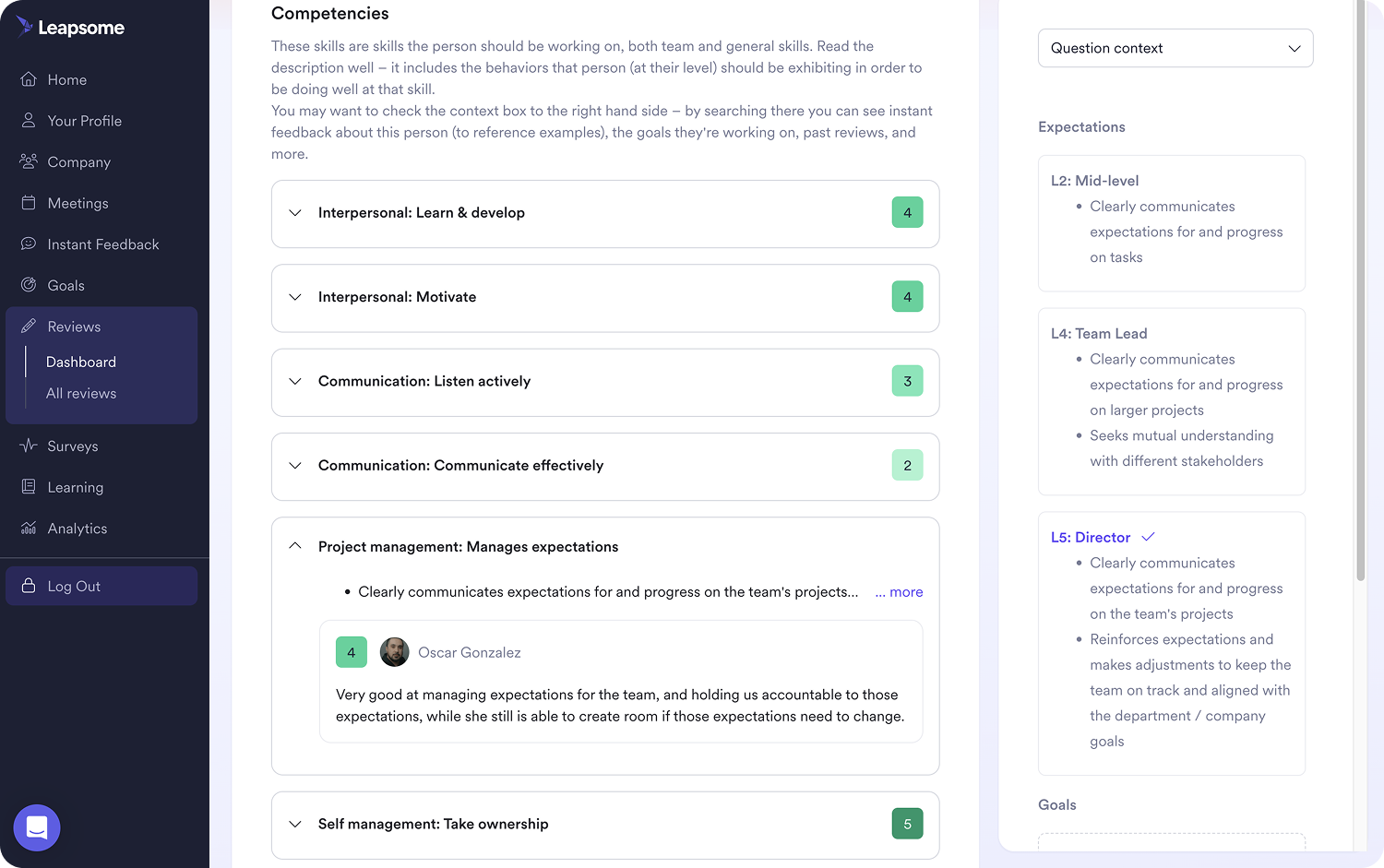
💰 Make merit increases fair and consistent
Link pay decisions to structured performance data, replacing subjective merit increases with documented decisions HR can justify to leadership and team members.
👉 Explore Performance Reviews
How to create a compensation philosophy that works in practice: Three steps
With the groundwork out of the way, here’s a three-pronged blueprint for approaching compensation philosophy development.
1. Lay out your compensation goals and values
The first stage isn’t digging right into market benchmarks, but taking a step back to identify which talent segments you should focus on and which you can safely deprioritize. The trick is to think of compensation as “pricing with higher stakes,” as Leapsome VP of People Strategy and Operations Jessica Zwaan puts it in her piece on developing a strong philosophy.
A statement like “We want to pay competitively across the board to attract the best talent” isn’t a strategy — it’s a slogan. Instead, think of different talent segments as buyer personas, and ask two questions:
- How skilled do you need employees to be?
- How much value does each role add to your organization, on an individual basis?
With those answers, you’ll know exactly where to compete aggressively and where you can afford not to.
2. Set market position and pay mix by talent segment
After you pinpoint the talent segments likely to have the biggest impact, your market position and pay mix will help you work toward those aims. Organizations often use 50th percentile market benchmarks to calibrate pay targets. You’ll likely aim above that midpoint for hard-to-fill positions, and below for lower-level roles where there’s plenty of talent available.
For example, a SaaS company’s compensation approach might focus on highly competitive pay for senior engineers, who have an outsized impact on the organization’s strategic objectives. Then they’ll match the market for lower-leverage roles that aren’t too tough to fill, such as basic office admin and entry-level positions.
As for pay mix, the right balance for each talent segment depends on how much risk you’re comfortable asking candidates to share. High-leverage, heavily outcome-driven roles benefit from variable compensation components, like pay-for-performance bonuses and stock options. More consistent, lower-impact roles may be better suited to fixed base pay.
3. Convert philosophical principles into clear rules
“Creating pay bands means defining minimums, midpoints, and maximums for each role. It’s not just a number; it’s a system that supports fairness, clarity, and long-term growth.”
– Alexandra Edl, Senior HR Consultant, Interim Manager, Coach, and Trainer at EDL Consulting
Once you know where you need to compete and how to structure compensation to get there, you have to convert that framework into actual day-to-day decisions. In practice, this usually means defining salary bands with minimum, midpoint, and maximum salaries for each talent segment you’ve identified.
As WorldatWork explains, using salary bands to build in flexibility lets you make decisions that account for experience and performance while remaining within shared guardrails. This keeps compensation consistent without sacrificing nuance.
The true test of any compensation philosophy is how it holds up in the real world. If two managers facing the same situation arrive at similar pay decisions, the system works. If instead there’s no reliable way to explain promotions, offers, and pay adjustments through your compensation philosophy, you need to get more specific.
“Money is a sensitive topic, so communication is everything. Use clear, simple language and make sure leaders know how to talk about pay with confidence and care.”
– Alexandra Edl, Senior HR Consultant, Interim Manager, Coach, and Trainer at EDL Consulting
To illustrate these principles, let’s turn to our own compensation philosophy example that ticks all the boxes.
No matter how painstakingly crafted your approach is, you also need the right compensation management tools. With Leapsome, it’s easy to make good pay decisions a consistent part of daily operations.
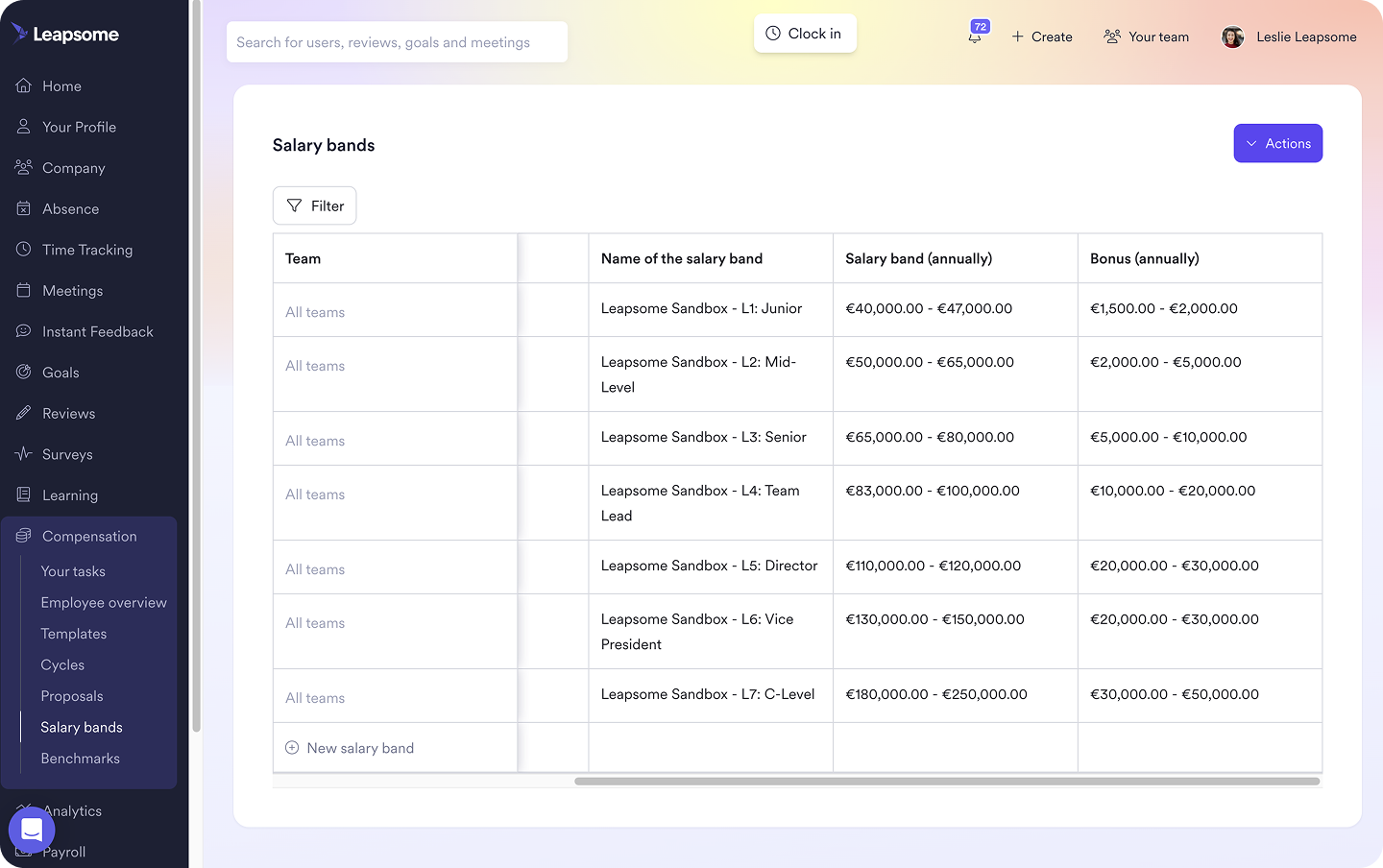
💪 Turn your compensation philosophy into a clear process
Centralize pay cycles, performance inputs, and employee records, so pay decisions always reflect your company’s principles.
👉 Explore Compensation Management
How to transform your philosophy into consistent decision-making
As Zwaan explains, compensation philosophies tend to fail when they’re made up of broad aspirations using ill-defined buzzwords like “competitive pay” and “best candidates.” If managers can’t derive similar decisions about offers, raises, and pay gaps by drawing on your compensation philosophy, that framework isn’t specific enough to matter.
Consistency comes after you’ve defined the talent segments you want to compete for. Only then can you apply the same criteria to decisions within those segments. The result is a compensation philosophy that builds trust, because it’s consistent enough to justify decisions and connected enough to scale smoothly.
Here’s what that looks like at key moments:
- New hire offers hold up under scrutiny and reflect role levels.
- Merit increases are justifiable and backed by performance history.
- Pay equity reviews expose the same gaps no matter who’s running them.
💸 Don’t leave anything out of your new compensation philosophy
If you want a jumping-off point, we’ve created a free compensation philosophy template you can use to get started quickly.
👉 Download the template now
Build a compensation philosophy that scales with Leapsome
All too often, compensation decisions feel reactive and inconsistent. And when the problem isn’t philosophical, it’s operational. Without a shared, integrated system to convert guidelines into practice, managers are left to their own devices, and HR has to rely on scattered spreadsheets. Pay decisions coalesce into obscure patterns that are hard to audit, and even harder to explain.
Leapsome’s scalable, interconnected HRIS and people management platform brings together everything HR leaders need to close the gap between philosophy and execution. That includes:
- Performance reviews to ground merit increases in documented outcomes.
- Compensation cycles that pull from a single source of truth to turn judgment calls into evidence-backed decisions.
- Employee records and people analytics, so every pay decision is grounded in real numbers instead of subjective opinions.
“Employees can now find everything in one place — their data, absences, goals, and reviews. I don’t have to explain which tool to use for what. It’s all in Leapsome.” – Merilyn L, Senior People Operations Specialist at Bob W.
🎯 Make consistent pay decisions the norm, not the exception
Trade in inconsistent decisions that leave employees feeling bewildered for a system built on standards and grounded in data.
👉 Request a demo

%20(1).png)

.jpg)




Sind Sie bereit, Ihre Strategie zur Mitarbeiterförderung zu verbessern?
your People operations?
Informieren Sie sich über unsere Leistungsbeurteilungen, Ziele und OKRs, Engagement-Umfragen, Onboarding und mehr.
.webp)
.webp)
 Fordern Sie noch heute eine Demo an