Time to hire: How to improve speed without sacrificing quality


Hiring managers need to fill vacancies quickly, and leadership expects hiring to use little time and resources. HR then feels the pressure to reduce time to hire, the number of days between a candidate entering a hiring pipeline and accepting an offer. Shortening that window can mean removing an unnecessary interview, but it can also mean settling for a candidate without enough evidence that they can do the job.
Robert Half’s research found that 43% of hiring managers admitted to making a bad hire.* While that doesn’t tell us if they rushed the decision, it puts the urgency to hire faster into perspective. Filling a role sooner offers little value if the team has to reopen it a few months later.
That’s why time to hire needs context from what happens after someone joins. Look at whether the new hire meets early expectations, how quickly they can work independently, and how long they stay. These signals help you gauge whether a faster hire paid off.
This guide explains how to calculate time to hire and remove delays without weakening candidate evaluation. It also shows you how to connect hiring speed with post-hire outcomes, so you can judge if a faster process delivered the desired results.
* Robert Half, 2024
What’s time to hire, and how do you calculate it?
Time to hire counts the number of calendar days between the successful candidate entering the hiring pipeline and accepting the offer. You can calculate it with this formula:
Time to hire = Offer acceptance date – Date the candidate entered the pipeline
To find the average, add the time to hire for each completed hire in the reporting period and divide by the number of hires.
Time to hire vs. time to fill
The difference between time to hire and time to fill boils down to when you start counting. Time to fill typically begins when the company approves or opens the job requisition, so it also captures the time spent finding the eventual hire. Both metrics have an end point at offer acceptance.
For example, a role opens in your company on June 1. The eventual hire applies on June 11 on the careers page and accepts the offer on July 1. This means the time to fill was 30 calendar days, while time to hire was 20 days.
What’s a good time to hire?
"The most important metric is the performance of the company. Everything else, engagement, sentiment, should serve that."
— Luck Dookchitra, VP People & Culture, Leapsome
A report by Ashby found time to hire averaged approximately 38 days for business roles and 48 days for technical roles. While this benchmark provides a starting point, it’s not a deadline for your HR department. In practice, a good time to hire is one that lets your team make an evidence-supported decision without unnecessary delays.
Before deciding if your hiring process takes too long or working to reduce it, consider:
- Role seniority and specialization: Hiring a head of engineering may take longer than hiring a junior support agent because the team needs to assess different kinds of experience. However, while a technical assessment may justify a longer timeline, another interview with the same questions doesn’t.
- Talent market and location: A candidate considering several offers may need more time to decide, while someone in another time zone may struggle to find an appropriate interview slot. Account for those delays, but separate them from internal waiting, such as a hiring manager taking five days to submit feedback.
- Your company’s baseline: Compare recent hires for the same role and level with earlier hires, then check how long each stage took. If the average time went from 30 to 40 days, find where in the workflow those extra days appeared, so you can focus your faster time to hire strategy on specific bottlenecks.
How to reduce time to hire without weakening evaluation
"We're imagining a human-centric company operating system. It goes beyond the employee and takes care of the entire organization."
— Ankit Saigal, Head of Product, Leapsome
Reducing time to hire starts with questioning if each step in the process helps the team make the final decision. Another interview may help assess a skill the hiring manager hasn’t tested. Repeating the same questions or leaving feedback unread for a week adds time without helping the team choose.
Prolonged time to hire affects candidates, too. SHRM reported that 36% of respondents had withdrawn from an interview process because employers asked them to jump through hoops.
To reduce time to hire without damaging evaluation, focus on these avoidable delays:
- Unclear role requirements: Run a kickoff with the hiring manager to decide which skills the applicant needs at the moment and what they can learn after the job offer. This avoids confusing candidates with requirements that change halfway through interviews.
- Duplicate interview stages: Give each interview a clear purpose. If two interviewers need to ask a candidate about the same past project, share the first assessment in your HRIS rather than scheduling another round to repeat it.
- Slow feedback: Ask interviewers to submit scorecards within one business day and set reminders for missing feedback. Agree on who makes the next decision, so recruiters don’t have to chase the whole panel.
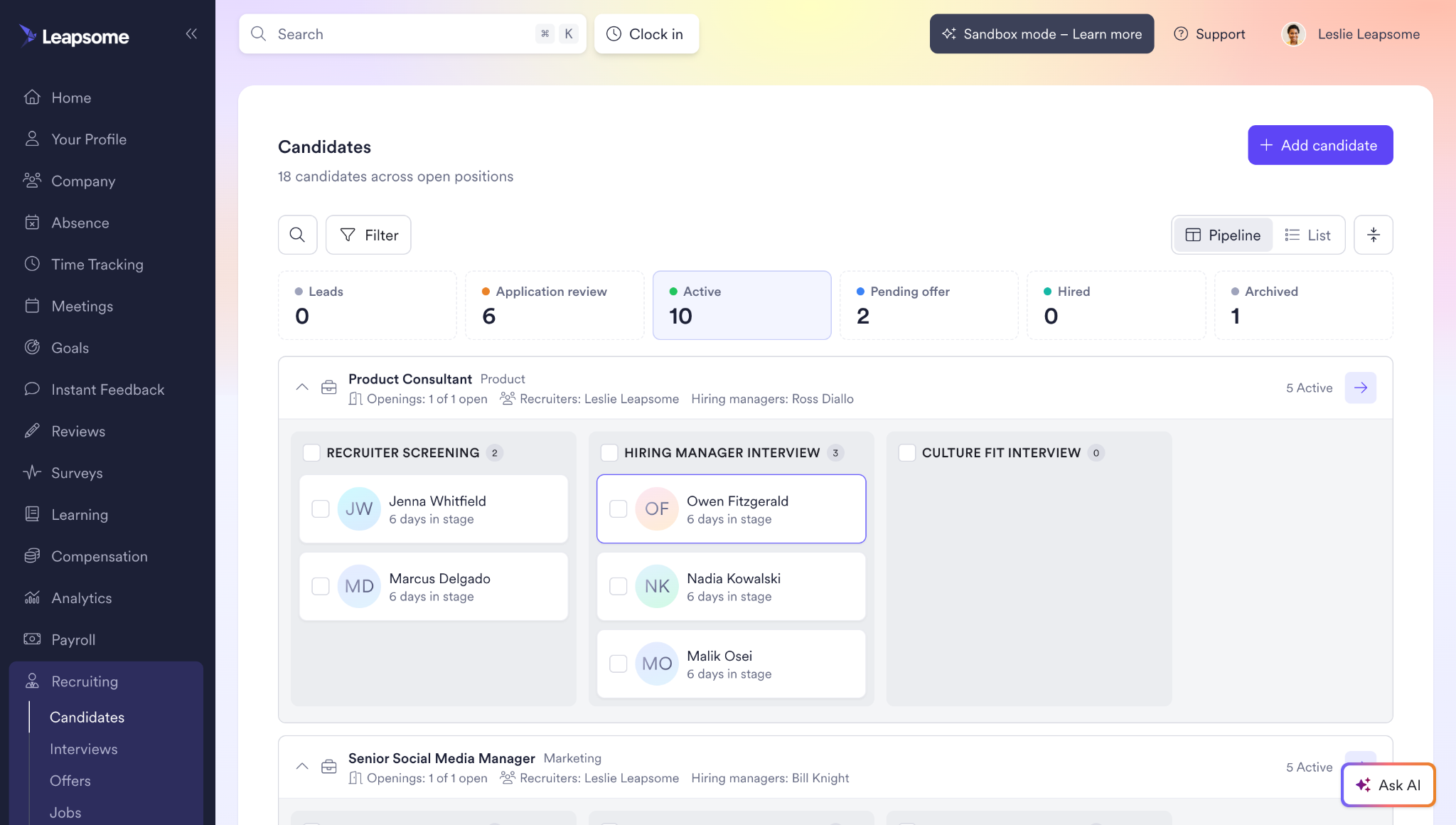
⏱️ Spot delays in your hiring pipeline
Leapsome Recruitment lets teams track candidates by stage, making it easier to see where progress stalls and address the delay.
👉 Explore Recruitment
How to tell whether a fast hire worked out
"Talking the language executives talk, in metrics and ROI that resonate, wins business cases for HR teams." — Katerina Arsova, Head of People & Talent Operations & Partnerships, Leapsome (at the time)
Treat time to hire as a process efficiency metric, not an isolated way to measure if the hiring was successful. If your team removes an interview round, you need to check how the people hired through the shorter process fare on the job before you make that change permanent.
In a SHRM interview, a talent assessment expert, Shiran Danoch, recommends evaluating quality of hire through post-hire measures, like gathering performance ratings at six and 12 months alongside time to productivity.
To check whether faster hiring worked out, compare hires from the shorter process with earlier hires in similar roles. Use the same expectations for both groups:
- Structured 90-day performance check: Compare how consistently each group meets the early goals set for the role. If more hires from the expedited process fall short, review whether the team removed an assessment that helped identify a necessary skill.
- Time to proficiency: Track how long new hires need to handle their core responsibilities independently. If the team saves a week during hiring, but new employees need several extra weeks of support, rethink the trade-off.
- Six or 12-month retention: Look for a rise in early departures among hires from the shorter process, using the same milestones for both groups. If exit interviews show more people leave because the job differs from what they expected, check whether the team cut conversations that helped candidates understand the role.
"We build trust from day one with live 30, 60, and 90-day check-ins where employees speak openly with HR, and even with the CEO at the one-year mark. When people see action after those talks, they start to trust that feedback truly leads to change."
— Janelle Doharty, Head of People & Culture at Knowtion Health
These signals help you judge whether faster hiring worked out, but they don’t prove that speed caused the result. A change in onboarding or manager support could also explain a difference between groups. Leapsome brings performance data together with broader people insights, helping HR investigate those differences before deciding whether the hiring process needs to change.
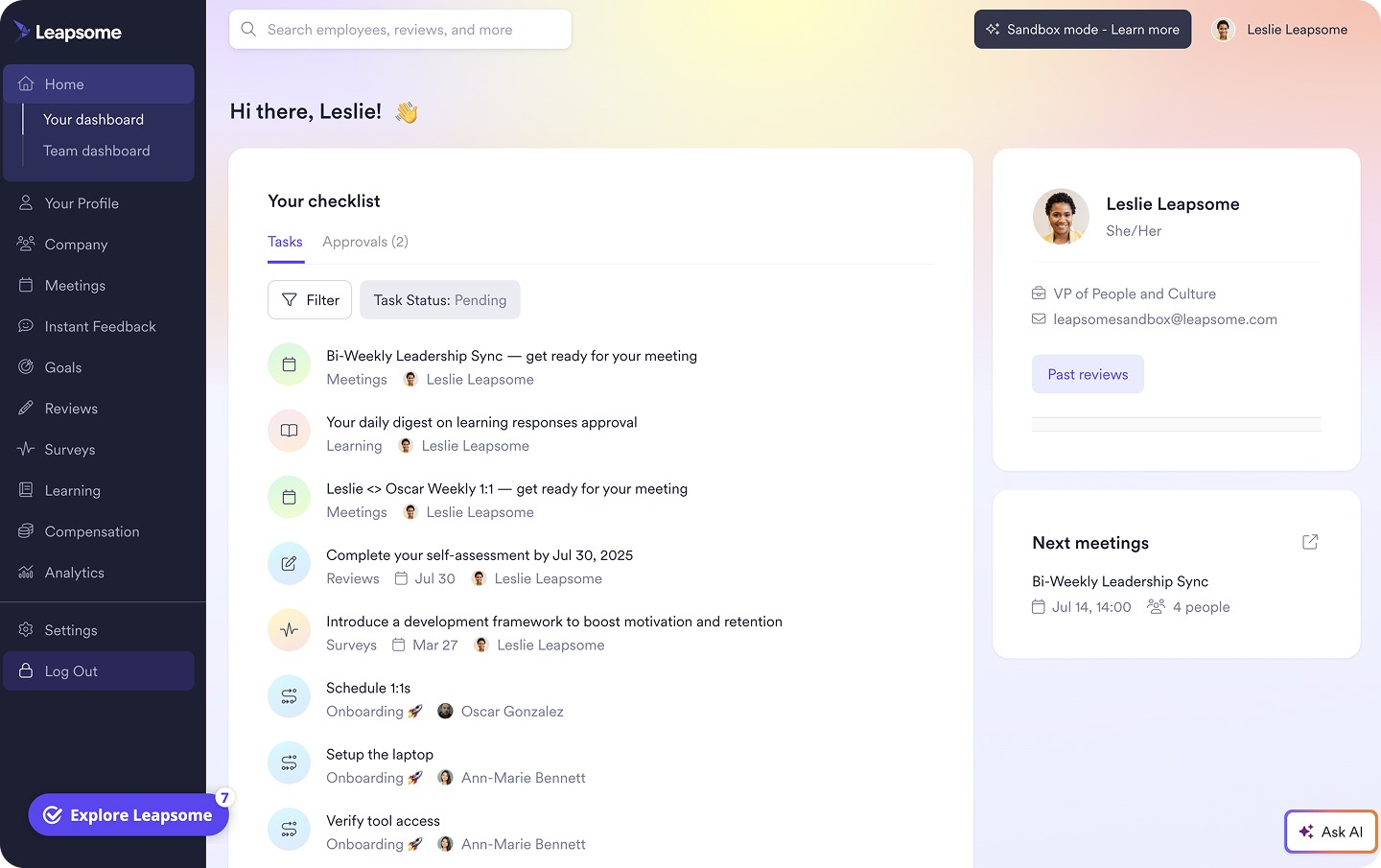
🕵️ See what happens after the employee accepts the offer
Leapsome’s People Analytics help you assess post-hire outcomes alongside recruiting metrics, so hiring speed becomes part of a broader view of employee success.
👉 Explore People Analytics
Track time to hire and what happens next, in one place, with Leapsome
When recruiting reports end at offer acceptance, a shorter hiring timeline can look like a success long before anyone assesses the outcome. By the time the data surfaces, the team lost the days they thought they saved.
When you connect hiring to the broader employee lifecycle with Leapsome, you make that assessment part of the process. With Leapsome, teams can:
- Keep hiring connected to employee data: Recruiting carries candidate information into the employee record, preserving context as the person moves into onboarding.
- Assess performance against agreed expectations: Performance Reviews connect with Goals and Competencies, helping managers evaluate whether new hires deliver the work the role requires.
- Investigate outcomes across comparable groups: People Analytics brings performance and HRIS data together, helping HR examine post-hire outcomes alongside hiring speed.
"All payroll data lives in Leapsome, it's a living number. When salaries change, managers update them directly." — Siddharth Dhanuka, Head of Finance & Operations, SQUAKE
🔎 Discover if faster hiring paid off
Leapsome connects recruiting with the employee lifecycle, helping HR evaluate hiring decisions through the performance and retention that follows.
👉 Request a demo
FAQ
What’s the average time to hire?
Recent benchmarks show that the average hovers between 38 and 48 days time to hire, depending on the role, measured from application to accepted offer. Highly specialized open positions may take longer because teams need more time to assess the required expertise.