OTE salary guide: How to calculate earnings and nurture employee trust


An OTE salary structure offers flexible earning potential that can look very attractive on both sides. In a perfect world, employees earn more when they perform well, and businesses get the chance to motivate workers toward concrete outcomes, such as better sales conversations or more closed deals.
Like most things in life, OTE structures rarely perform so neatly in practice. A plan you built to encourage ambitious employees quickly loses credibility if targets feel unrealistic, payout rules are unclear, or earnings depend (even in part) on factors employees can’t control. What’s more, Gartner found that overwhelmed sellers are 45% less likely to attain their quotas.* That means a poorly designed OTE plan can actually weaken the performance it was meant to improve.
In this article, we’ll cover the basics of OTE and explain how to calculate earnings. We’ll also discuss how you can spot when an OTE plan is failing, before top performers start leaving.
* Gartner, 2024
What’s OTE?
OTE, or on-target earnings, is the total amount an employee can expect to earn if they meet 100% of their performance targets. Most OTE structures include two parts: a fixed base salary and a variable component, such as commissions or performance-based bonuses.
Keep in mind that OTE is a target, not a guaranteed amount. Employees will naturally earn less if they miss their targets, but their earnings can also be lower than they expect if they exceed your OTE plan’s caps.
This variability in earnings makes clear communication essential, but AON research found that only 19% of companies feel ready for pay transparency. If candidates see OTE as a realistic earning expectation, while the business treats it as an aspirational number, your plan starts with a trust issue before an employee even closes their first deal.
“Transparency doesn’t mean sharing every number. It means explaining the logic — how pay decisions are made, what criteria are used, and how people can grow within the structure.”
– Alexandra Edl, Senior HR Consultant at EDL Consulting
Capped vs. uncapped OTE
You can design OTE plans as capped or uncapped, depending on how much upside the company wants to offer and how much payout risk it can manage. Each choice leads to different consequences:
- Capped OTE plans limit how much variable pay each employee can earn, even if they exceed their targets. Payout limits give the business more control over compensation costs, and they can reduce burnout risk for overachieving employees. However, top performers may feel like their earning potential is unfairly held back.
- Uncapped OTE plans let employees keep earning after they exceed their targets. Unlimited earning potential tends to attract high performers, because the upside is more motivating. But for employers, payroll and budgeting become harder to predict. HR leaders can mitigate that issue by using a compensation management platform like Leapsome to set clear benchmarks and consistent pay ranges.
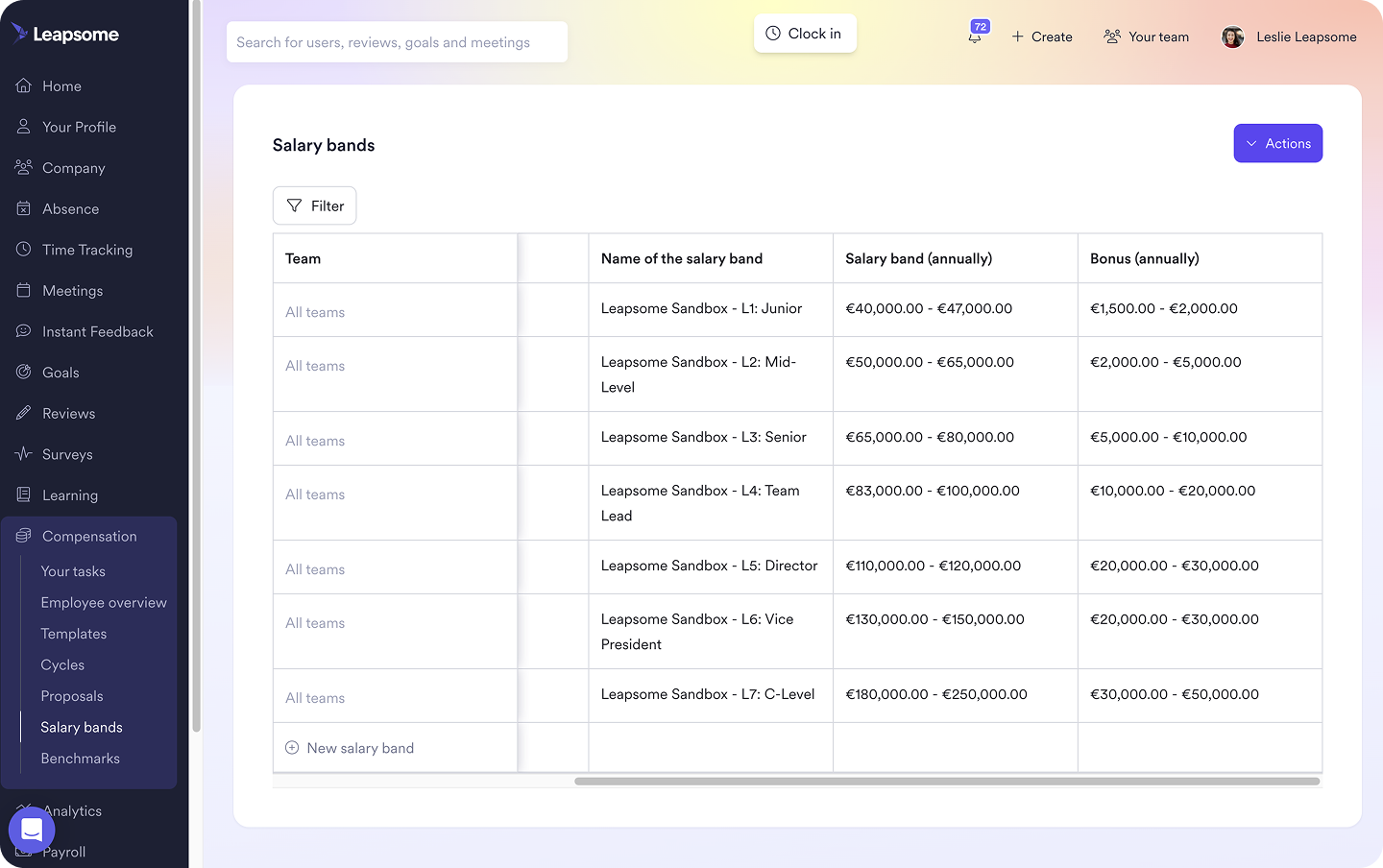
🏗️ Build reliable compensation structures
Leapsome helps HR teams build consistent, benchmarked pay structures, giving leaders a clear way to assess whether capped or uncapped OTE fits their goals.
👉 Explore Compensation Management
What does OTE look like for sales roles?
“Creating pay bands means defining minimums, midpoints, and maximums for each role. It’s not just a number; it’s a system that supports fairness, clarity, and long-term growth.”
– Alexandra Edl, Senior HR Consultant at EDL Consulting
OTE is most common in sales positions, where employees can directly influence revenue or selling targets. These roles include:
- Sales development representatives (SDRs) often use a base-heavy structure, such as a 70/30 split, to reward quality and not just sales quotas. The variable portion is usually tied to meetings booked or qualified leads.
- Account executives often have a more balanced OTE split, such as 50/50. Their variable pay is usually tied to closed deals or revenue generated.
- Sales managers typically earn variable pay based on team quota attainment, rather than individual targets. This kind of sales OTE plan works best when it rewards managers for improving team performance and overall progress.
How to calculate OTE salaries: Three steps
“Seventy-five percent of the company spend is on salaries. If that’s not effectively spent, you’re throwing money away. HR exists to make sure it’s invested wisely.”
– Melanie Naranjo, Chief People Officer at Ethena
OTE calculations look simple on the surface: just add the target variable pay to the employee’s base salary. But when compensation makes up such a large share of company spending (40–70% on average, according to Deloitte), that first calculation is only part of the process.
Your final number also needs to be realistic, fair, and clear enough for employees to trust. Here’s how to make that happen.
1. Establish the base salary
Start with the fixed part of OTE compensation. Use the role’s seniority, market benchmarks, location strategy, and internal pay ranges to set a base salary you can defend in hiring conversations and compensation reviews.
Also, consider how much earning risk the employee carries. If the role has a long sales cycle or limited inbound demand, a stronger base salary may make sense. Otherwise, your OTE can look competitive, while actual earnings feel too uncertain.
2. Define the pay mix and set a quota
Next, decide how much of the OTE should come from base pay and how much will come from variable pay. For example, a 70/30 split means 70% is base salary and 30% is the target variable.
It’s best to weigh base pay more heavily for roles with less control over final revenue, such as SDRs and customer success roles with expansion targets. A 50/50 split is more common for direct sales roles, such as account executives, where employees have more ownership over closed revenue.
You also need to decide whether earnings will be capped or uncapped. A capped structure gives you more budget control, while an uncapped structure can motivate higher performance but requires stronger compensation governance.
3. Calculate and assess the variable component
Once you set the base salary and pay mix, calculate the variable component. For example, if you’ve decided on a 70/30 split and a base pay of $60,000, your calculations would look like this:
- Calculate OTE from base salary: $60,000 = 0.70 x OTE, or OTE ≈ $85,714
- Calculate variable pay by subtracting salary from OTE: $85,714 – $60,000 = $25,714
Then, review the results in line with past achievements and expected impact. A good target should encourage performance without making full OTE feel out of reach.
As WorldatWork reports, overly ambitious targets can lead to employee dissatisfaction and higher turnover. If only a single employee can hit a quota in a normal cycle, you may have a plan problem, not a people problem.
What to consider before implementing an OTE structure
“Too often, managers say, ‘because HR said so.’ That’s not enough. They need to be trained to explain pay decisions with empathy and transparency.”
– Alexandra Edl, Senior HR Consultant at EDL Consulting
To make the most of your planned OTE structure, here’s what to consider before rolling it out:
- Transparency: Employees should know what counts toward variable pay, when they’ll earn it, and what could change the payouts.
- Achievability: According to a McKinsey survey, 72% of employees said goal-setting is a strong performance motivator. This means your OTE quotas can make a significant impact, but only if the target feels possible. Review potential attainment based on specific roles, teams, tenures, and territories to determine what’s realistic.
- Consistency: If two employees have similar roles but different quotas or commission rules, you’ll need a clear reason for that disconnect or you risk losing trust. Using a centralized HR platform that incorporates people analytics will help you back up and document decisions fairly.
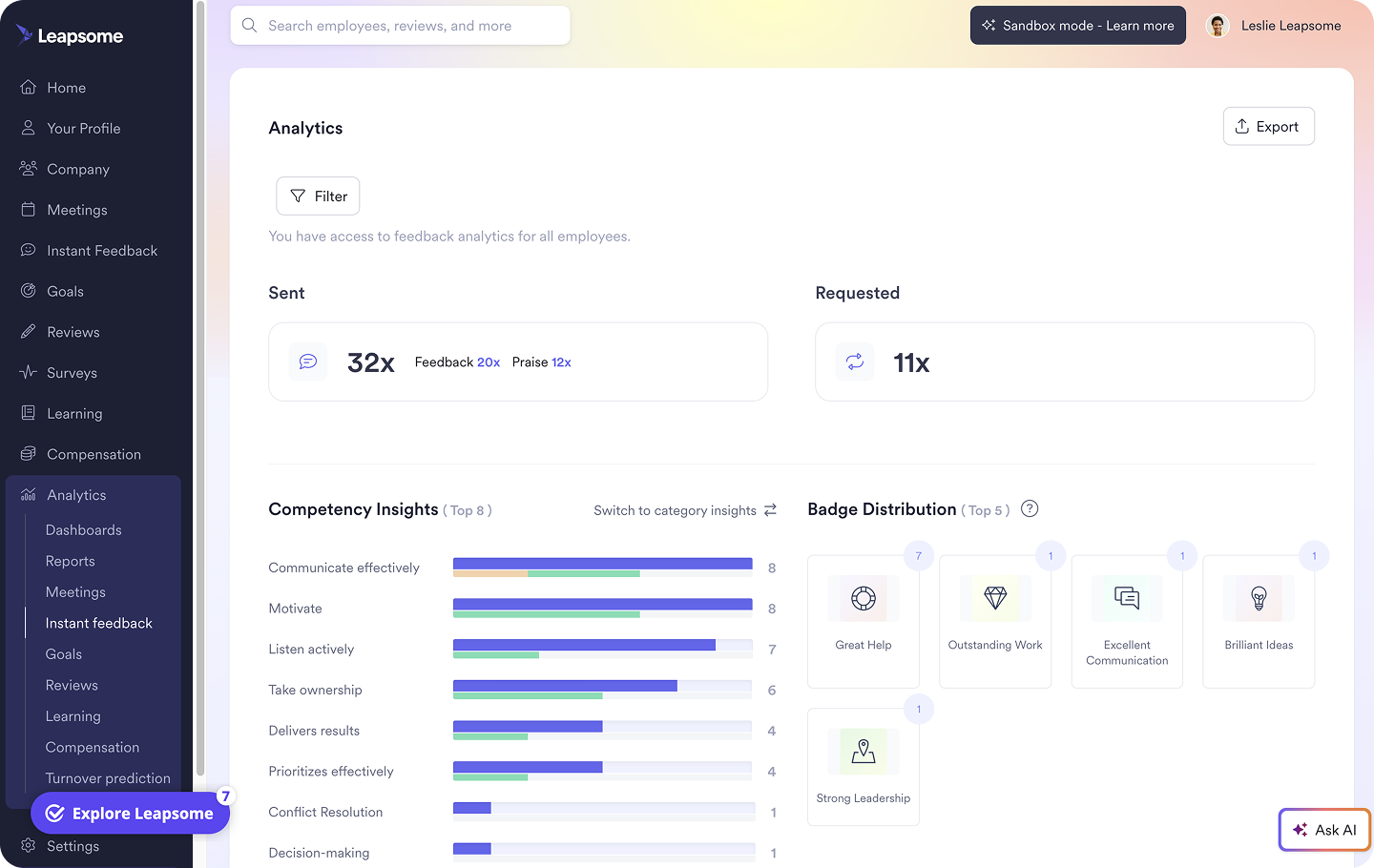
🔍 Spot pay risks before they become retention issues
Leapsome offers clear visibility into performance data and compensation structures, so you can easily assess quota achievability and spot inconsistencies.👉 Explore People Analytics
How to recognize when an OTE plan is losing credibility
“Disengaged employees who stay quietly can drain a company faster than those who leave. Engagement isn’t about who stays; it’s about who contributes with energy and ownership.”
– Emma Leeds, Founder, CEO, and Chief People Consultant at People Function
An OTE plan can drain performance long before someone resigns. Employees may still show up, attend pipeline reviews, and hit the basic requirements of the role. But they stop bringing the same energy once they no longer trust the earning path you’ve provided.
That’s why HR shouldn’t wait for attrition data to confirm there’s a problem. Instead, use these signals to spot the gap between your OTE plan and the employee experience:
- Top performers optimize for payout mechanics: If your reps push easier deals through before the payout deadline, while slower, higher-value opportunities receive less attention, you might have a compensation design problem. While employees are officially following the rules, they’re no longer aligned with business OKRs.
- Forecasting becomes less reliable: When employees aren’t sure how you’ll credit their deals or when commissions will land, they start protecting their payouts. They might leave deals sitting in the pipeline, or move earlier than the customer process supports. Sales usually sees a forecasting problem, but HR leaders can connect this behavior to a poorly designed OTE structure.
- Attrition clusters after the first full payout cycle: If people leave around the 12 to 18-month mark, there might be a gap between your OTE promises during onboarding and the payout realities employees experience. You can use engagement surveys and one-on-one meetings to discover early signs of frustration.
Build OTE plans that drive performance with Leapsome
Small and mid-sized organizations often build OTE plans under pressure. A new sales role opens, a top candidate asks about earning potential, or leadership wants a stronger pay-for-performance model.
The plan HR comes up with may look competitive during the offer stage, but the real test comes after the first payroll cycle. If the data behind your OTE plan sits in different places — performance reviews in one system, goals in another, and compensation benchmarks in yet another — it can be a real struggle to maintain the strategy.
With Leapsome, you can move from reactive compensation management to a more transparent, performance-aligned pay culture. OTE becomes easier to explain at hiring and defend at payout, because decisions are no longer separated from the people data behind them.
Leapsome helps HR teams build OTE structures that hold up over time, through:
- Performance cycles: Use performance review ratings to support fair compensation decisions.
- Goal attainment: Track goals and use progress to guide compensation recommendations.
- Compensation analytics: Use dashboards to review salary distributions, promotion trends, and compensation patterns across teams.
- HRIS data: Keep employee records and approved compensation changes connected with HRIS tools.
“Leapsome did a really great job with performance, OKR, and feedback management — everything in one platform.” - Zhen Wang, People Servicer at Jina AI
🤝 Build OTE plans your people can trust
Leapsome connects compensation, performance, goals, and HRIS data, so you can build an OTE plan that stays clear and encourages sustainable outcomes.
👉 Request a demo






.png)
Sind Sie bereit, Ihre Strategie zur Mitarbeiterförderung zu verbessern?
your People operations?
Informieren Sie sich über unsere Leistungsbeurteilungen, Ziele und OKRs, Engagement-Umfragen, Onboarding und mehr.
.webp)
.webp)
 Fordern Sie noch heute eine Demo an