
Pay transparency: How to create fair, compliant compensation policies


The days where it was a huge taboo to tell your coworkers how much you make are long gone. Regulations, remote workforces, and fierce competition for talent mean companies that don’t prioritize pay transparency risk falling behind.
Moving from a closed pay scale to an open one can be challenging, though. Despite growing regulatory pressure, just half of United States employers say they’re prepared to meet changing pay transparency laws.* Getting it right takes more than knowledge — what you really need is a structured system for handling each step in turn, like standardizing pay ranges for different roles and centralizing compensation data.
This guide explains how to create a pay transparency policy that helps you stay compliant and attract the best talent. You’ll also learn what you have to gain, and find out which states currently have pay transparency laws so you know what you’re up against.
*Mercer, 2026
What’s pay transparency?
Pay transparency is the degree to which an organization is open about its compensation decisions and philosophy. You might also see this referred to as salary transparency, wage transparency, compensation transparency, or payroll transparency.
A fully transparent policy surfaces every last detail of how compensation works at your company, while a partial one reveals some aspects but keeps others hidden. For example, a partial transparency policy might provide complete salary band information for different roles but leave the decision-making process behind closed doors.
Then there’s philosophical pay transparency, which goes beyond sharing information to focus on a company-wide culture of trust where people know what pay decisions are made and why.
“Transparency doesn’t mean sharing every number. It means explaining the logic — how pay decisions are made, what criteria are used, and how people can grow within the structure.”
– Alexandra Edl, Senior HR Consultant at EDL Consulting, for Leapsome
Three benefits of pay transparency your company can’t afford to ignore
Pay transparency touches every part of your organization, from hiring to company culture, and it’s essential when you want to:
- Stand out in cutthroat hiring markets: 58% of employees say they’d rather work for an organization that publicly releases salary information. Disclosing full pay details also helps distinguish your job postings, since providing realistic figures makes the company feel more trustworthy.
- Hold onto your best employees: Employees who feel fairly compensated are 60% more loyal to their employers on average.
- Amplify engagement: When pay practices are equitable, employees are a breathtaking 85% more engaged.
Staying on the right side of the law: What are the current wage transparency laws?
Regulations around pay transparency can be difficult to wrap your head around, especially if your company operates in multiple jurisdictions. We're not lawyers, so confer with your legal team, but to get you started, here’s a breakdown of the most important pay transparency laws in the United States.
If you’re based in the EU or have team members there, you’ll want to get familiar with the EU Pay Transparency Directive. This robust piece of legislation sets strict rules for pay equity and transparency, which are aimed at bridging the gender pay gap.
Taking stock: Is your organization ready for full pay transparency?
Whether or not full transparency is legally required in your company’s jurisdiction, it has deep governance ramifications. Going fully transparent will put your compensation system’s maturity, consistency, and defensibility to the test.
Reflect on the current state of your compensation strategy to find out which maturity level you’re at right now. The higher the level, the more ready you are for a shift to complete transparency.
“Start now, don’t wait for regulation to force you. Building pay equity takes time, alignment, and care. The earlier you begin, the stronger your position will be.”
– Alexandra Edl, Senior HR Consultant at EDL Consulting, for Leapsome
Level one: Reactive compliance
The company makes ad-hoc decisions in response to events like upcoming regulatory deadlines or pay equity complaints. Transparency may be limited to little more than general salary ranges. At this level, there’s a high risk of tension between employers and employees arising from unanswered questions.
Level two: Structured philosophical foundation
By this stage, the organization has a framework governing pay decisions and has shared it with the rest of the team. Salary bands are clear and comprehensive, and managers are obligated to follow them when making compensation choices.
Level three: Integrated governance
Compensation isn’t just structured, but also deeply embedded in the wider HR system. Standardized architectures make defining jobs and levels consistent company-wide, helping managers make decisions by the book instead of improvising.
The link between pay and performance has also been formalized. Performance ratings are based on clear criteria to reduce bias and promote equal pay within roles.
Level four: Full readiness
A company is ready for full transparency when culture and operations join the fray. Leadership is on board with the framework, decisions are always connected to hard data like performance ratings or market benchmarks, and managers have the training they need to approach compensation choices confidently.
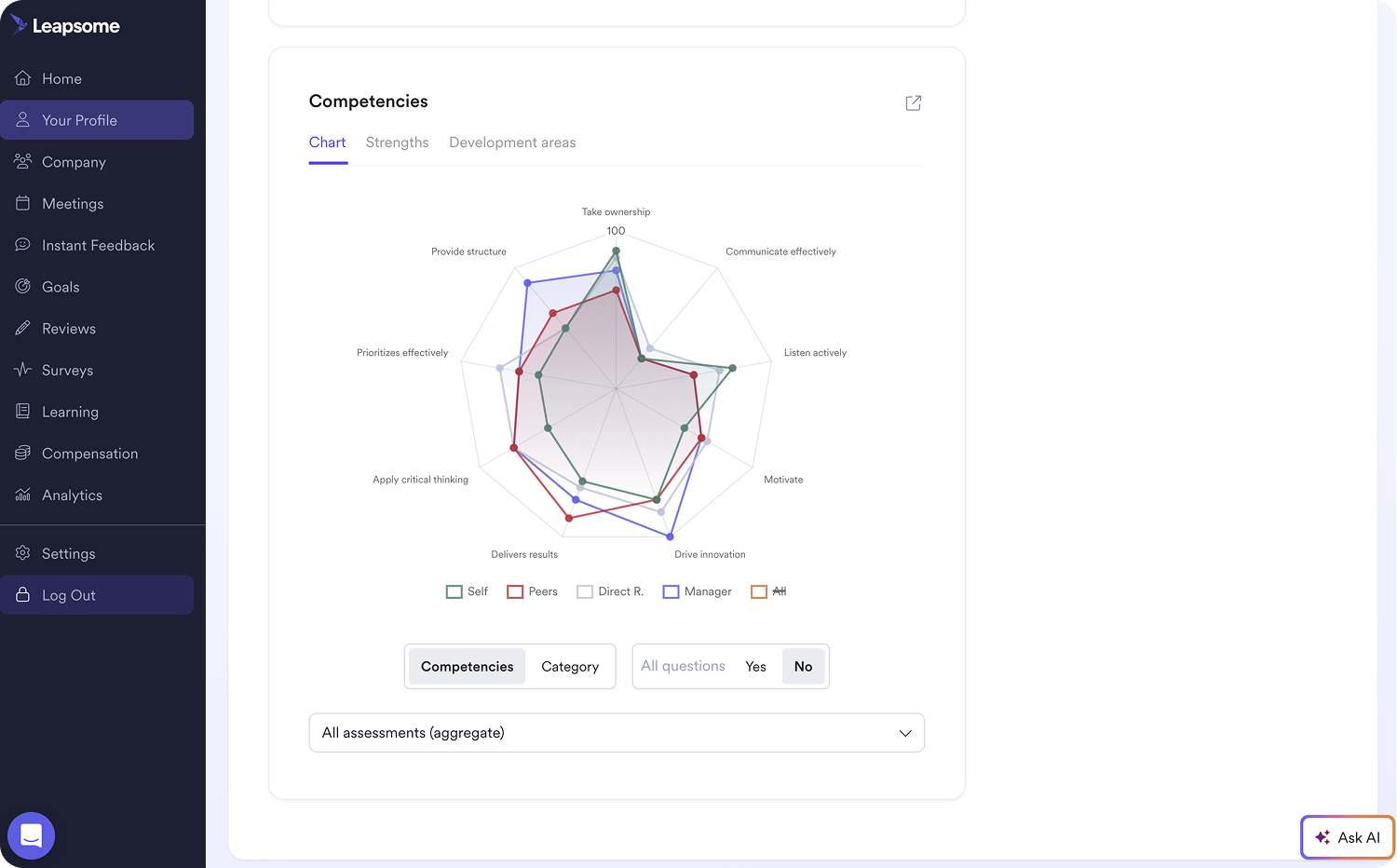
💪 Measure performance for data-backed pay range decisions
Leapsome’s customizable Performance Reviews incorporate historical performance data so you can eliminate hunch-based decisions and treat employees fairly.
👉 Explore Leapsome’s Performance Reviews
Pay transparency playbook: How to pull back the compensation curtain step by step
Transparency isn't something you want to rush, or you might do more harm than good. Take your time to consider the direction you’re after and how you can best communicate and support the change.
1. Get clear on your current compensation policies
To make your policies transparent, you need to know what they actually are (or should be). When people challenge pay and benefits-related decisions, you should be able to answer questions and explain the reasoning behind each policy clearly.
“Prior to implementing pay transparency actions, organizations should ensure that critical prerequisites are in place — which includes a clearly defined compensation philosophy; up-to-date and sound benchmarking of market pay levels; and a robust communications, education, and implementation strategy.”
– Jim Hudner, Managing Director at Pearl Meyer
So gather and analyze data points, like performance ratings and salary ranges, across all roles and levels. Don’t forget to look at any open job postings, as well. Your goal here is to figure out exactly how each role is compensated, then identify gaps or inconsistencies, such as significant spreads in wages for the same position.
If you find any issues, go check out our full guide on compensation reviews. You’ll need a standardized job architecture that defines roles and leveling company-wide, so you can clearly outline and document job titles, tiers, and promotion paths. This also gives you fixed guidelines for setting salary bands and other compensation policies that are fair and consistent.
2. Standardize performance ratings to avoid bias and inconsistency
Compensation should be linked to performance, but this only works when performance is well defined. Otherwise, bias creeps in and employees feel stuck in a system that works for some while giving others a raw deal.
Get together with management to discuss which performance metrics to track and what numbers will affect compensation decisions. Then consider how you’ll evaluate those data points alongside subjective judgements when deciding whether to promote employees or offer pay raises. Remember that you should be able to explain and defend these decisions, so strive for a balance between what’s best for the company and what’s fair to employees.
3. Lay everything out where team members can easily find and reference it
Now that you know what you need to communicate, scroll up and look at the four pay transparency levels again. What level is your company at, and what are you aiming for? Set a realistic goal: If you’re currently at level one, focus on achieving level two first, rather than shooting all the way up to level four with the best of (doomed) intentions.
Then pull your HR and company docs, and list out which pay policies are already transparent and which are outdated, unclear, or not in writing at all. Rather than making small tweaks to an already messy system, though, we recommend starting from scratch and outlining everything team members need to know in a dedicated section of your employee handbook. Include robust procedures for HR and managers, outlining how they should make decisions and answer questions.
4. Iterate and improve, rinse and repeat
Share your new pay transparency documentation, but don’t put it out of mind just yet. It doesn’t matter if you think the policies are clear if employees disagree or managers can’t action them, so immediately ask for feedback.
Are the salary bands well-explained and connected to each role and level? Do the underlying philosophical principles seem sound? Does everything work the way it’s supposed to when put into practice?
Learn from what team members have to say, and keep optimizing your pay transparency practices until the Venn diagram between policies and perceptions is nothing but overlap. After that, set up a regular review cycle. At one point (if you’re not at level four already), it might be time to repeat this process with an eye toward moving further up that pay transparency ladder.
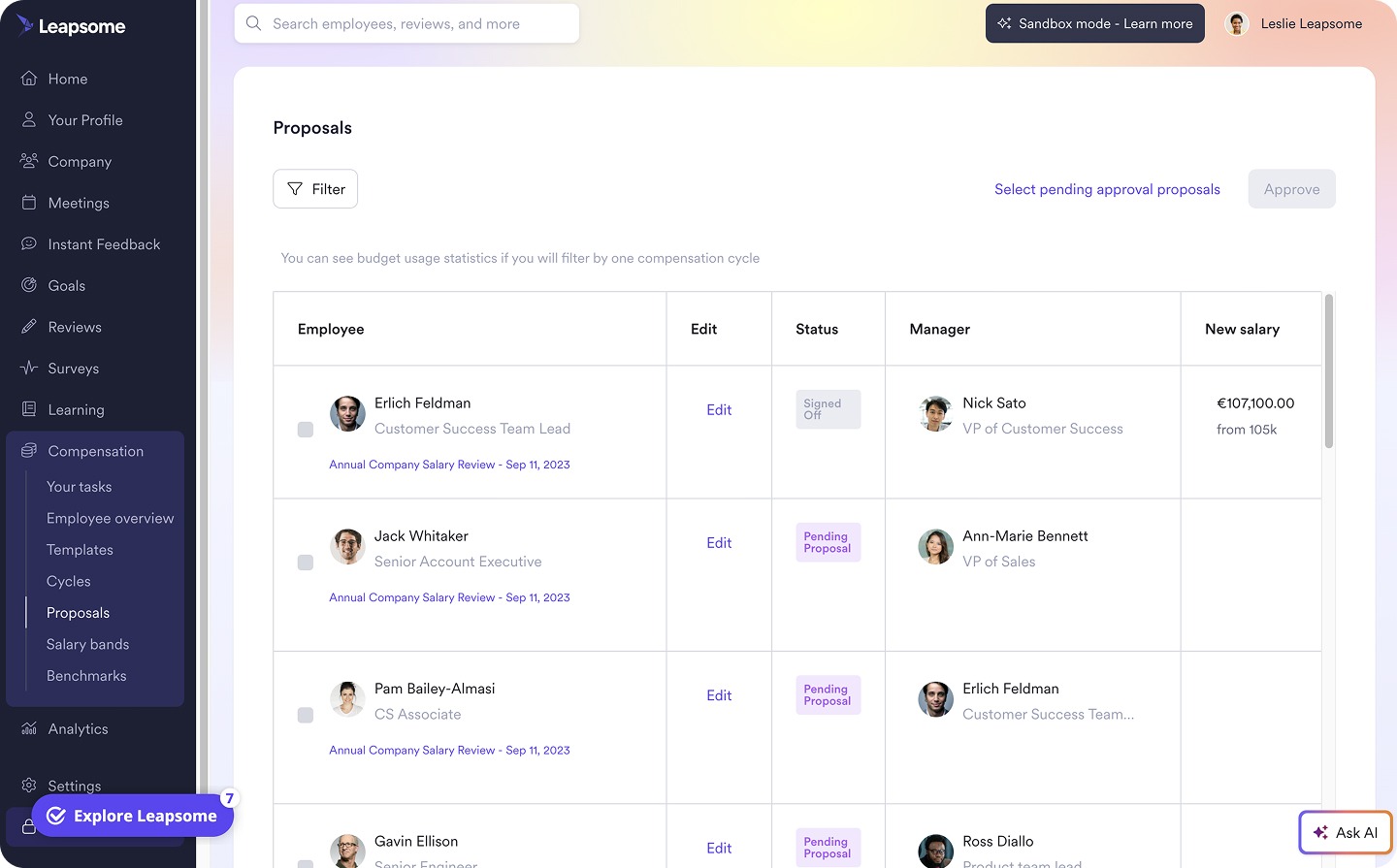
💰 Connect pay to performance and make better decisions
Leapsome helps HR teams painlessly link employee performance, goals, and compensation to make fair, data-driven pay decisions.
👉 Learn more about Leapsome’s Compensation Management
Close pay transparency gaps the easy way with Leapsome
Pay transparency has three basic elements: centralized employee data, historical performance documentation, and performance calibration workflows. If you’re using different tools for each of these functions, you’re putting your company at risk. Fragmented systems lead to error-prone manual exports and documentation gaps, undermining your ability to make fair and consistent compensation decisions.
Leapsome brings everything together, unifying employee data and policy documentation, linking performance reviews with compensation decisions, and automating reporting by level, tenure, and demographic info.
"The amount of time we save as an organization by using Leapsome versus our old methods is probably worth more than the cost of the module.” – Marc-André Lacombe, VP of Engineering, MavTek
🟰 Automate and future-proof your pay transparency efforts
Leapsome puts fragmented compensation systems back together and sets your pay transparency policy on a rock-solid foundation.
👉 Request a demo
FAQ
Do pay transparency laws apply to remote roles?
When it comes to pay transparency, it doesn't matter if someone works in the office or at home — remote and traditional workers have the same rights. However, if your remote employees are in another state or country, make sure you understand the local regulations, since they may differ from the laws where you do business.
What’s the Pay Transparency Act?
The Pay Transparency Act is a New York regulation requiring employers to list the minimum and maximum annual salary, piece rate, or hourly wage for every job posting.


.jpg)
.jpg)
%2520(1).png)

.jpg)