Employee relations: How to build stronger workplace relationships


Employee relations is how an organization manages its relationships with employees. It covers everyday interactions between workers and managers, as well as formal concerns, such as grievances and misconduct.
Many organizations focus on reactive measures when it comes to employee relations. They wait until a concern becomes a complaint, then ask HR to investigate and mediate. Yet only 59% of US workers said they were satisfied with their relationship with their manager. That share has fallen by three percentage points in one year.* HR might know how to resolve conflicts, but that won’t reverse the quality decline of daily working relationships.
Strong employee relations begin before someone has a problem. You need to help managers communicate clearly and give employees credible ways to raise their concerns. This guide explains how to strengthen those employee relationships and address recurring problems at their source.
* Pew Research Center, 2024
What is employee relations in HR?
“The foundation of great management is relationship-building. You can have all the tools, but without connection, communication, and safety, performance will always suffer.”
— Anja Schauer, Global Head of Customer Success | Leapsome
In HR, employee relations (sometimes called ER) means helping employees and managers work together fairly, and be respectful in disagreement. It includes creating the right conditions for healthy working relationships and stepping in when those relationships begin to break down.
While HR is in charge of the full employee lifecycle from hiring through exit, employee relations jobs focus on what happens between people at work. The terms often appear interchangeably, and they overlap. For example, HR may create the performance review process, while employee relations experts ensure managers use it fairly and employees can challenge a decision without fear.
However, organizations often weaken employee relations because they reduce it to case management. Proactive employee relationship management, where HR doesn’t wait for problems to appear or escalate, builds trust and helps employees stay engaged. It also gives people fewer reasons to leave, boosting retention.
What are some examples of employee relations?
Employee relations come into play whenever an organizational decision affects how employees feel treated. These examples show how the work can prevent problems and resolve them when they arise:
- Acting on employee feedback: If an employee survey shows that employees in one team feel unable to discuss their workload, HR helps the manager understand the pattern and make a visible change. This shows employees that speaking up leads to action, not retribution.
- Supporting employees through workplace change: When a restructure changes several roles and creates uncertainty, HR helps leaders explain what the change means and give employees a safe space to raise concerns.
- Handling grievances or misconduct: If an employee reports harassment or another serious concern, HR provides a reliable reporting route and investigates the complaint fairly.
What are the key strategies organizations can implement to build good employee relations?
Instead of waiting for a conflict to reach HR, help managers surface concerns earlier and respond consistently.
Create predictable two-way communication
“Stop treating listening like a one-off. Create a reliable cadence that blends sentiment and demographics, so leaders get clarity on where to focus and managers can act with confidence.”
— Craig Forman, Founder & Principal Consultant | CultureC Consulting
When Gallup asked what employees thought would help them feel cared about at work, 34% of respondents identified better communication and respect. If you want to improve employee relations and boost morale, give employees opportunities to raise questions and discuss concerns with their manager. At the same time, managers need to maintain regular 1:1s to identify issues before tension escalates. With centralized platforms like Leapsome, managers can choose a 1:1 template or create their own agendas, so every meeting has a clear purpose.
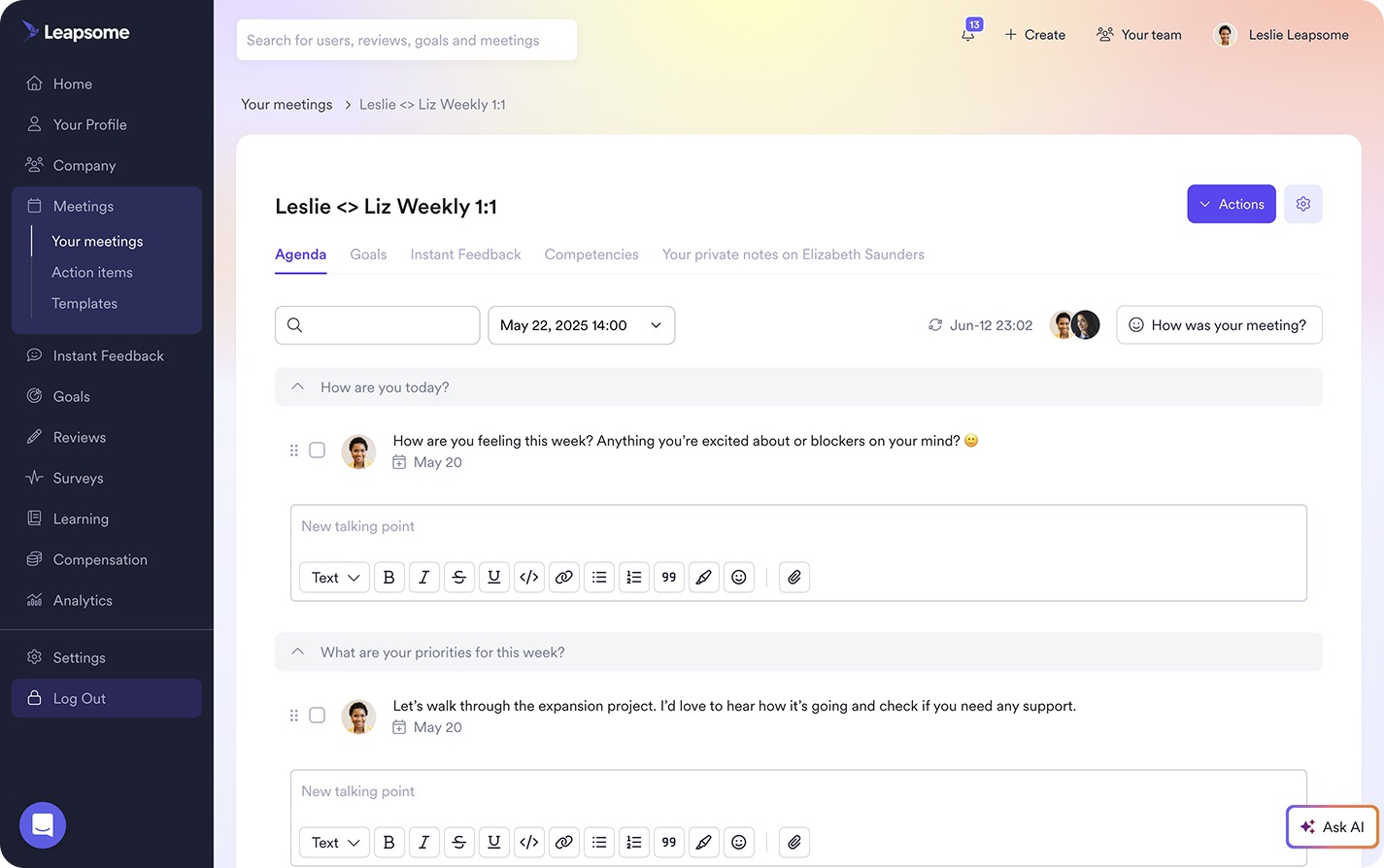
💬 Keep communication lines open
Leapsome helps managers structure regular 1:1s and track agreed next steps, so concerns don’t disappear between meetings.
👉 Explore 1:1s & Team Meetings
Make expectations clear and decisions consistent
“Individuals can’t muscle a 500-person org through chaos. Build the systems so good responses are easy, natural, and repeatable, especially when stress is high.” — Craig Forman, Founder & Principal Consultant | CultureC Consulting
Employees expect leaders to treat them fairly. If one manager approves a flexible work arrangement while another rejects a similar request, employees may question how the organization makes decisions. That inconsistency can also affect how people work. Gartner found that employee performance was 26% higher in an environment with a high degree of perceived fairness, yet only 18% of employees worked in one.
Make it clear where managers can use discretion and what should guide their judgment. You should also implement regular pulse checks to review compliance across teams and catch patterns that managers might have missed.
Develop managers before a difficult case tests them
“An ineffective manager doesn’t take time to understand their people or build trust. The best ones care deeply. They know where you want to grow, challenge you when needed and make space for honest feedback.”
— Luck Dookchitra, VP People & Culture | Leapsome
Gallup found that managers account for 70% of the variance in team-level employee engagement, so training them to handle difficult conversations and resolve workplace conflicts sets teams up for success. Instead of avoiding issues until they escalate, managers need to listen without becoming defensive and give timely feedback. At the same time, they need to recognize when a conflict resolution requires HR support.
Why recurring employee relations issues often point to deeper organizational problems
A single complaint can reflect an isolated incident, but repeated grievances usually point to problems in the organization around them. Here are a few reasons why issues keep happening in an organization:
- Expectations are unclear: If several employees dispute performance decisions, the problem might lie with the goals rather than the workers. Check whether managers set clear expectations and gave employees useful feedback before the review.
- Management practices vary too much: Several complaints from one team may point to a manager capability problem. Look at how that manager communicates and compare the team’s survey results with those from the wider organization. Repeated tension under the same manager should trigger support or disciplinary actions.
- Employees don’t trust the available channels: If concerns appear in exit interviews but never surface earlier, employees may lack a reliable opportunity to speak up or doubt that sharing will change anything. If there is useful feedback, but it sits apart from wider people data, HR might miss the underlying pattern.
Centralized HRIS platforms like Leapsome connect engagement surveys with people data, helping you identify team-level risks earlier and show employees that their feedback leads to action.
“We build trust from day one with live 30-, 60-, and 90-day check-ins where employees speak openly with HR — and even with the CEO at the one-year mark. When people see action after those talks, they start to trust that feedback truly leads to change.”
— Janelle Doharty, Head of People & Culture, Notion Health
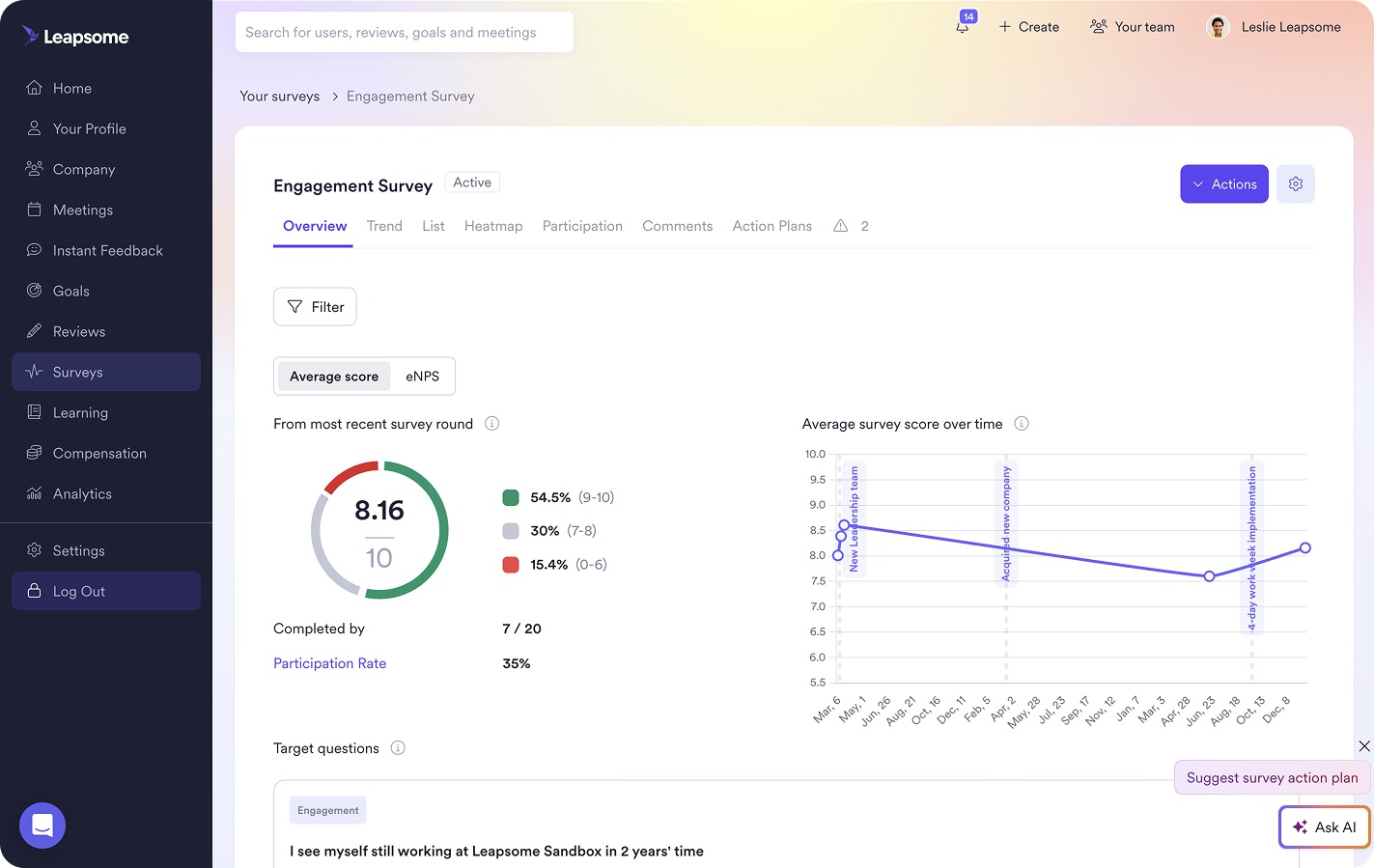
🕵️ Spot patterns earlier
Leapsome’s Engagement Surveys help you track sentiment patterns and recurring concerns, so you can act before they develop into formal employee relations cases.
👉 Explore Engagement Surveys
How Leapsome helps HR teams strengthen employee relations
A lean HR team can’t oversee every 1:1 meeting to ensure strong employee relations, but it can create the conditions for a healthy work environment and step in when other signals suggest policy implementation is going wrong.
The challenge is that employee concerns rarely appear in one place. An engagement survey may show a drop in trust, a 1:1 may reveal workload issues, and absence patterns may change before an employee files a complaint. If all those signals live in different tools, a systemic problem can look like an isolated case.
As an AI-powered people platform, Leapsome connects HRIS with performance management. With Leapsome, teams can :
- Track sentiment over time: Use the Employee Survey Tool to reveal recurring themes across teams.
- Make meetings efficient: Give managers a consistent structure for conversations and keep agreed action steps visible with Leapsome Meetings.
- Foster feedback and recognition: Let employees share Instant Feedback when an issue occurs instead of waiting for a formal review cycle.
- Standardize performance reviews: Bring goals and previous feedback into each review with Performance Review Software so managers make fair evaluations based on evidence.
- Enable anonymous conversations: Give employees an anonymous channel with a Whistleblowing Add-On for sensitive concerns.
“With Leapsome, we’ve seen some amazing improvements. The initiatives we identified from the survey results decreased our turnover by 12,2%, increased our survey participation rate to 82%, and it made people more productive and excited to come to the office. Listening and transparency is a part of our culture, and Leapsome is a tool that gives our people a voice.” — Natasa Kovacevic, Senior Change & Transformation Partner | Eurowings Digital
🌱 Build stronger employee relationships and teams
Leapsome gives you a clearer view of the employee experience, so you can support managers earlier and respond to concerns with better context.
👉 Request a demo
FAQ
What is the difference between employee relations and labor relations?
Employee relations covers the everyday relationship between an organization and its employees, whether the workforce is unionized or not. Labor relations focuses on the formal relationship between employers and unions. Common labor relations examples include collective bargaining and resolving union grievances. The two areas overlap when an employee relations issue involves rights covered by a collective bargaining agreement.






.jpg)