What a PEO really costs, and how it affects your business’ scaling


If your HR department struggles to keep up, you’re not alone. Many companies need more HR support than their internal teams and systems can manage. Outsourcing is a common choice in this scenario; according to NAPEO, 14% of employers with 20 to 499 employees adopt professional employer organization (PEO) services to cover the gaps. (1)
That support comes with a price tag, and as headcount grows, PEO costs can rise quickly and affect how much control you have over people data and long-term strategy. Luckily, there are plenty of other options. For instance, McKinsey estimates that two-thirds of HR tasks can be automated. (2)
So the pressing question isn’t whether a PEO can handle HR admin for you. It’s whether you should keep paying for outsourced execution as you grow, or build internal systems that give you more control over data, performance, and planning.
This guide dives into that scaling and ownership tradeoff. We’ll explain how PEO pricing works, which hidden costs to watch out for, and how to decide whether this model fits your next stage of growth.
1. NAPEO, Industry Overview
2. McKinsey, 2025
How PEO pricing works
A PEO helps companies manage HR administration and payroll processing. In this co-employment model, the PEO acts as the employer of record for tax and compliance purposes, while the client manages day-to-day work.
PEO pricing varies widely and depends on factors like your company’s size, payroll needs, benefits, and workers’ comp risk. Here are a few common models:
- Percentage-based pricing: The PEO charges a percentage of total payroll. This pricing might look affordable for startups, but it can become expensive down the line. For example, a company with a highly compensated workforce may lose more for payroll processing, even if its HR needs stay relatively modest.
- Flat per-employee pricing: In this model, the PEO charges a flat fee for each employee. This option is nice and straightforward, but your company will pay the same fee for employees who need very different levels of HR support.
- Hybrid pricing: Many PEO providers combine flat admin fees with some mixture of payroll-based charges, benefits costs, implementation fees, and service add-ons.
How much a PEO might cost your company
In practice, PEO costs often break down like this:
- Admin fees: $65 to $200 per employee per month (PEPM), or 1% to 6% of total payroll.
- Benefits expenses: $200 to $800 PEPM.
- Workers’ comp costs: 0.5 to 15% of payroll.
Rates are usually lower the larger your headcount grows, but heftier for high-risk industries like healthcare and manufacturing.
The impact of hiring a PEO, beyond upfront pricing
The above figures are a good starting point, but to understand the full cost of using a PEO, you have to look deeper. This model introduces tradeoffs, like rising fees and reduced control over people systems, that you'll need to consider.
EY found that companies have an average payroll error rate around 20%, with each error costing about $290 to correct. PEOs help reduce those mistakes, while also supporting compliance across locations. For small businesses in particular, PEOs can be worth the expense when the alternative is legal risk or overloading a small HR team.
But as your company scales, the downsides become more prominent. PEO outsourcing can reduce ownership over workflows, reporting, employee data, and people processes. You’ll also need separate tools for tasks like performance reviews and workforce planning.
When that happens, the PEO no longer operates as your full HR backbone. Instead, it becomes one part of a larger, often fragmented system.
So once you’re out of the early growth stages, you usually need a deeper cost review to decide whether a PEO makes financial sense. Alternately, you may find that internal HR systems and targeted providers could support people operations more effectively.
“We wanted to build an HR tool that grows with you, scales with you, and becomes your strategic partner every time you’re growing your organization.”
– Suraj Paneru, Customer Success Coach at Leapsome
🤝 Better systems, a better outcome
Whether you choose to use a PEO or not, having the right HRIS and people management software in place first makes scaling your team easier.
👉 Learn more
Ask yourself these questions when deciding whether PEO support is worthwhile:
- How do the costs scale with headcount?
- What’s the PEO’s role in payroll handling, and where does our team still need to step in?
- What does PEO insurance do for us, in terms of benefits access or talent acquisition?
- Where do we still rely on workarounds or extra tools?
- What capabilities will we need next?
Remember that the choice isn’t simply: PEO or no PEO? What matters is having an operating model that gives your team the right balance of control and scalability. You may find that a PEO is useful to process HR execution in the background, while an HRIS platform like Leapsome helps you define priorities, align employees around measurable outcomes, and track progress as your company grows.
Here’s how approaches based primarily around PEOs, HRIS platforms, and in-house HR operations compare.
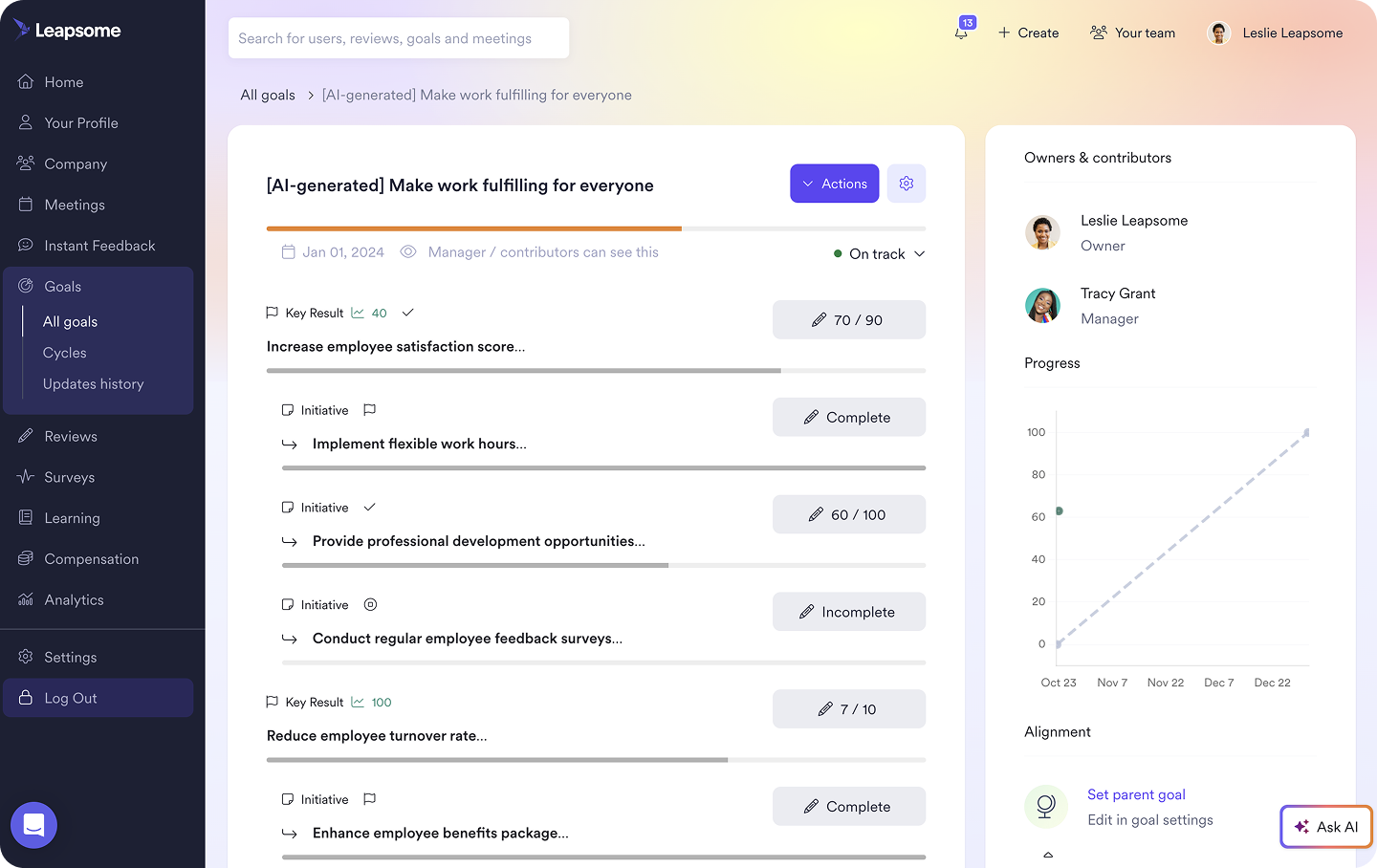
📐 Align growing teams around performance goals
Leapsome lets you move beyond basic HR setup, by giving your teams clear priorities, visible ownership, and a shared way to track progress toward business outcomes.
👉 Learn more
PEO decision-making framework for HR leaders: Five steps
Choosing whether to work with a PEO company is a stage-specific decision. The right setup depends on your company size, growth pace, internal HR capacity, and desired level of control. Use this framework to assess whether a PEO fits your scaling needs.
1. Identify your main HR pressure point
A PEO usually fits best when the main constraint is administration. If your challenges have shifted toward data ownership and strategic people management, you may need a stronger internal system like Leapsome.
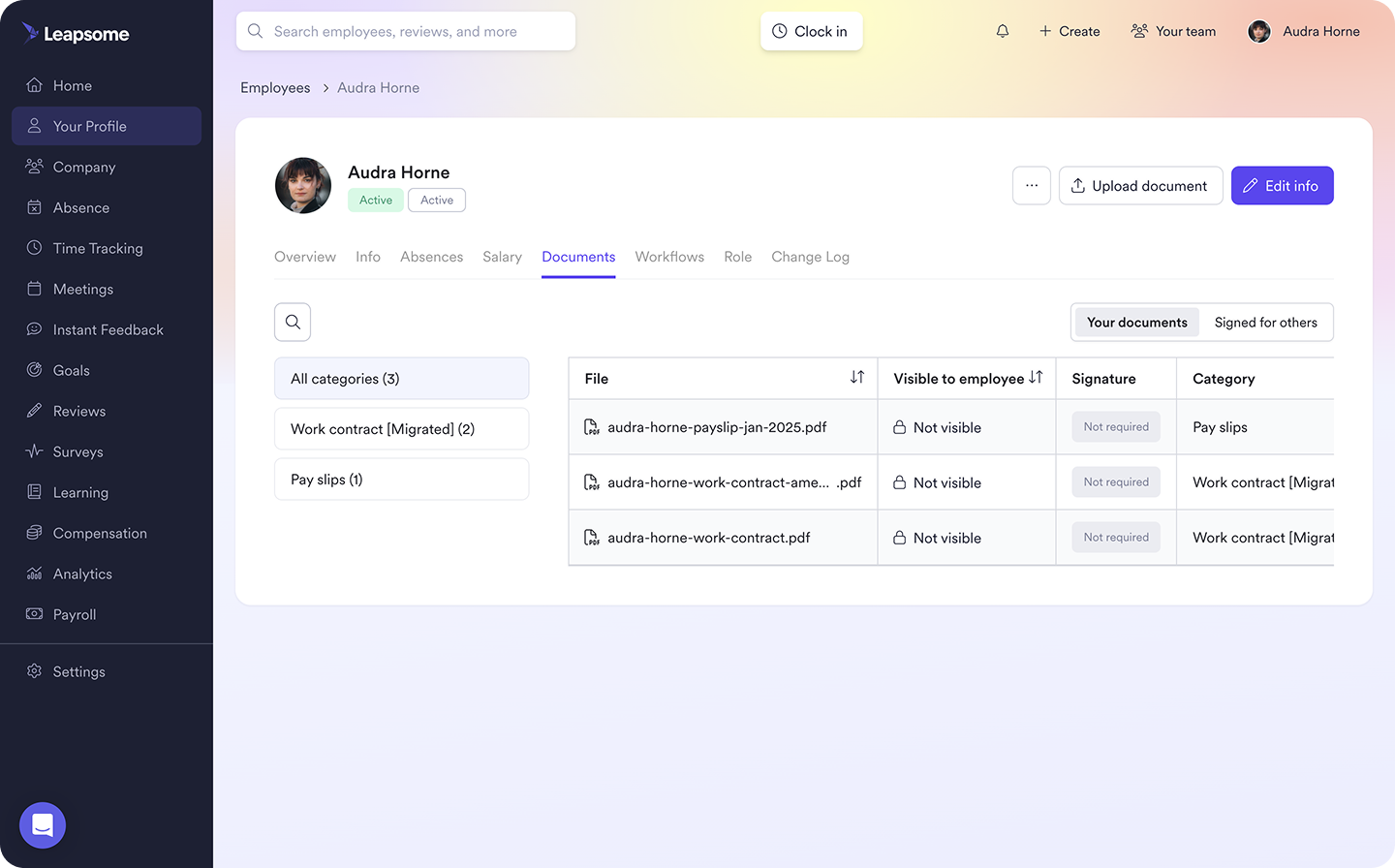
🎯 Centralize your employee data
Leapsome’s Employee Records brings all employee data into centralized, structured profiles, reducing manual work and maintaining clearer ownership over HR operations.
👉 Explore Employee Records
2. Estimate how your costs will scale
Evaluate your PEO costs at your expected headcount over the next 12, 24, and 36 months. A percentage-based model becomes expensive when payroll grows quickly, and flat fee models add up once hiring accelerates. Compare those expenses with the costs of an HRIS, internal HR hires, payroll software, and compliance support.
3. Map out what your PEO doesn't help with
“Start from the employee lifecycle — map the moments that matter and assess tooling for each one. If your systems can’t integrate, go all-in-one; if they can, just make sure it’s seamless.”
– Lee Bage, Global VP of Operations at Valtech
If you’re planning to outsource to a PEO, look at what your team will still have to manage, such as separate performance tools or compensation planning. If HR needs to keep adding processes and expenses to fill gaps, the PEO may no longer support your full operating model.
4. Assess your next-stage needs
Consider what your company will need as it grows. That may include stronger manager enablement, clearer performance cycles, and better employee feedback. If those needs sit outside the PEO’s features, you may require a more flexible people system.
5. Decide based on fit, not convenience
A provider may handle payroll and employee benefits well, but that doesn’t mean it should shape your entire HR operating model. The right decision may be to use a PEO only, negotiate pricing, add an HRIS, or gradually move more HR capabilities in-house. What matters is to align your decisions with long-term goals and projections, instead of focusing on how to solve immediate problems.
Leapsome: Centralized HR support for scaling organizations
PEOs can be beneficial in the early stages of growth, helping companies simplify payroll and HR admin when internal capacity is limited. But over time, the same cost structure and operating model often starts to feel restrictive.
At that point, switching PEO providers won’t add more internal HR capability and clearer ownership over systems. Instead, you’ll need to replace or supplement the PEO with a solution that goes beyond basic admin.
As an all-in-one people enablement platform, Leapsome helps teams:
- Centralize employee data
- Run structured performance reviews
- Support learning and development
- Connect goals to business priorities
Leapsome gives your HR team more ownership over the systems that shape the employee experience, manager effectiveness, and long-term company-wide strategies, while the PEO handles admin execution in the background.
“I would recommend Leapsome without hesitation. It’s been cost-effective, covers everything from performance reviews to surveys, and is backed by a team that truly supports us.” – Steve Hoffman, Chief People Officer at Mark43
🎖️Support for scaling HR departments
Let your PEO handle admin, while Leapsome supports your team with employee development and long-term planning.
👉 Request a demo






.jpg)