How to manage imputed income and explain its nuances to employees

.png)
Disclaimer: This content is for general informational purposes only and does not constitute legal advice. Leapsome does not guarantee legal compliance and cannot confirm how specific situations would be assessed in court. If you're unsure how the requirements apply to your organization, please consult qualified legal counsel.
More than one in three employees report struggling to understand what their employers tell them about benefits plans, according to MetLife.* And that level of confusion includes the relatively simple parts, such as dental and health insurance.
The communication breakdown is even more pronounced when it comes to tricky areas like imputed income. This term refers to perks and benefits, such as sports tickets or gym memberships, that are treated as taxable income by the IRS, even though they’re not paid out in cash.
HR teams must understand imputed income to run payroll and administer benefits accurately and compliantly. And they have to impart that understanding to employees to prevent misunderstandings and mistrust. This guide covers how imputed income works, and how to communicate the tax implications to your teams.
* MetLife, 2025
What’s imputed income?
Imputed income, also called imputed pay or imputed earnings, is a payroll term that describes certain non-cash employee benefits the IRS considers taxable income. Per the IRS guidelines: “Any fringe benefit you provide is taxable and must be included in the recipient's pay unless the law specifically excludes it.”
The IRS counts certain non-cash benefits, such as snacks or small gifts, as tax-free if they’re minor enough that accounting for them would be “unreasonable or administratively impracticable.” These are called de minimis benefits. There’s also an exclusion list that exempts some perks, like retirement planning services and term life insurance coverage, under certain circumstances or within specific limits.
If a benefit doesn’t meet the exclusion requirements or qualify as de minimis, it goes on the employee’s W-2 as taxable wages. Examples include:
- Use of a company car
- Moving expense reimbursements
- Domestic partner health insurance
- Off-premise gym memberships
- Non-business-related travel
What are the tax implications of imputed income?
To determine how much imputed income tax a benefit represents, employers use fair market value. The IRS defines fair market value as the amount an employee would have to pay for the benefit in a deal with a disinterested third party.
Once you’ve determined a benefit’s fair market value, you’ll withhold relevant Social Security, Medicare, and/or federal income taxes from employee paychecks. You can withhold federal income tax at the normal rate or at the flat 22% supplemental wage rate. At the state and local levels, jurisdictions may have their own rules about imputed income taxation.
The communication challenge imputed income presents
Calculating imputed income isn’t the hard part; what’s difficult is preparing employees for those numbers showing up on their paychecks. The question to ask yourself is: ‘If an employee noticed a higher taxable wage tomorrow, would they immediately understand why?’ If the answer is ‘no,’ it’s your job to change that.
Here’s how to inform your workforce about imputed income:
- Nip questions in the bud with employee education: No one likes to see payday finally come around, only to find out they’re receiving less than they expected. Proactively educating employees on the way imputed income works and how to interpret it on their paychecks keeps confusion and mistrust from arising in the first place.
- Follow a consistent messaging approach: If your organization is large, it might have three different teams covering HR, payroll, and benefits. If messaging about a taxable benefit doesn’t match up between departments, employees can quickly become overwhelmed and confused. To prevent this issue, align with other department leaders before sending anything out company-wide.
- Leverage clean data for proactive outreach: Accurate employee and benefits data helps HR catch events that trigger imputed income taxation, before they become trust-shattering surprises on an employee’s paycheck. For example, if all the details are in order, you can spot when group term life insurance is approaching the $50,000 exemption threshold and let employees know accordingly.
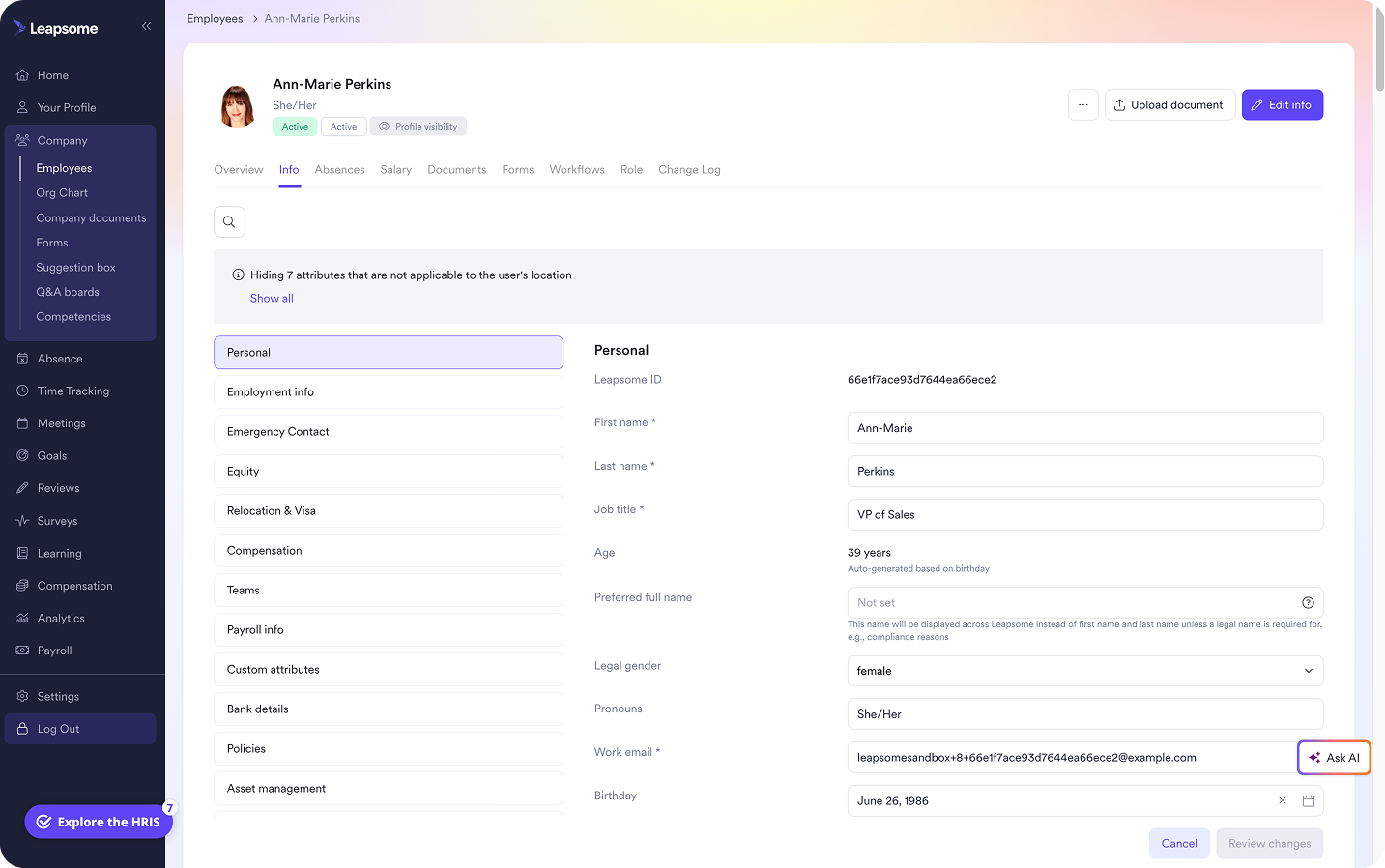
To keep your data pristine and up to date at all times, you can store it in a centralized HRIS and people management platform like Leapsome.
"Many HR teams still struggle with the basics — too many disconnected tools, limited insights. That's why we built a truly people-first HRIS that unifies all employee data into one source of truth."
– Suraj Paneru, Customer Success Coach at Leapsome
💸 Don’t agonize — centralize
Keep all your employee records and benefits documentation in one secure, connected location, and stop piecing together missing data from piecemeal sources
👉 Explore Employee Records
How to manage imputed income like a pro: Three best practices
Managing imputed income well requires ongoing collaboration between HR, payroll, and finance teams. These best practices keep everyone aligned.
1. Create a system for identifying taxable benefits
As SHRM explains, failing to manage fringe benefits accurately can hurt employee trust, result in extra internal audits, and lead to tax penalties. This means it’s crucial to develop a standardized process for catching benefits that might be subject to imputed income taxation. Collaborate with other stakeholders to decide how and when to review benefits, so you spot taxable events before they hit employees’ paychecks.
2. Keep employee and payroll records accurate
Maintaining current, complete employee and payroll records is the only way to make sure the imputed income calculations that rely on this information check out. You can take advantage of dedicated HRIS software to centralize everything, while simplifying both reporting and payroll processing.
3. Set a regular cadence for reporting audits
Tax laws and employee benefits usage fluctuate, and you need to stay on top of everything to avoid errors and compliance risks. So not only should you review data, you’ll need to periodically revisit your reporting methods and infrastructure to keep them airtight.
When you combine regular reviews with Leapsome’s HR software, you support easier, more accurate payroll prep and workforce reporting.
“We even flag compliance risks — for example, if a country requires a minimum of 20 paid days off, the platform won’t let you go below that."
– Suraj Paneru, Customer Success Coach at Leapsome
💪 Take control of your payroll
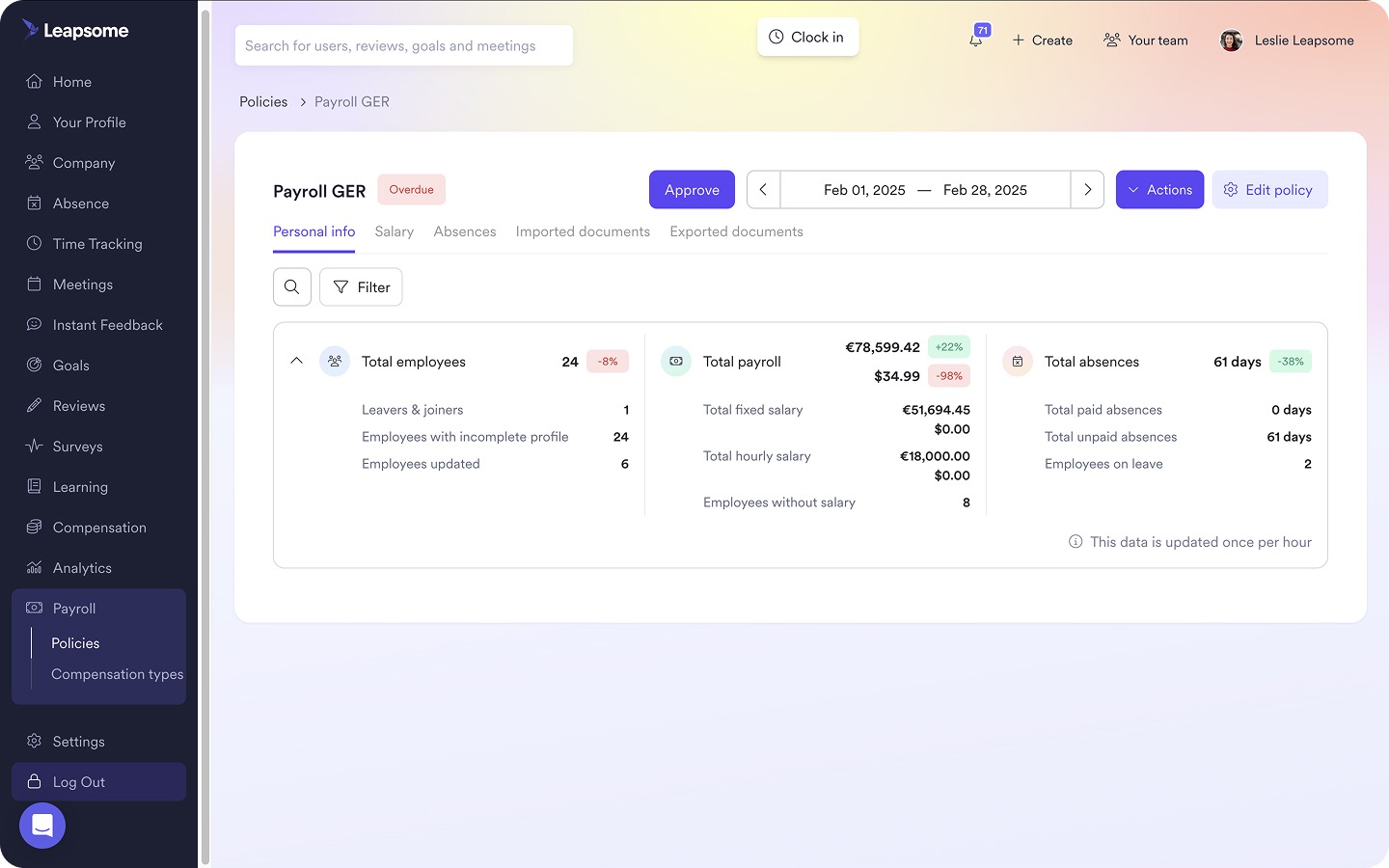
Leapsome plugs centralized employee data directly into payroll runs, complete with configurable rules you can apply consistently across every jurisdiction you do business in.
👉 Learn about Payroll Preparation
Run payroll right every time with Leapsome
It's tricky enough just managing the tax implications of imputed income. Add in employee records, benefits information, and payroll data scattered across disconnected systems, and you have a recipe for chaos. The resulting payroll reporting mistakes expose your organization to compliance risks, while inconsistent communication compromises employee trust.
But with Leapsome's AI-powered HRIS and people management platform, your HR team can:
- Centralize employee records: Store critical details in one source of truth, and keep everything in sync.
- Ease payroll prep: Connect employee records with time tracking and absence data that flow directly to your payroll provider.
- Improve workforce reporting: Pull across-the-board data into real-time dashboards, and create custom reports complete with AI-generated insights.
- Strengthen compliance: Use role-based access controls to safeguard payroll and benefits data, and get automatic notifications when compliance risks show up.
“We couldn’t have delivered our new performance model without Leapsome — the platform gave us the tools and support we needed to do it right.” – Garrett Kowalski, Senior Manager of Organizational Development at DrFirst
🤝 Get an HR solution that works with you
See how Leapsome centralizes employee records, automates the toughest parts of payroll prep, and flags compliance risks before they wreak havoc.
👉 Request a demo
FAQ
Is imputed income taxable?
Yes, imputed income is taxable. This income represents certain benefits that aren't paid in cash and it’s added to an employee’s gross wages, making it subject to payroll taxes.
Is imputed income deducted from paychecks?
Imputed income isn’t deducted from employees’ paychecks. Instead, this income is added to taxable wages, lowering take-home pay.
Is imputed income good or bad?
Imputed income taxation isn’t inherently good or bad, although it might seem like a downside for employees because it affects take-home pay. However, employees get valuable benefits in exchange, often at significantly reduced costs.

.png)