HR compliance: key laws, risk areas, and practical steps for HR teams
.png)

HR compliance ensures that your organization adheres to employment laws, labor regulations, and internal policies when managers approve pay, handle complaints, or process leave requests.
Get this right, and you avoid costly fines, legal disputes, and the reputational damage that comes with mishandling employee issues.
However, doing this effectively is becoming increasingly difficult. New technologies like AI tools bring additional transparency and consent requirements. Additionally, distributed teams and operations require tracking different rules for each location.
These expanding obligations likely contribute to increased workloads, with half of HR professionals reporting being more overwhelmed than a year ago.*
To help you stay compliant without burning out, this guide explains what HR compliance means in practice, which legal areas carry the most risk, where mistakes typically happen, and how to build focused action frameworks.
You’ll also learn how centralized systems and automated HR processes can help protect your people and reduce your manual compliance work.
🏢 Centralize compliance in one platform
Stop chasing scattered data across systems. Leapsome's HRIS brings employee records, workflows, and audit trails into one place.
👉 Explore Leapsome HRIS
HR compliance: how to define it and where HR carries the most risk
HR compliance is the ongoing work of ensuring your organization and its people follow employment laws, labor regulations, and internal workplace policies in everyday decisions.
Since changing regulations necessitate constant review, this is a continuous program where you coordinate with legal, finance, and IT to translate complex statutory requirements into practice. This helps you ensure:
- Documented processes everyone can follow
- Clear approval workflows for key decisions
- Consistent practices across the employee lifecycle
- Audit trails that show what happened and when
One of the key challenges you face is that regulatory compliance has become significantly more complex. According to PwC's 2025 study, 85% of organizations report that compliance requirements have grown more complicated over the past three years.
For HR teams, this means staying current with evolving rules while managing hiring, pay, benefits, performance, terminations, and data across multiple locations and worker types. You're expected to be an expert on multiple topics, from overtime calculations to data privacy rights.
Technology can help you manage this complexity. An HRIS platform helps you move from static policies to monitored, documented processes. Instead of relying on spreadsheets, email threads, and memory, platforms like Leapsome centralize employee data, automate approval workflows, and create audit trails.
This makes it easier to see whether your workplace policies are actually being followed and where gaps might expose you to risk.
How HR compliance links legal obligations, policies, and everyday decisions
Compliance gaps appear when people struggle to follow your stated policies as they make and implement decisions.
For example, imagine a regulation requires overtime pay for hours over 40 per week, so your company writes a clear policy explaining the rules. Then a manager approves a timesheet without checking the hours, or forgets entirely, or doesn't realize the rule applies to this employee.
In this case, compliance has broken down because of a disconnect between what's written in your policy and what actually happens when someone makes a hiring decision, approves a pay change, schedules a shift, or handles a complaint.
Your job is to close that gap by connecting core HR processes to the legal obligations behind them. This means:
- Making sure policies are accessible when people need them
- Building approval steps into the actual workflow, not as an afterthought
- Training managers on the decisions they're responsible for
- Tracking whether required steps actually happen
For example, our HRIS connects policies and guidelines to processes like onboarding, performance reviews, and compensation approvals. This gives you visibility into whether expectations are being followed in practice, not just documented in theory.
When your compliance program lives inside your actual workflows rather than sitting in a separate system, it's much harder for critical steps to get skipped.
Why growth, distributed work, and new tech make HR compliance more fragile
Every time you add headcount, open a new office, or adopt a new tool, you're adding compliance complexity. Each new state or country brings different requirements for minimum wage, overtime rules, data privacy, mandatory leave, and health and safety standards.
And you're expected to keep pace without extra headcount. Our research found that a third of HR professionals report rising personal workloads, while half say they feel more overwhelmed each year.
Remote and hybrid work can add to this burden if you have employees living in different regions, each with different rules on breaks, sick leave, and data privacy. Meanwhile, you're implementing new AI tools for recruiting or performance monitoring, each with its own consent, transparency, and fairness obligations.
Here's what makes this risky:
- Multi-locale operations mean tracking different pay, leave, and safety rules per location
- New monitoring or AI tools trigger data privacy and algorithmic transparency requirements
- Distributed teams make it harder to ensure consistent policy application
- Growth outpaces your ability to manually track and enforce compliance
An integrated HR system helps you address these challenges with location-specific rules in your workflows and learning paths. Instead of maintaining separate spreadsheets for each location's requirements, you keep data and approvals in one place where you can actually see what's happening.
HRIS implementation, therefore, becomes particularly important here. When your system can adapt to different regulatory contexts without requiring you to rebuild everything from scratch, you can scale without creating new compliance gaps.
🏢 Centralize compliance in one platform
Stop chasing scattered data across systems. Leapsome's HRIS brings employee records, workflows, and audit trails into one place.
👉 Explore Leapsome HRIS
HR compliance: key legal areas and where risk concentrates
You don't need to be a lawyer, but you do need to understand the main legal domains well enough to work with counsel, set up processes, and know when to escalate.
Here, we look at where HR compliance obligations sit and where mistakes often happen in practice, and how to support HR process automation by documenting policies, assigning training, and tracking acknowledgments across legal domains.
Disclaimer: our recommendations don't replace legal advice, so please consult with qualified employment counsel for guidance specific to your jurisdiction and circumstances.
Wage and hour compliance: rules and common risk points
Wage and hour errors are among the fastest routes to Department of Labor fines and employee lawsuits. In the US, the Fair Labor Standards Act establishes federal overtime standards, but state laws often provide more comprehensive protections.
Your core responsibilities:
- Correctly classify employees as exempt or non-exempt
- Track all compensable time (including travel, training, and after-hours work)
- Apply proper overtime rates based on employee location
- Maintain accurate records of hours worked and pay decisions
- Document contracts, offers, and changes to employment terms
Common mistakes include misclassifying salaried employees as exempt when their duties don't meet legal tests, failing to track hours for remote workers, and applying outdated salary thresholds.
The risk concentrates on time tracking and payroll processing. When time data doesn't sync between systems, managers don’t understand state-specific overtime rules, or manual calculations miss edge cases, errors multiply quickly.
To manage this risk, you can centralize role data, salary bands, and exemption status in employee profiles that feed compensation and approval workflows.
For example, Leapsome holds this information in employee records, so when you're reviewing exemption status during an audit or updating compensation decisions, all the relevant data is already connected to your approval workflows. At the same time, payroll automation reduces manual errors by ensuring that calculations reflect current and accurate employee information.
💰 Connect payroll to accurate employee data
Reduce manual errors and sync time tracking with your HRIS, and ensure pay calculations reflect current role and location data.
👉 See how Payroll works
Anti-discrimination and harassment: legal requirements and handling procedures
Anti-discrimination laws touch every People decision you make. The EEOC enforces federal protections covering race, gender, age, disability, religion, and other characteristics, with retaliation and discrimination remaining among the most common workplace complaints.
Your legal requirements include:
- Clear policies prohibiting discrimination and harassment
- Prompt, impartial investigation of complaints
- Consistent documentation of hiring, promotion, and discipline decisions
- Protection against retaliation for employees who report issues
- Objective, job-related criteria for all employment decisions
Of course, the compliance risk isn't only a legal issue. Poorly handled complaints erode employee trust and can damage your culture.
Therefore, you need clearly documented procedures for raising concerns, a simple way to track investigation steps, and a standardized approach to recording outcomes with clear rationale and assigned follow-up actions.
For example, with Leapsome, you can support consistent treatment through structured review templates and documented feedback flows. When performance data is centralized, you can identify patterns, like one manager receiving multiple complaints about favoritism, before they escalate into formal legal claims.
Data privacy and employee records: obligations and practical management
HR manages highly sensitive data with significant privacy obligations. US requirements are becoming stricter, led by California's CPRA, which now fully applies to employee data. Other critical regulations include the Fair Credit Reporting Act (FCRA) for background checks and the ADA for handling employee health information.
Your responsibilities:
- Document what employee data you collect and why
- Obtain appropriate consent* for collection and use
- Limit access to sensitive information based on need
- Retain records per legal requirements, then securely delete
- Provide employees access to their own data when requested
- Ensure transparency around monitoring and AI-driven decisions
*In the US (unlike the EU/GDPR), the legal requirement is typically "notice".
Fragmented records, where key employee documents are managed across multiple tools, increase this risk.
For example, if an employee files a discrimination claim regarding a termination decision, you must demonstrate the documented performance issues, manager feedback, and approval chain. When that data lives across spreadsheets, email threads, and multiple systems, you can't quickly prove what happened, when, or who approved it during audits or disputes.
The challenge compounds with scale. Different records have different retention schedules. I-9 forms, tax documents, and performance reviews each follow specific timelines. Without centralized tracking, it's nearly impossible to enforce consistent retention and deletion.
That’s why it’s so valuable to consolidate employee data in a single, permissioned system with audit trails. Employee document management features enforce consistent record-keeping by requiring specific documents before workflow steps can proceed.
📁 Keep employee records audit-ready
Centralize documents with retention controls and audit trails to ensure your compliance documentation is automated.
👉 Explore employee records
Health, safety, and leave: requirements for employees
OSHA sets workplace safety standards for on-site employees. For remote employees, OSHA generally does not inspect home offices, but you are still responsible for the safety of the equipment you provide and for recording work-related injuries (e.g., repetitive strain from a company laptop).
Beyond physical safety, you also need to manage time off correctly, with leave entitlements often varying significantly by location. For example, Federal FMLA provides unpaid leave for qualifying reasons, but many states and cities mandate paid sick leave, family leave, and safe time.
Your compliance obligations:
- Provide safe working conditions, including remote setups
- Track leave accruals and usage accurately
- Process leave requests consistently
- Document medical certifications and return-to-work processes
- Communicate leave rights clearly
Inconsistent tracking and approvals expose you to discrimination claims and wage violations. When leave requests flow through email and spreadsheets instead of structured workflows, you create gaps in documentation and inconsistent treatment across teams.
Centralizing these processes solves both problems. Systems that integrate with time-off tracking create consistent records, supporting compliance and fair treatment. For example, platforms like Leapsome connect leave management with employee records management, so required documentation is maintained while protecting sensitive health information.
Worker classification: contractors, freelancers, and remote employees
Misclassifying employees as independent contractors can trigger back taxes, penalties, benefits liabilities, and lawsuits from workers seeking the protections they should have received as employees.
The Department of Labor uses an economic reality test to determine whether a worker is economically dependent on you or operates as a truly independent business. Recent DOL guidance emphasizes that no single factor is determinative. However, states like California and Massachusetts use the stricter "ABC Test," which presumes workers are employees unless they meet specific criteria—often making it difficult to hire contractors for core business functions.
Classification factors include:
- Control — who sets the schedule and methods?
- Profit/Loss — can the worker earn a profit through their own initiative?
- Permanency — is this a project-based or indefinite relationship?
- Integration — is the work integral to your business? (e.g., a software engineer at a software firm).
The highest-risk scenarios include long-term contractors who work exclusively for you, freelancers who don't control how they complete work, or remote workers hired as contractors specifically to avoid setting up a legal entity in their state. (Remember: labor laws follow the worker's location).
Your role is to document the classification analysis for each engagement, tracking role responsibilities, reporting relationships, control over deliverables, and payment structure.
Keeping this information organized is critical for defensibility. Platforms like Leapsome maintain role and engagement details in worker profiles, making it easier to review classifications consistently and document your rationale when converting workers between categories.
🎯 Maintain clear worker classification records
Track role details and engagement types in one system so you can easily document classifications and consistently review them.
👉 Explore Leapsome HRIS
Turning HR compliance into role-based action frameworks for your organization
Generic compliance training doesn't work when your team is already overwhelmed. Instead, focus effort where risk actually concentrates by connecting specific obligations to the roles and decisions that trigger them.
Here's how to build your framework:
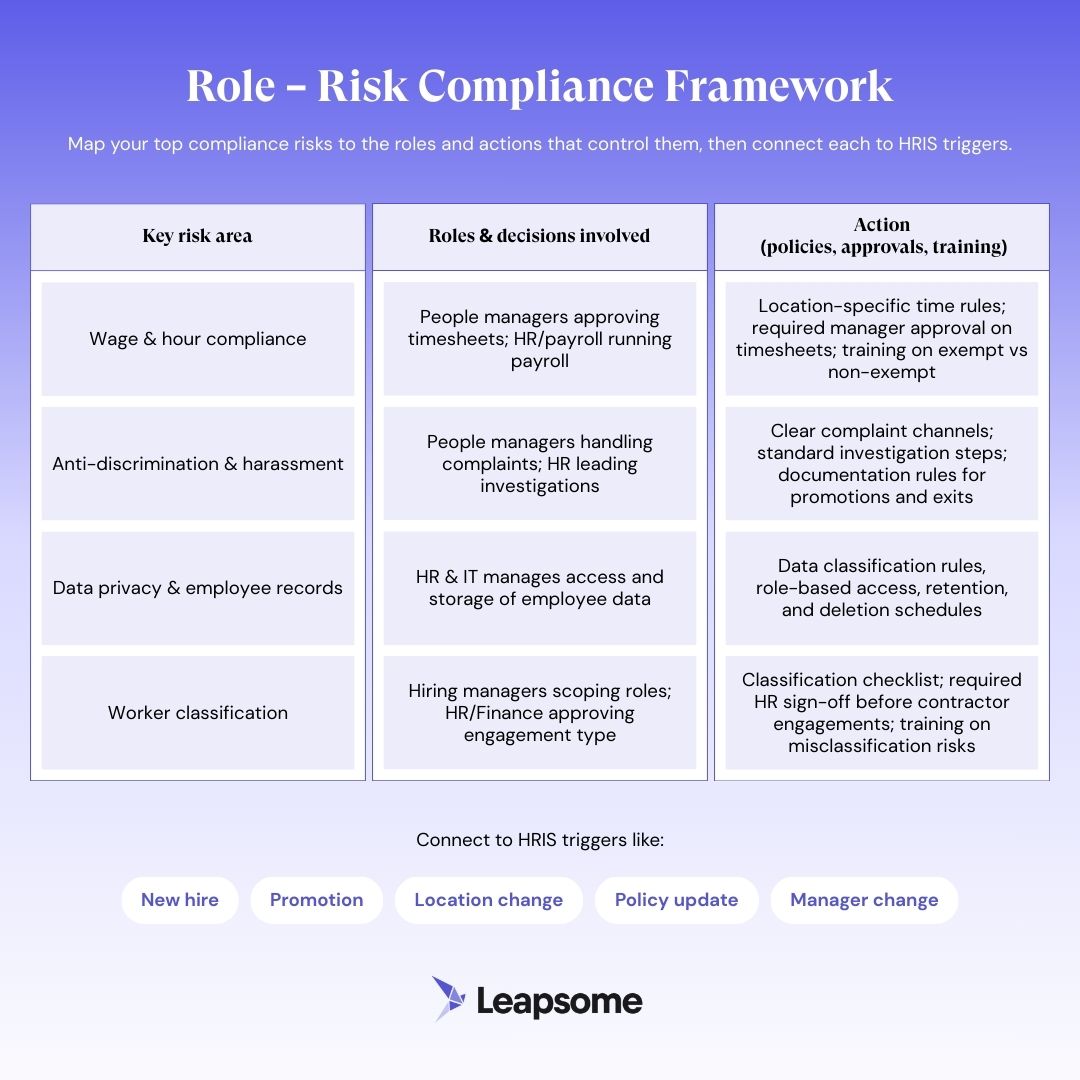
1. Prioritize your top 5 - 7 compliance risks — focus on recent issues, high-impact areas, regulatory changes, and audit feedback. Common priorities include wage and hour, anti-harassment, data privacy, health and safety, and employee classification.
2. Map risks to roles and decisions — connect each risk to where mistakes happen. For example, wage and hours connects to managers approving timesheets and payroll processing overtime. Anti-harassment connects to managers responding to complaints and HR handling investigations.
3. Build targeted action plans per role — combine clear policies (accessible at decision time), required approvals (built into workflows), and focused training (triggered by role changes or policy updates).
4. Automate through your HRIS — set triggers for new hires, promotions, location changes, and policy updates. According to PwC, integrated technology and data visibility are critical for effective compliance programs.
Platforms like Leapsome automate these tasks using employee data, making your program self-sustaining. Your compliance training marketplace and HRIS implementation work together, ensuring compliance remains tied to actual employee movements, rather than relying on HR's memory.
How HR technology makes compliant processes the default, not the exception
Centralizing data, automating approvals, and linking training to role changes reduce the reliance on memory and manual tasks, making compliance more streamlined. Instead of hoping people remember the right steps, you can build those steps into how work actually gets done.
The most effective systems centralize employee records and documents with audit trails and retention controls, so you always know what happened and when.
They automate approvals and reminders to route decisions to the right reviewers, eliminating the need for manual tracking. They integrate payroll, time tracking, and leave management, ensuring consistency across processes. Additionally, they provide analytics and alerts that surface compliance trends before they escalate into incidents.
Review how your current tools support or block these capabilities. If you're finding gaps, that's where an all-in-one platform like Leapsome adds value. With all your data and workflows stored in a single source of truth, compliance becomes an integral part of your everyday HR process automation, rather than a separate project you're constantly chasing.
✅ Make compliance part of your everyday workflows
See how Leapsome unifies HR processes, automates approvals, and keeps you audit-ready without the manual work.
👉 Book a demo
Frequently asked questions about HR compliance
Which HR compliance areas should growing companies focus on first?
Start with wage and hour laws, anti-discrimination protections, and data privacy. These three areas carry the highest risk of fines and lawsuits for most organizations. Ensure you're classifying employees correctly, tracking time accurately, handling complaints consistently, and protecting employee data with proper consent and access controls.
How can small HR teams manage HR compliance without a dedicated legal department?
Focus on risk mitigation through clear processes and documentation. Build a compliance checklist covering your priority areas, document your decision criteria, and maintain consistent records. Use your compliance program to structure routine reviews (quarterly payroll audits, annual policy updates).
How does an HRIS platform help with HR compliance and record-keeping?
HR technology like Leapsome centralizes employee data, automates approval workflows, and creates audit trails that prove compliance during audits and investigations. Instead of scattered spreadsheets and email, you have one system showing what happened, when, and who approved it.
Sam Abrahams

.jpg)


.jpg)
.png)