How HR scorecards report HR's impact on business beyond simple numbers


Most HR departments are drowning in data, yet only 12% of HR leaders in the United States think about their workforce plans beyond the next two years.* Poor long-term planning isn’t caused by empty dashboards, but by overwhelmed people teams who have to prove operations are working while still struggling to show leadership the weak spots.
Most organizations already track engagement, performance, and hiring and retention in some form. When those numbers sit in separate systems or measure activity without context, it’s hard to identify the underlying patterns, let alone explain what they mean for growth.
At its best, an HR scorecard turns those scattered people metrics into clear insights of organizational health. But too many HR scorecards have lost that purpose, and now prove HR teams’ activity instead.
In this article, we’ll talk through which metrics should have a space on your HR scorecard and how strong scorecards can be part of your growth strategy. We’ll also provide a free template to get started.
* McKinsey, 2025
What’s an HR scorecard?
An HR scorecard is a tool that helps you show how your people initiatives support the business’s overall goals. It puts HR projects, their associated metrics, and their business impact in one place, like a cheat sheet highlighting all the work your team has done. When they’re used effectively, they help leaders understand operational priorities beyond financial results.
Many people analytics dashboards show how many people completed a review cycle or responded to an employee survey. Those numbers can be useful, but they aren’t actionable unless they show leaders what's working and what needs to change. HR scorecards measure performance across business priorities using the Balanced Scorecard framework, which recognizes financial, customer, internal business, and learning and growth perspectives as equally important.
What should an HR scorecard include?
“The metrics leadership tracks should match what HR brings — data and sentiment must work together to show the full impact.”
— Luck Dookchitra, former VP of People and Culture at Leapsome
The right HR scorecard metrics depend on your company’s size, maturity, and current goals. A 200-person organization trying to reduce turnover needs to track a different set than a global enterprise using a talent scorecard to plan leadership succession.
Still, most useful HR scorecards include metrics across the following areas:
- Financial impact metrics show how people decisions add business costs or create value. Examples include turnover cost, revenue per employee, and cost per hire.
- Employee experience metrics help leaders understand whether employees feel supported enough to perform well and stick around. For instance, HR teams may track their employee net promoter score (eNPS), manager effectiveness, and internal mobility rate.
- Internal HR process metrics show whether key people processes work as intended. They include time to hire, onboarding completion, and review cycle completion.
HR scorecard template
A metric deserves space on the scorecard only if it helps leadership make a better decision.
Here’s an example of a basic HR scorecard to get started.
How to develop an HR scorecard in three steps
“Know your outcome goal, measure progress, and keep a dashboard — it keeps people teams focused on strategy, not just daily noise.”
— Luck Dookchitra, former VP of People and Culture at Leapsome
Every HR scorecard will look different because every business has different pressure points. But all HR teams can start with the following three steps to protect your scorecard from becoming another set of HR KPIs collecting dust.
Step 1: Start with business objectives, not HR metrics
“Engagement scores and trust metrics are signals, not goals. If a metric isn’t influencing business results, drop it and focus on what does.”
— Melanie Naranjo, Chief People Officer at Ethena
Some teams are tempted to start their HR scorecards by picking KPIs — especially ones that are easy to collect data on. They might pull the latest quarterly turnover rate, and training rates from the percentage of employees who completed a general skills course. Then, they try to make that collection of numbers look strategic, while leadership is left connecting the dots and basing decisions on hunches.
Rather than starting with the metric and bending business plans around the numbers, make your HR scorecard framework diagram more strategic by starting with the business priority instead. For example, if the company wants to grow revenue without hiring new team members, leadership needs to know whether the current workforce plan can support that goal.
Step 2: Identify the people outcomes that drive those objectives
Once the business goals are clear, HR can define the workforce conditions that support them to create an actionable people plan.
To continue our revenue example, sustainable growth depends on two people outcomes. Employees need to be productive and do work that actually moves revenue, and managers need to support stronger performance without pushing their team into burnout.
Those outcomes make the scorecard more useful, as they show whether the organization has the focus and leadership capacity to grow in a healthy way. This step also clearly lays out what actions to take and what success looks like for managers and employees, so everyone stays on the same page.
Step 3: Select a small set of actionable metrics
“Develop metrics that directly link to business outcomes and present them in a format the business understands.”
— Katerina Arsova, Head of People and Talent Operations and Partnerships at Leapsome
The next step is choosing just a few metrics to measure people outcomes.
If the business goal is increasing overall revenue by increasing employee productivity, for example, HR could track KPI completion rates to tell leaders if employees are moving the right priorities forward. They also may want to send surveys and track employee satisfaction scores, which can throw red flags if employees are headed toward burnout or become flight risks.
But all metrics need context. If survey feedback lives in a separate system from goals and performance data, HR may spot a dip in sentiment without understanding what it means for execution. Teams may still hit targets while motivation drops or trust in leadership weakens. That’s why HR needs a connected HRIS and people management platform like Leapsome to uncover patterns early enough to take action.
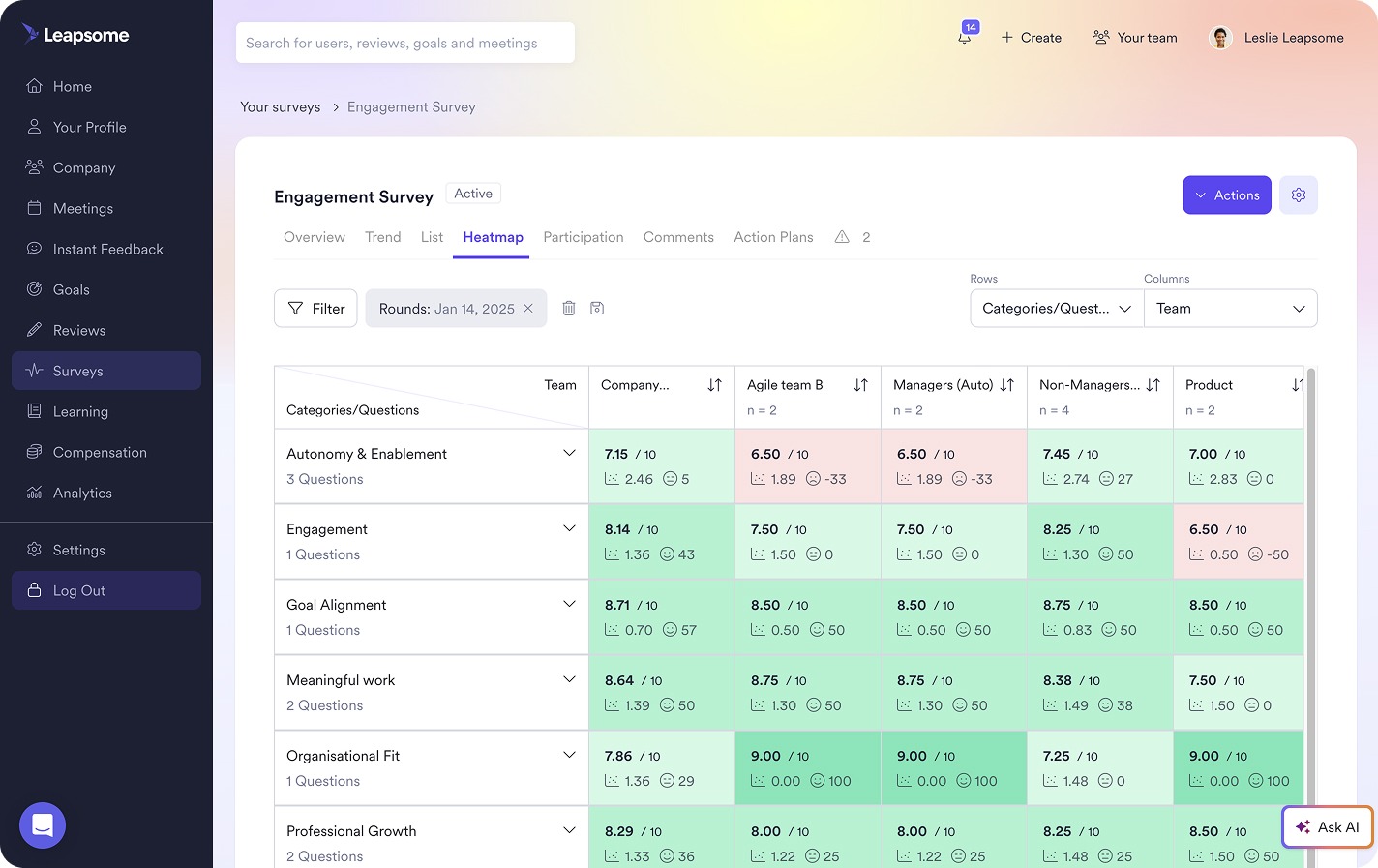
🔗 Connect sentiment to performance
Leapsome helps HR teams compare employee sentiment to goals and performance signals, so they can see what people processes support great work and what gets in the way.
👉 Explore Engagement Surveys
How to build an HR scorecard that influences business decisions
“Talking the language executives talk — in metrics and ROI that resonate — wins business cases for HR teams.”
— Katerina Arsova, Head of People and Talent Operations and Partnerships at Leapsome
Leadership doesn’t need a longer list of HR’s processes. They need to see where investments in people improve performance, where workforce risks are rising, and where they need to step in to help the business hit goals.
Here are a few examples of the differences between metrics that list what your team is doing and metrics that show the impact of that work, and what questions the metrics answer so leaders understand organizational impact.
No matter what metrics you choose, focus on the following three principles to build an HR scorecard that drives decisions:
- Keep the metrics focused: Choose the KPIs that connect directly to current business priorities and move everything else into operational reporting.
- Add context: Lean on a connected people system that pairs each metric with a trend, segment, or driver, so leaders understand what changed and why.
- Tie every metric to a strategic goal: Make sure each figure helps leaders decide where to invest and where to change course.
According to Gartner, only 35% of leaders believe their approach to HR technology is enabling them to achieve business objectives. So, the solution isn’t relying on bigger scorecards and vanity metrics through disconnected systems, but rather presenting that data using your tech stack in a way that helps leaders make better decisions. Leapsome collects and connects that information so you can make your case.
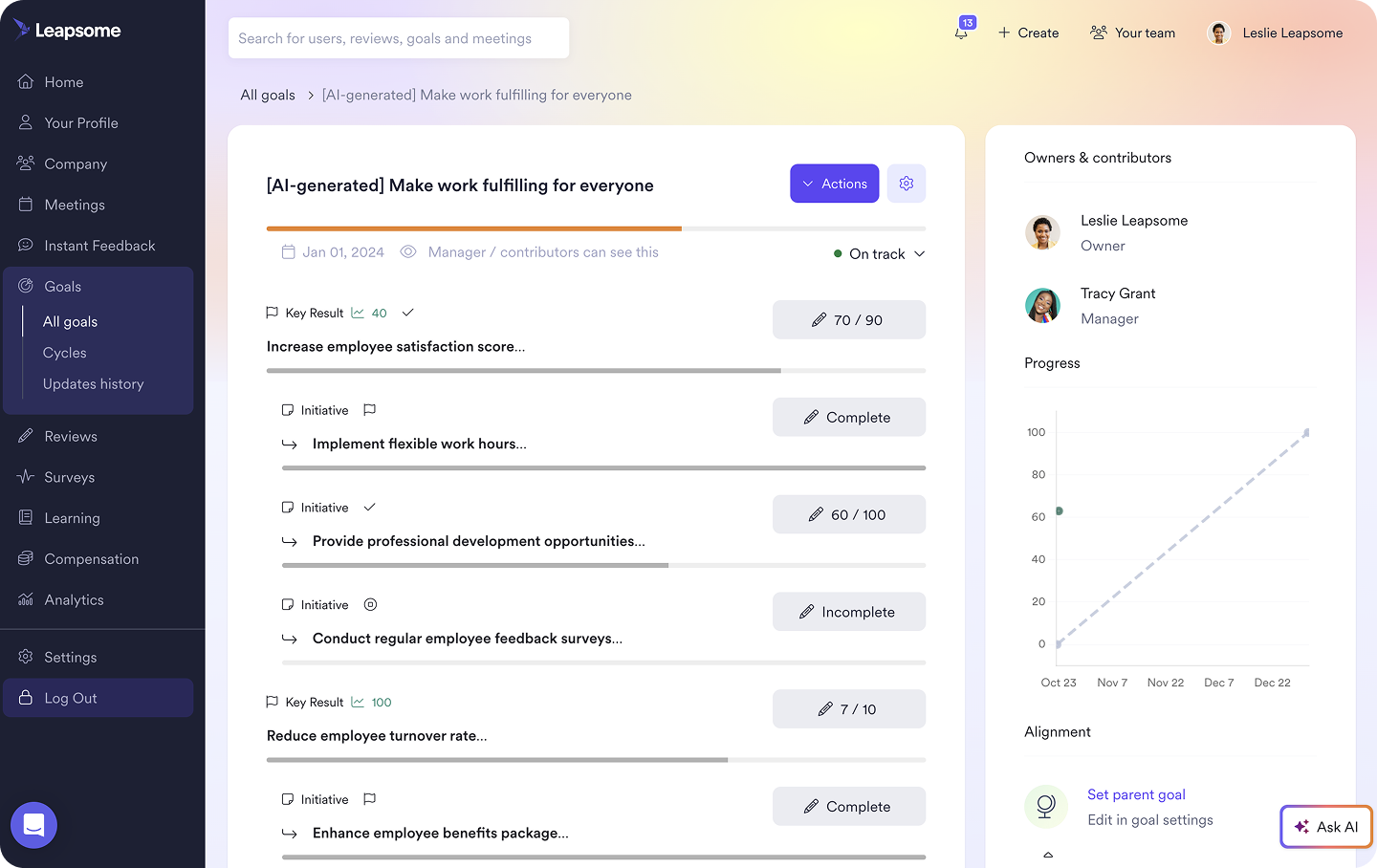
🔭 Show what moves the business
Leapsome connects employee performance data to business objectives, so HR teams can show leadership which people initiatives drive meaningful results.
👉 Explore Goals & OKRs
How Leapsome supports organizations in building a strategic HR scorecard
If leadership is still asking “so what?” after you present an elaborate HR scorecard, the problem isn’t the format or how many metrics you’ve chosen. It’s the lack of connection behind the numbers.
Leapsome helps HR teams build stronger scorecards by bringing people data into one connected HR platform. Instead of reporting isolated metrics that don’t move the needle, teams can see how workforce signals are shaping organizational health.
With Leapsome, teams can:
- Connect performance to business priorities: Goals and OKRs track progress against business objectives, giving HR a clearer view of how employee performance supports company priorities.
- Turn review cycles into usable performance insight: Performance Reviews help HR teams understand team quality, manager effectiveness, and growth needs beyond completion rates.
- Use engagement data as an early signal: Engagement Surveys give employees a way to voice concerns, so HR teams can spot sentiment trends before disengagement affects retention or performance.
- Build reports on reliable people data: Employee Records create a single source of truth for reporting with more confidence and fewer manual fixes.
“We’re really focusing on making sure the data we produce is high-quality and consistent across countries. Good data helps us identify pain points early, plan development initiatives, and return to the business with clear, actionable insights.” — Victor Tomas, Learning and Development Specialist at Swapfiets
📦 Stop collecting numbers. Start connecting them.
Leapsome connects all your people data and insights across the employee lifecycle, so your HR team can use scorecards to build smarter business decisions.
👉 Request a demo

.jpg)


.png)