How to set human resources goals that align initiatives with outcomes


We’re willing to bet your human resources goals often feel like a siloed-off checklist. At best, they might keep HR running smoothly, but they have little impact on the business.
While objectives are vital to give your HR team focus, their influence should spill over to the entire company. After all, effective HR goals touch every aspect of the employee experience, bridging people operations and business performance.
Recent Gallup data shows that the percentage of employees who know what’s expected of them dropped from 56% in 2020 to 46% in 2024. What’s more, this is a key factor driving reduced employee engagement across the board.*
The need for clear goal-setting has never been greater. So let’s explore how to recontextualize HR goals as strategic initiatives that can have positive, measurable impacts on your organization.
*Gallup, 2025
What are human resources goals?
Human resources goals are big-picture objectives designed to improve all stages of the employee lifecycle. From hiring to performance management, these goals provide your team with a roadmap for allocating resources and focusing their efforts. In turn, that roadmap helps you track progress and impact larger business priorities.
“HR shouldn’t just support business decisions — you’re shaping them. You have to think like a profit center, not an administrative silo.”
– Anita Anthonj, Founder and CEO at Talaera
Strategic HR goals can lead to:
- Improved engagement and productivity: Objective-driven initiatives help HR maintain a positive working environment, where employees know what’s expected and can consistently perform at their peak.
- Stronger company culture and less churn: By offering clear professional development plans and accessible resources, you make employees feel valued and heard. And as Gallup reports, a supportive workplace improves both engagement and retention.
- Better alignment between HR and business outcomes: The most impactful HR goals link people strategy to overarching organizational targets. According to a SHRM executive summary, only 18% of companies have seamlessly integrated HR strategies, and that lack often leads to worse profit growth.
Are your HR goals effective?
Even if you write great-sounding HR goals in a strategy meeting, there's no guarantee they’ll motivate people in the right direction. As McKinsey’s 2025 report explains, many organizations struggle to create and execute HR initiatives that have a real, lasting impact.
If that sounds familiar, you might face challenges like these:
- Goals are too broad: For goals to be effective, you need metrics and timelines to gauge progress clearly.
- No one owns goals: You might want to improve retention, but without a specific HR manager assigned to track that goal, it’s likely to fade from leadership discussions.
- There's no link to business outcomes: If it’s hard to see the connection between an objective and higher customer satisfaction or employee productivity rates, associated projects tend to be ineffective.
Using the SMART framework for HR goals
“The purpose of an HR function is to create a people strategy that most effectively drives business goals. It starts with the business, then you build your people strategy from there.”
– Melanie Naranjo, Chief People Officer at Ethena
The SMART framework explains how to set goals that motivate employee engagement and make a difference to your business. Each HR objective should be:
- Specific: Define exactly what the goal is and what success looks like. Instead of deciding to “improve onboarding,” build that goal around a clear statement of intent. A better example of an HR goal would be: “Reduce new hire ramp-up time by improving onboarding completion rates.”
- Measurable: Choose which HR metrics you’ll use to track progress on the objective. You might adjust the above goal statement to clarify that, for the initiative to be successful, it should decrease the average new hire ramp-up time from 90 to 60 days.
- Achievable: When proposing changes, be mindful of your current resources and time constraints. It’s probably reasonable to push for an increase in onboarding completion by 10% within two quarters, while expecting to boost that metric by 100% in two weeks is unrealistic.
- Relevant: This is where you align the goal with what the company wants to achieve. You could link improved onboarding to a larger performance target like higher productivity or better cost-per-hire efficiency.
- Time-bound: Add accountability to your goals by setting a clear deadline. Otherwise, it’s easy to fall into “we’ll get to it eventually” territory. If the objective is complex, break it down into smaller steps, then give each one its own timeline.
Leapsome’s all-in-one HRIS platform helps you put SMART HR goals into practice and monitor their progress. Centralized employee data and time-tracking tools make it simple to allocate resources in line with organizational objectives.
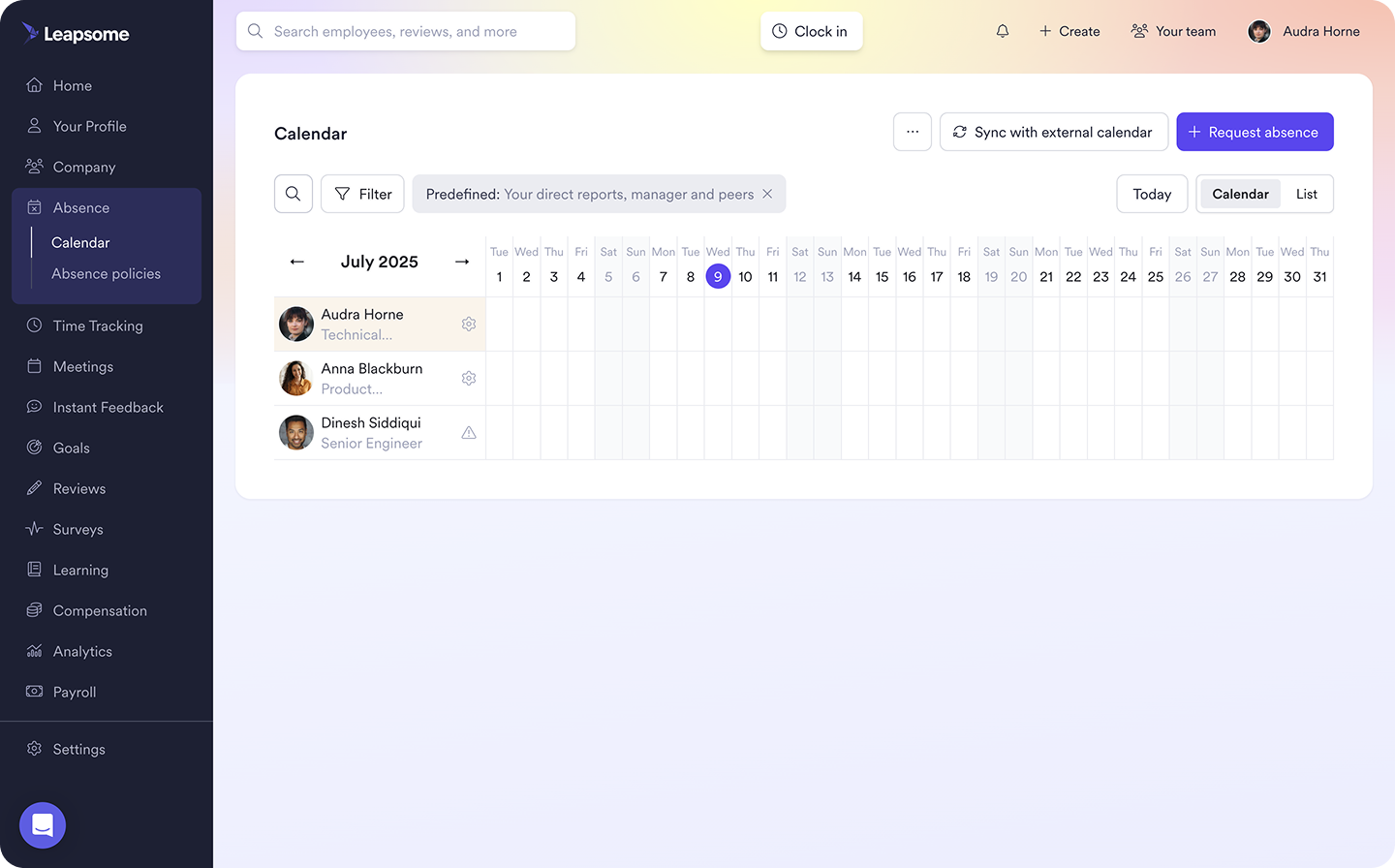
⏱️Manage resources efficiently
Leapsome helps you set realistic workforce goals based on complete visibility into team resources.
👉 Explore our Time-Tracking Software.
Setting effective goals for HR: Quick four-step guide
Here's how to take each potential goal from idea to executable plan.
1. Choose a goal that aligns with business and HR priorities
“The first step is defining exactly what we want to achieve with our people strategy, then everything else should ladder up to those measurable goals.”
– Monica Sarkar, Co-Founder at Purple Umbrella
Start by identifying organizational goals that could benefit from HR policies. Bring stakeholders together to talk through short and long-term plans, and get specific about the challenges standing in the way. This kind of deep dive helps you know what to focus on, whether that’s strengthening leadership or preparing for a fast growth period.
After that, conduct an audit to gather the latest data on where your team and core HR systems perform well, and what’s lacking. Consider which HR goals might have the most impact on weak areas. Then compare this list to the business priorities you identified, and look for overlap.
2. Make your goal SMART
“Engagement scores and trust metrics are signals, not goals. If a metric isn’t influencing business results, drop it and focus on what does.”
– Melanie Naranjo, Chief People Officer at Ethena
Once you have a goal in mind, take another look at the SMART guidelines. Rewrite your goal statement until it’s specific, achievable, relevant, and time-bound. You’ll know you’re in a good spot when it’s crystal-clear what the goal is, why it matters, and how to accomplish it.
Then turn your attention to the “measurable” criterion. Review your HR KPIs to see which ones are most relevant, then decide how to measure success using straightforward, unambiguous metrics. Whenever possible, set specific numbers or percentages you want to see.
It’s best to opt for just a few KPIs to avoid clouding the bar for success. Also, tie them to relatively short time frames that keep momentum going.
3. Break down the goal and assign ownership
Unless the goal you’re chasing is very simple, it’s a good idea to make ownership multi-layered. Assign overall responsibility for the goal first. That person will keep an eye on big-picture progress, watch metrics, and decide when the goal is met or should be reassessed.
After that, break the goal down into smaller steps and/or tasks, and assign ownership for each one. It’s fine if some responsibilities overlap. What’s important is that each person involved knows exactly what they’re responsible for and when, along with who they should report progress or flag issues to.
4. Track and review progress over time
Even the best goals are easy to overlook in the hustle and bustle of daily work. Keep them front of mind by setting regular meetings with accountable parties, and using those opportunities to review actions and metrics. This helps with alignment and motivation, while making it easier to surface roadblocks early.
Leapsome’s analytics tools give you a boost at this stage. Our platform integrates all your workforce data — including performance reviews and engagement scores — so you can quickly gather insights on each goal’s impact. Plus, with AI-powered recommendations and custom reports, you can build SMART strategies and keep an eye on progress at all times.
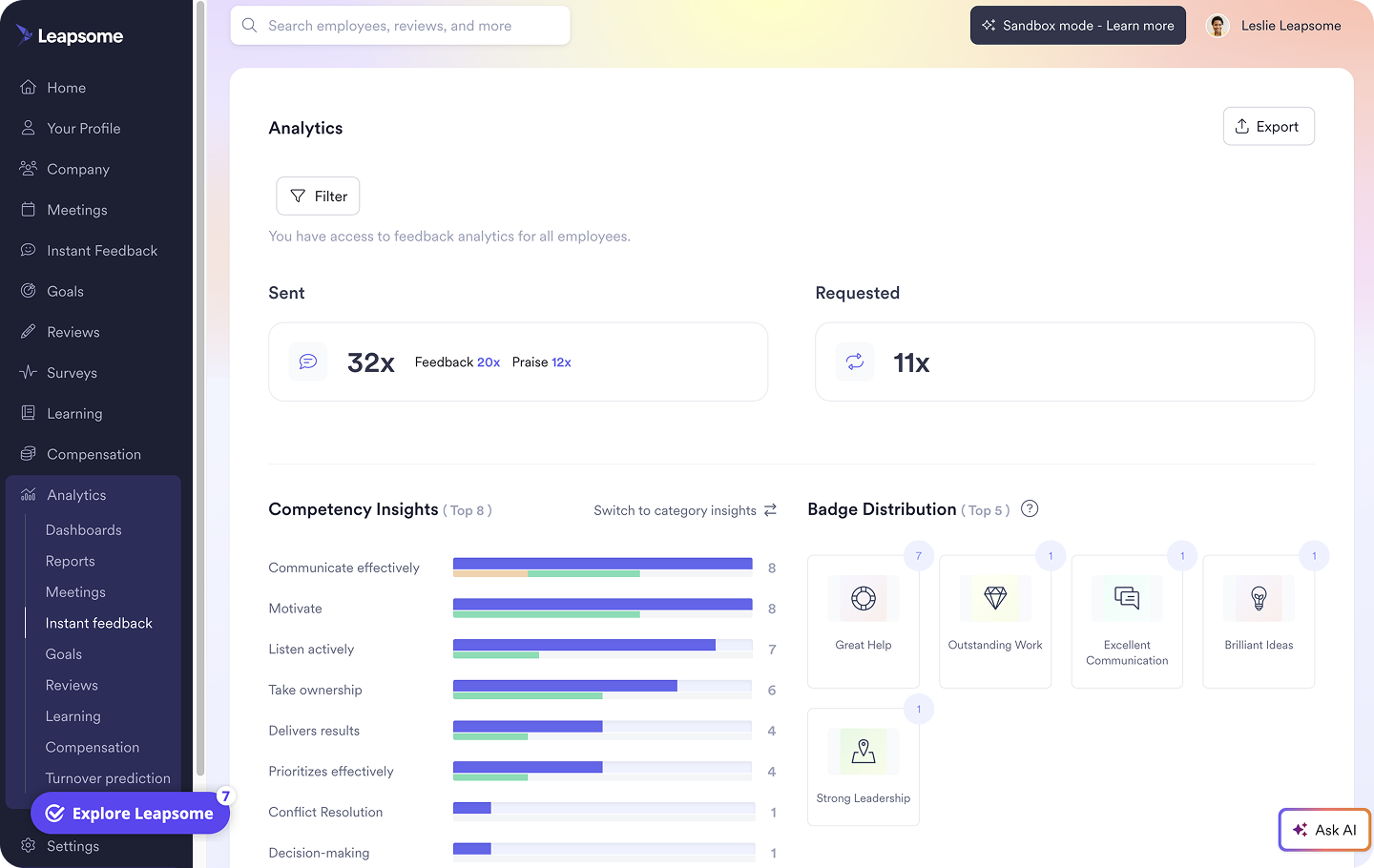
📊Measure HR goals with real-time analytics
Leapsome’s Analytics solutions bring together workforce and engagement data, so all parties stay in the loop about in-progress goals.
👉 Learn more
Achieve your HR goals with Leapsome
Working hard toward the wrong goals won’t get you very far. Real success starts with the goal itself: whether it’s designed to make next steps clear and success measurable. After that, your ability to meet objectives hinges on the tools you use.
Leapsome’s unified platform combines HRIS features with centralized people data, bringing together everything you need to surface insights and set productive goals. Collaboration tools let you share plans across departments for maximum alignment. And you can chart progress with instant feedback and analytics, so you see when your SMART goals go off track and have the chance to make quick adjustments.
“My primary goals were to build an ongoing feedback culture, improve conversations about performance, and better understand competencies across the company.” – Nadja Kaderli, People and Culture Manager at Advertima
🎯Keep all your HR goals on target
Spot trends earlier and adjust strategies faster, when all your tools and people analytics are in the same place.
👉 Request a demo

%20(2).jpg)