Systems, not snapshots: How to measure employee satisfaction

.jpg)
In 2024, a Gallup survey found that 42% of voluntary leavers said action by their managers or organizations could have prevented their departures. But 45% reported that no one proactively discussed their job satisfaction in the three months leading up to their resignations.*
The takeaway? Measuring employee satisfaction and intervening early can have an outsized effect on critical business goals, like slashing preventable turnover.
Of course, putting that knowledge into practice isn’t always easy. Maybe you’ve already conducted a few surveys, and used the results to make a stab at improving employee satisfaction scores. Yet the next round of measurement showed you’re no better off than when you started, leaving you wondering what’s going on.
For many organizations, the core problem is treating employee satisfaction measurement as an individual event instead of a comprehensive system. Measuring satisfaction isn’t about crafting the perfect survey and tracking a dozen metrics. It’s about building a clear framework that connects team sentiment to business outcomes, driving consistent, scalable actions.
This guide explores how to measure employee satisfaction, plus how you can design an effective system for acting on what you learn. You’ll find out which metrics to focus on and the best ways to measure them. We’ll also talk about how to turn insights into data-backed decisions that improve job satisfaction and the overall employee experience.
* Gallup, 2024
What’s employee satisfaction, and why does it matter?
Employee satisfaction measures how happy and fulfilled team members feel, both in their roles and in the workplace at large. This broad metric is influenced by:
- Overall morale
- Company culture
- Work environment
- Compensation
- Learning and development opportunities
- Work-life balance
Employee satisfaction often drives engagement, according to more research by Gallup, but the two concepts are still distinct. Satisfaction is a prerequisite for engagement, but happy employees don’t necessarily feel motivated to go above and beyond.
For small and mid-sized organizations, it’s crucial to build an employee satisfaction measurement system early. Workplace culture is still taking shape at that stage, and employee sentiment can change fast. Instituting a consistent framework ensures that HR and managers always have recent data to draw on when making decisions that affect employees.
“Stop treating listening like a one-off. Create a reliable cadence that blends sentiment and demographics, so leaders get clarity on where to focus and managers can act with confidence.”
– Craig Forman, Founder and Principal Consultant at CultureC Consulting
Employee satisfaction metrics: Feelings, behaviors, and results
“Change management and agility are vital — proactively react to market shifts and tie HR data together into a storyline that connects sentiment, turnover, and business results.”
– Katerina Arsova, Head of People, Talent Operations, and Partnerships at Leapsome
Efforts to curb dissatisfaction tend to fail when HR teams concentrate on the wrong experience metrics. The secret is to measure across three dimensions that complement and inform each other, so you get a well-rounded picture.
How do they feel? Sentiment metrics
Sentiment metrics use self-reports to gauge how employees feel about their daily work and the organization as a whole. One of the most useful data points in this class is employee net promoter score (eNPS). This metric involves one simple question: “How likely are you to recommend this company as a place to work, on a scale of 0 to 10?”
The difference between the percentage of promoters (9–10 ratings) and the percentage of detractors (0–6 ratings) gives HR a quick, easily repeatable temperature check. Falling eNPS can signal a coming spike in employee turnover rate, while a consistently strong score reflects a workforce that feels heard and appreciated.
What are they doing? Behavioral metrics
Behavioral metrics shift the focus from qualitative self-reports to observable behaviors. The latter category is harder to fake, and it can surface problems before they start showing up on surveys.
For instance, a high absenteeism rate — total absences divided by total scheduled workdays — might be the result of low morale or disengagement. Either one can send productivity into a nosedive.
What are the results? Outcome metrics
Outcome metrics connect data to performance, showing how well your satisfaction measurement efforts translate into business results. Employee turnover rates are among the most revealing outcome metrics, because they reflect everything HR touches: from onboarding to performance management.
If your employee turnover rate is creeping up, it’s time to dig into your sentiment and behavioral metrics to pinpoint the problem. You may find that the issue is largely isolated to a specific role, or appears to be a response to unclear standards during a period of chaotic growth.
How do you measure employee satisfaction? Three techniques
The best way to measure employee satisfaction is to gather a range of both qualitative and quantitative info. Here are three of the most flexible and revealing employee satisfaction measurement tools.
1. Employee satisfaction surveys
Surveys look at how team members feel across key dimensions of the employee experience, such as management quality, company culture, and career development opportunities. Use shorter pulse surveys for ongoing sentiment tracking, and reserve in-depth surveys aimed at deeper diagnosis for EOY or after major organizational changes.
When developing these surveys, mix open-ended questions with quantitative ratings to paint a complete picture of what’s going on. And consider using a tool like Leapsome with built-in HR automation, allowing you to easily standardize surveys and track the results.
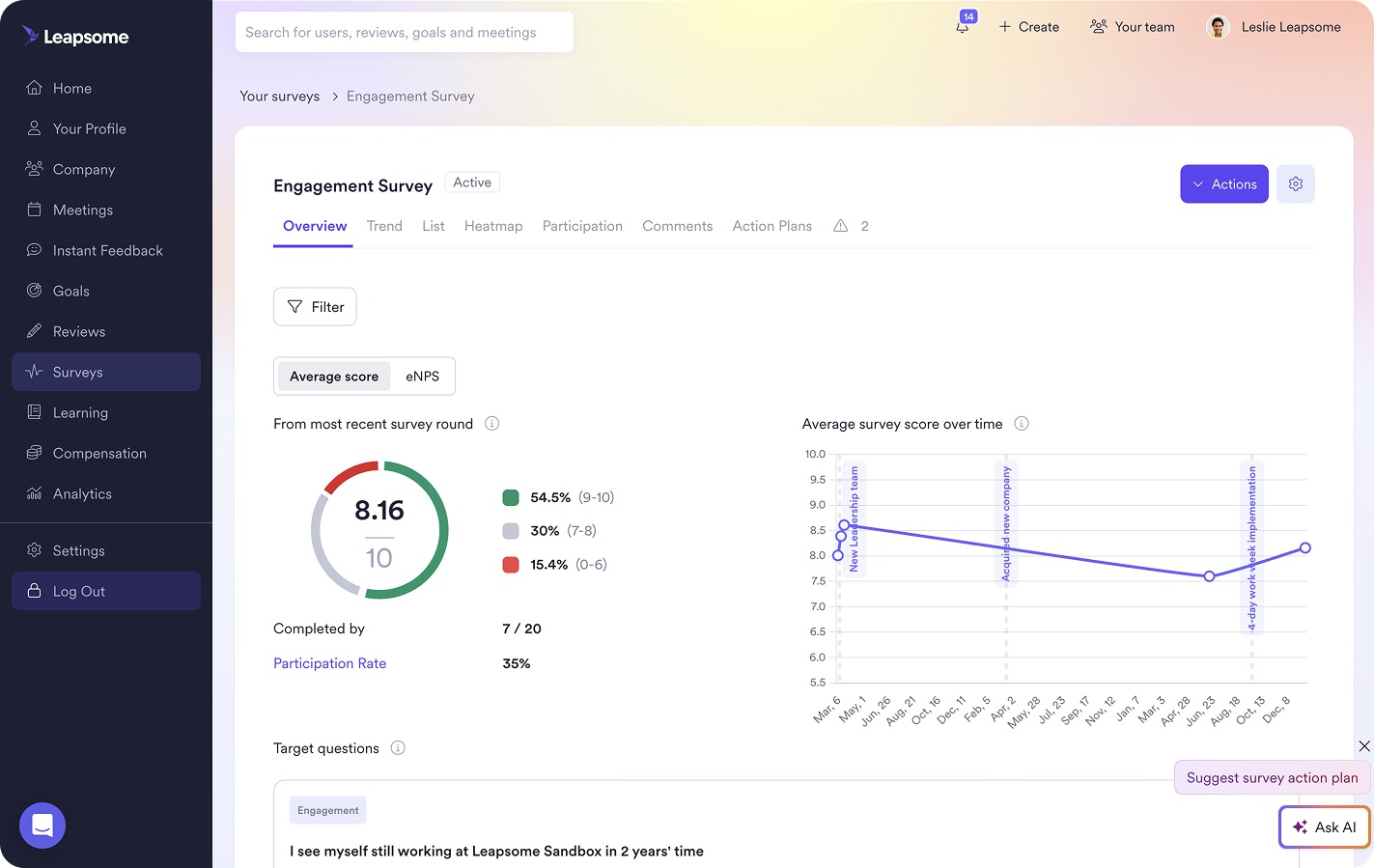
📝 Gather and act on sentiment data
Run pulse and in-depth surveys, track eNPS over time, and connect sentiment data, all in one place.
👉 Explore Engagement Surveys
2. One-on-ones
Regular one-on-one meetings help HR teams drill deep into the specific conditions affecting individual team members’ satisfaction (or lack thereof). These conversations add detail to the bird’s-eye view surveys provide.
One-on-ones are most effective when conducted on a scheduled basis, so everyone involved has time to prepare. Keep these discussions open-ended to encourage honest, unguarded responses that are hard to come by in structured survey formats.
3. Exit interviews
Departing employees have little to lose, which means they tend to be the most candid. Conducting exit interviews consistently can unearth insights employees may be too afraid to bring up in surveys or one-on-ones.
How to turn satisfaction insights into actionable decisions
“Too many organizations collect feedback that never sees daylight, and that’s where engagement dies. When you share results quickly, involve leaders in decisions, and clearly communicate the actions being taken, employees can see their input creating real change. That visible follow-through is what builds lasting credibility.”
– Monica Sarkar, Co-Founder at Purple Umbrella
Companies often fail to improve employee satisfaction scores, not because they don’t gather enough data, but because they lack clear systems for acting on what they learn. When teams don’t operationalize insights, meaningful change is hard to come by, and satisfaction suffers. As Gartner reports, two-thirds of employees don’t feel their organizations follow through on promises about benefits, culture, work-life balance, and development opportunities.
Effective action requires clear ownership, a well-defined decision-making framework, and a closed feedback loop between knowledge and action. Here’s how to make that happen:
- Prioritize key metrics and assign ownership: Choose the two or three highest-impact metrics, based on the insights you’ve collected so far. Assign clear ownership for each one to maximize accountability and follow-through. Example: You might feel you don’t have a good baseline understanding of employee sentiment. So you choose to focus on eNPS and pulse survey scores, assigning a different manager to oversee each.
“Engagement scores and trust metrics are signals, not goals. If a metric isn’t influencing business results, drop it and focus on what does.”
– Melanie Naranjo, Chief People Officer at Ethena
- Share and structure the data: Set timelines for sharing insights to keep the system moving. Before making decisions, segment data to hone in on meaningful patterns across teams. Example: You decide to track eNPS and survey results both globally and for individual teams, and set a regular monthly review cadence.
- Act, measure, and iterate: Taking action without measuring the results is like throwing darts blindfolded. Example: Once you’ve established baseline sentiment metrics, you can run follow-up pulse surveys after making changes to gauge how they affect satisfaction levels. Then, add in continuous retention and performance tracking with software like Leapsome to comprehensively measure impact over time.
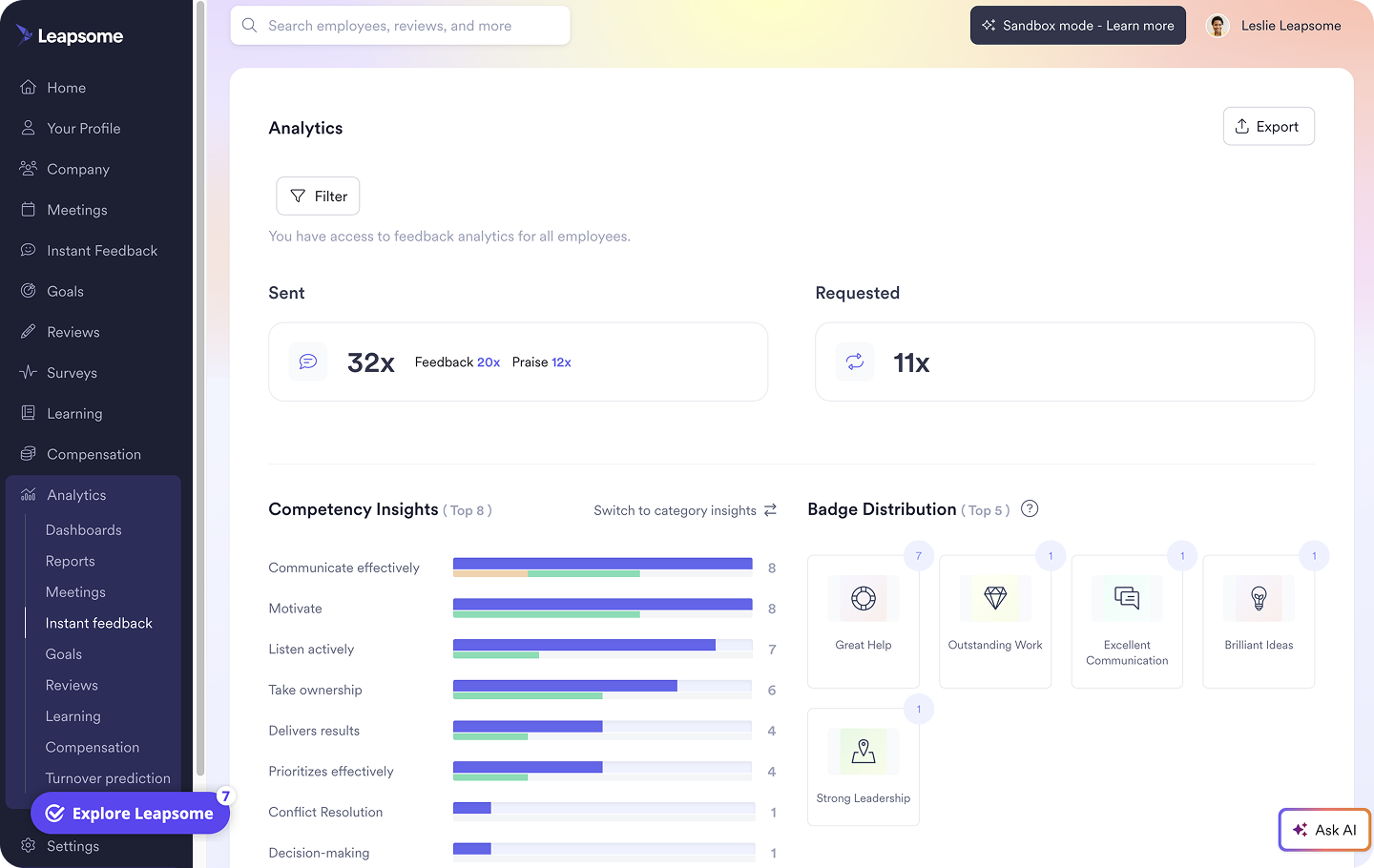
📊 Robust analytics without the technical overhead
Leapsome simplifies identifying patterns across teams and managers, triaging high-priority actions, and measuring success.
👉 Learn about People Analytics
Build a digital feedback-to-action pipeline with Leapsome
As companies grow, converting employee satisfaction data into effective action gets harder. The volume of data you need to collect can quickly outpace your system’s capacity to act on it. As a result, HR spends more time sending out surveys and organizing the results than actually using these insights to boost satisfaction.
But with Leapsome, HR managers get everything they need to measure and capitalize on employee satisfaction insights, including HRIS capabilities and people management tools. You get employee engagement surveys, eNPS and behavioral analytics tracking, and employee records, all in the same centralized platform. This helps you trade in one-off measurement projects for a robust system, one that continuously mines employee sentiment and suggests improvements.
“Leapsome did a really great job with performance, OKR, and feedback management — everything in one platform.” – Zhen Wang, People Servicer at Jina AI
💪 Translate employee satisfaction data into better initiatives
Leapsome connects how your team feels to what HR does about it, by combining measurement methods and people analytics into a comprehensive source of truth.
👉 Request a demo

.png)