Eight common HR challenges + how to solve the real issues behind them


The workforce is changing faster than most people systems can keep up. AI introduces new core skills, compliance depends on cleaner data across more HR processes, and employees expect more clarity and support from the organization.
Those new needs should put HR in a stronger strategic role. Instead, many HR teams are still treated like admin support and asked to manage modern workforce problems through scattered data and disconnected tools. They can respond when engagement drops or turnover rises, but they struggle to see what those issues have in common when the employee lifecycle is split across systems.
DHR Global’s 2026 Workforce Trends report found that 83% of workers consider company culture to be somewhat or very important to their experience (and engagement), but 46% would describe that culture as reactive and inconsistent.* So staying on top of the challenges of human resource management frees HR teams’ time, so they can step into more proactive roles and create a reliable workplace culture.
This guide looks at the challenges HR professionals face as connected workforce signals, not isolated fires. We’ll cover common HR challenges, the conditions behind them, and how connected people data helps HR act before issues spread.
* DHR Global, 2026
Why HR challenges rarely exist in isolation
Most organizations treat individual HR challenges as separate problems because it makes the work easier to assign. Name the issue, choose an owner, and launch the fix. It feels practical, especially when HR is under pressure to act quickly.
But when HR manages every issue independently, they solve the symptoms without seeing how they might be connected. That’s how the same root cause keeps showing up as new problems across the employee lifecycle.
Manager effectiveness influences multiple outcomes
“An ineffective manager doesn’t take time to understand their people or build trust. The best ones care deeply, they know where you want to grow, challenge you when needed, and make space for honest feedback.”
— Luck Dookchitra, former VP of People and Culture at Leapsome
Gallup found that managers account for 70% of the variance in employee engagement, so when managers struggle, the impact rarely stays inside one metric.
A manager who avoids giving feedback can leave employees unsure of where they stand. Over time, that uncertainty affects performance, motivation, and trust. Similarly, a manager who constantly shifts priorities can make overload feel normal — which might go unnoticed until burnout starts showing up in engagement surveys and exit interviews.
At first glance, a team may appear to have an engagement or performance problem, but the real issue may be in how the manager sets expectations and creates clarity day to day.
Career growth affects more than retention
Retention is one of the most cited HR challenges, and LinkedIn’s 2025 Workplace Learning Report confirms that 93% of organizations are concerned about keeping their employees around. The top way these companies are working to improve their chances is learning opportunities. But if growth paths feel uncertain, the consequences spread beyond whether people stay.
“Disengaged employees who stay quietly can drain a company faster than those who leave. Engagement isn’t about who stays, it’s about who contributes with energy and ownership.”
— Emma Leeds, Founder, CEO, and Chief People Consultant at People Function
Employees who can’t see a clear next step in their career start making their own paths. Some leave the company. Others stay, but stop engaging because the effort no longer feels connected to their future. Over time, the lack of direction turns an engagement concern into a retention problem.
Lack of growth opportunities also weakens recruiting and talent management efforts. Candidates might want competitive pay first, but Gallup found that 87% of millennials applying also want jobs with development opportunities. If your organization can’t show how you’re investing in peoples’ growth, top talent will look for employers who are ready to offer more.
Internal mobility can also stall when learning and development programs get deprioritized. Without connected performance and development data, HR may know the company has strong teams, but struggle to see whose skillset indicates they’re ready for a bigger role. Leaders keep hiring externally, while employees wonder why their potential was easy to miss.
Workforce planning affects the employee experience
McKinsey’s HR Monitor found that 73% of organizations have operational workforce planning, but only 12% of HR leaders plan with the next three years in mind. That short-term perspective often comes from a lack of or disconnected data. If HR can’t easily connect goals, performance, and development, it’s harder to see where the business will need capacity next.
Employees feel the impact of poor planning while HR is busy connecting the dots. Workloads creep up, but managers delay hiring requests until the pressure is obvious. Then, teams miss goals, and have to hustle with even heavier workloads to get back on track. What starts as a planning gap can quickly show up as burnout, productivity issues, and hiring difficulties.
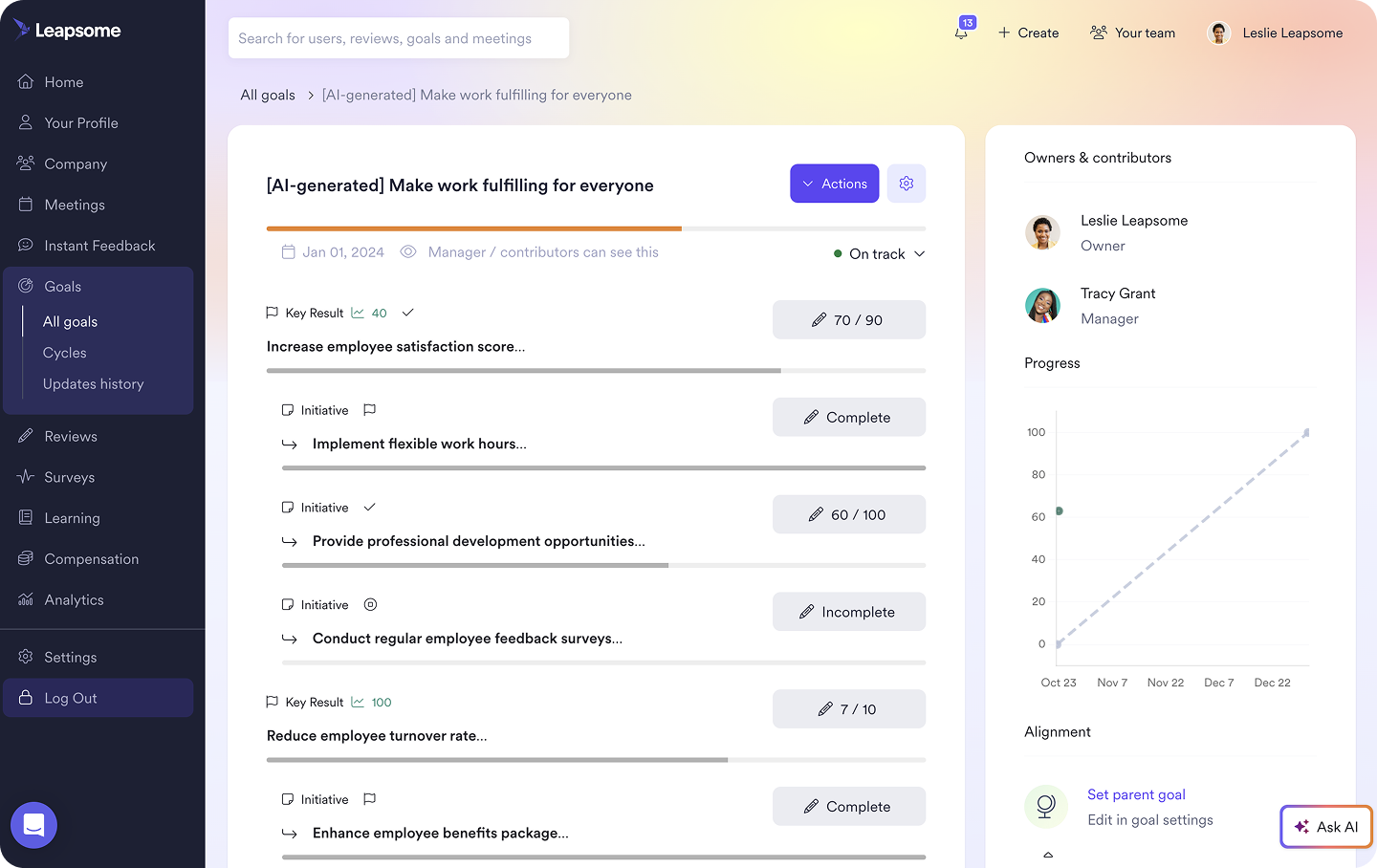
🔁 Turn performance data into people insights
Leapsome helps HR teams connect engagement, performance, and employee development trends, so the underlying people challenges are easier to spot.
👉 Explore Employee Records
Eight HR challenges and solutions
“If your department has people, you have HR. Our job is to drive the business — always has been. Now we finally have the opportunity to do it.”
— Steve Browne, Chief People Officer at LaRosa’s
Some HR problems need a deep audit to get a diagnosis. Others just need HR to connect the signal, find the source, and act before the issue spreads.
Here are eight common HR challenges and the steps you can take to solve them.
Operational HR challenges
- Disconnected employee data: Every decision takes longer to make when HR can’t rely on one source of truth. Track down duplicate information or inconsistencies, then centralize employee data in a connected HRIS.
- Manual HR processes: If HR spends more time chasing updates than advising leadership, the process has outgrown the system. Automate repeatable workflows to keep HR focused on strategy-heavy work.
- Compliance risks: Compliance gets messy when HR policies, records, and third-party data don’t align. Review where errors happen most often, then tighten ownership and documentation.
People and culture challenges
- Low engagement: Low engagement often signals a deeper issue with managers, workload, or growth. Use engagement survey results to spot where the problem is, then compare team patterns to understand why it’s happening.
- High turnover: When HR is reactive and only studies exits, turnover is harder to fix. Look earlier — at onboarding, manager support, and career growth — to spot turnover signals in time to intervene.
- Burnout: Burnout is often a big-picture planning problem, not just a question of personal well-being. Check for holes in teams’ workload, goals, and hiring strategy before just adding another wellness perk.
Strategic workforce challenges
- Talent acquisition: HR’s issues with hiring may point to poor role design or reactive workforce planning. Check whether teams are repeating the same backfills or missing opportunities to promote internal talent before opening another role.
- Skills gaps: Skills gaps grow when learning is disconnected from business needs. Link development plans to goals, performance, and future role requirements.
Are you solving symptoms or root causes?
Many HR programs fail long-term because they focus only on the most visible problem. For example, if engagement is low, reactive HR might add more pulse checks or recognition moments. When turnover rises in the same team, HR asks managers to run stay interviews.
If HR leaders don’t try to understand what’s creating the issue (in this case, whatever caused the initial drop in engagement), everyone will likely spend a lot of time polishing surface problems while the real driver stays untouched.
A better diagnostic approach starts with patterns, not panic. Here are three ways to start building your own.
Identify workforce patterns, not isolated metrics
One lagging metric, like low engagement, may look like a culture issue. But if that same team also has missed goals, low review participation, and rising absenteeism, that low engagement is a much brighter red flag.
HR managers need connected people data to see how engagement, performance, and development relate to each other and the broader employee history. Otherwise, HR’s limited visibility forces reactivity, and the bigger pattern stays hidden.
Focus on the conditions driving multiple outcomes
Once HR sees a pattern, the next step is to look past the metric. Data doesn’t tell you why something’s happening, and low engagement and missed goals are symptoms. The real issue may be that employees don’t know what good performance looks like, or managers aren’t actually giving useful feedback.
It’s easy for HR to slip back into process-first work at this stage. Another survey or training session may look productive, but it’s only worthwhile if it changes the day-to-day employee experience.
The strongest solutions improve the conditions behind several outcomes at once. For example, clearer goals and OKRs support performance, and consistent development conversations and 1:1s make growth paths feel real long before retention becomes a problem.
Track whether conditions improve over time
“When people say they’re good with change, they’re just lying to themselves. Internal resistance should be expected. The problem is we focus on resistance instead of opportunity. People just need context — we jump to execution instead of taking time to talk through the ‘why.’”
— Steve Browne, Chief People Officer at LaRosa’s
Change takes time, especially when HR is asking managers or employees to trust that a new process can improve their entire experience. It’s easier to build stakeholder buy-in when you have proof that the process works, so HR should closely track how the employee experience and key metrics change. If you train managers, feedback quality and goal clarity should improve. Or, if career growth is the priority, development conversations should become more consistent and employees should rate survey questions about their future with the company more positively.
To keep up with all these challenges and find new solutions for better outcomes, strategic HR teams need to get workforce insights from all-in-one platforms like Leapsome.
🕵️ Find issues and track fixes
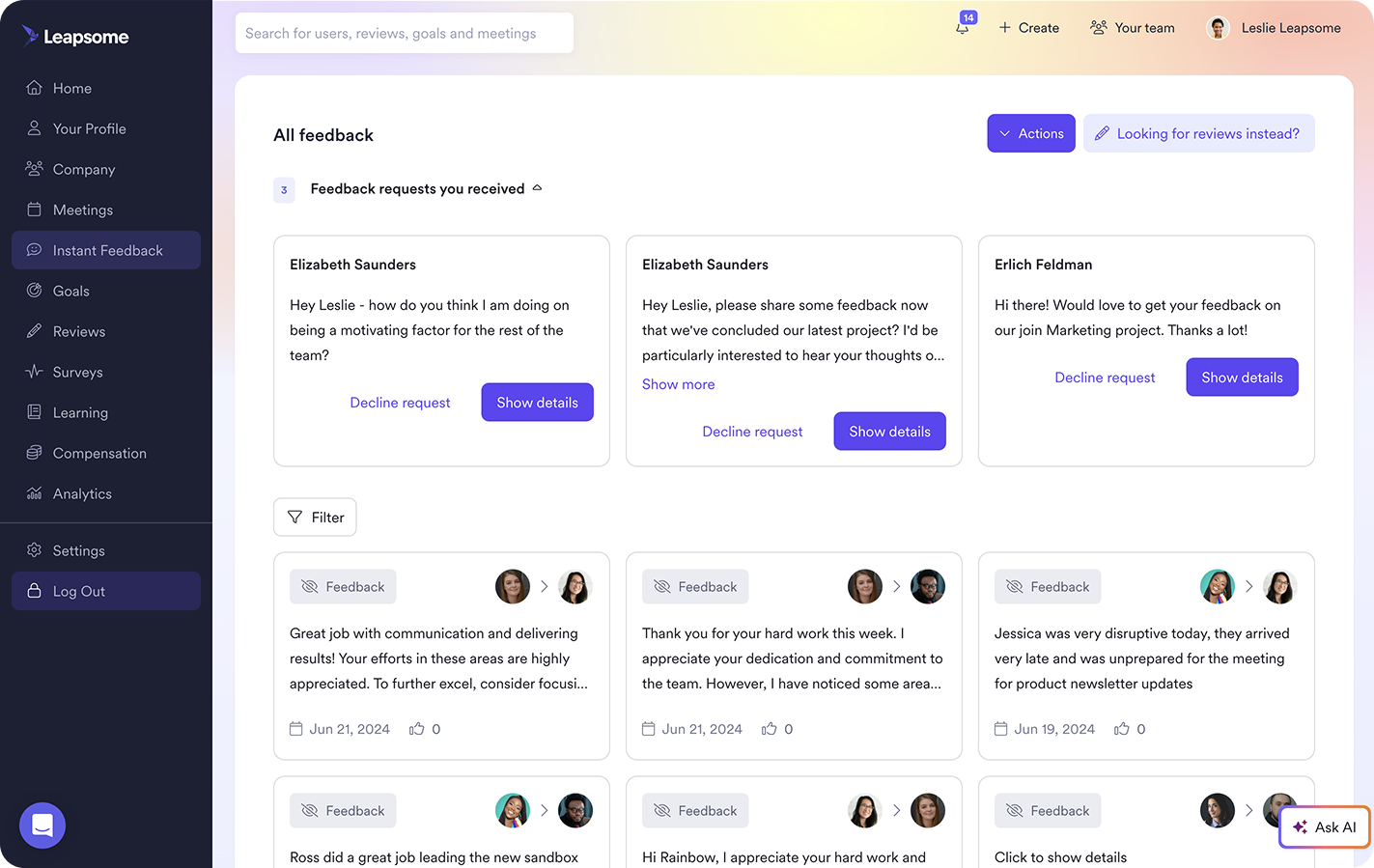
Leapsome’s Continuous Feedback helps HR spot people challenges early and see whether solutions are working as they roll out.
👉 Explore Continuous Feedback
Address HR challenges proactively with Leapsome
HR loses time and resources when every people problem is a rescue mission. One team tries to lift engagement, another tightens performance processes, and development becomes yet another siloed workflow. Everyone is busy, while the deeper issue continues to quietly damage the employee experience.
The problem with fragmented people data is that it keeps HR’s attention on the squeakiest wheel instead of revealing the full pattern early enough to act. Leapsome helps HR teams understand workforce trends by bringing together:
- Engagement: See how employees feel before disengagement turns into turnover.
- Performance: Track goals, reviews, and feedback patterns in one place.
- Development: Connect growth conversations to real employee progress.
- People analytics: Turn workforce data into clearer signals for better decisions.
Together, those insights mean HR can identify workforce risks earlier, support managers with better context, and help employees grow before people challenges become business problems.
“Leapsome did a really great job with performance, OKR, and feedback management — everything in one platform.” — Zhen Wang, People Servicer at Jina AI
🔭 Build an HR strategy that addresses the full picture
Leapsome helps HR teams connect people data across the employee lifecycle, so they can identify and focus action on the root causes of multiple challenges.
👉 Request a demo




.jpg)

.jpg)