High turnover rate explained: Causes and how to reduce it


Employee turnover rates are easy to measure, but one number doesn’t paint the whole picture. A few resignations may reflect healthy movement as people relocate, retire, or move into new roles that fit their next chapter better.
But a high turnover rate likely shows where the employee experience is breaking down. It usually means something in the organization is making it harder for employees to stay. This might be unclear career paths, managers who lack the support to lead well, or the actual company culture not matching what leadership promised during interviews.
If HR teams treat a high turnover rate as a hiring problem only, it pushes the organization into a cycle of backfills and repeated exits. In this guide, we’ll explain what a high turnover rate means and what causes it, then explore how HR teams can reduce turnover by fixing the systems behind employee exits.
What’s a high turnover rate?
HR teams usually measure employee turnover as the percentage of employees who leave during a specific period, such as a month, quarter, or year. A high turnover rate means employees are leaving the organization faster than expected for its size, industry, and growth stage. On average, businesses in the United States have a turnover rate of 13%, according to a 2025 iMercer survey, and turnover rates above 20% annually are generally considered high.
Some job turnover is expected, and a work environment with no movement at all may have problems with limited growth or internal mobility. But when turnover climbs and stays high, HR teams need to look beyond the numbers and find the real reason why people no longer see a reason to stay.
Repeated exits are a problem for finance teams as much as HR teams. According to SHRM, replacing an employee can cost between 50% and 200% of the role’s annual salary. For leaders, it’s not financially sensible to keep replacing employees during periods of high churn without fixing the systems that pushed them out.
How to calculate employee turnover rate
To determine your turnover rate, use this formula:
Turnover rate = (number of employees who left ÷ average number of employees) x 100%
For example, if the company had an average of 200 employees during Q1 and 12 people left during Q1, the quarterly employee turnover rate would be 6%.
It’s useful to calculate employee turnover in smaller segments, too. Tracking turnover across departments (or even roles) can surface insights about things like manager effectiveness and misaligned role expectations that could be driving employees away.
Are you experiencing high turnover?
Reactive HR teams might use exit interviews to explain why someone left, but they can’t recover the knowledge, trust, and momentum the organization has already lost.
Strategic HR teams continuously track and analyze turnover trends, so they can spot where exits are increasing and what those departures have in common.
Here are a few early warning signs of high employee turnover:
- Frequent resignation in specific teams: If one team loses employees faster than others, HR should treat it as a manager or department-level distress signal. Lopsided turnover often points to friction within the team environment, like ineffective managers, burnout caused by lack of support, or unresolved conflicts that only reach HR when someone resigns.
- Difficulty retaining new employees beyond six months: Early turnover often means there’s a gap between what new hires expect and what they experience. The role may have been poorly explained during hiring or onboarding may lack structure.
- Declining engagement or morale: Engagement issues often appear long before your employee turnover rate rises. If survey participation drops and employees stop raising concerns, HR should treat the silence as a red flag for disengagement (which could lead to high churn).
Common causes of high turnover
“An ineffective manager doesn’t take time to understand their people or build trust… without connection, communication, and safety, performance will always suffer.”
— Anja Schauer, Global Head of Customer Success at Leapsome
Employees generally don’t leave for no reason, and it’s not common for employees to flee at the first sign of a problem. More often, team communication and trust have been failing for some time when an employee submits a resignation letter.
Exit reasons might sound simple: a better offer, a change of pace, or a misalignment between the role and what they expected. Those reasons are valid, but they can mask deeper systemic problems. Here are a few of the most common reasons organizations experience high turnover rates, and what you can do about it.
Common causes of high turnover
Lack of career growth and development
“If people are there and they’re quitting while they’re still there, they’ll do all the upskilling with the thought that they’re going to leave.”
— Steve Browne, Chief People Officer at LaRosa’s
According to SHRM, one of the top three reasons employees quit is a lack of career development opportunities. Turnover tends to be higher when employees can’t see a clear future inside the organization, and that doesn’t always mean a promotion. Growth can also mean technical skill development or a role that better suits their strengths and aspirations.
Gaining visibility on an employee’s growth potential requires centralized documentation. When employee data lives in one place, performance insights in another, and learning progress in a completely separate system, this can create uneven development. One employee might get a thoughtful career conversation with their proactive manager, while another waits for months for vague feedback and starts looking elsewhere in the meantime.
Lack of feedback and recognition
Without regular input, employees can spend weeks or months guessing whether they’re meeting expectations or doing work no one notices. Feedback can be positive or negative, but both help employees understand their work in the bigger picture.
Recognition fills a different gap: It shows employees that their effort is visible and valued. Gallup found that well-recognized employees are 45% less likely to leave after two years. Improving feedback and recognition mechanisms is a crucial way to retain top talent and reduce high staff turnover rates.
By using an all-in-one HRIS and people management platform like Leapsome, HR teams can store employee data and get a better sense of big-picture engagement and feedback. Consistent feedback and recognition means HR teams have a better chance of spotting who’s well-supported and who could use a boost before turnover rises.
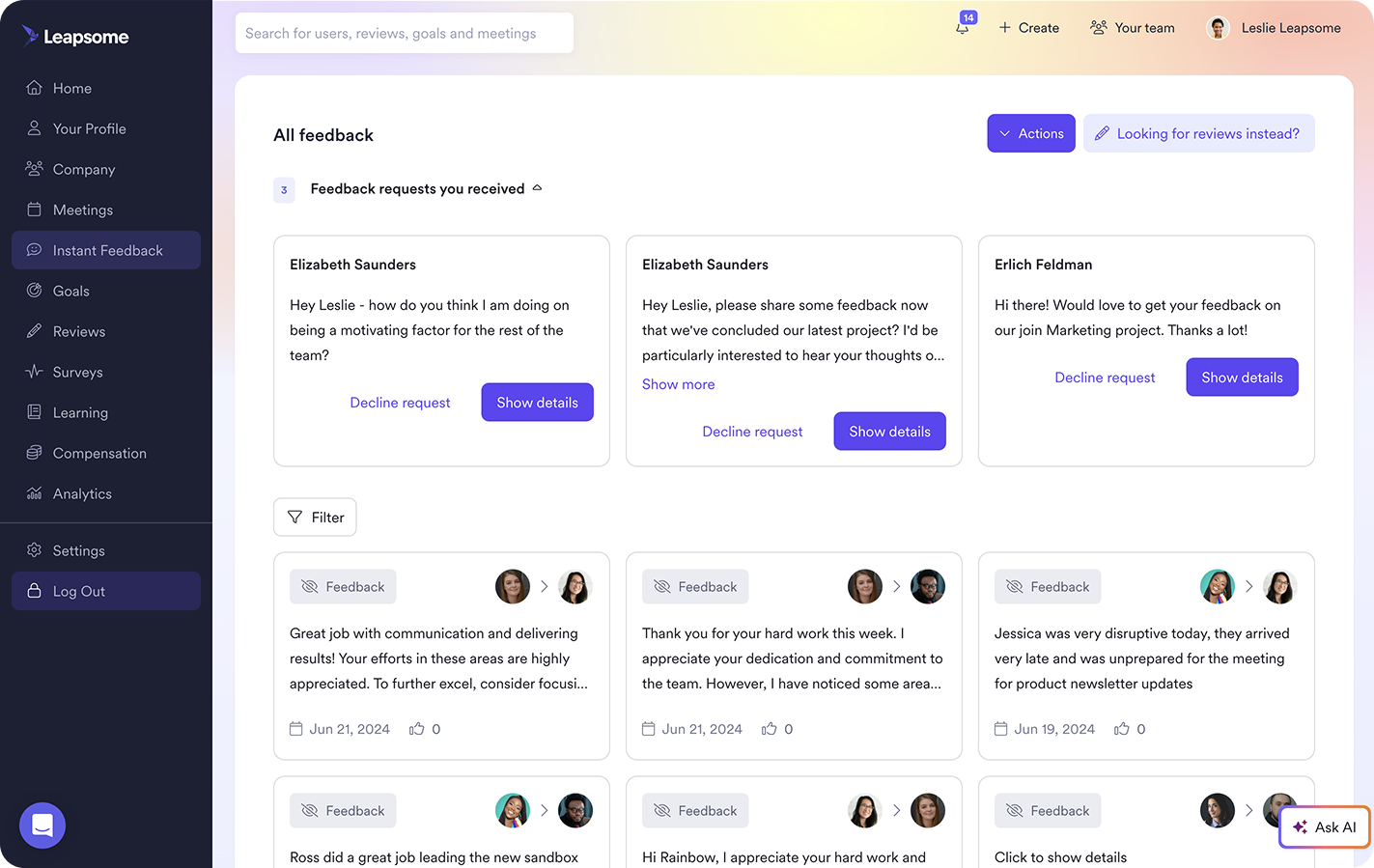
💬 Reduce turnover risk with instant recognition
Leapsome’s Instant Feedback tool helps teams share feedback, recognize progress, and surface concerns before they grow into turnover risks.
👉 Explore Instant Feedback
Poor company culture
“Disengaged employees who stay quietly can drain a company faster than those who leave. Engagement isn’t about who stays, it’s about who contributes with energy and ownership.”
— Emma Leeds, Founder and CEO at People Function
A toxic company culture doesn’t always show up as extreme expectations or open hostility between colleagues. Sometimes, its effects manifest as quiet disengagement. Employees keep attending meetings but not actively participating, or completing their tasks without feeling invested in the outcome, because they feel nothing they do matters.
Poor cultural fits are a major driver of high turnover: Gallup found that problems with engagement and company culture encompass the most common reasons employees leave their jobs, accounting for 47% of responses. Instead of treating culture as a broad sentiment score, managers and HR teams can use regular 1:1s and pulse surveys to find out if employees feel disengaged or unsupported before they decide to leave.
How to reduce high turnover in three steps
To reduce high turnover rates, HR teams need a structured system for finding where employees disengage from their roles. Then, they can fix the conditions that make leaving feel like a better option than staying.
Here are three steps to help your team stop the problems that lead to high turnover.
1. Identify what’s at the root of departures using data
“Change management and agility are vital — proactively react to market shifts and tie HR data together into a storyline that connects sentiment, turnover, and business results.”
— Katerina Arsova, Head of People, Talent Operations, and Partnerships at Leapsome
Instead of treating every resignation as a one-off, look at where turnover clusters. If the same team, tenure group, or role keeps losing people, HR has a pattern to investigate. Use different people data to spot what’s breaking:
- Engagement surveys show where sentiment is dropping, which may point to declining trust or weak communication.
- Performance reviews uncover whether employees understand expectations and see a future in the organization.
- Continuous feedback reveals whether managers give timely support and recognition before frustration turns into disengagement.
When you connect turnover data to employee engagement, performance, and feedback signals, you can see which part of the employee experience needs to change and create a practical action plan.
2. Strengthen onboarding and create clear career paths
“Employees who keep learning will outrun automation. The organizations that invest in skill growth will retain that talent and thrive.”
— Jonathan Passmore, Senior Vice President at EZRA
Lower turnover means stronger retention, and retention starts earlier than many organizations realize. SHRM reports that employees are 58% more likely to stay with a company for at least three years when they have a structured onboarding program.
So, onboarding is the first point in the employee lifecycle where people decide if the organization is prepared to help them succeed. If they only receive tool access and policy reminders, HR has technically completed the onboarding process — but reduced the likelihood of long-term retention.
To improve onboarding, create a map of the first 30, 60, and 90 days to guide new hires through the process. Map learning milestones to role expectations, and work with managers to check in and give feedback early and often throughout the process. Career paths, development goals, and learning plans should build on the expectations you set during onboarding, so people understand how they can grow with your organization before leaving feels like the only path forward.
3. Implement engagement systems and track retention metrics
Onboarding gives employees a strong start, and career development gives them opportunities to grow, but HR needs to regularly check whether people still feel supported enough to stay.
That support comes through the people systems employees interact with every day: how managers listen, how they handle feedback, and whether good work gets recognized. In fact, SHRM notes that companies with effective recognition initiatives report 31% lower voluntary turnover.
Instead of waiting for exit interviews to find out an employee felt ignored for months, HR should keep the conversation active at predictable intervals. Feedback loops and retention surveys give employees ways to share how work feels and help managers respond before frustration builds, so recognition is part of your normal operating rhythm instead of an occasional empty gesture.
Retention metrics show HR teams if those efforts are working. Employee satisfaction rates and absence rates can identify who’s at risk of turnover, for instance. Teams can track how long employees stay after onboarding, if strong performers see a future inside the organization, and whether turnover drops.
🚀 Use employee sentiment to boost retention
Leapsome’s Engagement Surveys help HR teams measure and track how employees feel, then act before dropping engagement becomes turnover.
👉 Explore Employee Surveys
Improve retention with Leapsome
HR teams need to see where employees are losing clarity, support, trust, or motivation before they decide to leave, then intervene.
Leapsome helps HR teams stop high turnover in its tracks with multiple tools:
- Engagement surveys: Track sentiment, spot where engagement is dropping, and ask employees what they need to feel supported.
- Continuous feedback: Help employees and managers recognize progress and surface concerns before they become a reason for resignation.
- Performance management: Connect performance reviews and goals with development conversations, so employees understand expectations and growth opportunities.
- People analytics: Identify trends across teams, managers, and roles before high turnover becomes a culture risk.
With all these signals in one connected HRIS and people management platform, HR teams can use Leapsome to move from reacting to exits to improving the conditions that motivate employees to stay.
“With Leapsome, we’ve seen some amazing improvements. The initiatives we identified from the survey results decreased our turnover by 12.2%, increased our survey participation rate to 82%, and it made people more productive and excited to come to the office. Listening and transparency are a part of our culture, and Leapsome is a tool that gives our people a voice. The results are visible to the team members, so they can openly discuss with their managers during their retros.” — Natasa Kovacevic, People and Culture Manager at Eurowings Digital
🤝 Support retention with connected people insights
Leapsome brings engagement, performance, and people data into one connected platform, so HR teams can identify retention risks and act before a few resignations become an organizational crisis.
👉 Request a demo


.jpeg)

%20(1).png)