Beyond headcount: How to choose and evaluate manager span of control

.jpg)
Managers only have so much time and attention to spare. The number of direct reports each manager oversees — their span of control — determines how widely that capacity is spread.
Organizations evaluate span of control to improve both individual manager effectiveness and overall efficiency. This number affects feedback quality and workforce performance, employee engagement, and even succession planning initiatives.
Leadership quality is under pressure. Manager engagement has plummeted to 22%, barely higher than the average employee engagement of 19%.* These signals reflect how many supervisors have too much to do and too many people to oversee, hurting their ability to give every direct report the attention they deserve.
In this guide, we’ll explain why manager capacity is a better predictor of success than team size. You’ll learn how to optimize span of control not just by adding more managers, but by creating conditions that enable them to lead better.
* Gallup, 2026
What’s span of control?
Span of control is defined as the number of direct reports a leader or supervisor manages. Organizational structures usually divide span of control into two broad categories: narrow and wide.
A narrow span of control means each people manager has a small number of direct reports, typically less than five according to Gallup. This structure is more common in technical or inexperienced departments, where employees need close supervision.
A narrow span of control is more hierarchical, which allows for stronger team cohesion and closer day-to-day oversight. But it can also lead to stifling hand-holding and decision-making bottlenecks.
“Micromanagement shows you don't trust me. You hired me to do a job, treat people like adults in the workplace.”
– Liliya Apostolova, former VP of Marketing at Leapsome
In contrast, a wide span of control means managers have more subordinates to keep tabs on, often 10 or higher. This structure supports greater employee autonomy and empowerment, making it ideal for environments with experienced teams and self-directed work. Yet managers can’t give each employee as much support, which may hurt job satisfaction and retention numbers.
Team size is a red herring: Why capacity matters more
How many direct reports should a manager have? The Gallup research we looked at above found that the median team size is 5–6 employees per manager. And the same study revealed that how many people a manager oversees affects team performance more than employee engagement.
Larger teams, with 12 or more employees, can still thrive — as long as they’re highly engaged and backed by effective management. The right question isn’t “What's the ratio of managers to employees?”, but “How many meaningful relationships can this manager maintain?”
In many cases, the reason one manager flourishes under a wider span while another collapses comes down to whether they have too much on their plates. Here are some of the biggest contributors to variations in workload:
- The complexity tax on capacity: Specialized and technical teams generally require more involvement from managers. When employees build complex projects or solve open-ended problems, they need more frequent input and work reviews, as well as highly specific, actionable feedback.
- Employee experience levels: Junior employees require more hand-holding than seasoned pros, who often thrive on independence. A manager with six direct reports who are all veterans in their fields faces an entirely different challenge than someone supervising six new grads.
- Pace of organizational change: During periods of restructuring, rapid growth, or transformation, managers become the liaison between leadership theory and workforce reality. The coaching and oversight burden doesn’t change, but managers have the added responsibility of fielding anxiety and uncertainty while keeping momentum going strong.
“Managers should be the frontline of care, creating safety, connection, and trust. But too often, they’re the frontline of defense, fielding tough news with limited context. Companies need to equip them with the right tools and communities so they can lead with confidence.”
– Luck Dookchitra, former VP of People and Culture at Leapsome
How to optimize span of control: Three steps
This framework will help you figure out the best management spans of control for different teams.
1. Match workloads to complexity
“We keep measuring whether people show up or not. We should be measuring what they’re doing when they’re there. Quantity only measures activity.”
– Steve Browne, Chief People Officer at LaRosa’s
Just as there’s no universal span of control for every organization, there’s no single number that works for every team. Tailor each manager’s span of control to their team’s complexity, and speak with them one-on-one to uncover where capacity might be stretched too thin. In some cases, reducing a manager’s headcount by just one or two people can make the difference between failure and success.
2. Watch the data, not the org chart
Declining performance and engagement scores are often early indicators that a manager is reaching their breaking point. HR teams that regularly review these signals can catch emerging issues early enough to intervene. Consider using anonymous surveys to regularly gauge team morale and productivity.
3. Invest in support and development
Recent research conducted by CMI revealed that 82% of managers received no special training when they entered their first leadership roles. So it should come as no surprise that, according to Gallup, only 20% of managers show high talent for the role. What’s more, half of employees have left a job due to poor management at least once.
The takeaway is that restructuring teams shouldn’t be the first lever you reach for. Investing in managerial development programs and structured 1:1s can be a far more effective approach.
To do that well, your tools matter just as much as your strategies. When managers have what they need to run effective coaching and improve engagement, the quality of their relationships with direct reports tends to strengthen. With Leapsome, you can foster manager development through structured communications and AI-powered people insights.
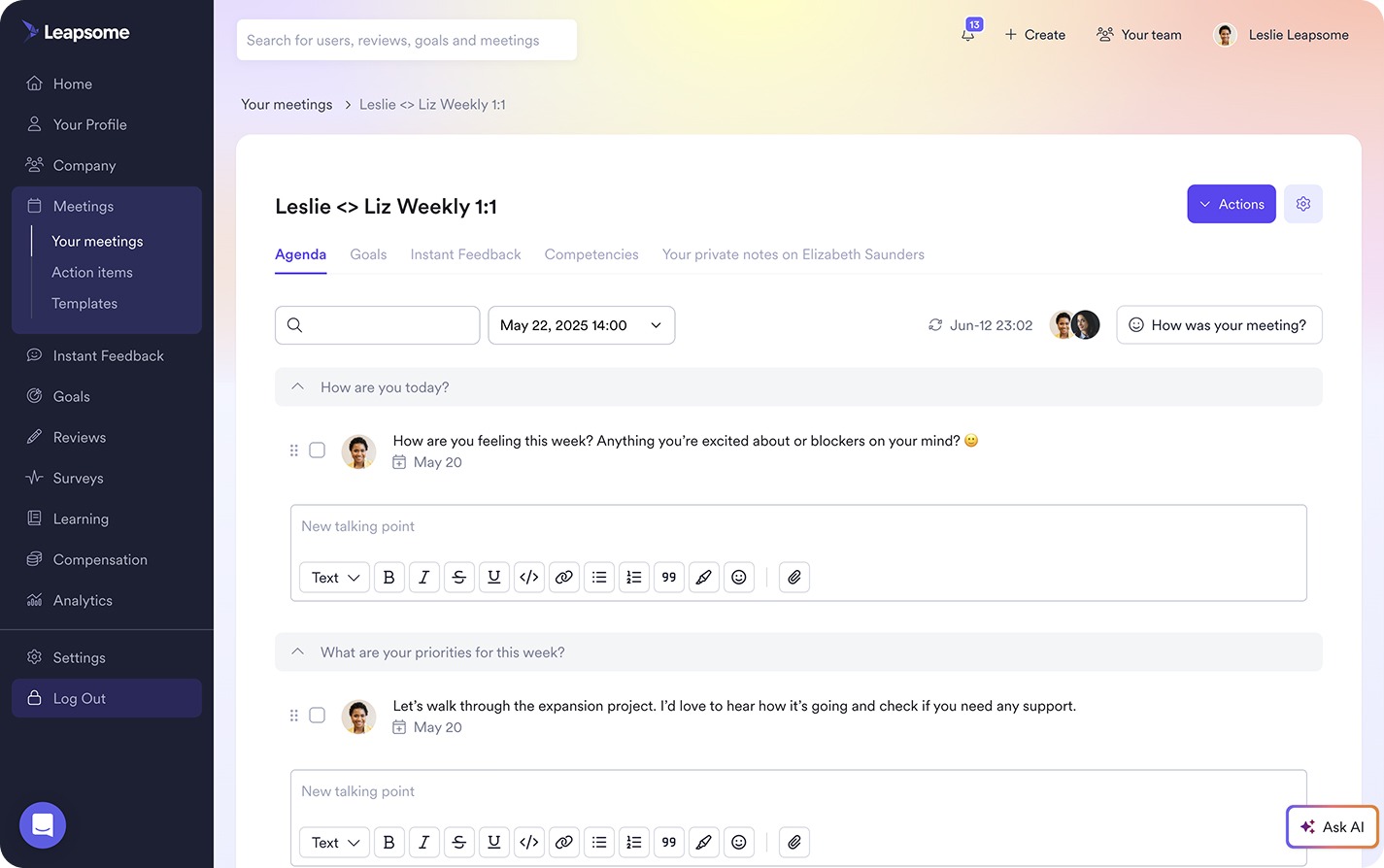
🤝 Help managers nurture productive and lasting relationships
Leapsome helps HR teams promote accountability and performance through reusable meeting agendas and tools to maintain alignment.
👉 Explore Meetings
Manager overload warning signs
These warning signs will help you decide whether your organization is at risk for manager overload:
- Feedback quality devolves: When managers have overly demanding workloads, it’s hard to find time for meaningful coaching. Feedback becomes general, reactive, and rare, leaving employees to fend for themselves.
- Employee engagement dips: Disengagement doesn’t run — it creeps. Because managers have so much influence on engagement, even subtle declines can mean they’re starting to crack under pressure.
- Burnout becomes contagious: Burnout often isn’t flagged until it has already taken hold. Watch for 1:1s that grow shorter and more generic, and increasing disengagement among subordinates.
Evaluating and adjusting span of control
Recognizing the warning signs is only half the battle. Here’s what you can do about them.
Measure manager workload, not just headcount
“An ineffective manager doesn’t take time to understand their people or build trust. The best ones care deeply, they know where you want to grow, challenge you when needed, and make space for honest feedback.”
– Luck Dookchitra, former VP of People and Culture at Leapsome
According to a Gartner survey, three in four HR leaders say their organizations’ managers are overwhelmed by expanding responsibilities. Tracking the number of direct reports might be easier than evaluating workloads, but it doesn’t fully capture how demanding the role is. Check in regularly with managers to see where their time is going, and whether there’s enough of it to go around.
Update structures as the organization evolves
As headcount changes and strategy evolves, span of control should shift with them. Regularly revisit the way teams are structured, so span of control decisions become ongoing conversations instead of one-off plans that don’t survive disruption.
Regularly dig into the data
Disengagement and declining feedback quality are two of the earliest indicators that managers are growing overwhelmed. Periodically review those numbers at the team level, and do it often enough to catch potential problems before they spiral. A people analytics tool like Leapsome can help you track, segment, and generate insights from the data.
“Busy doesn’t mean effective. True productivity starts with clarity on what success looks like and why it matters. When people see how their work connects to company goals, they find energy and meaning in what they do.”
– Priscila Bala, CEO at LifeLabs Learning
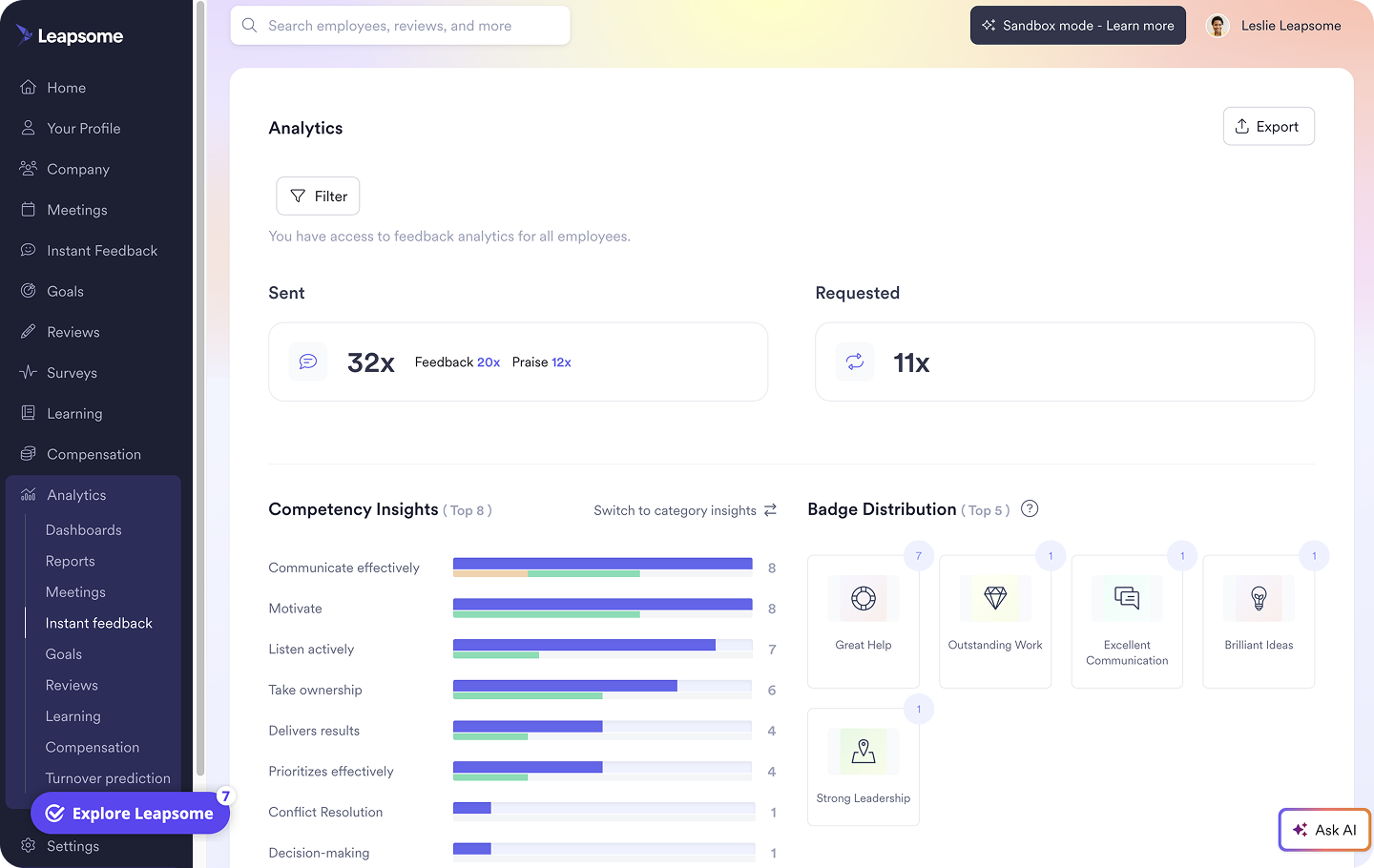
📈 Leverage data for smarter span of control decisions
Leapsome lets organizations centralize workforce analytics, like engagement and performance metrics, and pair them with AI-generated insights so you can catch overload early.
👉 Explore People Analytics
Bring out the best in every manager with Leapsome
Organizations that struggle with overloaded managers and fragmented workforce visibility are the rule, not the exception. Leapsome aims to tip the balance by centralizing workforce analytics, while facilitating engagement and performance management.
With Leapsome’s HRIS and people management tools, your HR team can:
- Monitor engagement and performance trends: Connect performance review data and engagement survey results with AI-generated insights to spot concerning patterns early.
- Support more effective manager development: Build custom development paths for managers to nurture their talent and keep them engaged.
- Identify team and leadership risks earlier: Employ predictive models to anticipate turnover risk and understand what’s driving it, to avoid overwhelming managers with constantly shifting teams.
“With Leapsome, we were able to automate performance reviews, goal setting, and onboarding and offboarding, and together that helped us reduce about 20% of our team’s manual efforts.” – Weronika Czerny-Nowakowska, Chief Operating Officer at Neurons Lab
📈 Create the conditions for managers to thrive
Leapsome gives HR teams the visibility, tools, and insights needed to support managers at every stage, from spotting early warning signs to building employee development programs.
👉 Request a demo




.jpg)