Setting company policies: Which ones matter and how to support them


Disclaimer: This content is for general informational purposes only and does not constitute legal advice. Leapsome does not guarantee legal compliance and cannot confirm how specific situations would be assessed in court. If you're unsure how the requirements apply to your organization, please consult qualified legal counsel.
Structured company policies give HR and managers a shared standard for handling day-to-day situations. They also help protect both employees and the organization in more unusual or difficult moments.
But writing down a policy doesn’t mean people will use it, even if it’s well-polished and full of pretty graphics. In one Gartner survey, 87% of employees said they’d dealt with situations over the previous year where they weren’t sure how to comply with company policies.* When docs sit in disconnected systems or are never referenced again after onboarding, employees rely on unwritten rules and managers fall back on personal judgment.
Effective policies must be easy to find and consistently reflected in how managers organize work. In this guide, we’ll cover the most important guidelines and how to write them, and we’ll show you how to keep them relevant as your business scales.
* Gartner, 2025
What role do company policies actually play?
Company policies are written rules that explain how an organization handles workplace decisions and what it expects from employees. They help team members understand how the business approaches everything from leave requests to data security. These general company policies are distinct from procedures, which explain the steps employees should follow in specific situations.
Strong company policies serve three key purposes:
- Support compliance: Clear guidelines help your organization meet legal obligations, and they show employees how to respond in regulated circumstances.
- Create consistency and fairness: Shared standards reduce the risk that managers will handle similar situations differently across teams.
- Set clear expectations: Employees can make better decisions when they understand the organization’s boundaries and responsibilities.
How to create company policies people won’t just ignore
"If you're asked ‘what is the process’ and you're finding yourself thinking ‘Oh, I have to write it down,’ maybe those are the kinds of signals you should make standard operating processes."
– Sammie Masley, People and Talent Partner at Leapsome
According to Deloitte, HR professionals already spend 57% of their time on admin. Unclear policies drain even more resources, since you’ll need to field constant questions and misunderstandings. Good policies lay out guidelines using language that’s easy for employees to understand and for managers to apply.
Here’s how to make that happen:
- Use employee-friendly wording: Avoid legal jargon when plain language will do, and define any terms employees may not recognize.
- Bring stakeholders into the process: HR should work with legal counsel and relevant business leaders before approving any policy.
- Treat policies like living documents: Set repeatable review cycles, communicate changes promptly, and remove outdated versions before they cause confusion.
Six common company policies every organization should have
Each company needs a list of HR policies that suit both its workforce and legal obligations. Still, most face the same points of friction as they grow. Let’s look at six examples of policies you’ll want to put in place (yesterday).
1. Workplace codes of conduct
When your organization leaves “acceptable behavior” open to interpretation, managers often enforce different standards across teams. Clear guidelines help leaders act consistently before poor behavior becomes part of the culture.
A workplace conduct policy defines how employees must treat colleagues and represent the company. This is also the place to outline the ways workers can raise concerns, and how HR will respond to misconduct allegations.
2. Employee lifecycle and workplace operations guidelines
These policies explain how the organization manages key employment moments in the employee lifecycle, from hiring through offboarding. Here, you should include any details about probation periods, workplace accommodations, company equipment, and remote work rules.
“We've intentionally created clear hybrid policies — twice a week in the U.S., five times in Berlin — because culture and context differ. The key is clarity: Set expectations, be honest about the why, and keep evaluating if it still works.”
– Luck Dookchitra, former VP of People and Culture at Leapsome
This guidance prevents managers from improvising decisions that affect employee trust or may create avoidable compliance risks.
3. Time off, attendance, and working hours policies
Clear guidance can account for different working models without leaving every request open to negotiation. These policies explain when employees need to be available and how they’ll report time away. They should also give managers one consistent process for approving leave.
But even the most thorough time off and attendance policy only works when the system behind it reinforces those same rules. Leapsome’s HRIS and people management platform places leave guidelines inside the workflow employees and managers already use. Employees can check the current policy before submitting requests, while managers approve leave through one central hub.
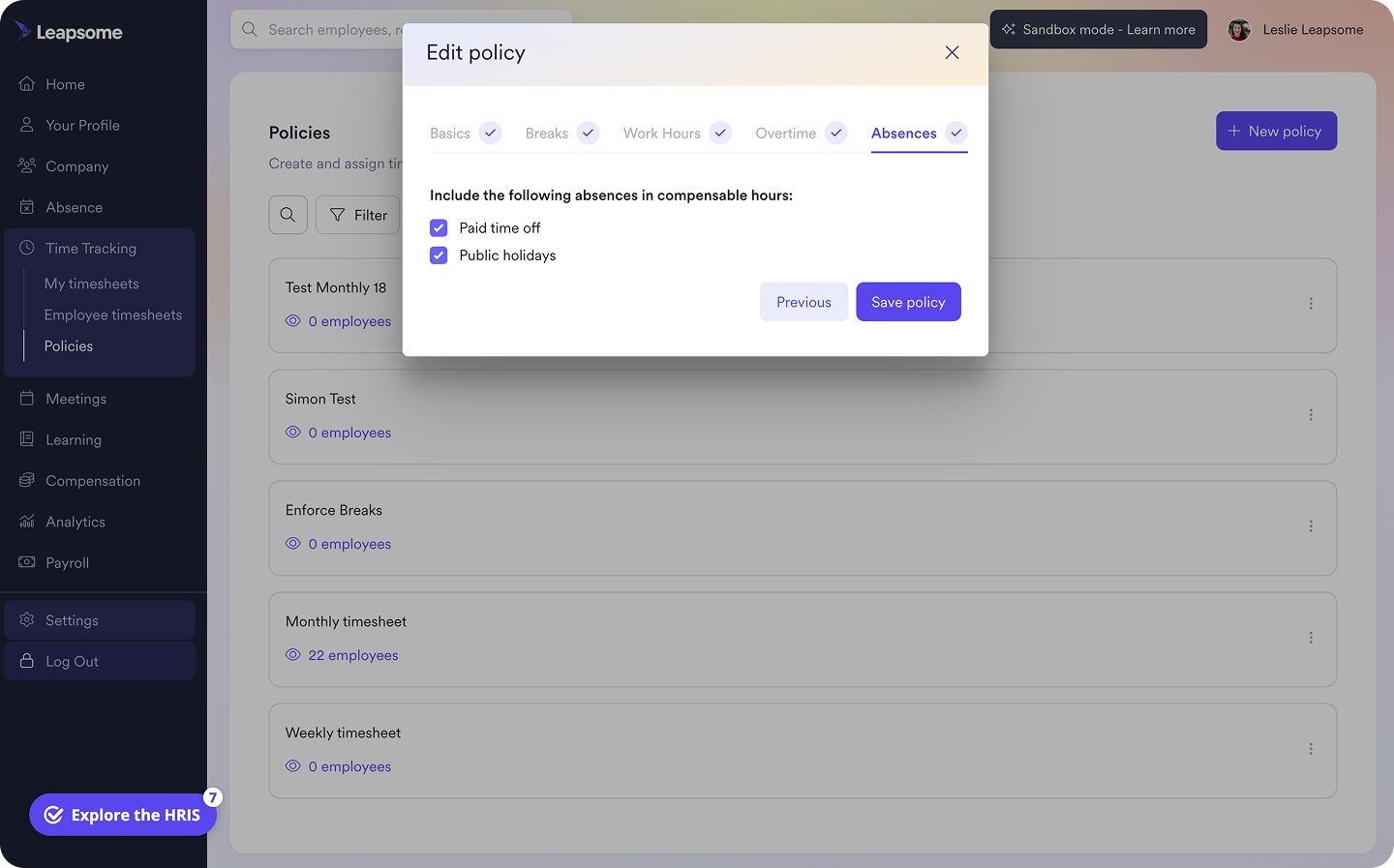
⚙️ Turn policy into practice
Leapsome brings policy guidance and leave requests into the same workflow, so employees know what to expect and managers follow a pre-defined process.
👉 Explore Absence Management
4. Data security and privacy rules
“People are already using AI privately. Companies now need to legitimize that use — but with guardrails to protect sensitive data and keep innovation safe.” – Luck Dookchitra, former VP of People and Culture at Leapsome
Employees now move company info between systems that older confidentiality policies never anticipated. AI tools add a new layer of risk, because employees may share sensitive data without realizing it goes outside approved company systems.
A data security policy should explain how employees must handle organizational details and personal data. It should also set boundaries around approved software and AI use, and clarify when team members need approval before sharing data.
5. Compensation and benefits policies
“Transparency doesn’t mean sharing every number. It means explaining the logic — how pay decisions are made, what criteria are used, and how people can grow within the structure.”
– Alexandra Edl, Senior HR Consultant at EDL Consulting
According to AON research, only 19% of businesses feel they’re ready for pay transparency, while just 29% say they’ve improved this area in the past 12 months. Instead of leaving decisions up to informal conversations, HR can use compensation policies to standardize and clarify how the organization approaches salary review and pay changes. And benefits policies should define eligibility and show employees where to find support.
6. Equal opportunity regulations<
An equal opportunity policy defines how your organization prevents discrimination across key dimensions like hiring, pay, promotion, and termination. This guidance should also explain how employees can raise concerns or request reasonable accommodations. When equal opportunity is more than a vague value statement, team members can feel confident that the company will act if someone crosses the line.
How to make company policies part of everyday work
Policy enforcement often stalls after approval. HR uploads the final documents, includes them in onboarding, and assumes the organization will follow the new rules. But if your policies aren’t easily accessible and connected to daily work, they’re just easily ignored suggestions.
“This work can't just be HR's problem. It has to be built into your business foundation — into your policies, your processes, and your management training.”
– Madison Butler, Founder at The Employee Journey Blueprint
When managers have clear guidelines, HR can spend less time acting as the company rulebook and more time empowering people. Here’s how to make policies active resources that help teams grow:
- Put someone in charge: Give each policy an owner who checks to see if it still reflects current law and the way the organization works today.
- Bring guidance back at the right moments: Introduce policies during onboarding, then resurface them when managers face related decisions.
- Create one reliable source of truth: Make the latest policy versions easy to access, and ask employees to acknowledge substantial changes.
Policy adoption might start during orientation, but it needs visibility throughout the employee lifecycle. Leapsome keeps current policies within the same platform team members use daily.

🔁 Connect policies to the employee lifecycle from day one
Leapsome keeps guidance visible from onboarding onward, so employees can follow the latest policies without friction.
👉 Explore Preboarding and Onboarding
How Leapsome helps HR teams manage company policies at scale
Growth exposes weak policy management quickly. One team follows the latest guidance, while another relies on an old PDF, and HR spends time answering questions the policies clearly cover. Scattered systems make it hard to know which version employees have seen or whether managers apply the rules consistently.
Leapsome brings policy management into one connected HRIS and people management platform, where HR teams can:
- Centralize policy documents: Keep current guidance alongside employee records, so everyone has access to the latest updates.
- Build policies into onboarding: Share the right documents with new hires, and collect signatures as part of the same workflow.
- Track policy updates: Distribute revised guidance and verify who’s reviewed it without manually chasing down confirmations.
- Reinforce expectations through learning: Turn complex policies into structured training, when you’re not confident signatures alone will change behaviors.
“Ahead of implementing Leapsome, we had lots of different ways of managing the review process across the organization. Not only did we want to create one global approach to managing the review cycle consistently, but we also wanted a tool that supported our managers in having genuine conversations with their people.”
– Holly Smith, Culture and Employee Experience Manager at ComplyAdvantage
💼 Put your HR policies to work
Leapsome helps HR teams connect written guidance with on-the-ground people management as your organization grows.
👉 Request a demo
FAQ
What are the most common company policies for employees?
The most common types of employee-focused company policies include:
- Behavioral codes of conduct
- Operational guidelines for key moments like onboarding and offboarding
- Working hours and PTO policies
- Data security and privacy rules
- Guidelines for compensation and benefits
- Equal opportunity regulations

.png)


Automate, connect, and simplify all HR processes across the employee lifecycle.