How to choose the right talent management system for your organization

.jpg)
According to research by McKinsey & Company, organizations with excellent talent management are six times more likely to report higher total return to shareholders than competitors with weak talent management.* That’s a staggering competitive advantage. So why do so many HR teams still struggle to translate people strategy into better business outcomes?
Part of the problem is a fundamental tension in how HR tools are built. Most are designed around company goals and high-level metrics, making it easy to track business outcomes while leaving HR leaders with little insight into how their people are actually doing (whether they’re engaged or disengaged, burnt out or thriving, etc.). The result is an ironic blind spot: In trying to optimize for business performance, organizations lose sight of the very thing driving it.
Talent management systems are designed to close that gap. By consolidating people data and workflows into a single platform, they give HR leaders and people managers the visibility they need to take a genuinely people-first approach — one that, in turn, produces the business outcomes they’re after.
In this article, you’ll learn how talent management systems work, when you might need one, and how to find the right fit.
*McKinsey & Company, 2021
What’s a talent management system?
A talent management system, or TMS, is a comprehensive platform that helps HR teams streamline a huge range of tasks, including:
- Recruiting and onboarding new hires
- Measuring and promoting employee engagement
- Monitoring team performance
- Running learning and development programs
- Managing compensation
- Planning succession
A good talent management system isn’t just a bunch of isolated tools in one package. Integrated talent management platforms tie everything into a central command center for understanding, developing, and retaining your people across the entire employee lifecycle.
Does your company really need a talent management system? Key signs
“Before you even start comparing vendors, it’s critical to clarify what problems you’re solving and how success will be measured…It’s not to diminish manual work but to consolidate data in a secure location.”
— Expert Panel, Forbes Human Resources Council
Here are some signals that your organization might benefit from talent management technology:
- People development has stalled: You regularly run performance reviews and learning and development programs, but processes feel disconnected and backed by your best guesses, not data.
- Reporting takes hours: Even simple reports burn through resources faster than they should due to manual processes or disjointed data.
- Rapid growth: Keeping up with a growing headcount is taking exponentially more time and effort. Siloed tools in your current HR tech stack make people processes inconsistent, and you’re wasting time moving or cross-referencing information between multiple tools.
An effective talent development system solves these problems via four pillars: a centralized human resource information system (HRIS), structured performance management, interconnected learning and development tools, and engagement measurement.
Even if you’re already working with a talent management system, chances are it’s limited to applicant tracking, contracts, and approval workflows. For the best results across the employee lifecycle, you need a solution that puts people development first. It should link performance with engagement to help HR leaders spot patterns, so you can understand what’s happening and why, then take the right steps to address it.
🔎 Understand your company culture from the source
Leapsome’s AI-powered surveys let you ask employees about their workplace happiness, then spot trends in that feedback using advanced analytics.
👉 Explore Leapsome’s Employee Survey tool
Seven of the best talent management solutions on the market
According to a 2024 Gartner survey, just 35% of HR leaders believe modern HR technology helps their organization achieve their business goals. A further two out of three believe they need to take action to improve their approach to HR technology or risk HR’s effectiveness dropping even more.
In many cases, the problem isn’t a lack of good options, but choosing the wrong software. HR teams need solutions that go beyond basic payroll and time tracking. The best products prioritize people strategy to help you build and develop a highly skilled workforce.
Here’s a breakdown of seven popular options, exploring their strengths, weaknesses, and who they’re best suited for.
1. Leapsome
Best for: Small and scaling, forward-thinking businesses
Leapsome is a comprehensive HRIS that bakes its people-first ethos into every feature, making it perfect for effective talent management. For example, users can set up customizable, growth-driven performance reviews and engagement surveys, then dig into the data with intelligent analytics for better-informed decision-making that improves team well-being.
Because Leapsome has a wide range of features, from form builders to payroll tools to absence management, the initial learning curve may feel on the steep side for some users. However, teams can pick and choose which features they need and which can safely be ignored, making Leapsome suitable for organizations of all sizes.
2. Workday HCM
Best for: Enterprise teams of ~300–1,500 employees
Workday’s human capital management (HCM) software is scalable and configurable. Advanced talent management features include interactive learning and development solutions, an AI-driven talent acquisition framework, and actionable insights for improving people strategies. However, Workday’s pricing is on the higher side, and some users find the implementation process complex.
3. SAP SuccessFactors
Best for: Large, globally distributed organizations of at least 1,000 employees
This HCM is especially useful for onboarding. SAP SuccessFactors comes with features like AI-assisted onboarding with customizable programs and an integrated onboarding dashboard. That said, many users find the user interface outdated and unintuitive, and the software can be expensive (especially compared to more modern competitors).
4. BambooHR
Best for: Small to mid-size businesses wanting simple, affordable HR tools
BambooHR has an easy-to-use interface and built-in global workforce payments for a diverse talent pool, designed for small businesses with 10–500 employees. On the other hand, it has limited automation features, and payroll is a paid add-on, unlike most HRIS platforms.
5. Rippling
Best for: Teams needing HR, IT, and finance management in one place
Rippling is a strong choice for fast-growing companies with 50–5,000 employees. It’s particularly well-suited for managing talent across national borders, and it takes a modular, automatable approach that helps streamline operations.
When it comes to drawbacks, some users mention that Rippling’s implementation process is sluggish and customization features are limited.
6. Culture Amp
Best for: Companies prioritizing employee engagement analytics
Culture Amp comes with deep people analytics. Its AI-driven insights are presented in an intuitive way accessible to a general audience. However, smaller teams may balk at the price, and Culture Amp lacks some performance and compensation workflows provided by similar platforms.
7. Lattice
Best for: Mid-market teams focused on performance management and retention
This platform links compensation to performance ratings by automatically pulling review data when making compensation decisions. Lattice is less comprehensive than other solutions, however, lacking the built-in time and applicant tracking tools most other programs have out of the box.
What every talent management system needs to actually improve outcomes
Look for these talent management software features so you don’t discover process-breaking gaps after you’ve already committed to a platform.
HRIS capabilities
It can take hours to reconcile numbers from fragmented data and procedures when you have to bounce from tool to tool. Well-designed talent management system software includes robust HRIS features that unify fundamental HR functions, like employee records, payroll, and time off.
Bringing everything into one place eliminates unnecessarily time-consuming and error-prone administrative overhead, so you can save resources and get better results.
Performance reviews and check-ins
If your performance management workflow involves one-off reviews instead of structured review cycles, your team might not be learning from their work very well. Great talent management systems include an integrated toolset linking goals and feedback from regular reviews and updates from check-ins. This gives HR teams broad visibility across each employee’s development so they can monitor and log progress in one place.
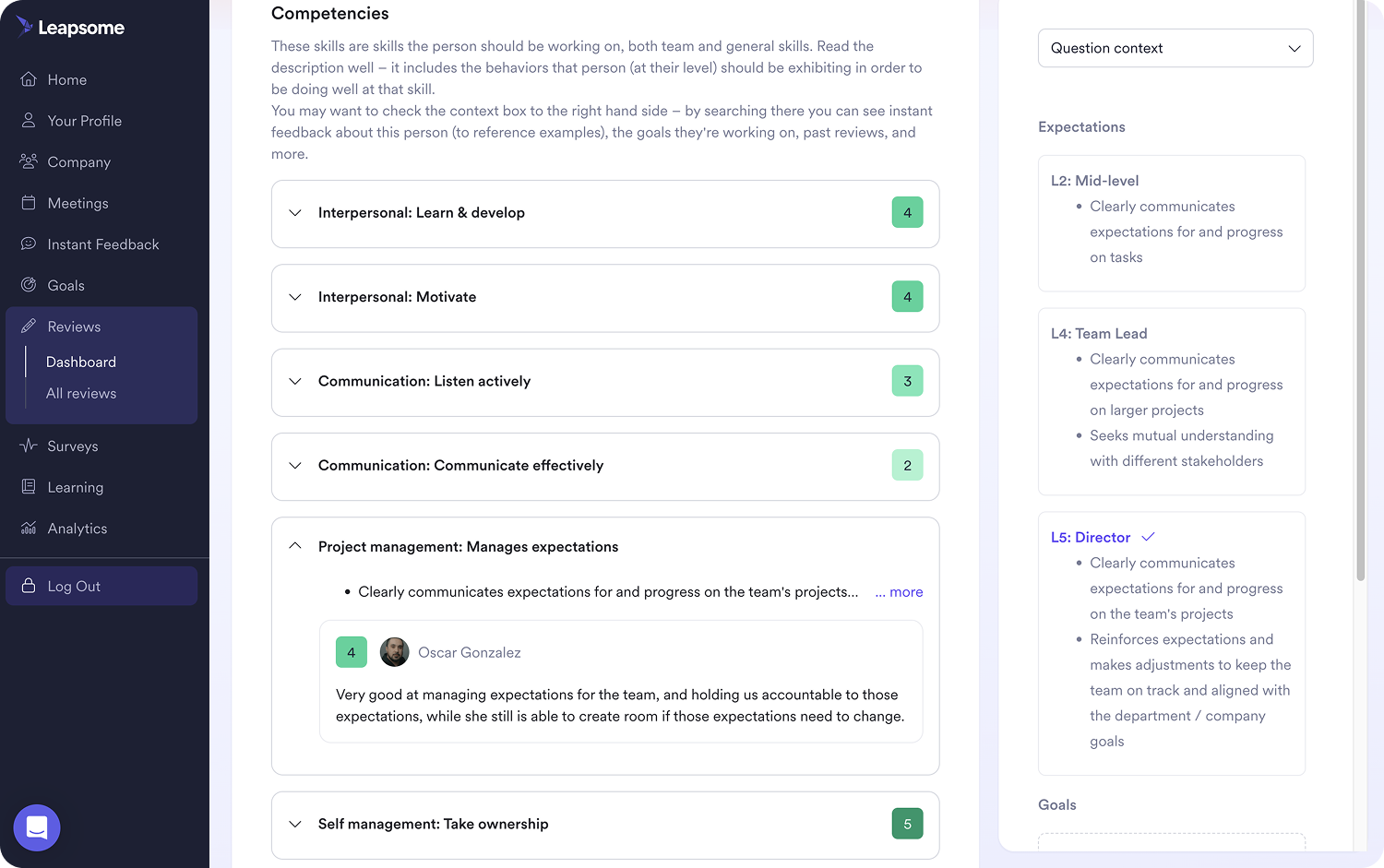
🔎 Gauge performance as it happens
Use customizable performance review templates to explore trends and measure overall workforce performance at your convenience.
👉 Learn more about Leapsome’s Performance Management
Employee engagement measurement and surveys
Don’t waste your time trying to spot patterns in isolated, confusing data points — this isn’t “A Beautiful Mind.” Effective talent management systems come with dedicated employee engagement features, such as sentiment surveys, analytics, and automatically generated insights that connect engagement patterns to broader workforce data.
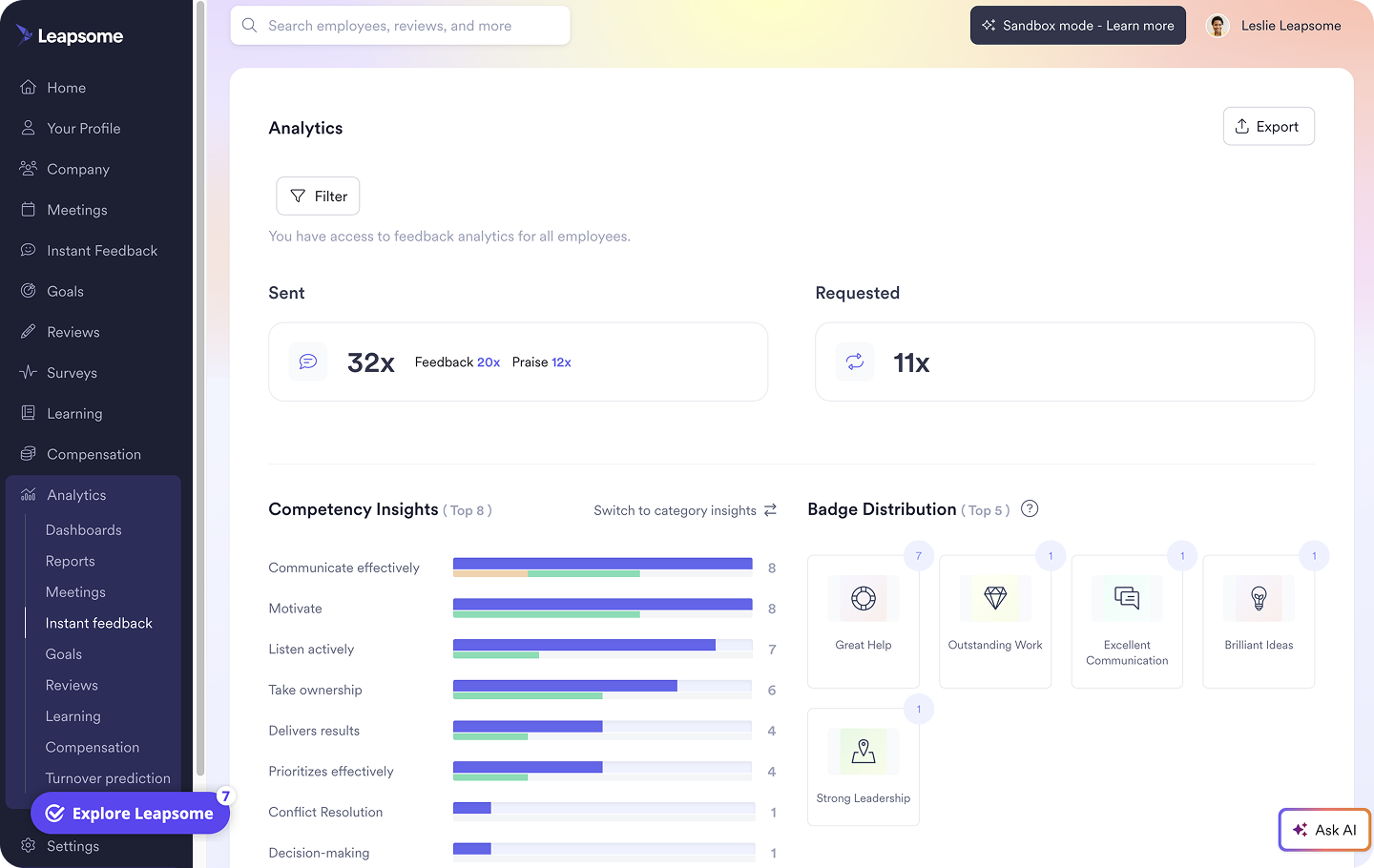
🔢 Make the most of your data — no stats degree required
Trade best guesses for automated AI-driven insights to make decisions that drive growth.
👉 Explore Leapsome’s Analytics
How to find a talent management system that works as hard as your team
“Netflix’s superpower is its revolutionary talent management system. It favors people over processes; it treats managers as responsible adults and gives them the freedom to make decisions for their parts of the business…It rewards high performers…”
— McKinsey & Company, 2024
Finding the best talent management platform for your organization means matching product features with your priorities and needs. Netflix focuses on retaining their top employees with generous compensation packages and plenty of managerial autonomy, but your company may take a different approach.
Here’s how to evaluate the options to find the best match for your team.
1. Clarify priorities to start the search with intention
Analyze your company’s engagement, development, and succession-planning needs to give structure to your quest. This makes for a more efficient search that quickly rules out solutions that definitely won’t fit.
For example, if your performance review process could use some work, you might prioritize finding a platform with structured learning and development features and continuous feedback tools.
2. Hunt down weaknesses in your current tech stack
Look for areas where your existing solutions aren’t up to par. List every missing or unsatisfactory feature and describe why exactly they’re not working to guide your search. Bottlenecks and inefficiencies (like data you’re still manually transcribing) will point you toward what you should look for in a new program.
3. Investigate the implementation experience
Onboarding speed varies widely across talent management systems. So, pick a platform that matches how much time you have for setup — rushing to get a new process in place hurts more than it helps.
If you’re attached to certain tools and don’t want to lose them in a complete overhaul, look for solutions like Leapsome that offer a wide range of integrations with little extra overhead.
4. Find the most cost-effective solution for your needs
Once you have a shortlist of candidates, compare their pricing. Compile licensing fees, admin time, and migration costs for each platform you’re considering. Don’t forget to double-check which features are included and which aren’t. You don’t want to build buy-in and then have to pivot thanks to unexpected added costs you can’t cover.
Stack your team with the best talent
While easy HR process management is a win, the ultimate goal is attracting and retaining incredible talent. You need to look at your HR foundation: Does process dictate your people work, or does people work dictate your process?
Leapsome was designed with people strategy in mind from the very beginning. Unlike many traditional platforms, it’s the foundation of what we do — not an add-on package or afterthought.
Leapsome lets you connect performance management, engagement tracking, and employee sentiment for a unified approach to people strategy. Combined, these features eliminate manual HR workflows and still offer deep workforce visibility by replacing a tangle of disconnected tools and data with one interconnected, centralized dashboard.
Our easy setup means you can get up and running fast. Once you do, you’ll be able to go beyond managing basic processes to continuously improve the way you build up your team.
“Employees can now find everything in one place — their data, absences, goals, and reviews. I don’t have to explain which tool to use for what. It’s all in Leapsome.” — Merilyn L., Senior People Operations Specialist at Bob W.
💪 Say goodbye to disconnected systems and fragmented workflows
Leapsome gives HR teams an integrated platform for managing people data, conducting productive performance reviews, and measuring engagement.
👉 Request a demo
FAQ
What are some effective tools for talent management?
The best talent management tool on the market depends on your organization’s needs. Small teams comfortable with their existing HRIS but looking to give talent management a boost might stick with traditional talent management tools like ADP Talent Management or Workday. Teams who are ready to replace their HR tech stack might want a more comprehensive solution like Leapsome.
How does a talent management system work?
Talent management systems put HR data, performance, engagement, and learning efforts in a single piece of software. The major benefits of talent management systems include less tool sprawl and better visibility backed up by real data.