9 best HR tools for pulse surveys in 2026
.png)
Running more pulse surveys alone won’t improve employee engagement. Acting on feedback while it’s still fresh will.
Pulse surveys are short, recurring surveys you run frequently, and from which HR teams get a timely snapshot of overall employee sentiment. This makes it easier to spot issues early and act before small problems turn into systemic ones.
Research shows a clear link between regular engagement measurement and timely follow-through, with better business outcomes — including higher profitability and productivity, and lower employee turnover and absenteeism.*
In this article, we compare the best HR tools for pulse surveys in 2026, so you can choose one that will help you surface potential issues early and support faster, better decisions instead of just keeping the data isolated in dashboards.
Let’s get started.
*Gallup, 2024.
🌱 Run engagement surveys that actually lead to change.
Engagement surveys work best when results flow directly into goals, feedback, and development, not static reports. See how Leapsome helps HR teams turn engagement data into clear actions across one connected platform.
👉 Explore Leapsome’s engagement surveys
Best HR tools for pulse surveys: top features and use cases
This list evaluates pulse survey platforms based on how effectively they help HR teams move from employee feedback to action. We’ve factored in speed to insight, ease of execution, and how you can connect pulse data to broader people decisions.
All tools included support ongoing employee pulse surveys, but they differ significantly in how they handle analytics, integrations, and follow-through. Some solutions work better for lightweight, always-on listening, while others embed pulse surveys into performance, goals, and people analytics workflows.
If you understand these differences early, you’ll save time and resources on potential migration later on.
Disclaimer:
Information is accurate as of January 2026, based on publicly available product documentation, vendor websites, and review platforms. Features and capabilities evolve over time. Buyers should validate details directly with vendors before making a final decision.
{{TABLE}}
Leapsome: Best for turning pulse feedback into measurable business outcomes
.jpg)
Leapsome approaches pulse surveys as part of a connected human resources information system (HRIS) that supports how teams operate across the entire employee lifecycle.
Rather than treating surveys as a standalone listening exercise, Leapsome embeds pulse feedback directly into core HR data, performance reviews, goals, learning, and analytics, all within one system of record. This reduces tool sprawl and removes the need for exports, duplicate data, or manual stitching across platforms.
For HR teams under pressure to streamline their tech stack and demonstrate impact, this is critical.
Pulse results live alongside employee data and workflows, making feedback immediately usable in manager conversations, people decisions, and follow-up actions. Surveys become an operational input, not an extra layer of work.
This is why Leapsome is a strong fit for organizations looking to consolidate tools, reduce context switching, and use pulse surveys as part of a broader HRIS strategy, rather than managing engagement in isolation.
Key capabilities
- Flexible survey design that fits real org structures. Configure survey cadence, anonymity thresholds, and custom questions to match team size, maturity, and change cycles. Surveys follow proven employee engagement survey questions and employee survey best practices, without forcing one-size-fits-all templates.
- Surveys embedded into continuous feedback and manager workflows. Pulse feedback flows into a continuous feedback system, enabling managers to discuss results in context and follow up through goals, feedback, or development actions. Open text responses are supported and summarized to surface themes, with guidance on using open comments in engagement surveys.
- Built-in people analytics, not isolated dashboards. Engagement trends, segments, and priority areas are visible directly inside the platform. People analytics tools surface patterns across survey rounds without spreadsheets or manual synthesis. AI assistance supports summarization, while interpretation and decisions stay with HR and managers.
- Feedback connected to development and execution. Survey insights link directly to corporate learning solutions and OKRs and goal setting, making it easier to translate feedback into targeted development plans and aligned execution.
- Group-level trend analysis across teams and locations. Compare engagement trends across offices, departments, or manager populations. Examples include Berlin vs New York or Sales managers across regions, helping HR spot meaningful differences and patterns over time.
- Simple, shareable reporting for stakeholders. Export survey results in PowerPoint (PPT) format to support leadership updates, planning discussions, and alignment without manual rework.
Best for
Leapsome is a strong fit for mid-sized to enterprise organizations that want to replace fragmented engagement tools with a unified HRIS-led system. It works well for HR teams focused on manager enablement, execution, and demonstrating how pulse surveys contribute to measurable outcomes across the employee lifecycle.
What customers say about Leapsome
“With Leapsome, we’ve seen some amazing improvements. The initiatives we identified from the survey results decreased our turnover by 12.2%, increased our survey participation rate to 82%, and it made people more productive and excited to come to the office. Listening and transparency is a part of our culture, and Leapsome is a tool that gives our people a voice. The results are visible to the team members, so they can openly discuss with their managers during their retros.”
— Natasa Kovacevic, People and Culture Manager at Eurowings Digital
“I would recommend Leapsome without hesitation. It’s been cost-effective, covers everything from performance reviews to surveys, and is backed by a team that truly supports us.”
— Steve Hoffman, Chief People Officer at Mark43
“Using Leapsome, especially for engagement surveys, saves me hours. I used to collect everything in Excel, run calculations, and compare results manually. Now it’s all in one place, it’s faster, easier, and gives us clearer data.”
— Lianne De Vries, People Lead at TicketSwap
🌱 Turn pulse feedback into action without switching tools.
Pulse surveys deliver real value when feedback is connected to performance, goals, and development, not trapped in standalone tools. See how Leapsome turns employee feedback into action across one unified platform.
👉 Explore Leapsome’s HRIS
Officevibe by Workleap: Best for lightweight pulse surveys
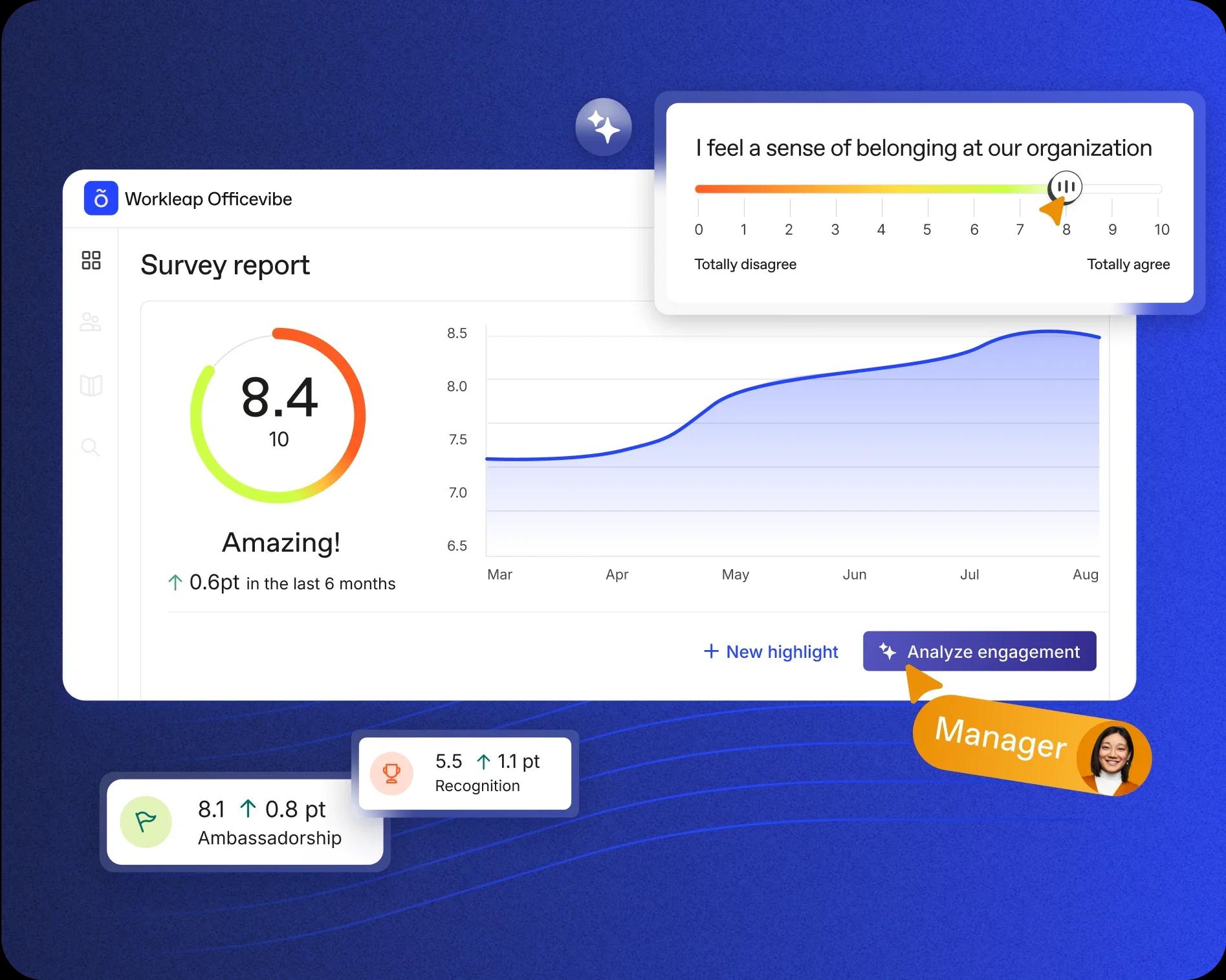
Officevibe is designed for teams that want a simple, low-friction way to check employee sentiment on a regular basis. The platform focuses on short, recurring pulse surveys that are easy to deploy and easy for employees to answer, making it a common choice for organizations prioritizing participation and consistency over depth.
For HR teams that want to establish a baseline listening habit quickly, Officevibe offers a straightforward entry point.
Key capabilities
- A large library of ready-made questions that support frequent pulse surveys
- Short and repeatable survey design
- Anonymous feedback to encourage honest responses
- Simple dashboards with trends and issues highlighted
- AI-recommended actions
Best for
Officevibe is a good fit for teams that value simplicity and are looking for a lightweight pulse survey platform that supports regular check-ins and manager awareness.
What customers say about Officevibe
“Officevibe provides a regular stream of honest feedback and discussion between managers and employees across our company.”
— G2 reviewer
“I’ve used it as an employee, it’s really quick and easy to use. My supervisor said it’s easy to set up. “
— Reddit user
Culture Amp: best for engagement benchmarking and pulse surveys at scale
.jpg)
Culture Amp is built for enterprise organizations that want to combine pulse surveys with large-scale engagement measurement and external benchmarking. The platform emphasizes survey depth, comparative insights, and longitudinal tracking across teams, roles, and regions.
It is often used by organizations that want to understand how engagement trends compare internally over time and externally against broader benchmarks, rather than focusing primarily on day-to-day execution workflows.
Key capabilities
- Extensive survey libraries with ready-to-use surveys and customizable questions
- Strong benchmarking capabilities with segmentation and tracking options
- Dashboards designed for organizational analysis
- Unbiased AI comment summaries
- Individual and central reports for parent companies and subsidiaries
Best for
Culture Amp is well-suited for mid-sized to enterprise companies that prioritize benchmarking and engagement analytics at scale, especially where HR teams own analysis and reporting centrally.
What customers say about Culture Amp
“Culture Amp makes it really easy to gather and analyze employee feedback in one place.”
— G2 reviewer
“ It’s easy to use. As long as your data is put in correctly, you can pull all kinds of reports. “
— Reddit user
Lattice: best for pulse surveys connected to performance management
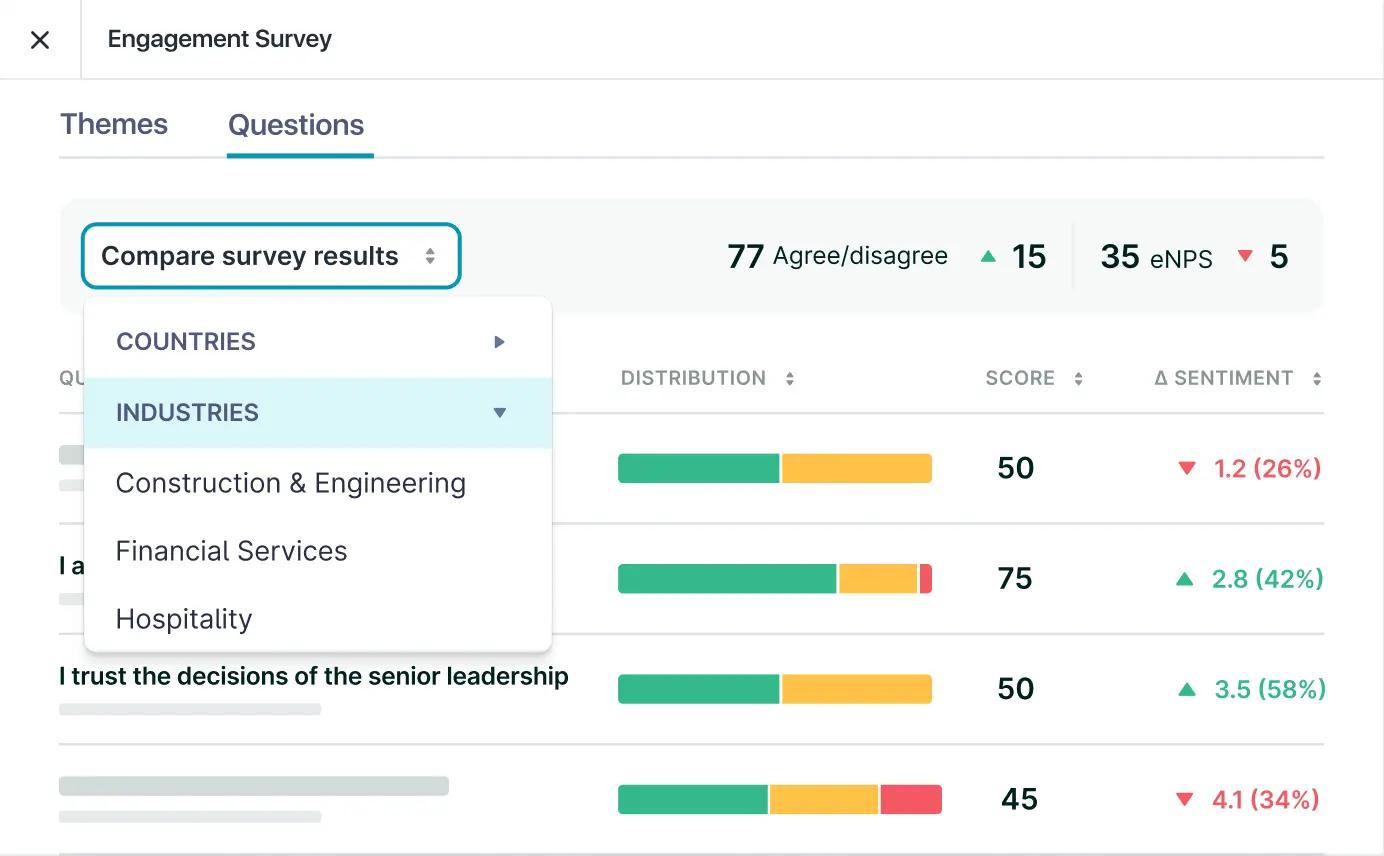
Lattice’s pulse surveys are a part of a broader performance management system. The tool connects employee listening to reviews, goals, and feedback, with a strong focus on structured performance cycles.
HR teams typically use pulse surveys in Lattice to complement performance conversations rather than act as a standalone engagement measurement layer.
Key capabilities
- Recurring pulse surveys that feed into performance and engagement insights
- Parallel view of survey results, performance reviews and goal progress
- Advanced engagement analytics or benchmarking
- Easy export of real-time data to share with the management team
- Instant AI insights as soon as the survey is closed
Best for
Lattice works well for organizations that already rely on structured performance management processes and want pulse surveys to support those workflows rather than operate as a separate engagement system.
What customers say about Lattice
“Lattice has tools that helps me stay organized and attentive to my team's projects, goals, development areas, enabling me to show up as the best leader I can. “
— G2 reviewer
“We use Lattice for performance management, and we like the tool and its AI features. We are looking forward to having most of the HR processes in the same tool.”
— Reddit user
15Five: best for manager-led continuous feedback and check-ins
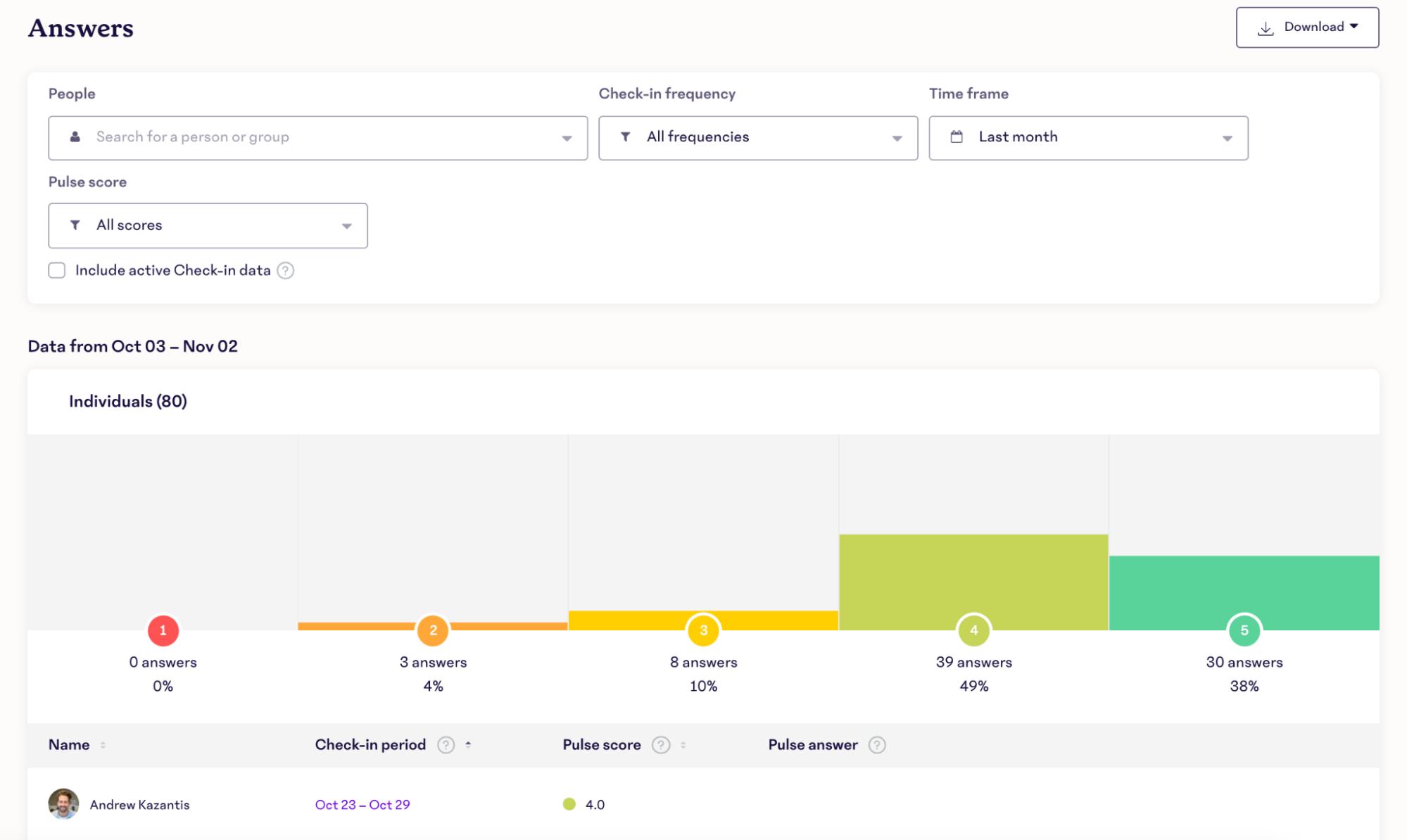
15Five focuses on ongoing manager-employee communication, with pulse surveys supporting regular check-ins and feedback loops. The platform is designed to help managers stay close to team sentiment through frequent touchpoints.
Pulse surveys are often positioned as part of a broader weekly or biweekly rhythm rather than as a dedicated engagement analytics tool.
Key capabilities
- Diverse survey options: short questions, check-ins and feedback features
- Benchmarking and employee Net Promoter Score (eNPS) surveys and tracking
- Customizable and targeted questions for specific segments
- Dynamic heatmaps to visualize engagement across teams
- Predictive Impact Model that guides the HR team’s focus
Best for
15Five is a good fit for organizations that want to strengthen manager-led feedback and check-ins, especially where engagement conversations are owned at the team level.
What customers say about 15Five
“I really appreciate the interface — it's user-friendly, dynamic, and simple to manage. Integration with our core human resources management system (HRMS) is straightforward.”
— G2 reviewer
“I find 15Five very relevant as it provides good feedback from our survey and has relevant topics in the transform series for our managers.”
— G2 reviewer
Workday Peakon Employee Voice: best for continuous listening in Workday-centric enterprises
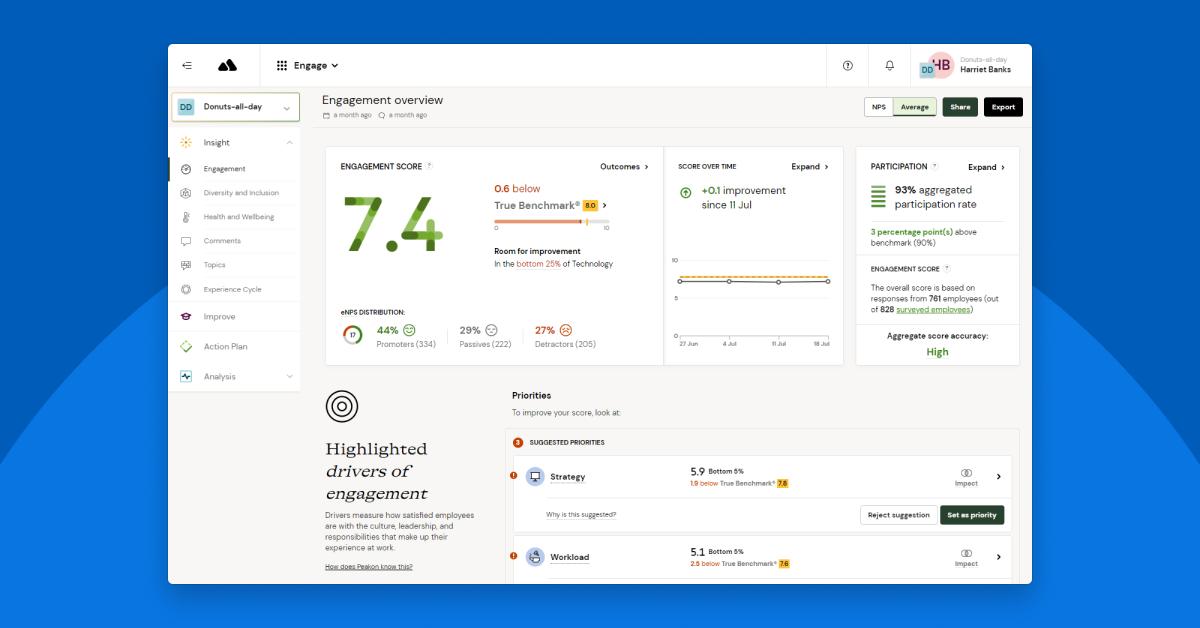
Workday Peakon Employee Voice is designed for organizations already using Workday as their core HR system. The platform supports continuous listening and engagement measurement within the broader Workday ecosystem.
Pulse surveys are positioned as part of enterprise-grade HR operations rather than a standalone engagement solution.
Key capabilities
- Frequent pulse surveys with advanced segmentation
- Enterprise-level reporting
- Tight integration of survey data with the Workday human capital management (HCM)
- Personalized action plans and learning resources for managers
- Coverage for different devices, communication tools, and languages
Best for
Workday Peakon is best suited for large enterprises that are deeply invested in Workday and want pulse surveys that are easily embedded into their existing HR infrastructure.
What customers say about Workday Peakon Employee Voice
“Peakon allows users and employees in a company to easily provide feedback about how they feel working there while providing leaders with useful insights and training to address issues in their organization.”
— G2 reviewer
“The integration is very easy to set up and I don't think it requires much maintenance. And the UX is pretty good, many helpful tips for first time users.”
— Reddit user
Personio: best for pulse surveys built into an HRIS for European teams
.webp)
Personio offers pulse surveys as part of its broader HRIS, with a strong focus on European organizations. Surveys are positioned as an embedded HR feature rather than a specialized engagement or analytics product.
Pulse surveys in Personio are typically used to complement core HR processes like employee data management and administration.
Key capabilities
- Precise, science-based scores within Personio’s own People Matter framework
- Psychology-backed templates you can use immediately
- A library with 200+ questions and customization options
- Inshight sharing with ready-to-use presentations
- Custom reports and segmentation features
Best for
Personio is a practical option for European teams that want pulse surveys included in their HRIS and do not require advanced engagement analytics or complex execution workflows.
What customers say about Personio
“What I particularly like [about Personio] is the ability to customize many things individually – for example, [...] creating custom feedback cycles, or incorporating automatic calendar notifications. ”
— G2 reviewer
“Personio has a clean, intuitive interface that makes daily HR tasks like managing employee data and contracts very simple. It centralizes documents, approvals, and employee information in one place, which saves time and reduces manual errors.”
— G2 reviewer
TINYpulse: best for simple, anonymous pulse surveys for small teams
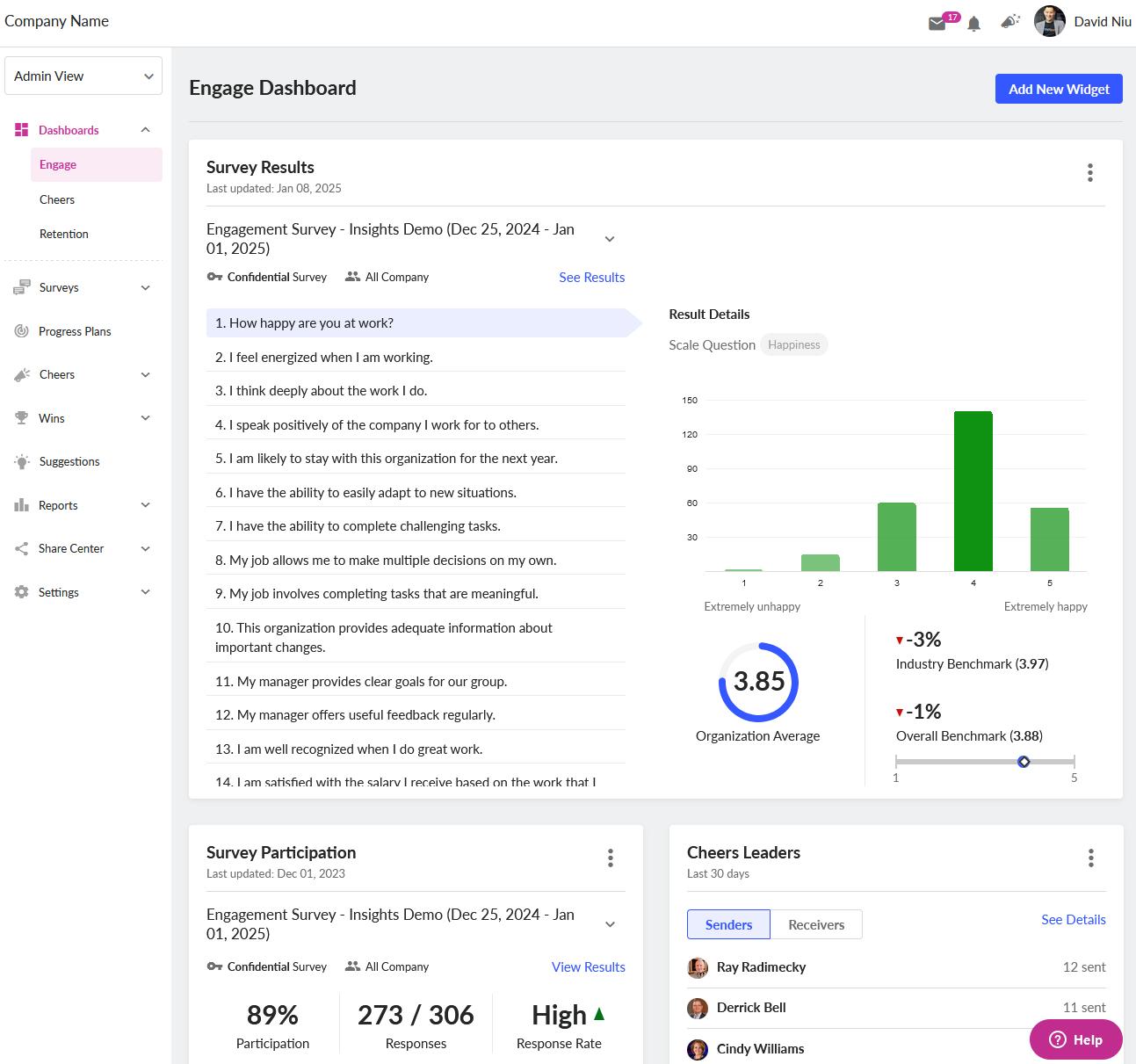
TINYpulse focuses on simplicity and anonymity, offering an easy way for smaller teams to share feedback regularly. The platform emphasizes psychological safety and ease of participation.
Pulse surveys are intentionally lightweight, with minimal configuration and straightforward reporting.
Key capabilities
- Simple, intuitive interface
- Short pulse and engagement surveys
- AI summaries and action plans
- Tools for immediate feedback resolution, like Cheers for Peers
- Anonymous two-way communication functionalities
Best for
TINYpulse is well-suited for small teams or growing organizations that want a simple way to gather honest feedback without investing in complex systems.
What customers say about TINYpulse
“The pulse surveys have industry data to compare your own with, and it's easy to select different questions or move them around to show up on different weeks. ”
— G2 reviewer
“TINYpulse is ok. A bit glitchy and cumbersome one the mobile app. Easy to use from your desktop/pc. Wish it had a bit more functionality, but it serves its purpose.”
— Reddit user
Qualtrics EmployeeXM: best for enterprise-level pulse surveys and experience analytics
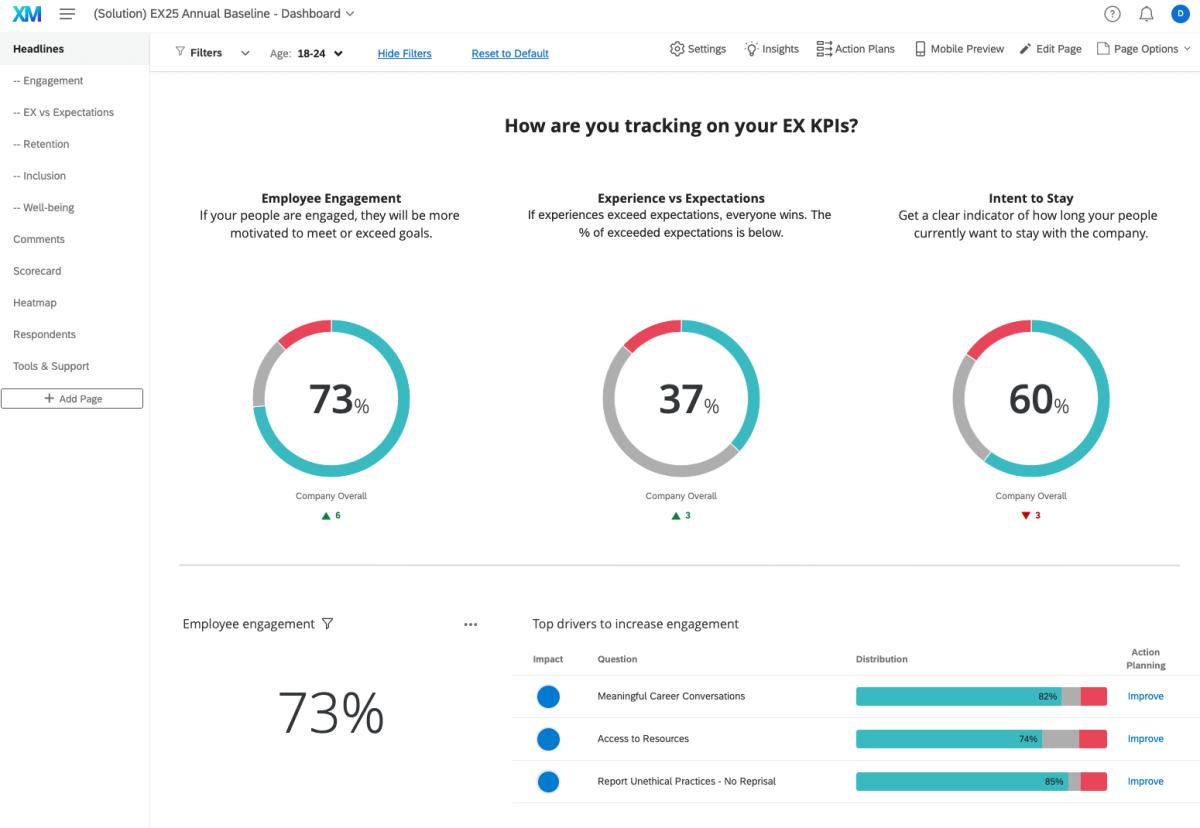
Qualtrics EmployeeXM is built for organizations that require advanced survey design and experience analytics across large, complex environments. Pulse surveys are one component of a broader experience management platform.
The tool is often used by enterprises with enough resources to interpret the data properly, like dedicated analytics or research teams.
Key capabilities
- 300+ survey questions with built-in benchmarks
- AI-recommended action plans
- Automated survey scheduling
- Real-time data analytics
- Tailored surveys for specific employee experiences
Best for
Qualtrics EmployeeXM is best for large enterprises that need enterprise-grade survey capabilities and have the resources to manage complex analytics and experience programs.
What customers say about Qualtrics EmployeeXM
“This tool makes it easy for us to collect data and helps us save time.”
— G2 reviewer
“All I can say is it is great for gathering data and analyzing it further to get effective feedback. The access to real-time insights into the sentiment analysis, which is really helpful to make data-driven decisions.”
— G2 reviewer
The PULSE-R framework for choosing pulse survey tools
Many pulse survey roundups create more confusion than confidence. Long lists make tools look interchangeable, even though their impact depends on how feedback moves through the organization.
Below you’ll find Leapsome’s PULSE-R framework, which you can use to evaluate pulse survey tools based on how effectively they turn feedback into action.
Precision: question quality and configurability
Strong pulse survey tools help HR teams ask focused, validated questions that reflect real decision needs. Precision comes from customizable questions, thoughtful templates, and the ability to tailor surveys by team, role, or moment without introducing noise. Tools that rely only on generic question banks often produce surface-level signals that are hard to act on.
Example: York Street Project
York Street Project used Leapsome’s customizable surveys to focus questions on engagement and internal feedback loops that mattered to a small, mission-driven team. Instead of generic engagement scoring, they gained clarity on how staff were experiencing their work and where support was needed. This improved signal quality and reduced noise, giving leadership a clearer pulse on engagement than they had before.
“Overall, it’s a great resource for our organization — we have a better pulse on our employees’ engagement level than ever before. Leapsome’s internal feedback loop options make it easy to listen and learn from staff members.”
— Kyle O’Neil, Director of Operations
Uptake: driving honest, high response rates
High participation depends on trust and design. Anonymity thresholds, clear communication, and predictable delivery all influence whether employees respond candidly. Tools that make anonymity transparent and respect employee time are more likely to sustain participation over repeated survey cycles.
💡 Pro tip: Ask vendors to show exactly how anonymity is handled in small teams. If HR or managers cannot clearly explain it to employees, response quality will suffer.
Latency: frequency without fatigue
Running surveys too often can degrade response quality, while running them too infrequently can delay action. Effective platforms allow HR teams to control cadence and timing so feedback aligns with business rhythms, team changes, and decision cycles rather than fixed calendars.
Example: Swapfiets
Swapfiets (1,300+ employees) used surveys and feedback cycles aligned to review moments and organizational change, rather than fixed schedules. This allowed them to collect input when it was most relevant without overwhelming employees across offices, warehouses, and retail locations.
“I really like the process of taking a look at yourself and understanding your strengths and your opportunities to develop even more. It’s also always very rewarding to be able to provide feedback to the people around you as well.”
— Victor Tomas, Learning and Development Specialist
Synthesis: turning signals into insight
Pulse data becomes useful only when analyzed in context. Strong platforms combine segmentation, trend tracking, and integration with other systems to surface patterns and root causes. Embedded people analytics tools help HR teams understand what is changing, where, and why, without manual exports or disconnected dashboards.
💡 Pro tip: During demos, ask vendors to walk through how an HR team would explain one negative trend to leadership. If insights require manual exports or interpretation outside the tool, synthesis will slow down.
Execution: closing the feedback loop
Execution is where many pulse programs stall. Tools that support follow-up workflows, manager enablement, and action planning make it easier to respond to feedback in a visible way. When employees see actions taken, trust and participation improve over time.
💡 Pro tip: Evaluate how managers are prompted after survey results are released. If the tool stops at reporting and relies on HR to chase follow-up, execution will break down at scale.
ROI: measuring impact over time
Measuring return means tracking a small, consistent set of indicators. Engagement trends over time, retention signals, and completion of follow-up actions help HR teams assess whether pulse surveys are contributing to meaningful change.
💡 Pro tip: Decide upfront which one or two business outcomes pulse surveys are meant to influence. Avoid tools that require complex reporting to show progress against those outcomes.
How to choose the right pulse survey tool for your organization
Choosing a pulse survey tool becomes easier once priorities are clear. Comparing every feature is time-consuming and inefficient. Instead, here’s what can help align tools to the primary constraint your team is trying to solve.
The scenarios below reflect common decision paths for time-pressed HR leaders.
If you need speed and simplicity
Want to launch quickly and maintain a steady listening rhythm?
Teams like yours often prioritize ease of setup and employee participation. Lightweight tools work best when the goal is to establish a feedback habit and don’t add process overhead. These tools support fast deployment and consistent check-ins, but typically rely on HR or managers to interpret results and drive action outside the platform.
If you need deep analytics and ROI proof
Are you under pressure to demonstrate impact and benefit from platforms that connect pulse results to broader people data?
Look for strong analytics, segmentation, and trend tracking. This helps HR teams link engagement signals to outcomes over time and supports leadership conversations that go beyond sentiment to evidence-based decision-making.
If you need manager enablement, not just surveys
Does employee engagement in your team depend heavily on manager behavior?
Tools that embed pulse feedback into day-to-day workflows are very effective in this case. Platforms that support follow-up actions, feedback conversations, and development planning help managers respond in real time. This is even more relevant if your team is looking to turn survey insights into concrete employee engagement ideas that managers can apply consistently.
Choose the best HR tool for pulse surveys
The most effective pulse survey tools reduce the time between listening and action. Software that only collects feedback adds reporting work without improving outcomes, which doesn’t contribute to business success.
Platforms that connect surveys to execution help HR teams respond faster, support managers, and track whether changes are working. For organizations that want pulse surveys to influence engagement, retention, and performance, the strongest tools are those that integrate listening into everyday people processes.
Leapsome stands out for teams that want pulse survey tools to drive sustained engagement and measurable business outcomes. The platform unifies surveys with performance, learning, analytics, and execution to fully support continuous improvement rather than isolated measurement.
If you’re ready to dive into designing and running effective pulse programs, follow our practical guidance on how to create employee pulse surveys.
✨ Build a pulse survey program people actually trust
If you’re planning your next survey cycle, Leapsome helps you design, run, and follow through on feedback with built-in workflows and analytics — all in one place.
👉 Book a demo
Frequently asked questions about pulse survey tools
What are pulse surveys in HR?
Pulse surveys are short, recurring questionnaires that HR teams use to gauge employee sentiment regularly. Unlike annual engagement surveys that provide a once-a-year snapshot, pulse surveys capture how people are feeling in the moment and track changes over time. This continuous feedback loop helps organizations spot emerging issues early and respond before they become larger problems.
How often should pulse surveys be run?
The ideal pulse survey frequency depends on your company’s capacity to act on feedback. Most companies run pulse surveys monthly or quarterly, often enough to stay connected to employee sentiment without creating survey fatigue. The most important factor isn't the cadence itself, but ensuring that your team can review results, identify priorities, and implement changes between survey cycles.
Are pulse surveys anonymous?
Most pulse survey platforms offer anonymous response options, which are critical for encouraging honest feedback. Many tools use minimum response thresholds (typically 5-10 people per group) to prevent individual identification when viewing segmented results. The key is clear communication: explain how anonymity works, what protections are in place, and when results might be aggregated. Transparency builds the trust necessary for employees to share candid feedback.
How do pulse surveys improve engagement?
Pulse surveys improve engagement when they're part of a closed feedback loop. The survey itself doesn't create change, but what happens next. When HR teams and managers review results, identify actionable themes, communicate what they've heard, and implement visible improvements, employees feel heard and valued. Without follow-through, frequent surveys can actually harm engagement by signaling that leadership asks for input but doesn't act on it.
What metrics should HR track from pulse surveys?
Focus on three core metrics: response rates (measuring participation and trust), engagement score trends over time (tracking whether sentiment is improving or declining), and recurring themes in qualitative feedback. These metrics become more valuable when analyzed alongside broader people data: turnover patterns, performance trends, goal achievement, and manager effectiveness.
Can pulse surveys replace annual engagement surveys?
Pulse and annual surveys serve complementary purposes and shouldn’t replace one another. Pulse surveys provide continuous listening and agility; they help you spot trends quickly and respond in near real-time. Annual engagement surveys offer depth, allowing for comprehensive benchmarking, reflection on long-term themes, and detailed analysis across the organization. Many organizations use both: pulse surveys for ongoing monitoring and course correction, and annual surveys for strategic planning and year-over-year comparison.
Emily Laytham



.jpg)

.jpg)