How to manage remote teams at scale: Building culture and systems


Remote work is no longer a novel experiment, but managing it effectively remains a rare skill. Recent data shows that manager engagement dropped sharply over the past few years, and it now sits at an all-time low of 22%.1 In other words, the people responsible for holding increasingly complex and distributed teams together are feeling a lot of disconnect.
This issue often signals a design flaw, rather than a lack of effort. Many companies still manage remote and hybrid teams using frameworks built for a co-located world, and more than half of leaders report feeling only “somewhat effective” in distributed environments.2 When HR and management rely on intuition and office-based standards, rather than intentional people enablement systems, misalignment creeps in and culture suffers.
In this article, we’ll explain how to manage remote teams effectively, by treating distance as an operational architecture challenge.
1Gallup, 2026
2i4cp, 2025
What does remote team management look like today?
Remote team management is the intentional coordination of a workforce across borders and time zones. Many leaders still trivialize distributed operations as simply “working from home,” assuming that while employees’ physical locations change, most everything else can stay the same. This mindset leads to ad-hoc models that mimic office life through an exhausting schedule of video calls.
Mature distributed organizations recognize that traditional oversight depends too much on visual cues, like needing to see a person at their desk to know they’re working. To lead a remote team effectively, you have to make the transition from supervisor of time to manager of results. This shift means you need to trust internal, outcome-driven systems more than your eyes, trading proximity for a structured operating model.
Core principles of effective remote team management
Before we dive into the full process, let’s preview the best practices for managing a remote team effectively:
- Asynchronous collaboration: Prioritize documentation over immediate responses to keep work moving across time zones.
- Communication clarity: Provide full context in every message to cut down on follow-ups and repeat work.
- Technology enablement: Use an integrated tech stack that creates a single source of truth for employee data and goals.
- Trust-based accountability: Define clear milestones and outcomes, rather than monitoring active hours or “green light” status.
“Building a strong culture of trust is essential for remote team success. Micromanagement, while detrimental in any setting, can be particularly damaging remotely, as I've found that it undermines confidence and stifles initiative.”
– Dmitriy Schwarzburg, Forbes Councils Member
Building remote management architecture that drives performance: Four phases
Remote teams can only perform at the highest level when you design a results-oriented system upfront. Managers shouldn’t have to burn out due to poor operational architecture, then compensate by following generic tips for managing remote teams, like more Zoom calls and lots of hand-holding.
The good news is that declining engagement isn’t inevitable, and for organizations that follow best practices, 79% of managers are engaged at work. It’s up to HR leaders to build intentional remote frameworks, where alignment and accountability are native parts of key workflows.
1. Set clear goals and make them visible to everyone
Teams often suffer from diminished productivity and increased turnover when priorities are unclear or change without context. Remote employees are at highest risk, since they lack office-based communication channels that support quick, passive clarifications.
So instead, these teams need a system that’s easy to access and visible to all. A shared, goal-oriented remote framework shows every employee the direct connection between their daily tasks and company OKRs.
This level of visibility eliminates the need for constant status chasing, and it provides distributed workers with a clearer sense of purpose. You can measure the strength of this alignment by tracking goal completion rates and monitoring the percentage of objectives with active owners.
2. Keep bias out of performance management
Proximity bias often threatens talent retention in distributed environments. To avoid that problem, you’ll need to make performance evaluations less subjective, and more standardized.
Use AI-powered analytics to identify high performers and to curate objective feedback that doesn’t depend on physical presence or individual judgment. This consistency keeps career growth accessible for everyone, regardless of their geographic locations.
To verify the success of this method, HR leaders should monitor review completion rates and employee engagement scores, particularly when they relate to discussions about professional development.
3. Make feedback and recognition part of daily workflows
Informal feedback is easy to overlook in a digital environment, unless you intentionally build it into your workflows. Performance-based remote architecture uses real-time sentiment analysis to detect friction points before they lead to turnover, and it encourages public recognition to prevent high performers from feeling invisible.
When you integrate feedback into the natural flow of work, that feedback comes across as more genuine and helps remote employees connect to the organization’s mission. Just keep in mind that gathering feedback is only one part of a successful remote structure. You also need to put what you learn into action, addressing concerns promptly to keep the feedback loop meaningful and encourage future participation. Leapsome helps your team with both parts of that process.
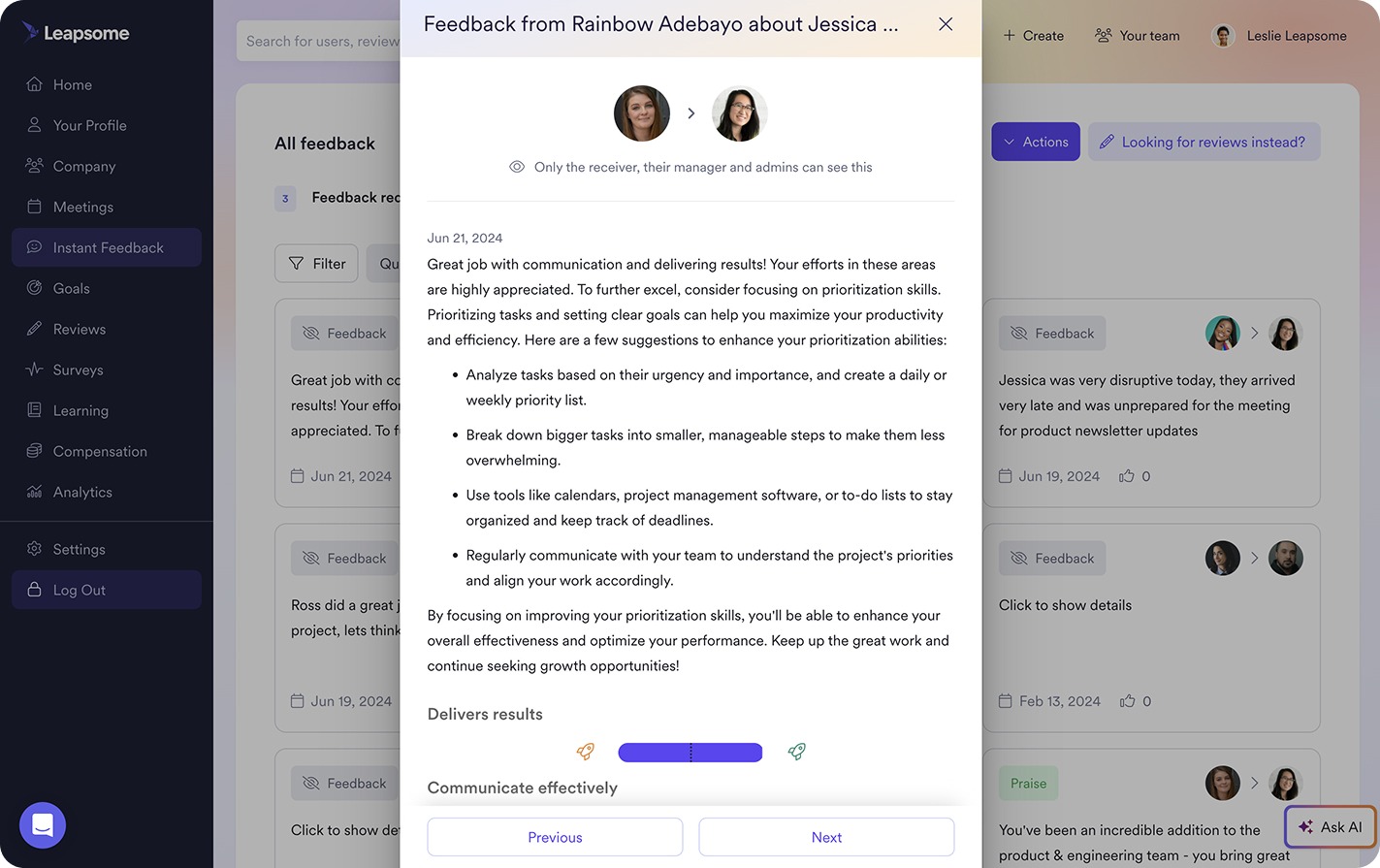
🏆 Empower your remote team with instant feedback
Leapsome embeds continuous feedback into your team’s daily workflows, so remote high performers stay visible and connected to company goals.
👉 Explore Instant Feedback
4. Replace meeting overload with a predictable communication strategy
It’s often not lack of communication that’s the issue; it’s lack of structured communication. To move away from problematic “always-online” culture, provide your team with a remote architecture that protects deep work while maintaining absolute clarity.
“Over-communicate and set clear expectations for response time — otherwise, async breaks down and projects stall.”
– Anita Anthonj, Co-Founder at Talaera
Over-communication in remote settings doesn’t mean a constant flood of Slack messages. To stay effective, you need a structural safeguard to ensure that every team member remains aligned with their core objectives, regardless of locations and time zones.
This hierarchy of touchpoints might include:
- Daily asynchronous updates for blockers
- Weekly synchronous deep-dives for strategy
- Bi-weekly 1:1s to anchor personal growth
- Monthly cross-functional alignment sessions
- Quarterly performance reviews
Common challenges and best practices for managing remote teams
Distributed working environments reveal structural flaws that office proximity often hides. Research shows that remote work introduces notable challenges to cohesive communication, team connection, and work-life boundaries.
Here are some of the issues your HR systems must proactively manage to maintain a high-performing virtual team:
- Uneven workload visibility: It’s notoriously difficult to see who’s drowning and who’s coasting when you’re leading remote teams. To improve communication and task visibility, use shared Kanban boards or weekly sprint planning.
- Administrative fragmentation: Managing remote employees’ contracts, payroll, and absences across multiple time zones is often a logistical mess. That’s why you should use a unified HRIS to tailor these processes for each jurisdiction, supporting local compliance and a consistent experience for every employee.
- Burnout and boundary blur: Only 36% of fully remote employees are thriving in their out-of-virtual-office lives, compared to 42% of on-site, remote-capable workers. This lower satisfaction usually comes from difficulty disconnecting and blurred work-life boundaries. So HR leaders should model “off-grid” working hours, and set up easy leave requests and approvals to help remote teams achieve better balance.
- Lack of KPI tracking: Many managers default to tracking activity over impact, because they lack a framework for measuring real success. Transitioning to outcome-based KPIs like goal completion rates, collaboration efficiency, and engagement metrics helps you better evaluate growth. With Leapsome’s detailed reporting tools, you can see exactly where your remote architecture needs adjustment.
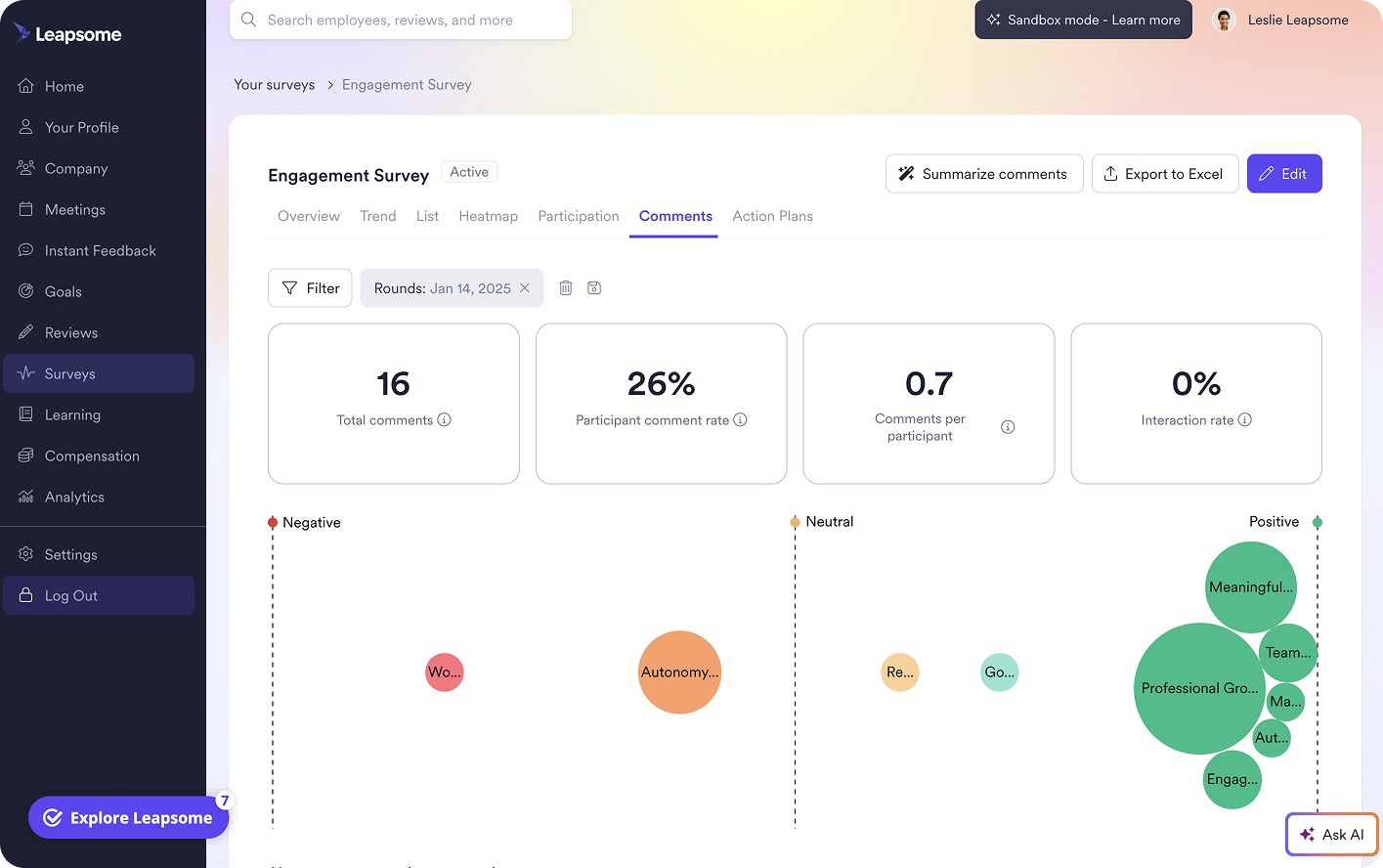
🔭 Bridge the distance with deeper remote workforce metrics
Leapsome’s AI-powered surveys connect engagement data directly to performance and retention outcomes, allowing you to identify and resolve hidden points of friction.
👉 Learn more
Make remote management intentional with Leapsome
Remote management is an infrastructure challenge, not just a collection of better habits. High-performing organizations use clear frameworks to lay out how they’ll manage remote teams efficiently, so productivity doesn’t depend on constant micromanagement.
Leapsome provides the operational architecture you need to maintain alignment and high performance across any distance. Leapsome centralizes your people enablement strategy and supports the entire employee lifecycle through:
- Aligned objectives and goal tracking that ensures every individual in your remote team understands their impact on the company’s OKRs
- Structured check-ins and performance cycles that create a predictable rhythm for growth
- Engagement insights and analytics that identify points of friction before they lead to turnover
- Asynchronous feedback and recognition that keeps distributed high performers visible and productive
- Contracts, payroll, and absences management across time zones, tailored for each jurisdiction through a unified HRIS
When you replace office-based intuition with intentional remote systems, you stop managing remote workers based on visibility and start scaling through measurable results.
“Leapsome is our go-to place for looking at our work from a goal perspective — how we’re progressing and hitting those goals. It has proven to be really successful in uniting us while working remotely and across different offices, and keeping us focused on the right things. Leapsome is a core part of how we do our business.” – Lisa Potter, VP of Marketing, KCare
🧭 Confidently lead remote teams at scale
Leapsome unifies your essential remote systems into one seamless command center for performance, alignment, and engagement.
👉 Request a demo

.png)


Automate, connect, and simplify all HR processes across the employee lifecycle.