HR shared services for people leaders in scaling companies
.png)
.jpg)
As companies grow, everyday HR requests become harder to manage through scattered emails and ad-hoc channels.
HR can’t provide the service their people need, and as a result, employees receive conflicting answers depending on whom they ask. At the same time, HR team members spend entire days answering the same payroll questions, while managers escalate basic requests because no one's sure where they should go.
This pressure is intensifying. Nearly two-thirds of professionals in our most recent research report rising workloads, and about half feel more overwhelmed year over year.* For hybrid and multi-location teams, inconsistency in HR support compounds these challenges and damages trust.
HR shared services offers a way to centralize support without losing the human element.
With the right processes and an HRIS platform that connects operational efficiency to employee development, you can handle routine queries consistently while freeing your HR team to focus on strategic work that genuinely improves the employee experience.
This guide walks you through:
- What shared services actually means for People leaders
- Why the single-entry-point approach works better than complex operating models
- How to measure success beyond cost savings
- The practical habits that will keep your HR shared services running well
Whether you're deciding if your organization is ready or figuring out how to design a model that improves rather than erodes employee experience, you'll leave with a clear blueprint for what to do next.
🏗️ Build a foundation for scalable HR operations
Leapsome's HRIS centralizes employee data, automates workflows, and connects operational efficiency to strategic people work.
👉 Explore Leapsome HRIS
*2026 Leapsome Workforce Trends Report
What HR shared services means for growing companies and people operations
HR shared services is a centralized approach to handling repeatable HR queries and administrative tasks through standardized processes and shared technology.
Instead of every HR generalist answering the same payroll questions or processing the same data updates individually, you create a dedicated team and system to handle these consistently.
This differs from fully decentralized HR, where each business unit manages its own processes independently. It's also not the same as outsourcing, where you hand functions to an external provider. With shared services, you keep the work in-house but organize it more efficiently.
The HR services delivery model has become the standard for companies with more than one hundred employees, especially those managing hybrid teams or multiple locations. When your HR inbox becomes unmanageable, and employees get different answers depending on who responds, shared services offers a way to bring order without losing the human element.
Your tech stack typically includes both operational tools for shared services (ticketing systems, knowledge bases) and platforms for strategic HR work like performance management and employee development.
How HR shared services centralize support without replacing strategic HR work
Shared services creates a clear front line for standard questions and transactions, freeing your HR team to focus on strategic and complex work.
This way, you can semi-automate the answers to simpler questions like 'What's the parental leave policy?', freeing up time and headspace for deeper conversations like 'How do we restructure this team?"
The work that typically moves into shared services includes:
- Employee data changes
- Policy clarifications
- Simple benefits queries
- Time-off approvals
- Basic payroll questions
Meanwhile, your HR specialists continue handling organizational design, complex employee relations cases, leadership coaching, and talent strategy.
This separation actually strengthens your HR function rather than weakening it. When your specialists aren't fielding repetitive administrative questions, they have more capacity for the high-impact work that genuinely requires their expertise and judgment.
"People first doesn't mean business last. When you give employees space to think and do, you unlock performance, loyalty, and innovation. People strategy is business strategy."
— Luck Dookchitra, former VP People & Culture at Leapsome
Core benefits of shared services for consistency, compliance, and scalability
The strongest case for shared services hinges on predictable outcomes. When you centralize how HR queries are handled, employees get consistent answers regardless of who responds or which office they're in. No more conflicting information about the same policy depending on which HR generalist someone happened to email.
HR compliance becomes easier to manage as well. You can standardize documentation, track requests effectively, and ensure uniform policy interpretation across the company. This matters especially during audits or when you're managing employees across multiple jurisdictions with different regulations.
Scalability is the other major advantage. With shared services, you can support headcount growth without linearly increasing your HR admin team. A well-designed system handles 500 employees almost as efficiently as it does 300, whereas decentralized HR typically requires more personnel as the company grows.
However, these benefits only materialize if employees actually experience them. Therefore, running regular pulse surveys can be a helpful way to track whether your shared services setup is delivering on these promises or creating new friction points.
Risks and concerns you should tackle before centralizing HR
Centralizing HR support can backfire if you don't address some common pitfalls upfront. The biggest worry is losing the personal touch that makes employees feel heard and supported.
A badly implemented shared services model can turn into a "ticket factory" where people feel like numbers rather than individuals.
There's also the risk of creating bottlenecks instead of solving them. If you centralize a broken process, you've just amplified the problem across the entire organization. Poor documentation, unclear handoff rules, or insufficient staffing can make shared services slower and more frustrating than the decentralized chaos you're trying to fix.
Remote and hybrid teams face additional challenges since they rely heavily on digital channels for HR support. If your shared services setup isn't designed with distributed work in mind, you risk creating a system that works well for headquarters but fails everyone else.
You can catch these issues early by monitoring feedback. When engagement survey scores on questions like "It's easy to get help from HR" start dropping, or when you see critical comments about HR responsiveness, those are warning signs that your centralization effort needs adjustment.
📊 Catch early warning signs before they become problems
Use Leapsome's engagement surveys to track how employees feel about HR accessibility and support quality over time.
👉 See how it works
How to create a single HR help page as the entry point to shared services
Rather than starting with a complex operating model, make it obvious where employees go when they need HR help.
An "HR help page" is simply a single, well-signposted entry point, such as an intranet page, Notion page, portal, shared inbox, or chat channel, that becomes the default starting point for any HR question.
This matters because confusion about where to start undermines trust. When employees don't know whether to email HR, message their manager, check the intranet, or fill out a form, they either give up or spam multiple channels, hoping something works.
At Leapsome, we use Notion as our source of truth for all HR information. Our Notion page is called the People & Culture Guide and it is carefully organized to allow employees to find answers independently before needing to reach out, and when they do require assistance, it's clear where to go next.
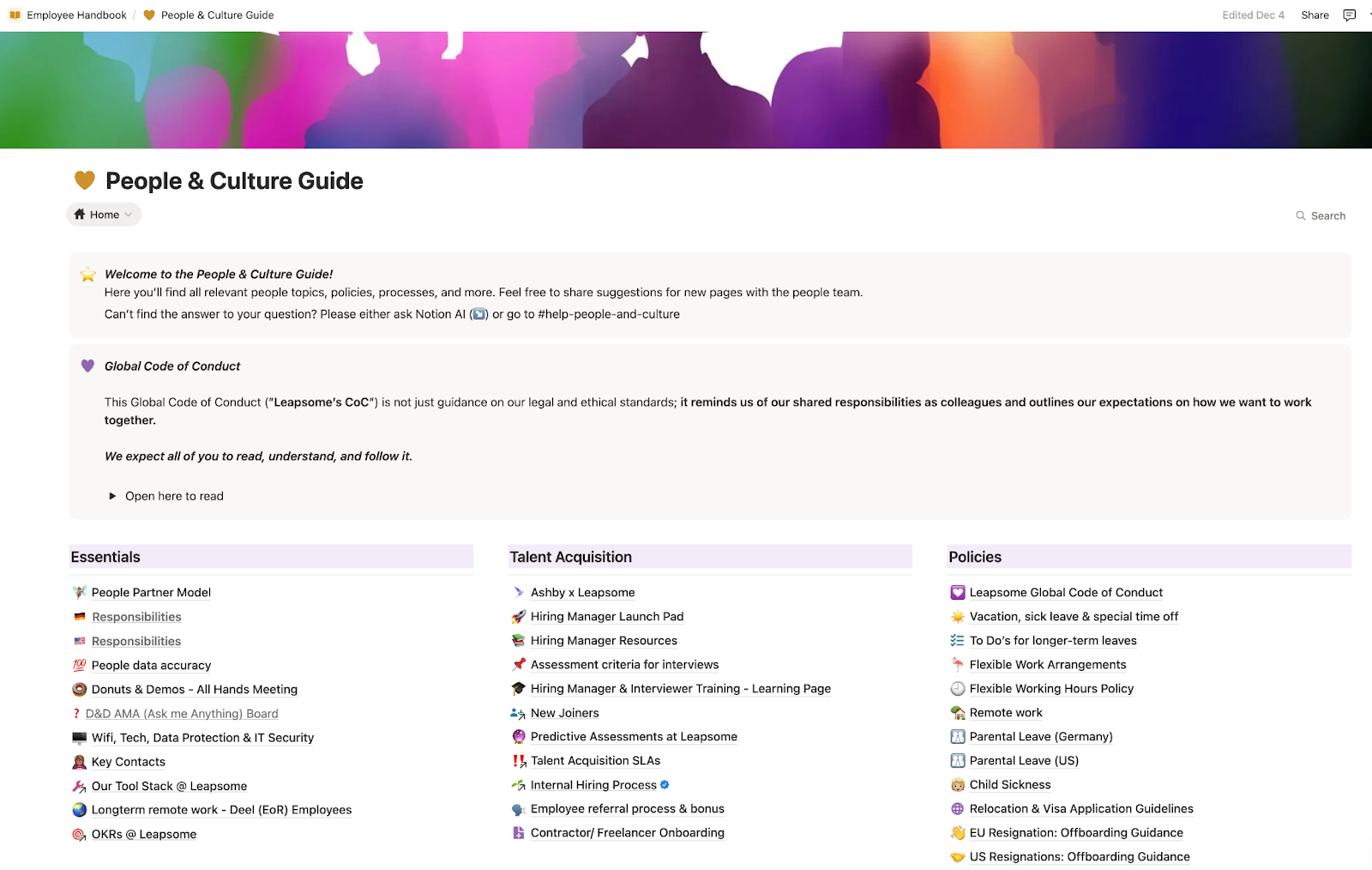
This approach works regardless of which tools you use. The key is having one obvious starting point.
Choose one simple place where every HR question should start
Your entry point needs to fit your culture and existing tools rather than requiring new systems. This could be an intranet page titled "HR Help," or a channel in Slack or Notion. What matters is clarity and visibility.
Reference this entry point consistently everywhere: in onboarding, policy documents, and manager communications. This helps create positive habits so that "check the HR help page" is the automatic first step for any HR question.
Therefore, it’s essential to avoid creating multiple entry points for different types of requests. Even if you have separate systems behind the scenes, employees shouldn't need to guess which link, platform, or channel is best. One clear starting point that routes them appropriately works far better than five possible options.
Map everyday HR questions to self-service, shared services, or specialists
Your most common HR questions from the past quarter reveal which belong in each bucket, based on the complexity of the request.
- Self-service — policy lookups, form downloads, and process guides that employees can resolve with clear documentation.
- Shared services — data changes, payroll questions, benefits enrollment, and time-off approvals that need a person but follow a standard process.
- Specialist or strategic HR work — performance concerns that need nuanced judgment, complex employee relations cases, organizational changes, and sensitive issues where context and discretion are paramount.
The boundary between these buckets won't be perfect, and that's fine, as there will inevitably be cases where the distinction is blurred. Nevertheless, when employees know that simple data updates are directed to shared services while serious concerns are addressed by their HR specialist, that clarity alone improves their experience.
Meanwhile, some self-service content naturally lives in tools employees already use. For example, an HRIS platform can centralize all your policy documents, host learning resources on HR processes, and provide access to forms. This reduces the volume of basic questions your shared services team needs to field.
🎥 See how an all-in-one HRIS simplifies HR service delivery
Leapsome centralizes policies, automates processes, and reduces the volume of basic HR requests.
👉 Watch the walkthrough
Measuring HR shared services
Focusing purely on your speed and efficiency to resolve issues risks missing the bigger picture and other key issues that affect your people and operations.
After all, efficiency means little if employees feel bounced around or ignored, and large numbers on your HR help page might indicate unclear documentation rather than good engagement.
A balanced measurement approach tracks both operational performance and how people feel about the service. You need to know whether queries are being resolved quickly and correctly, but also whether employees trust the system enough to actually use it instead of working around it.
Gathering employee feedback through engagement surveys complements the operational data from your service desk or ticketing system. When you track both sides, i.e., how efficiently queries are resolved and how employees feel about the process, you get a fuller view of whether your shared services model is actually working.
Track both efficiency and trust to see the full picture
Your shared services model needs measurement on two fronts: how efficiently it runs and whether employees trust it.
Operational metrics without experience data can make a struggling system look successful on paper, while experience feedback without operational context makes it hard to diagnose specific problems.
First-contact resolution shows how well your team solves problems
First-contact resolution reveals whether employees get actual answers or need to follow up repeatedly. If only 40% of queries get resolved on first contact, your documentation is unclear or your team needs better training on common scenarios.
Improving this rate to 70-80% has a ripple effect, resulting in faster resolution times, fewer frustrated employees, and lower ticket volume, as people are less likely to submit follow-ups.
Employee feedback reveals whether efficiency undermines trust
Survey questions like "It's easy to get help from HR" tell you whether operational improvements translate to better experiences. You might cut resolution time from five days to two, but if accessibility scores drop, something in the process is damaging trust.
Open-text feedback surfaces what numbers miss. Comments like "I got three different answers" point to fixable problems, such as inconsistent training or unclear handoff rules.
Process completion rates signal documentation clarity
When employees struggle to complete straightforward tasks like updating their personal information, your self-service content may not be clear enough. Low completion rates on core HR processes create unnecessary tickets for your shared services team.
Improving HR process automation and simplifying documentation can reduce these requests before they occur.
Review both efficiency and experience data together on a quarterly basis. Your HR ops team, specialists, and leadership can then agree on focused improvements based on what the combined data reveals.
Using consolidated tools to capture feedback and improve HR service quality
Combining operational metrics from your service desk with experience data from engagement tools provides a more comprehensive picture than either source alone. Your ticketing system shows volume and speed, while survey feedback reveals whether employees feel supported or frustrated.
However, analyzing qualitative feedback is time-consuming and difficult at scale. Reading through hundreds of comments manually takes hours and makes it hard to spot patterns.
This is where AI becomes useful: it can summarize themes across large volumes of open-text responses and automatically flag common issues.
For example, Leapsome's AI features include recommended actions based on engagement data, helping you identify which process improvements will have the biggest impact.
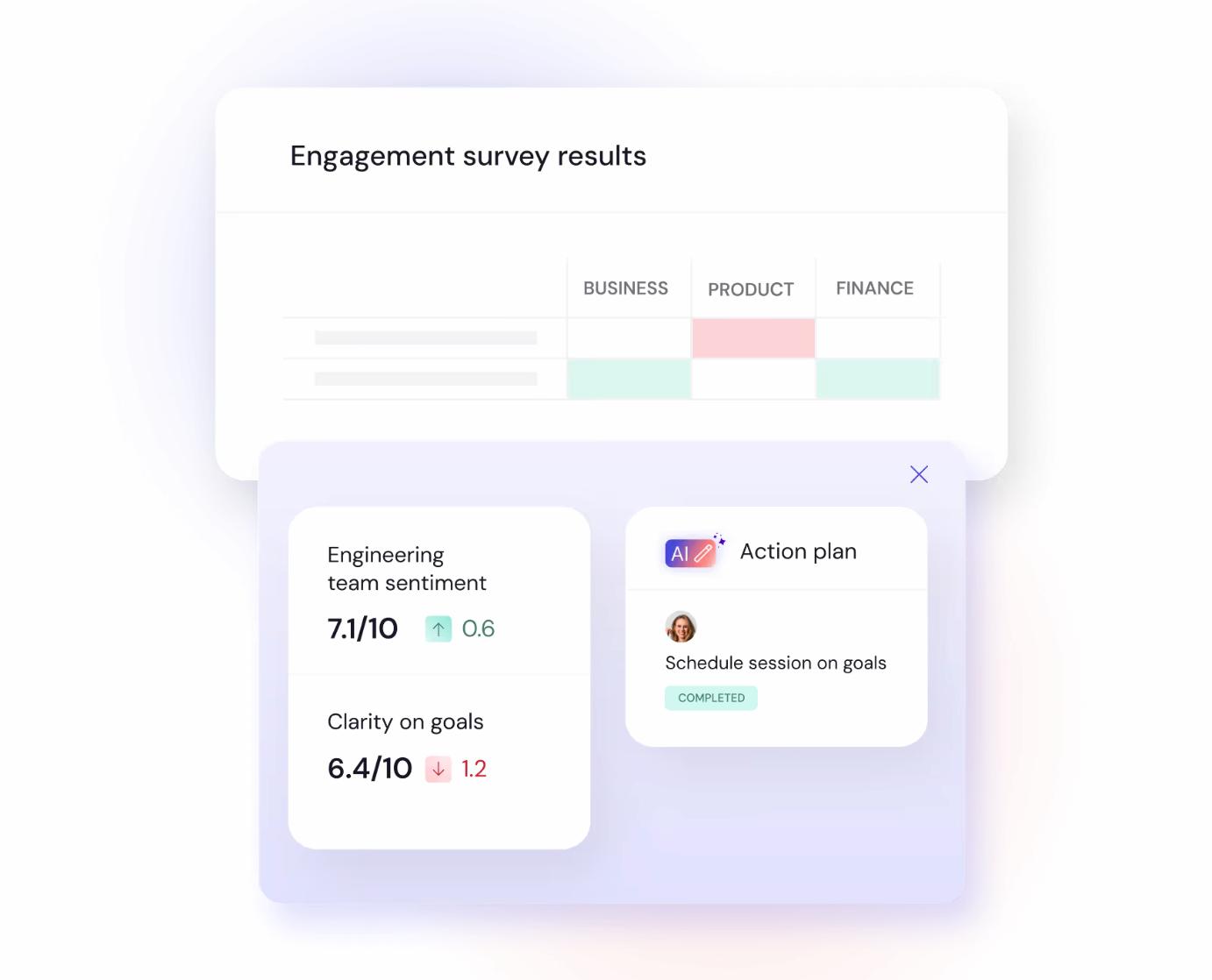
To make this data actionable, create a quarterly review where your HR operations team, specialists, and leadership review both data sets together.
Watch for disconnects: if resolution times are fast but satisfaction is low, your answers might be quick but unhelpful. Similarly, if ticket volume drops but engagement scores don't improve, employees might be giving up rather than getting better service.
Most importantly, track sentiment over time so you can tie improvements to outcomes. When you update documentation or change a process, you should see it reflected in both faster resolutions and better feedback.
🤖 Turn feedback into action with AI-powered insights
Leapsome's AI features surface patterns in employee feedback and recommend specific improvements to your HR processes.
👉 Discover Leapsome AI
Bringing HR shared services into your People strategy
HR shared services work best when your approach aligns with your broader goals, including manager enablement, consistent performance practices, and employee engagement.
When managers spend less time fielding basic HR questions, they have more capacity for coaching and mentoring. Equally, when employees get consistent answers about policies, trust in HR increases.
Building good habits keeps the system working over time. The single entry point you create for HR questions only stays effective if you maintain it. Therefore, you need to update documentation as policies change, adjust routing rules as request patterns shift, and respond to employee feedback about clarity.
You can also run quarterly reviews to determine which requests belong in shared services versus those handled by specialists, keep your HR help page current, and use employee feedback to refine your workflows.
These recurring practices prevent your shared services model from becoming outdated or unresponsive to the needs of your people.
An all-in-one HRIS plays a central role here. When employee records are centralized and accessible, employees can self-serve routine tasks while your HR team focuses on strategic work like engagement, performance management, and development.
🚀 Transform how your HR team delivers support
See how Leapsome's all-in-one platform connects operational efficiency with employee development and engagement.
👉 Book a demo
FAQs about HR shared services
How do I know if my company is ready to move to an HR shared services model?
Inbox-based support, which creates more problems than it solves, is the clearest signal. Employees get different answers to the same policy question, your HR team spends most time on repetitive queries, or unclear processes cause constant escalations. Companies with multiple locations or hybrid teams often reach this point sooner, as inconsistency compounds across distance.
What is the difference between HR shared services and outsourcing HR functions?
Shared services keep work in-house with your own team, just organized more efficiently. Additionally, it provides you with more control over processes, culture fit, and employee experience. On the other hand, outsourcing hands-on functions to an external provider entirely creates more distance between employees and HR support.
How do HR shared services work with HR business partners and People strategy?
Shared services handles the operational front line, so your HR specialists focus on strategic work. Standard queries, such as data updates and policy questions, are directed to shared services, while specialists address complex employee relations, organizational design, leadership development, and tasks that require judgment. This separation strengthens your people strategy by freeing capacity for high-impact initiatives.
Sam Abrahams

.jpg)
.jpg)

.jpg)