How to choose an HR system you won’t outgrow


An HR system is a software platform that puts employee data side by side with the HR functions and people practices that rely on it. Instead of cobbling together data from multiple spreadsheets and plugging it into separate tools, HR teams can work from one interconnected command center.
HR systems come in three overlapping varieties, each with its own focus and terminology:
- Human resources information system (HRIS).
- Human resources management system (HRMS).
- Human capital management (HCM).
Choosing the right HR system isn’t always easy. Thirty percent of HR leaders regret their last HR technology purchase, often because they focused too much on feature checklists.*
Choosing the right system comes down to the people practices you want to build now and in the future. While efficient administration lays the foundation, growing companies should consider how solutions help employees, managers, and HR staff do their best work.
This guide explores the features and benefits of HR systems. It also offers a decision-making framework to help growing SMBs and lean HR teams find a platform that won’t collapse as their organization scales.
* SHRM, 2026
What are human resource systems, and what can they do?
HR systems simplify employee data management and core HR processes. The best HR system software goes beyond automating everyday tasks to support strategic people practices like performance management, engagement, and employee development.
Human resources software traditionally falls into three main categories:
- HRIS: An HRIS system combines employee data and fundamental HR functions like payroll processing and benefits administration. Some HRIS systems are more expansive and add advanced tools and custom workflows for tasks like analytics research and compliance monitoring.
- HCM: HCM systems cover many of the same bases as advanced HRIS systems, with a special emphasis on workforce management. They facilitate high-level talent management work, such as recruitment and workforce planning.
- HRMS: Some professionals use the term “HR management system” to refer to any comprehensive HRIS that does more than the bare minimum. However, it’s often used as a blanket term for any type of HR software platform.
In practice, these terms increasingly overlap, often to the point of interchangeability. What matters isn’t so much choosing a specific type, but analyzing actual capabilities and whether they support your organization’s goals.
“Many HR teams still struggle with the basics — too many disconnected tools, limited insights. That’s why we built a truly people-first HRIS that unifies all employee data into one source of truth.”
— Suraj Paneru, Customer Success Coach, Leapsome
So, what are HRIS systems and similar platforms actually good for? Here are the most compelling benefits:
- Centralizing employee data: HR software keeps employee records and personal info directly linked to create a reliable source of truth. That means less manual work, fewer errors, and people analytics you can trust.
- Informing people decisions: Connected data gives HR teams wide-ranging visibility they can use to make smarter people decisions.
- Automating repetitive HR processes: Deloitte research shows that HR professionals spend up to 57% of their time on administrative tasks. Automating routine tasks can dramatically reduce that burden, freeing HR to focus on strategic work.
“On the C-level, I learned to doubt people data because it arrived late and conflicted across files. Then, sitting in HR, I felt the pain from the inside and saw how much time went into rebuilding the same reports. Centralizing restores trust and your calendar.” — Florian Klages, Managing Partner, torq. partners
In 2025, McKinsey predicted that people management would become more proactive, data-driven, and fluid, leveraging forward-looking data for real-time workforce management. Today, Leapsome has turned that prediction into reality.
“Dashboards remove the detective work. If a leader has a gut feeling about absence spikes, they can verify it in seconds and act. Real-time beats month-old exports every single time.”
— Florian Klages, Managing Partner, torq. partners
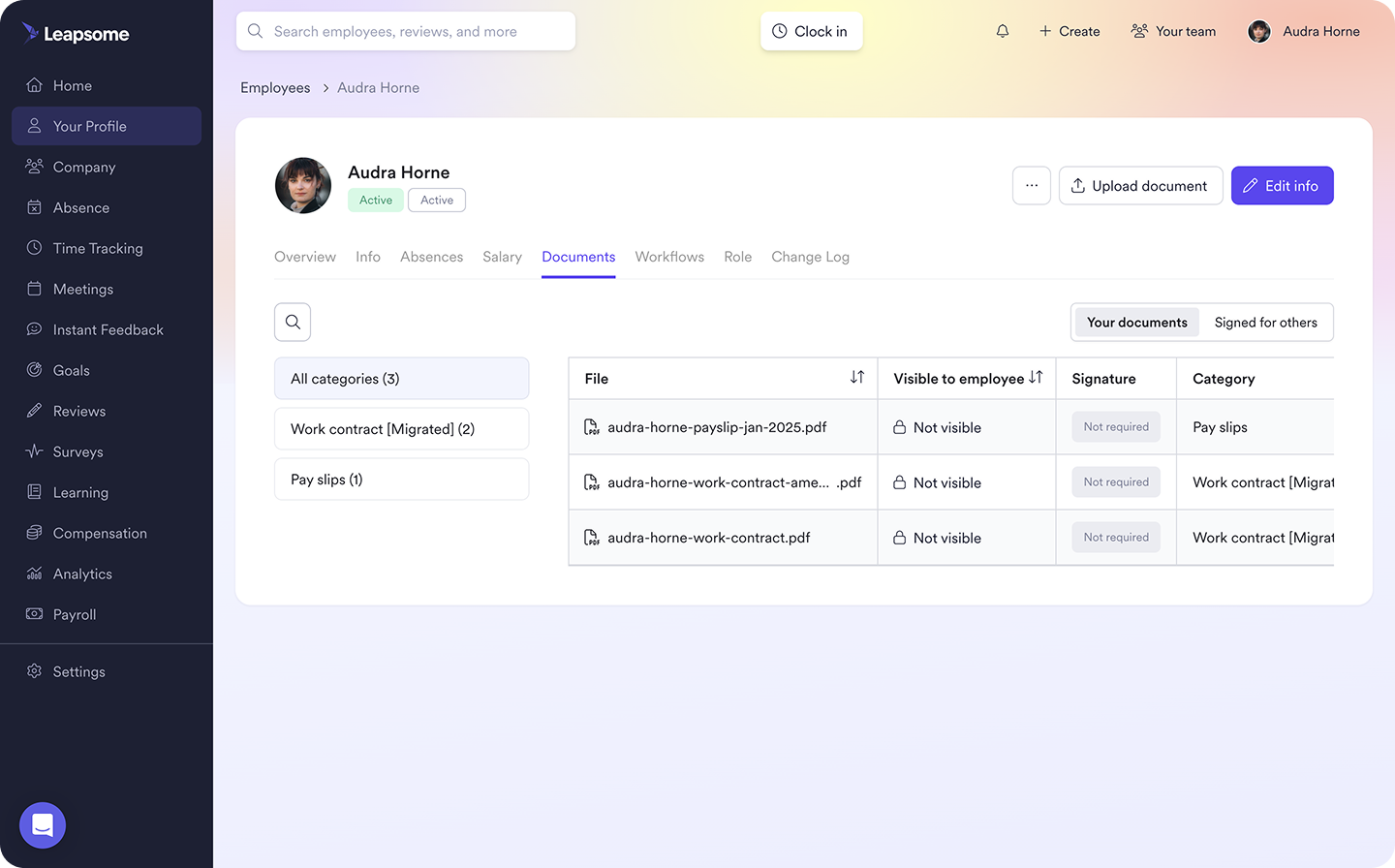
🧑💻 Stop juggling HR systems
Centralize your employee data, automate complex compliance-related workflows, and strengthen workforce visibility for accurate real-time reporting
👉 Explore HRIS tools
What are some top HRIS system examples?
Here are three of the most popular global HRIS systems on the market today:
- Leapsome: Leapsome’s comprehensive HR system drops employee records directly alongside everything HR teams need to do their jobs well. Teams can collect detailed data by running engagement surveys and tracking performance history, then work with AI to surface actionable insights. The data feeds back into performance management and employee learning efforts to create a feedback loop that continuously strengthens workforce management.
- Rippling: Rippling links standard HR functions with IT and finance, supporting tasks like data management and payroll processing. It’s known for its user-friendly interface and onboarding automation.
- Gusto: Gusto concentrates on the operational side, especially payroll processing, but also benefits administration and basic functions like attendance and time tracking. Users appreciate the intuitive interface and simple setup process.
What features should you look for in an HR system?
A long list of features might look impressive, but that doesn’t mean much if those features can’t support your unique problems, growth stage, or future people practices. Finding the right global HRIS system for your organization means strategically evaluating feature sets based on three critical evaluation criteria:
- Data management, core HR, and automation: These are the operational backbone of any well-run HR department. Look for tools that keep employee records accurate and easy to access. Reporting should be clear and reliable. Onboarding, time tracking, and document storage should run without manual fixes.
- Performance, development, and employee experience: Gartner research found that 60% of HR leaders believe their existing tech stack actually hurts the employee experience. Choose an intuitive employee self-service portal that helps employees complete tasks without relying on HR. It should include structured reviews that give managers clear cycles to follow and feedback modules that encourage regular coaching.
- Integrations, security, and scalability: The platform should integrate with your existing tools and have the built-in flexibility to scale with your organization. It should also come with robust data security to simplify compliance.
These features matter, but without the right implementation, they can easily become “nonfunctional ornament[s],” as SHRM puts it. Look for platforms with self-service “how to use an HRIS system” documentation and a reputation for excellent customer support.
“Managers shouldn’t email HR to ask who’s on leave or what a team’s balances are; they should see it live. The moment people self-serve, interruptions drop and decisions speed up. That’s the point of a single source of truth.”
— Carolin Leidel, Consultant, torq. partners
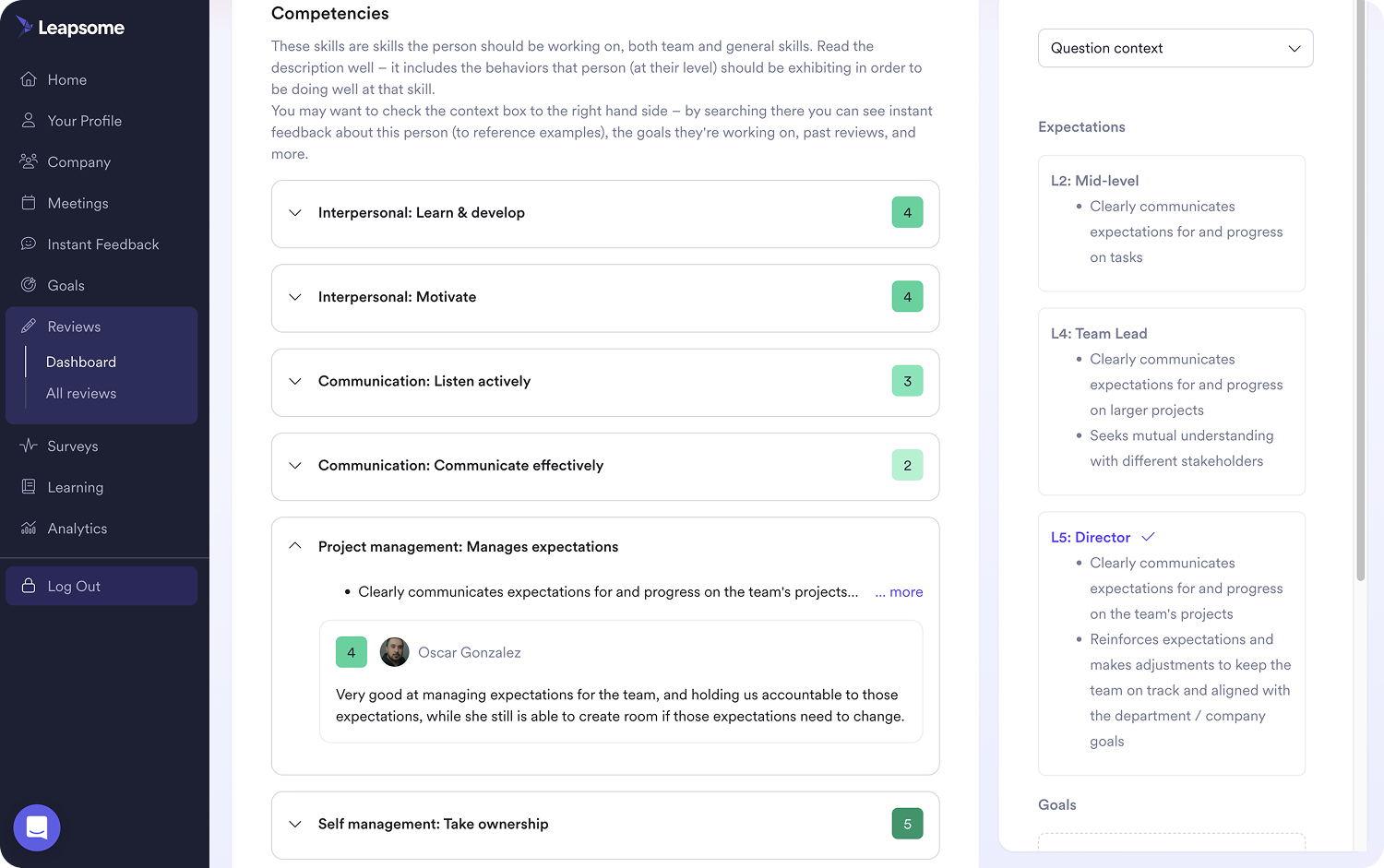
📈 Reviews that tell the whole story
Build custom automated review cycles backed by rich context, from goals and engagement surveys to competencies and feedback.
👉 Explore Performance Reviews
Future-proof your tech stack with an HR system that scales
No matter how many tasks it automates, an HR system isn’t worth the investment if you have to replace it six months later. Here’s what to look at when evaluating a potential HR system:
- Data and processes: Look for tools that unify scattered employee data. Automated workflows should reduce manual steps and keep records consistent. As your team expands, the system should support more complex processes without breaking.
- Engagement and performance: Reviews need a clear structure that managers can follow. Surveys should capture sentiment in real time. Insights from both areas must connect to goals, feedback, and workforce decisions.
- Development and growth: Reliable data reveals skill gaps across roles. Learning paths give employees a clear way to build the right capabilities. Over time, this structure supports internal mobility and prepares teams for future demands.
A best practice is to define your current needs and your future requirements before booking a demo. That way, conversations center on your actual business needs instead of the shiny new features the vendor wants to show off.
“It’s one big lift to automate, but every cycle after that becomes faster and easier. Automating the invisible work gives HR leaders back time for culture, strategy, and meaningful connection.” — Emma Leeds, Founder, CEO & Chief People Consultant, People Function
Put your people first with out-of-the-box interconnectivity
Many scaling HR teams reach a point where employee data is spread thin across multiple spreadsheets and tools. Leadership expects high-quality reporting anyway, and even routine HR functions need manual coordination. Alongside all that, HR is still tasked with continuously improving performance, engagement, and development.
The answer isn’t hiring more HR staff. Teams need a way to reduce repetitive administrative work while connecting employee data and HR processes to support employees and managers.
Leapsome combines the baseline functionality that makes HR tick with high-level strategic people practices that don’t fall apart as your organization matures. Teams get access to:
- Performance and engagement: Run automated performance review cycles with customizable templates and AI-powered notes. If performance dips, conduct pulse surveys to find out if falling engagement is the culprit.
- Learning and goal setting: Choose an expert-curated learning path or build a custom course in minutes with AI. Set and track goals linked to individual, team, and company-wide objectives.
- Documents and employee records: Eliminate manual data reconciliation by centralizing employee records and connecting them to performance, engagement, and absence management data. Store employee documents securely and link them to the right employee records.
- Onboarding: Build engaging onboarding experiences to set new hires up for success. Create custom workflows that automate reminders and document collection.
- Reporting and analytics: Design reports that draw on your full suite of people data to surface pay gaps, predict turnover, and compare engagement and compensation with industry benchmarks.
Together, these interlinked pieces form an all-in-one HRIS that supports real work, not just admin tasks.
“With Leapsome, we were able to automate performance reviews, goal setting that was even prior, but now even further and onboarding and offboarding and that together helped us save about 20% of manual effort of our team.” — Weronika Czerny-Nowakowska, Chief Operating Officer | Neurons Lab
🌱 A modern HRIS that grows with you
Trade fragile HR software that can’t keep up for an HRIS that’s built to scale.
👉 Request a demo
FAQ
Can an HR system track time and attendance?
Yes, many HR systems include time tracking and leave management tools.
What does an HR system help a company manage?
HR systems help companies manage nearly every aspect of the employee lifecycle, including:
- Onboarding and new hire paperwork.
- Payroll processing.
- Benefits administration.
- Performance management.
- Workforce planning.
- Learning and development.
- Analytics and reporting.

.jpg)
%2520(1).png)


.jpg)
.png)