Top HCM software: How to choose the right solution


Human capital management (HCM) software should make running HR operations easier. But choosing the right platform can be difficult. More than 80% of HR technology buyers experience some regret after their software purchase, according to Gartner.* And with most HCM platforms now offering similar combinations of automation, analytics, AI, and all-in-one functionality, feature lists alone aren’t enough to help you make a decision.
The best HCM systems have a measurable business impact. They reduce the burden of HR administration and use data to support employee performance and development. This guide evaluates five top HCM software platforms based on their ability to deliver these outcomes and support your organization as it grows.
* Gartner, 2024
What features should the best HCM software include?
“If your HR systems don't really talk to each other... you kind of have to pull this from your HRIS, this from your performance review, this from payroll... I think the trails break down a little bit.”
— Sammie Masley, Senior People Operations Manager, Leapsome
A long feature list tells you what a platform contains, but it says little about how easily employees can use it. Gartner has found that 69% of employees have encountered at least one barrier when using HR technology. The same research found that only 24% of HR functions gained the maximum business value from their tech stack.
That’s why you need to look for HCM software features that can remove an administrative bottleneck and strengthen your people management.
Here are some top features the HCM software should prioritize:
- Core HR that removes handoffs: Look for one employee record that keeps documents and relevant changes together. Employee self-service reduces routine requests, while automation makes onboarding and approvals faster. Users should be able to connect data across systems instead of reentering it manually.
- Useful tools for employee development: Managers should be able to access a useful performance dashboard that keeps goals and feedback in one place for each direct report. Employees should be able to track data from each performance review and access learning tools. HR can track survey results to see which teams need more support.
- Connected data you can trust: Reliable reporting depends on consistent employee information. Integrations keep that information accurate across your wider tech stack. AI only adds value when the platform protects sensitive data and controls access properly.
"Without a single, reliable data set, AI is just a buzzword. Put your people data in one place, keep it accurate, and only then will AI deliver value on top."
— Florian Klages, Managing Partner, torq.partners
While evaluating HCM software features, consider your company size. Smaller organizations usually need intuitive workflows and reliable core HR processes. As head count grows, connected performance and engagement capabilities become more important. Large enterprises often require global payroll or complex permissions along with in-depth reporting.
Buying a basic system and adding separate tools later can create a fragmented tech stack. According to research reported by SHRM, organizations use an average of 26 HR technology systems — more than double the average in 2020. Always loop in your IT team before you finalize your HCM software shortlist. They can recommend platforms that work with systems your organization already uses to maintain efficiency and assess security risks.
"Many HR teams still struggle with the basics — too many disconnected tools, limited insights. That's why we built a truly people-first HRIS that unifies all employee data into one source of truth."
— Suraj Paneru, Customer Success Coach, Leapsome
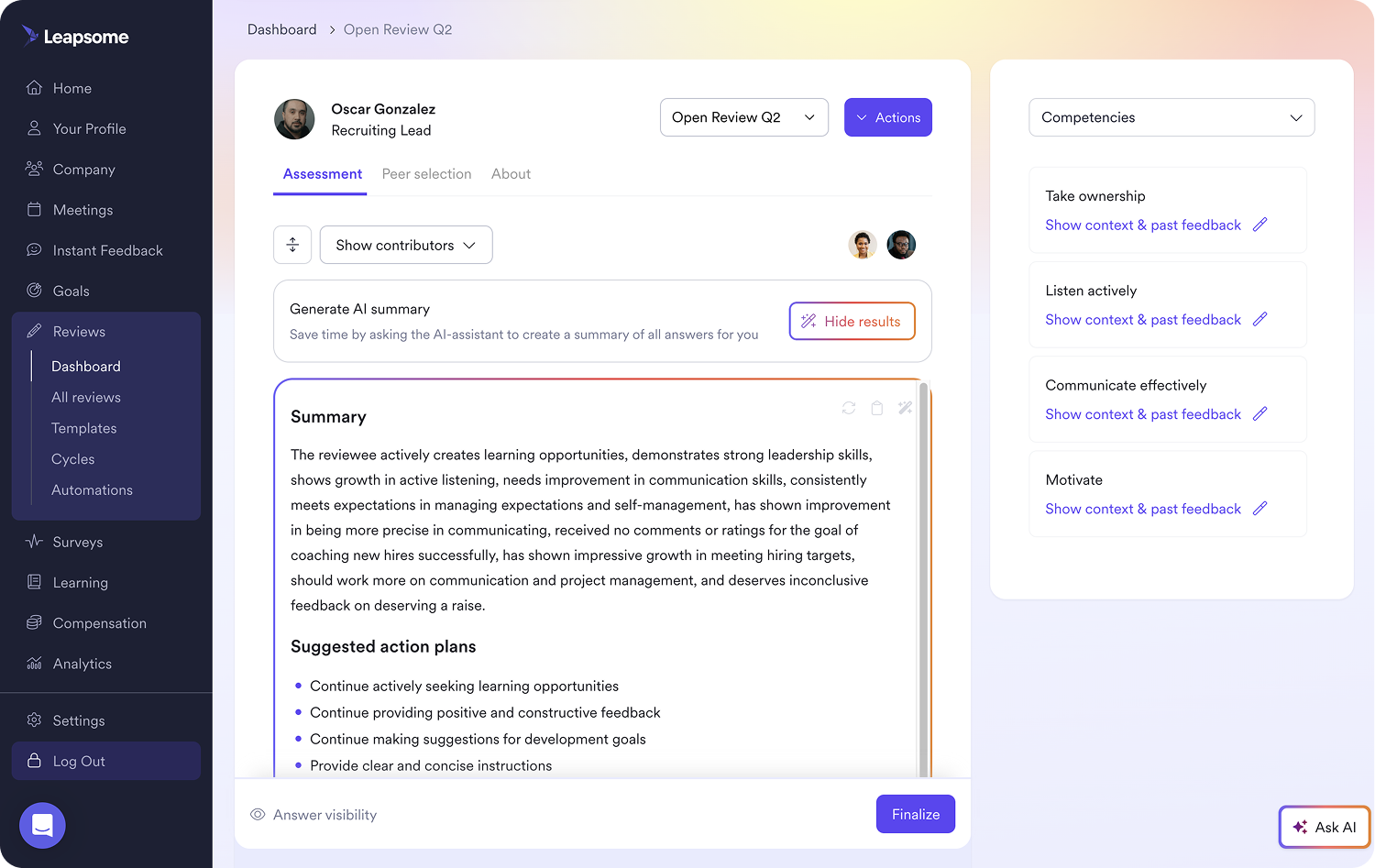
🌱 Run reviews that keep pace with your company
Leapsome’s Performance Reviews provide flexible review cycles and reusable templates, so managers can follow a consistent process as your organization grows.
👉 Explore Performance Reviews
Five top HCM software platforms
“It’s one big lift to automate, but every cycle after that becomes faster and easier. Automating the invisible work gives HR leaders back time for culture, strategy, and meaningful connection.” — Emma Leeds, Founder, CEO & Chief People Consultant, People Function
When assessing HCM platforms, start with your company size and HR maturity to filter the candidates. Workforce complexity and geographic footprint can further narrow your options.
Compare each system from these top HCM companies based on the people practices you need to improve.
1. Leapsome
Best for: Growing organizations that want core HR to support stronger people management.
Leapsome combines employee records and automated workflows with comprehensive performance and engagement tools. Goals and learning keep development connected to everyday work. Shared people data also supports broader workforce analysis.
Organizations with complex multicountry payroll processing should confirm how integrations will cover those requirements.
2. BambooHR
Best for: Small and mid-sized organizations prioritizing straightforward core HR.
BambooHR centralizes employee records and onboarding in an accessible interface. It also offers U.S. payroll and performance management. More than 150 integrations help connect BambooHR with a wider tech stack.
BambooHR manages global payroll through localized partners, so multinational organizations need to assess coverage carefully.
3. Rippling
Best for: Organizations that want HR operations to connect with IT administration.
Rippling connects HR and payroll with app access and device management. It also supports global workforce operations and cross-functional automation.
Its modular breadth can create a larger rollout than a lean HR team needs. Buyers focused on manager development should test those workflows in detail.
4. Workday
Best for: Large enterprises with complex structures or global workforces.
Workday HCM provides workforce planning and advanced analytics on a global HCM foundation. It also supports complex organizational structures and enterprise talent management.
Implementing and maintaining that system requires significant internal capacity. Smaller HR teams may end up paying for more complexity than they can use.
5. ADP
Best for: Organizations that place payroll accuracy and compliance at the center of their HCM decision.
ADP combines established payroll infrastructure with HCM products for different company sizes. Its global payroll services cover more than 140 markets and provide workforce analytics.
ADP offers several products based on company size and location. Doublecheck that their recommended offering has all the capabilities your team actually needs.
How to choose HCM software you won’t outgrow
“Look for one platform that covers your key needs and integrates with your stack. Don’t scatter data across 10 or 20 disconnected tools.”
— Katerina Arsova, Head of People & Talent Operations & Partnerships, Leapsome
Most HR leaders start the HCM buying processes by making a requirements spreadsheet. But that keeps you focused on features when you should be looking at how each system can help your team as the organization grows.
To save time and make a better longer-term decision, use these three steps:
- Start with today’s friction: Map all the bottlenecks that HR runs into with your current system. Where do managers and employees struggle to access tools? Your new system should get those processes running smoothly.
- Separate foundations from future capabilities: You may need reliable records and workable integrations now. But as your people practices mature, structured reviews and engagement insights may become more important. Then, you may need tools for learning and development. You don’t need every capability on day one, but you should be able to access them when needed without rebuilding your stack.
- Test the operating model, not the demo: Give HCM vendors a realistic scenario, such as an employee moving to a new role. Ask how that change affects the employee record and the processes that rely on it. The right platform should be able to update all the necessary data and systems efficiently.
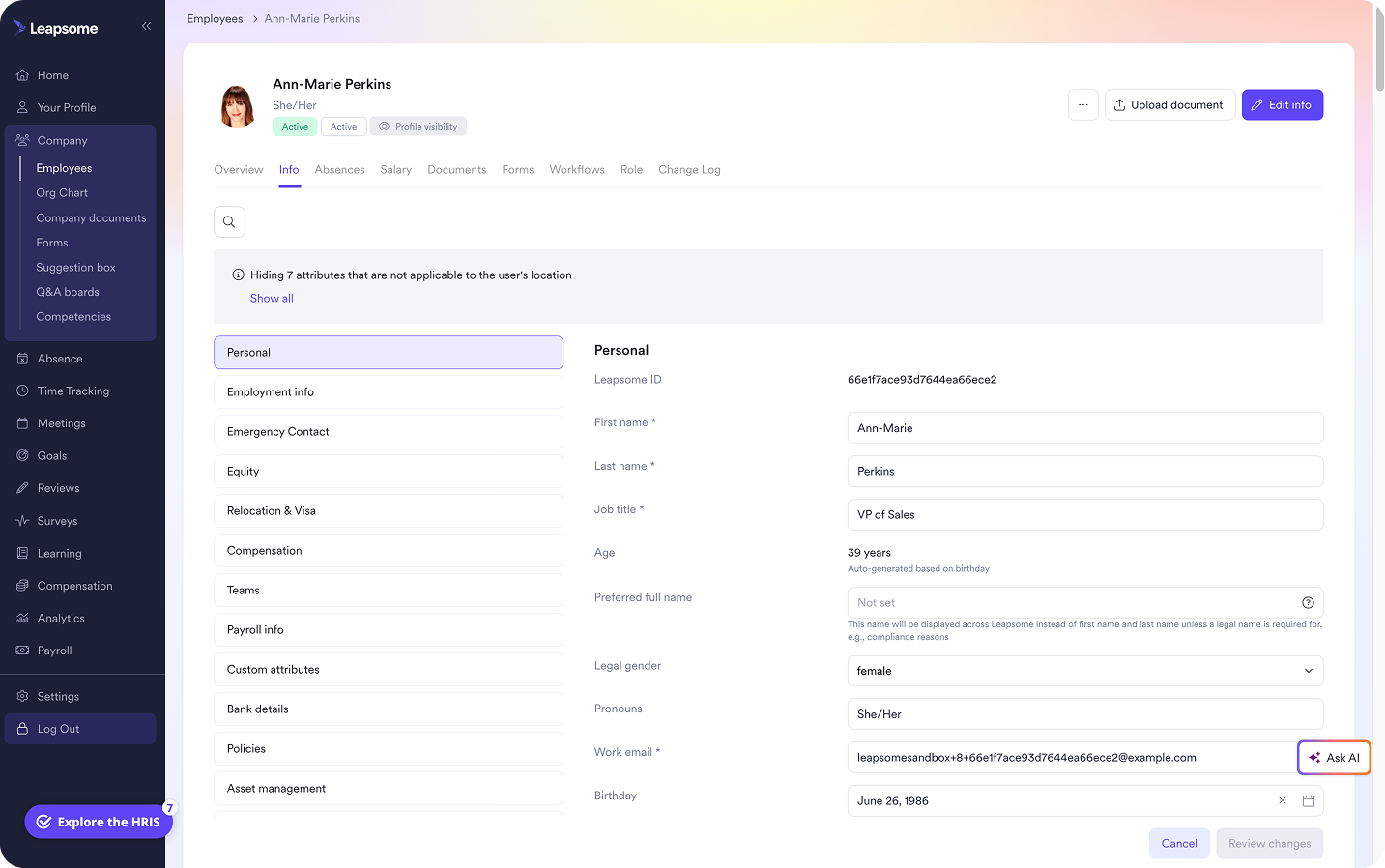
🏗️ Add capability without rebuilding your foundation
Leapsome gives growing teams a shared employee record that can support more structured people processes over time.
👉 Explore Employee Records
Build an HCM foundation that supports people as you grow with Leapsome
Growth exposes weak HCM infrastructure quickly. A weak system may store employee data and automate a few tasks, but every new people process adds more coordination work. HR ends up rebuilding reports while managers and leadership wait for updates. The right platform should be able to grow with you.
Leapsome combines core HR with deeper people enablement. This makes essential administration the support structure for a stronger people strategy. With Leapsome, HR teams can:
- Establish a reliable HR foundation: Employee Records centralize workforce data, while automated workflows keep recurring tasks moving.
- Create consistent management practices: Performance Reviews connect with Goals & OKRs. Competencies clarify expectations, while Instant Feedback and 1:1s keep progress visible between formal cycles.
- Connect insights with development: Engagement Surveys help HR identify where teams need support. Learning provides a way to act on development needs, while AI-powered insights help HR interpret connected people data.
“If you’re looking for a comprehensive feedback tool enabling your organization to profit from further modules — including surveys and goal tracking — and you’d like to use one efficient tool rather than several, I encourage you to use Leapsome. [...] Leapsome can improve various processes within organizations, which makes daily operations way leaner and more efficient — not only for People/HR teams.” — Leonie Stratbüker — Team Lead People & Organization | CHRONEXT
📈 Give HR room to lead
Leapsome connects core HR with the people practices that support performance and development.
👉 Request a demo
FAQ
What’s a human capital management (HCM) platform?
An HCM platform is a unified HR system that combines core HR administration capabilities with talent management. It supports the employee lifecycle from hiring through long-term development.
Which other HCM software market leaders are worth considering
The HCM software market leaders vary by company size and workforce complexity. Dayforce, formerly Ceridian Dayforce, and Oracle HCM Cloud serve large organizations with complex global requirements. UKG offers strong workforce management capabilities, while Gusto gives small businesses a simpler payroll-led platform.