PEO vs. ASO: Choosing an HR outsourcing model for your business


Organizational growth is stressful. Leapsome’s 2026 Workforce Trends Report shows that 66% of employees say their personal workloads increase year-over-year, with 57% of managers and HR leaders overseeing more direct reports.*
As your team feels the growing pains of people management at scale, you can reach out to an HR outsourcing organization, like a professional employer organization (PEOs) or administrative services organization (ASO), for support. Both models promise seamless service streamlining, but they have a big impact on your ability to manage data and shape company culture — and outsourcing HR processes isn’t your only option for a lighter workload.
In this guide, we’ll help you decide when it makes sense to build your internal capabilities and when it’s time to reach out to a PEO versus an ASO. We’ll break down the differences between PEOs and ASOs so it’s clear what they offer, their tradeoffs, and how to make the right choice for your long-term goals.
* Leapsome, 2026
What are PEOs and ASOs? Essential traits
When you work with a PEO or ASO, you’re agreeing to send some (or all) of your HR duties to a third party. The fundamental distinction between the two is how intimately these systems weave into your business structure.
What’s a PEO?
PEO solutions are third-party providers that use a co-employment model to manage HR functions such as payroll services, benefits administration, and workers’ compensation. In this arrangement, the PEO takes over specific administrative and legal functions, but you still retain control over day-to-day employee management.
What’s an ASO?
ASOs don’t enter a co-employment agreement with you. Instead, they work with your team as a vendor to take on similar administrative tasks to a PEO. Choosing a more tailored ASO HR solution for your needs means you’ll retain complete control and responsibility for your people operations: You stay the employer of record (EOR), which keeps legal compliance and tax records in-house.
PEO vs. ASO: What sets them apart?
There isn’t a particular stage in a company’s scaling journey where a PEO is “better” than an ASO or vice versa. Instead, the right choice depends on your resources and long-term priorities.
Here are the biggest things that separate PEOs and ASOs.
Employment model
PEOs operate through co-employment. ASOs keep everything in your name.
Since PEOs become closely entwined with your company’s legal and tax framework by co-hiring your employees, they can take on more work (at the price of risk redistribution and less control on your end). By contrast, an ASO’s separation as a vendor offers you more flexibility and keeps things like tax documentation in-house.
Services and delivery method
PEOs and ASOs handle similar tasks, like compliance, payroll, and benefits administration, but their delivery methods differ. PEOs have the advantage of aggregating employees across multiple clients to bundle services, which often translates to more attractive benefits packages and insurance plans.
Since ASOs offer a more à la carte service, you can choose the level of support you want while maintaining ownership over your current employee programs and benefits strategies. But that means they can’t give you the same robust menu of compliance services since they aren’t co-employers.
Risks and strategic considerations
Working with PEOs frees up your team’s time and energy, but it introduces the risk of becoming too reliant on external systems. Outsourcing can dampen company culture and discourage engagement from employees who fit in before those processes changed.
ASOs require more active monitoring from your internal HR team, which limits how much more bandwidth they’ll get. You’ll also stay on the hook for any legal or compliance issues, even if they came from the ASO. If the ASO provides health insurance, health claims (rather than premiums) may come out of your budget, too.
These risks are part of the reason more companies are seriously reassessing whether to transition back to insourcing HR processes. According to Deloitte’s 2024 Global Outsourcing Survey, 70% of executives said they brought outsourced efforts back in-house over the past five years. As they wrote, “Insourcing…is not a new lever for organizations. However, adoption is at historic high levels.”
Pricing and payment structure
PEOs tend to be pricier than ASOs. Since PEOs usually charge as a percentage of payroll or per-employee-per-month (PEPM) fees, those costs rise substantially as your company scales. ASO pricing is generally lower, and providers are more likely to offer a flat-fee or service-based model that’s more affordable and consistent long term.
Tradeoffs and hidden costs
“Switching tools has a big cost. Always plan for scalability and test integrations early what works globally must still fit locally.”
— Marie Richter, Fractional VP People & Consultant
Even though PEOs and ASOs can reduce administrative burdens, they introduce new vulnerabilities. For PEOs, the biggest downside is the loss of control over decision-making structures for HR functions, such as choosing benefits providers, that can lead to losing sight of your growth path. And ASOs require greater oversight from your internal team, restricting how much support they can get from the investment.
No matter which model you pick, outsourcing can fragment your employees’ experience. It can weaken your agility to do your best, especially in situations where you have to send a dozen emails to get data on your own employees, for example.
If you want to reduce HR workloads without relying solely on third parties, start by looking into Leapsome’s all-in-one HR platform. With tools like our Workflows feature (which automates routine HR tasks), you’ll stay in control of your processes while giving your team the help they need to avoid burnout.
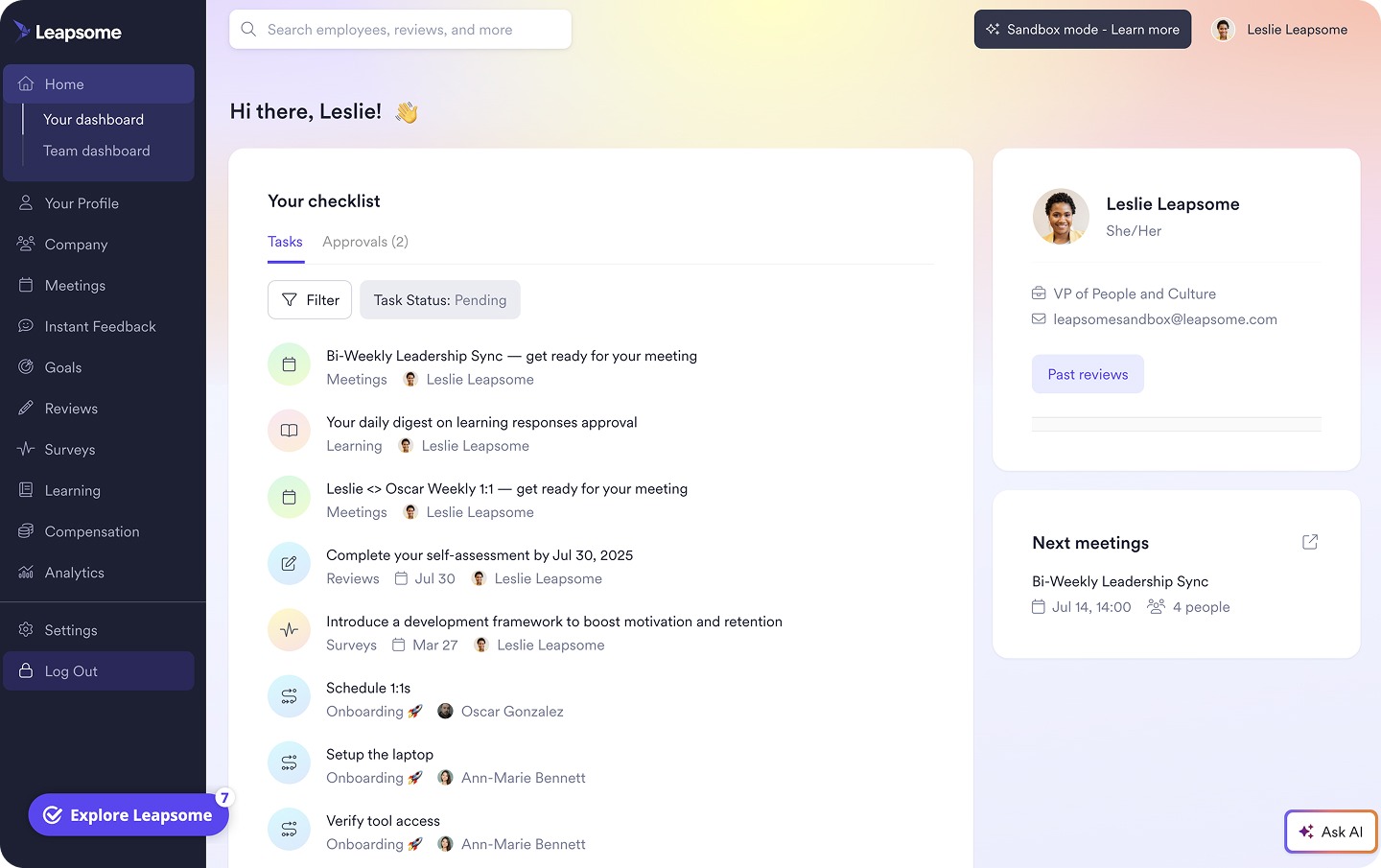
⚙️Automate HR operations without losing control
Leapsome’s Workflows reduces time-draining HR tasks without outsourcing processes, so your team always stays in charge of the most important operations.
👉 Explore Workflows
Choosing between PEOs and ASOs for your company’s needs
“It’s about doing more with less. We cut back on recruitment but invested those efforts into employer branding and people development. The strategy stays the same, it’s the implementation that changes.”
— Pernilla Wraneus, VP Global Head P&C at Accedo
At first, the choice between a PEO and an ASO might feel like a practical choice: What can do the most at the lowest price? However, only looking at costs doesn’t capture how either model could play a role in your long-term scaling strategy.
Take stock of factors like your company’s current size, growth trajectory, and internal capability, then see what a PEO or ASO brings to your HR organization. Here are some common moments when HR outsourcing likely makes sense:
- For early-stage startups: A PEO is the most common call in these cases. You likely don’t have in-house HR expertise (nor the budget for it), so a PEO bundles access to enterprise-grade compliance, benefits, and payroll services. Plus, young start-ups with small teams have a much lower relative cost for PEOs that charge PEPM, so this is one of the few instances where PEOs can be cheaper — you’re not shouldering the fees for individual services or hundreds of seats.
- Scaling fast with a small HR team: Companies in the middle of their first growth spurts will likely find ASOs useful because they let you preserve ownership over your operations. However, you should also consider building out their core HR functions internally with the help of HR software like Leapsome to keep a handle on the department as it grows.
- Your HR setup starts to limit operations: When your HR team takes a long time to complete simple tasks like collecting onboarding paperwork, your current model likely isn’t keeping pace with your growth trajectory. First, consider integrating with scalable HR software that enhances your team’s agility without sacrificing ownership, to more immediately lighten the load and get things back on track. Then, you might consider an ASO to address pain points and regroup.
Leaving the debate between just PEOs and ASOs overshadows the importance of strong internal systems and the team you’ve already built. HRIS platforms serve as a hub for planning and executing everything from your daily tasks to long-term strategy. Instead of defaulting to external solutions after things become unmanageable, consider upgrading your existing HR processes with Leapsome.
“Change is constant, so reactivity just doesn’t work anymore. Responsiveness isn’t about speed; it’s about design. If you don’t build the structure before the next fire, you’ll default to knee-jerk moves that create confusion and burnout.”
— Craig Forman, Founder & Principal Consultant at CultureC Consulting
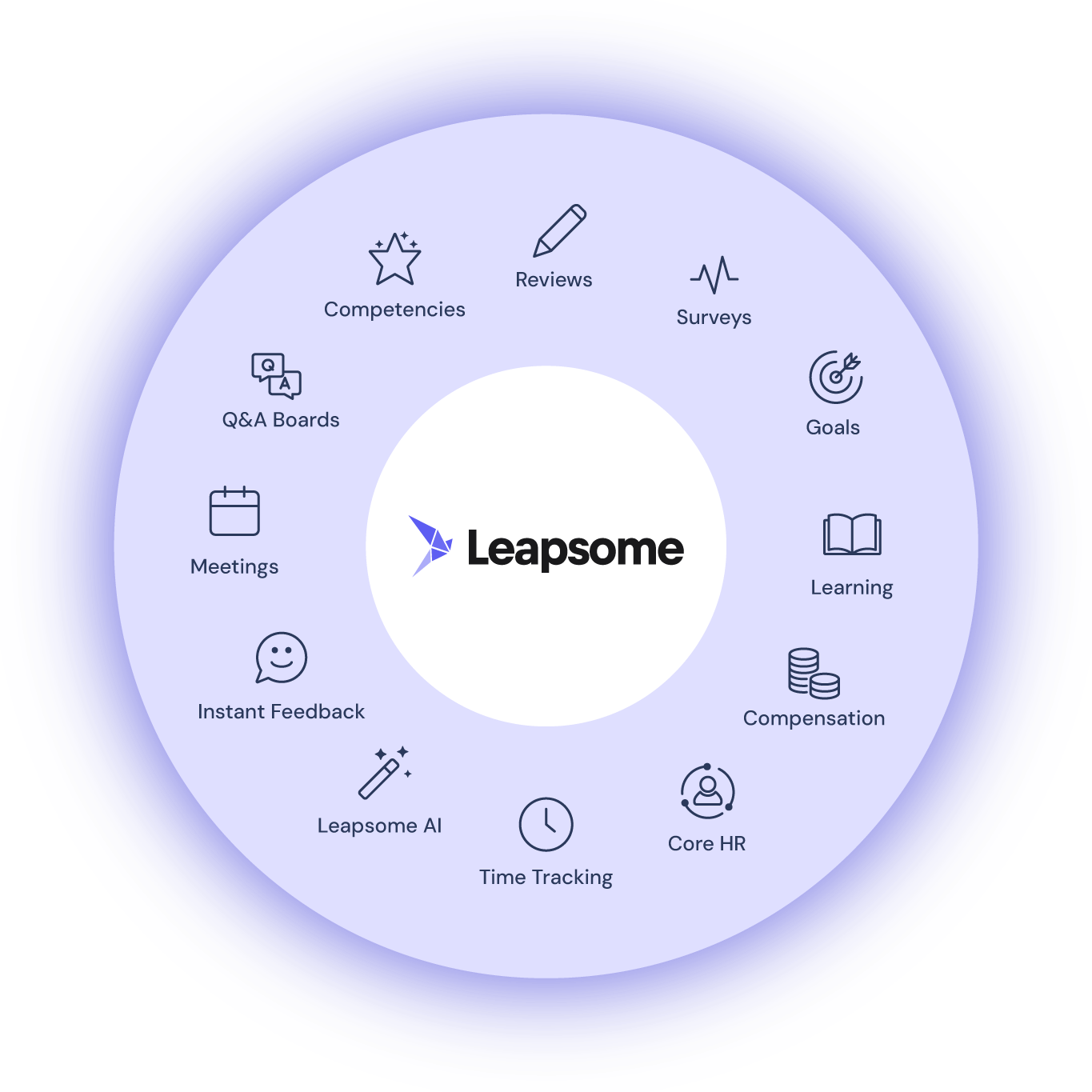
🎛️ Take control of HR processes
Leapsome’s HRIS empowers your team by giving them automated tools to support all their tasks, from goal-setting to new employee onboarding, at scale.
👉 Explore HRIS features
Centralize and improve your HR processes with Leapsome
Outsourcing with PEOs or ASOs isn’t always the best strategy for managing heavy HR demands. If the underlying problem is inefficient and fragmented internal systems, just handing the reins over to another organization won’t fix it. Instead, you could see a marked improvement by simply updating your toolbox.
Leapsome’s all-in-one HR platform offers a practical solution for teams who want to enhance their capacities and avoid the problems that come with outsourcing. From centralizing your employee data to AI-powered reporting and automating workflows, our complete system supports scalability while keeping you in the driver’s seat.
“With Leapsome, we were able to automate performance reviews, goal setting that was even prior, but now even further and onboarding and offboarding and that together helped us save about 20% of manual effort of our team.” — Weronika Czerny-Nowakowska, Chief Operating Officer | Neurons Lab
💪 Build a stronger, more scalable HR foundation
Leapsome’s HRIS replaces fragmented systems and outsourcing needs with one platform, for more efficient HR and talent management operations without external dependencies.
👉 Request a demo
FAQ
How do PEOs and ASOs compare in terms of services?
PEOs and ASOs differ more in their employment structure than the services they deliver. These third-party providers typically offer payroll processing, benefits, and compliance coverage. But PEOs provide these services in a bundle as co-employers, and ASOs let you pick and choose different plans for your needs.
What’s the downside of using a PEO?
PEOs reduce your ability to control how your company changes due to their more binding co-employer status. Generally, PEOs also have higher costs and allow for less customization than ASOs.




.jpg)

.jpg)