The 9 best SAP alternatives for 2026
.png)
.jpg)
SAP is a powerful ERP, but power comes with tradeoffs. For many buyers, flexibility, user-friendliness, and people enablement ultimately matter more.
Luckily, there are many great SAP alternatives for 2026. This article compares the 9 best, focusing on traditional ERP replacements as well as modern HRIS platforms that are often easier to implement, more configurable, and better aligned with people-first organizations.
Whether you're a mid-sized company looking to escape SAP's overhead or an enterprise seeking more adaptable HR technology, you'll find practical comparisons here to help you evaluate your options quickly and confidently.
🧩 Ready for a more flexible alternative to SAP?
See how Leapsome’s flexible, people-first HRIS supports growing organizations (without SAP-level complexity).
👉 Explore Leapsome HRIS
The best SAP alternatives for 2026
This shortlist focuses on the HR platforms organizations most often consider when moving away from SAP. Each option was evaluated based on its configurability, integrations, migration effort, and how well it supports mid-sized to large organizations modernizing their people operations. Don’t worry, we’ll also include advice for startups and scaling organizations.
Disclaimer: All information below is accurate as of February 2026 and based on publicly available information from each vendor’s official website. HR and ERP software evolves quickly, so features and capabilities should always be verified directly with vendors during evaluation.
{{TABLE}}
Leapsome
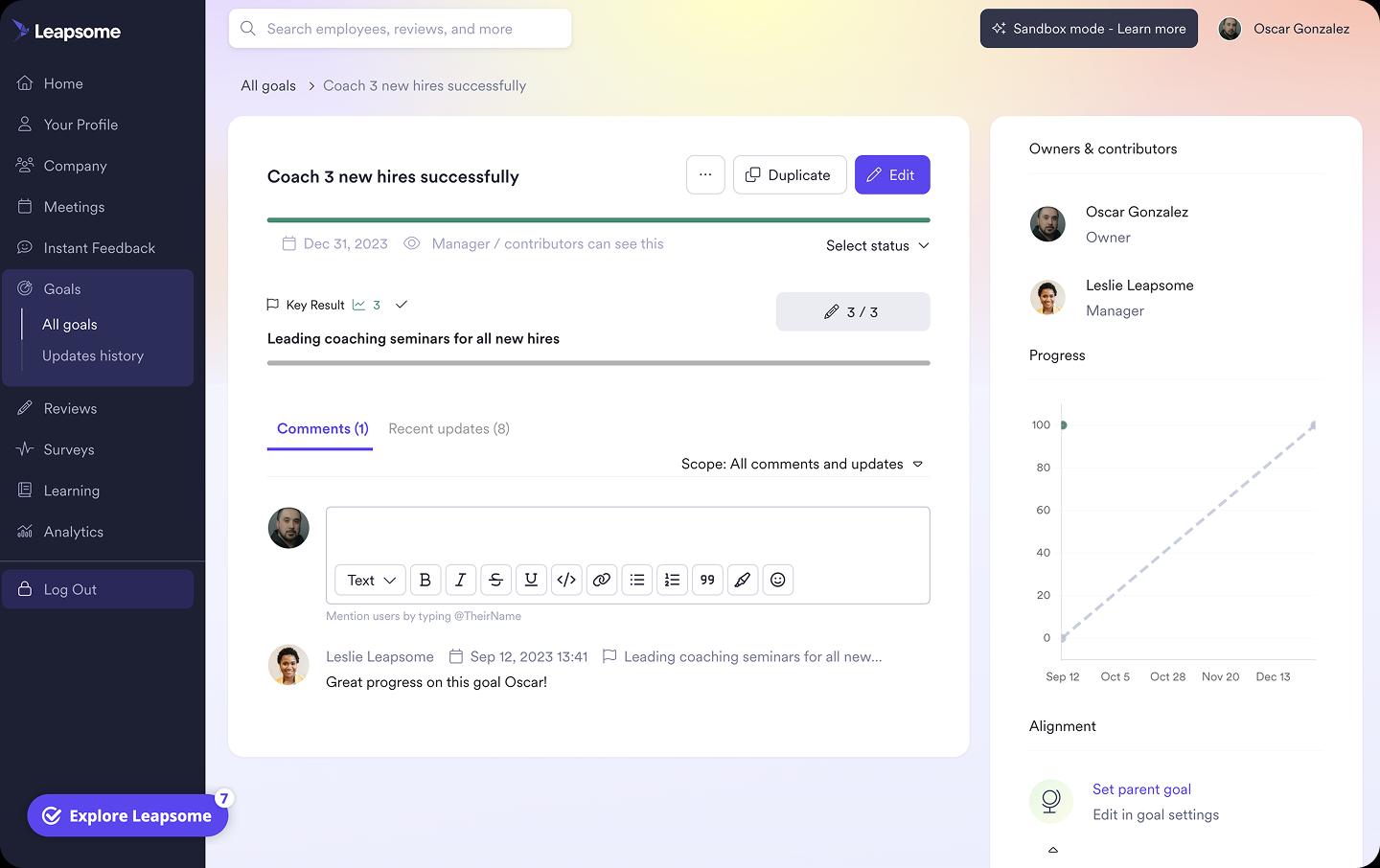
Leapsome is a people-first HRIS designed for organizations that want SAP-level structure without SAP-level complexity. It connects core HR data with performance, engagement, learning, and compensation, giving HR leaders a single system to run people operations and support long-term growth.
Unlike legacy ERP-driven tools, Leapsome is built to be flexible and easy to implement. Teams can configure workflows, reporting, and automation without heavy IT involvement, which makes it easier to adapt as organizational needs change.
💭 “[With Leapsome], we wanted to build an HR tool that grows with you, scales with you, and becomes your strategic partner every time you're growing your organization.”
— Suraj Paneru, Customer Success Coach at Leapsome
Key features
- Core HR and employee data management with centralized records
- Onboarding and offboarding workflows that adapt to different roles and locations
- Absence and file management built into the HRIS
- Configurable automation for approvals, reminders, and lifecycle events
- Reporting and people analytics across HR, performance, and engagement
- AI-powered insights and assistance to support reviews, planning, and workflows
- Native connections between core employee data, payroll prep, and people enablement functions like surveys
Pros
- Unified HRIS with performance, engagement, and learning in one platform
- Highly configurable without developers or IT support
- Fast to implement compared to enterprise HRIS tools
- Clean, intuitive UI that drives employee and manager adoption
- Automation reduces manual HR admin work
- AI features support insights, reviews, and workflow efficiency
- Strong onboarding and customer support
Limitations
- Payroll depends on location and integrations
- Depth may exceed the needs of very small teams
Best for
Teams of all sizes that want to replace SAP with a flexible, modern HRIS that supports both operational HR and people development without fragmentation.
📊 Turn people data into decisions, not dashboards
Connect HR data with performance, engagement, and learning to support smarter planning and execution.
👉 Book a demo
Workday HCM
.webp)
Workday HCM is one of the most established SAP competitors at the enterprise level. It is often evaluated by organizations that want a cloud-based platform with broad coverage across HR, finance, and planning.
For HR teams, Workday offers depth and scale, but that breadth can come with tradeoffs. Implementation timelines are typically longer, and ongoing configuration often requires dedicated technical resources or partners — so keep that in mind if you have similar concerns with SAP.
Key features
- Core HR and global workforce management
- Talent management covering recruiting, performance, and succession
- Workforce planning and headcount modeling
- Payroll and benefits administration in select regions
- Analytics and dashboards for people and financial data
- Mobile access for employees and managers
Pros
- Proven platform for large, global organizations
- Strong reporting and analytics capabilities
- Broad functional coverage across HR and finance
- Scales well for complex organizational structures
- Large ecosystem of partners and integrations
Limitations
- Long and resource-intensive implementation cycles
- Configuration and changes often require specialist support
- Can feel rigid for teams that want faster iteration, like startups
Best for
Large enterprises with complex requirements, global operations, and the internal resources needed to manage a highly structured HR platform.
Oracle Fusion Cloud
.webp)
Oracle Fusion Cloud is often shortlisted by organizations already invested in Oracle’s broader enterprise stack. It positions itself as a unified cloud platform that connects HR with finance and operations, appealing to companies within the Oracle ecosystem that want tight alignment across systems. The platform offers depth and global reach, but the experience can feel closer to a traditional ERP than a modern HRIS.
It’s worth noting that Oracle HCM and Oracle ERP are separate applications. Leaders may need to invest in both if they’re looking for the configurability of an HRIS.
Key features
- Core HR and global workforce management
- Recruiting, onboarding, and talent management modules
- Payroll, benefits, and compliance support across regions
- Workforce modeling and planning tools
- Embedded analytics and reporting
- Integration with Oracle’s finance and ERP products
Pros
- Strong option for organizations already using Oracle products
- Comprehensive coverage for global HR operations
- Broad compliance and regulatory support
- Scales well for large, complex enterprises
- Unified data model across HR and finance
Limitations
- Implementation and configuration can be time-consuming
- User experience can feel less intuitive for managers and employees
- Requires multiple applications for access to core HR data
Best for
Large enterprises that want an HR platform tightly integrated with Oracle’s ecosystem.
UKG Pro
.webp)
UKG Pro is a common choice for organizations that value payroll accuracy, workforce management, and compliance. It is especially well known in industries with hourly workforces and complex labor requirements.
From an HRIS perspective, UKG Pro offers reliable core functionality, but some teams find that its strength in payroll and time tracking outweighs its flexibility in broader people operations and experience-driven workflows.
Key features
- Core HR and employee record management
- Payroll processing and tax compliance
- Time, attendance, and scheduling tools
- Benefits administration
- Workforce reporting and analytics
- Mobile access for employees and managers
Pros
- Strong payroll and compliance capabilities
- Well-suited for organizations with large hourly populations
- Integrated workforce management features
- Reliable reporting for labor and pay data
- Established presence in regulated industries
Limitations
- User interface can feel dated compared to newer HR platforms
- Configuration changes may require vendor support
- Less focus on engagement and development workflows
Best for
Organizations with complex payroll, time tracking, and compliance needs, particularly those managing large hourly or shift-based workforces.
ADP Workforce Now
.webp)
ADP Workforce Now is a well-established HR software covering payroll, benefits, and core HR, all in one place. It’s often shortlisted by teams looking for a dependable system with broad regulatory support across regions. Furthermore, ADP’s modular structure allows organizations to adopt specific capabilities over time, which can be helpful for teams with clearly defined payroll and compliance priorities.
Key features
- Centralized employee records with configurable data fields and role-based access
- Payroll processing with automated tax filing and compliance reporting
- Benefits enrollment and administration with carrier connections
- Time and attendance tracking tied directly to payroll calculations
- Standard HR reporting across headcount, payroll, and compliance metrics
- Employee and manager self-service through web and mobile access
Pros
- Long-standing expertise in payroll and compliance
- Broad coverage for tax and regulatory requirements
- Flexible module-based approach
- Suitable for a wide range of organization sizes
Limitations
- HR capabilities are organized across multiple modules, so you may need to pay for features you don’t necessarily need
- Workflow customization is more limited than some HRIS-first platforms
- Reporting depth depends on the modules in use
Best for
Organizations that prioritize payroll accuracy, compliance, and broad HR coverage, and prefer a modular system that can be expanded over time.
Personio
.webp)
Personio is a cloud-based HRIS built to help organizations standardize core HR processes as they grow. It’s commonly used by teams that want a clear system of record for employee data, hiring, and time off, without adopting a broader ERP.
The platform centers on consistency and administrative efficiency. For HR leaders, this makes Personio a practical option for managing everyday people operations, particularly in the EU.
Key features
- Centralized employee profiles with configurable fields and permissions
- Applicant tracking and recruiting workflows from job posting to hire
- Onboarding and offboarding task management for HR and managers
- Absence and time-off tracking with policy-based rules
- Payroll preparation with structured data exports for payroll providers
- Standard HR reporting on headcount, absences, and workforce changes
Pros
- Clear focus on HR administration and record keeping
- Straightforward setup for core HR workflows
- Consistent experience for employees and managers
- Well-established in European markets
- Supports growing teams formalizing HR processes
Limitations
- Limited depth in performance, engagement, and learning
- Analytics are more basic compared to enterprise HR platforms
- May not be suitable for organizations without operations in Europe
Best for
Mid-sized organizations in the EU that want a focused HRIS to manage their core HR processes.
HiBob
.webp)
HiBob is an HR platform designed around employee experience and people visibility, with a strong emphasis on engagement, culture, and manager-level access to people data. It’s a good choice for organizations seeking user-friendly, intuitive interfaces.
Rather than positioning itself as a traditional system of record, HiBob focuses on making workforce data easy to understand and act on. This approach resonates with teams that prioritize communication, engagement, and day-to-day people insights.
Key features
- Centralized employee records with configurable fields and permissions
- Org charts and people directory with real-time updates
- Time off and attendance tracking
- Engagement tools such as surveys and shoutouts
- Reporting and dashboards focused on people metrics
- Integrations with payroll and other HR systems
Pros
- Strong focus on employee experience and engagement
- Intuitive interface for employees and managers
- Visual people data through org charts and dashboards
- Supports fast-growing and distributed teams
- Integrates with a wide range of HR tools
Limitations
- Payroll and advanced workforce management depend on third-party integrations rather than native tools
- Limited support for complex financial, supply chain, or operational workflows outside HR
- Workforce planning and scenario modeling are lighter than ERP-led platforms
Best for
Organizations that want a modern HR platform with a strong emphasis on engagement, visibility, and people experience, rather than deep ERP functionality.
Rippling
.webp)
Rippling brings multiple operational functions, including HR, payroll, and IT administration, together under one roof. The platform’s strength lies in automation across employee lifecycle events, simplifying rote processes like onboarding and offboarding.
Key features
- Unified employee records powering HR, payroll, and IT workflows
- Automated onboarding and offboarding across apps, devices, and permissions
- Payroll and benefits administration in supported regions
- Device and application management tied to employment status
- Workflow automation triggered by role or status changes
- Cross-functional reporting across people and systems
Pros
- Strong automation across HR and IT processes
- Reduces manual coordination between HR, IT, and finance
- Centralized control over employee access and tools
- Works well for distributed or remote-first teams
- Broad integration ecosystem
Limitations
- HR functionality is less focused on performance and engagement
- Broad scope may be more than some HR teams need, especially at startups
- Costs can stack up as additional modules are added
Best for
Organizations that want to tightly connect HR data with IT access and operational workflows, and value automation across departments.
BambooHR
.webp)
BambooHR is an HRIS built around simplicity and clarity in day-to-day people operations. The platform concentrates on giving HR teams a clean system of record for employee data, policies, and core workflows.
Its design prioritizes ease of use over breadth. If you’re moving away from SAP, you’ll probably want to consider BambooHR if you’d like to significantly reduce administrative overhead and give employees a straightforward way to interact with HR processes.
Key features
- Centralized employee records with customizable fields and permission controls
- Onboarding and offboarding checklists for HR and managers
- Time off tracking with configurable policies and approvals
- Document storage and e-signatures tied to employee profiles
- Basic reporting on headcount, turnover, and HR activity
- Employee self-service for personal data and requests
Pros
- Simple and intuitive interface for HR teams and employees
- Fast setup compared to enterprise HR systems
- Clear system of record for employee information
- Strong adoption among managers due to usability
- Well-suited for teams standardizing HR for the first time
Limitations
- Limited depth in performance, engagement, and learning
- Reporting and analytics are relatively basic
- May fail to meet requirements in complex enterprises
Best for
Small to mid-sized organizations that want a straightforward HRIS to manage core HR processes without the overhead of a full ERP or highly complex platform.
A buyer’s guide to choosing a SAP alternative
Before deciding which SAP competitor is right for you, you’ll need to determine what kind of HR platform best fits your organizational needs. To make this determination, you’ll need to weigh a few different factors, including your company’s size and HR goals.
ERP vs HRIS (and why the distinction matters)
ERP systems like SAP are built to manage core business operations, such as finance, procurement, and supply chain. HR is typically one module within such a platform. This is why ERPs work well for organizations that need tight operational control across departments. However, they can sometimes slow down iteration and customization for HR teams.
HRIS platforms, by contrast, are purpose-built for people management. They focus on employee data, workflows, and experiences, and usually integrate more easily with tools already used by managers and employees.
When an all-in-one HRIS beats a legacy ERP
Is your HR team looking to move fast and adapt processes without heavy technical support? An all-in-one HRIS may be a better fit. Because these platforms are designed around People workflows, changes to onboarding, reviews, or approvals are typically easier to make and maintain over time.
All-in-one systems also reduce fragmentation. Instead of managing separate tools for performance, engagement, and development, HR teams can work from a single source of truth. This makes it easier to connect insights across systems and act on them, particularly when managing goals, feedback, and retention initiatives.
However, all-in-one HRIS platforms aren’t designed to replace financial, supply chain, or operational systems. Organizations that rely on tight coupling between HR and these functions may still need an ERP alongside an HRIS to fully support their business.
Don’t let SAP prevent your enterprise from scaling
Many HR leaders find that SAP’s complexity and cost make it challenging to adapt people processes as expectations around hiring, engagement, and workforce planning naturally fluctuate. If you’re reading this, there’s a good chance you’re one of those leaders.
As organizations grow, HR systems need to support change without adding friction. That means prioritizing configurability, clear reporting, and tools that managers and employees can actually use day to day, rather than maintaining rigid workflows that require constant workarounds.
Leapsome was built for this reality. As a people-first HRIS, it combines core HR with performance, engagement, and learning in a single platform, offering HR teams a flexible alternative to SAP that scales alongside the business.
⚙️ Simplify core HR without sacrificing structure
Leapsome centralizes employee data, workflows, and reporting so HR teams can move faster with confidence.
👉 Book a demo
Frequently asked questions about SAP alternatives
What are the best SAP alternatives for mid-sized companies?
For mid-sized organizations, the strongest SAP alternatives tend to be platforms that balance structure with flexibility. Leapsome is often a leading choice for HR teams looking for a unified HRIS that supports core HR, performance, engagement, and learning. Other commonly considered options include Workday HCM for larger-scale needs, Personio for European-focused teams, and HiBob for organizations prioritizing employee experience.
How much does it cost to switch from SAP to a new HRIS?
The cost of moving away from SAP depends on several factors, including software licensing, implementation support, data migration, and internal training. Company size, process complexity, and the number of integrations required can all influence the total cost of ownership. In general, cloud-based HRIS platforms tend to have lower upfront costs and faster time-to-value than traditional ERP solutions.
Is migrating from SAP difficult?
Migration difficulty depends on how SAP is currently configured and how deeply it is embedded across your systems. Common challenges include data cleanup, integrations, and change management. Many modern HRIS vendors offer structured migration support, which can significantly reduce disruption when planning and execution are carefully managed.
Do I need an ERP or just an HRIS to replace SAP?
ERPs are designed to manage finance, supply chain, and operational processes in addition to HR, while HRIS platforms focus on people management. Most HR teams don’t need a full ERP to run effective people operations; a dedicated HRIS does the trick. That said, if tight integration between your core logistics processes and HR is key, an ERP may suit your organization better.
Emily Laytham

.jpg)

.jpg)
.jpg)