HR audits: Cut compliance risks and protect your company from penalties


HR audits offer so much more than a thumbs-up from auditors and investors. Instead, they push teams toward better documentation practices and more thoughtful processes. And they help you find opportunities to strengthen your legal defenses and scale without increasing your risk profile.
But compliance is challenging in the best of circumstances, and ever-shifting legislation makes it increasingly complicated. According to PwC’s Global Compliance Survey, 85% of business leaders believe compliance requirements have grown more complex over the past three years.*
In this article, we’ll explain how human resources compliance audits work and introduce best practices for conducting them efficiently, so you feel better equipped to navigate compliance requirements.
* PwC, 2025
Covering the basics: What’s an HR audit?
While most HR leaders believe they’ve prepared their organizations for changing regulations, one in four admit they don’t understand all the laws involved. An HR compliance audit reviews an organization’s human resources policies and procedures to find policy gaps before they become legal problems.
These audits are usually led by a compliance officer and/or HR manager, often once per year for a full review and more frequently for specific HR functions. To keep them focused, it’s best to run compliance audits separately from HR reviews focused on general operations and efficiency.
Choosing your weapon: Types of HR audits
These are the most common types of HR audits you’ll likely come across as an HR leader:
- Compliance audits: When auditing for compliance, the goal is to surface potential issues that might cause your organization to fail an external review.
- Functional audits: Reviewing specific HR functions, such as payroll preparation or employee classification, allows you to improve parts of your system without the time and expense of a full audit.
- Strategic audits: These reviews take a big-picture view of your HR systems, and they focus on supporting wider HR aims such as attracting top talent or fostering a diverse culture.
The boundaries between these audit types aren’t always clear-cut. For example, when conducting a compliance audit, you may also review broader HR processes and specific workflows to catch problems that could lead to compliance issues.
Why HR compliance audits matter
It’s no surprise that 58% of companies ran at least four audits in 2025, since HR audits can:
- Save you money: Strengthening your HR systems helps you avoid penalties, which can otherwise be steep. For example, data breaches due to noncompliant processes cost an average of $174 thousand more than breaches not related to compliance.
- Build employee trust: When your team knows you’re serious about documenting everything, they’ll likely feel more confident about being treated fairly if an issue ever comes up.
- Support company objectives: 77% of C-suite leaders report that compliance has a significant or moderate impact on company goals.
- Mitigate risks: Strengthening your HR systems is well worth the expenditure of time and resources; noncompliance with labor laws can cost up to $10 thousand per employee.
- Provide better cost visibility: Audits put an overall picture of your finances into sharp relief, and budgeting gets easier when you know where every penny goes.
How do you know if you’re audit-ready?
Many companies view HR audits as one-off reviews to prepare for upcoming inspections — we don’t recommend this approach. Instead, audits reveal how well daily workflows function under normal circumstances. Efficient systems prepare you proactively, so you can conduct a successful audit at the drop of a hat. Erica Ancobia (KUNO) and Sammie Masley (Leapsome) chatted about this in our webinar, “Compliance challenges for HR teams and how to avoid them.”
“Teams that are ready don’t just prepare before the audit, they prepare their day-to-day work, so they don’t have to do the preparation when it comes.”
– Erica Ancobia, CEO of KUNO
Here are several signs your organization may not be audit-ready:
- Fragmented data and tooling: If a basic request (like offering headcount numbers or explaining a workflow) causes stress, that’s a sign your process steps are too fragmented, which makes compliance audits much harder/less successful.
“If your HR systems don’t really talk to each other, you kind of have to pull this from your HRIS, this from your performance review, this from payroll…I think the trails break down a little bit.”
– Sammie Masley, Senior People Ops Manager at Leapsome
- Incomplete documentation: Documentation that omits crucial details, such as when and why an employee received a large bonus, can leave you at a loss when you need to prove compliance or justify a past decision.
- Undocumented workflows: If processes only live in your head, they’re not audit-ready. Poorly defined processes often result in informal decision-making that doesn’t leave a paper trail. For instance, if terminations happen only by verbal agreement, you have little recourse against legal challenges.
One quick-ish fix for some of the issues above is using an HR platform that brings documentation and process steps under one roof. We say “quick-ish” because we recognize that you still have to implement the new tool/train your team on it, etc.
“Many HR teams still struggle with the basics — too many disconnected tools, limited insights. That’s why we built a truly people-first HRIS that unifies all employee data into one source of truth.”
– Suraj Paneru, Customer Success Coach at Leapsome
Doing your due diligence: Essential HR laws and regulations
Here’s a quick rundown of the core laws and regulations you’ll likely review when conducting an HR audit.
Employment laws and benefit policies
Full reviews often include an employee compliance audit, where you make sure your employment policies are aboveboard. You’ll look for noncompliance risks in wage and hour legislation, overtime regulations, leave policies, and minimum wage laws.
Workplace health and safety regulations
Many governments set mandatory standards to prevent employees from getting injured at work. These regulations often include workplace safety training, personal protective equipment, and emergency planning.
Equal employment laws
Equal employment laws encourage fairer workplaces. Audits should focus on anti-harassment policies and equity-focused hiring practices, plus reasonable accommodations for employees who need them.
Data storage and privacy rules
You must store employee data securely — if there’s a breach, not knowing who has access to sensitive documents makes legal recourse virtually impossible. Failing to protect data also puts the company at serious risk of regulatory penalties and reputational damage.
📝 Centralize your people data
Leapsome securely stores all your employee data in one place, so you can avoid disjointed records and last-minute scrambles that lead to expensive compliance mistakes.
👉 Learn more about Leapsome’s Employee Records
HR audits that leave no stone unturned: Six steps for success
Don’t let your HR audit process only live in your head; here’s a six-step guide for successfully conducting human resources audits.
1. Define goals and stakeholders
Start your HR audit process by choosing a leader to head the project (you might send this article to them as a good starting point), then assembling a core team. Pull in employees from other departments, like legal or finance, who also need to be involved.
With this group, discuss how comprehensive your HR audit will be and what you hope to achieve. You can audit your entire framework or specific aspects, such as payroll or benefits.
If you can’t decide where to start, focus on the highest-risk areas first. Then set a clear goal and target completion date — something like “confirm legal compliance within two weeks” — and map out longer audits, breaking them into smaller milestones.
2. Gather documentation
Now you’ll bring together all the information you need to conduct the audit. This is trickier to spell out as it depends on the audit type you’re doing, but refer to our checklist below if you’re wondering what might be relevant. And if documentation is scattered or inconsistent, collect it all and begin your audit by reconciling those records.
3. Compare HR practices against legal requirements
Review your HR policies by comparing them to the latest legislation and looking for gaps or mismatches. Confirm whether your policies and procedures are fully compliant, and if you spot a potential problem, flag it for deeper review.
If the legal requirements are unclear or you worry that your policies could be misinterpreted, involve your legal team or seek a third-party expert.
4. Document and investigate compliance gaps
Compliance gaps often show up in very practical ways: Information is scattered, ownership is unclear, and documentation is outdated.
“Gaps rarely come from the lack of effort. More often, they result from fragmented systems, unclear ownership, outdated documentation, or people data that hasn’t been reviewed consistently over time.”
– Sammie Masley, Senior People Ops Manager at Leapsome
For any compliance gaps, dig deeper to identify the root cause, whether that’s outdated policies or inconsistent training. If you find multiple issues, look at their effects and rank them by severity so you know what to address first.
5. Create and deploy an action plan
Once the review is complete, it’s time to solve your compliance problems. Work your way down the list based on importance/urgency, and create plans with ownership, timelines, and expected results.
The core theme here will likely be improving documentation efforts, because missing decision rationale and inconsistent documentation are two common reasons audits don’t go well.
“You could have three different employee files, one in the system, one in the Google Drive, one in paper, that could all be different.”
– Sammie Masley, Senior People Ops Manager at Leapsome
Auditors expect clear documentation behind every decision, so the best way to immediately improve your audit efforts is by centralizing your process documentation.
6. Monitor results and keep improving
Keep track of how many problems you found and which solutions were most successful — you can use this knowledge to improve future audits. Monitor your team’s performance via HR analytics tools so it’s easier to see if your changes actually led to smoother operations and improved compliance.
HR audit: six steps for success
A clear process so nothing gets missed
Define goals & stakeholders
Assign a lead, assemble your team, set scope and target completion date
Gather documentation
Collect all relevant records — reconcile anything scattered or inconsistent
Compare against legal requirements
Review policies for gaps and flag anything unclear for legal review
Document & investigate gaps
Find root causes, rank issues by severity, prioritise what to fix first
Create & deploy an action plan
Assign ownership and timelines — centralise documentation first
Monitor & keep improving
Track what worked, use HR analytics to measure impact over time
📊 Track team performance with centralized analytics
Get more out of your people data — Leapsome offers centralized insights, custom dashboards, and AI-powered recommendations.
👉 Learn more about Leapsome’s Interconnected People Analytics
A human resources audit checklist that leaves nothing to chance
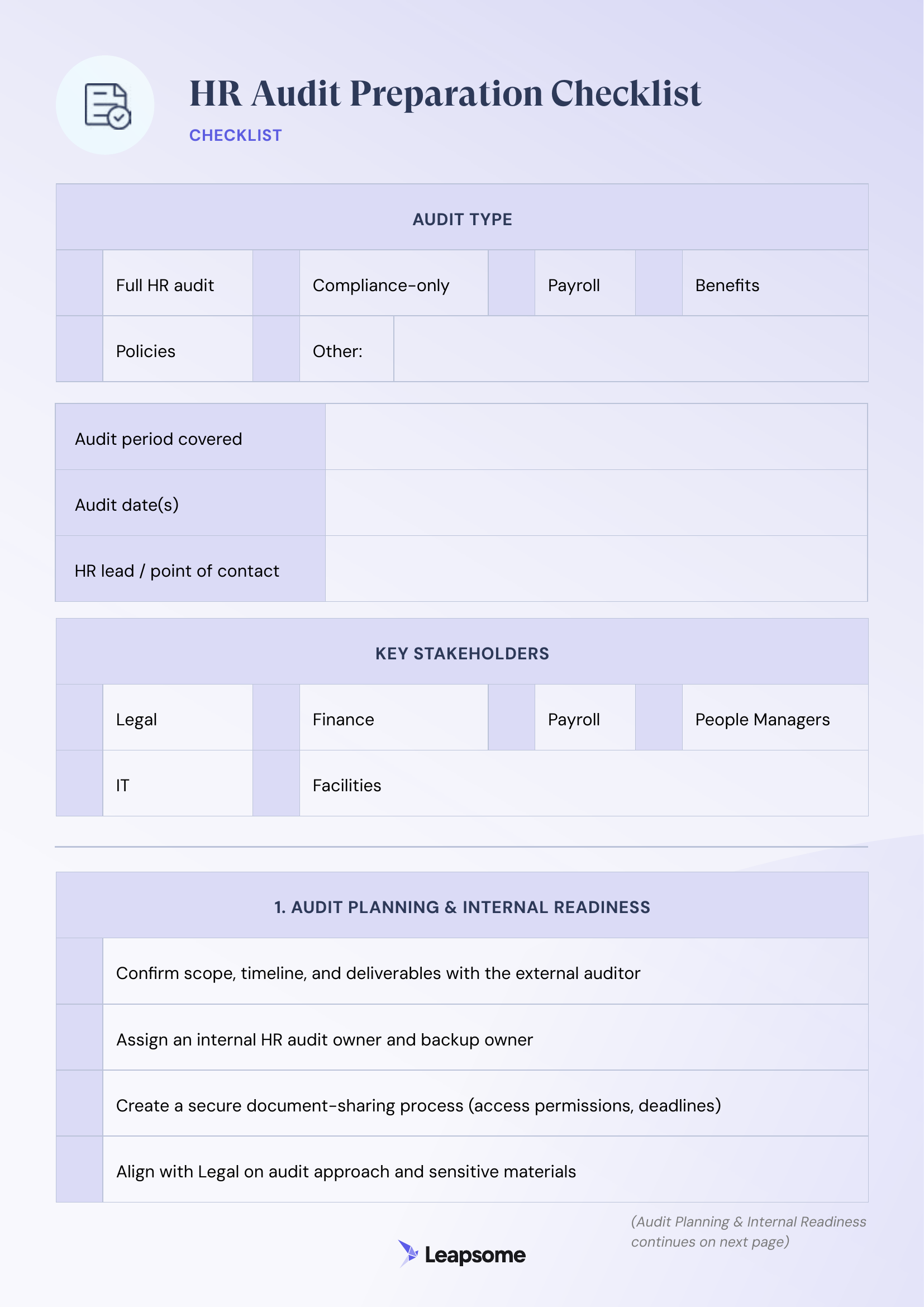
Not sure whether you’ve covered the most important areas? Here’s what you can’t ignore:
- Hiring, onboarding, and termination policies: Review resources and systems such as offer letters, background checks, onboarding documentation, and exit procedures.
- Employee classification and payroll: Verify that you’ve categorized exempt employees, non-exempt employees, and independent contractors correctly. Also, look at payroll to gauge accuracy and overtime compliance.
- Benefits and leave: Compare your leave policies to the relevant laws, and make sure your benefits admin is accurate and efficient.
- Health, safety, and workplace conduct: Compliance in this area requires well-crafted safety training programs and harassment prevention policies, plus a transparent system for reporting incidents.
- Training and disciplinary action: Maintain detailed records of all performance issues and disciplinary actions.
- Employee-facing HR resources: Handbooks and other employee docs should include up-to-date information on compliance requirements and how your company aligns with those regulations.
💸 Don’t miss any steps during your HR compliance audit
In case this all feels overwhelming, we’ve put together a template you can use to quickly structure your HR audits.
👉 Download the tempate now
Best practices for seamless HR compliance audits
For the best chance of a smooth HR audit, keep these tips in mind.
Standardize processes and documentation
Haphazard workflows and messy paperwork lead to inconsistent outcomes and compliance risks. Standardize your HR work and reporting as much as possible, and keep notes when you make process changes so you can review those decisions later.
“If you’re asked, ‘what is the process’ and you’re finding yourself saying ‘Oh, I have to write it down,’ maybe that’s a signal that you should make standard operating procedures.”
– Sammie Masley, Senior People Ops Manager at Leapsome
Get buy-in from other departments
Compliance audits work best when you bring in expertise from outside the HR department. For instance, legal and finance can help you catch issues your team doesn’t have the specialized background to fully understand. Plus, collaborating on these audits encourages the whole company to own some responsibility for compliance.
Choose HR tools that work for you, not against you
Your HR platform can make audits easier or bog your team down with the wrong tools and missing information. Opt for a solution with all the standard HR functions, plus meticulous data collection and reporting to make audits as painless as possible.
Make compliance headaches history with Leapsome
Mitigating noncompliance risks requires a structured approach, meticulous documentation, and in-depth analytics. Doing all this manually uses up a lot of resources, especially when you rely on ad hoc systems that can be prone to costly errors.
According to a survey of high-level business leaders by PwC, companies that take advantage of compliance technology improve risk visibility and processes by 64% and proactive response by 53%, translating to an overall cost savings of 43%.
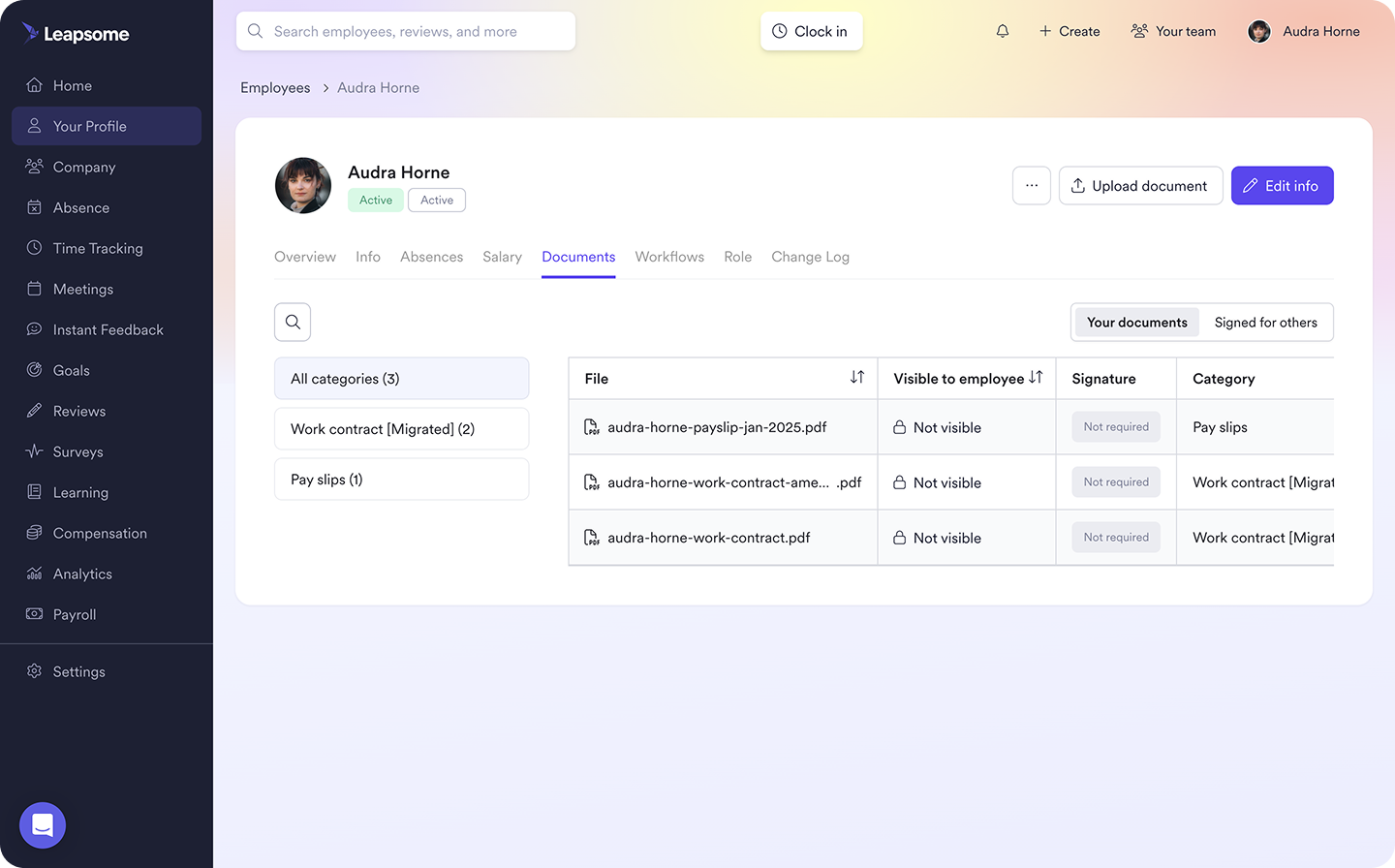
Those savings can be yours with Leapsome. This all-in HR platform centralizes employee documentation in a single user-friendly dashboard. Plus, Leapsome AI automatically collects and organizes easy-to-understand insights to inform your audits for continuous monitoring.
“Employees can now find everything in one place — their data, absences, goals, and reviews. I don’t have to explain which tool to use for what. It’s all in Leapsome.” – Merilyn L, Senior People Operations Specialist at Bob W.
💸 Say goodbye to non-compliance issues
Leapsome keeps your HR processes compliant 24/7 by bringing all your data together and automating payroll and reporting.
👉 Request a demo
FAQ
What are auditing and compliance in HR?
HR compliance audits review laws and internal resources to ensure that you’re in line with all regulations. Your HR department is compliant when its policies and procedures fully satisfy employment laws.
What does an HR audit involve?
Human resources audits for compliance often include:
- Identifying compliance gaps
- Evaluating HR policies
- Reviewing hiring, onboarding, training, and termination guidelines
- Verifying correct employee classification and payroll processing
- Checking data protection procedures
What are the five Cs of audit reporting?
The five Cs give you a structured way to record and organize your findings during an audit. You’ll answer these key questions:
- Criteria: How do you measure compliance?
- Condition: What problem did you find?
- Cause: What created the problem?
- Consequence: What impact did the problem have?
- Corrective action: How will you solve the problem?
Learn how to take HR compliance by the horns with our free webinar
Erica Ancobia of KUNO and Leapsome’s own Sammie Masley spoke together in a Leapsome webinar that dives deeper into many of the discussion points in this article. Watch the full webinar here to learn what auditors really look for and how to stay audit-ready with strong documentation, ownership delegation, and data integration.

.png)


Automate, connect, and simplify all HR processes across the employee lifecycle.