What should an employee information form include? + template

.png)
Each payroll error costs businesses an average of $291 to correct.* A large number of those payroll mistakes come from the same preventable source: inaccurate or incomplete record-keeping, which often starts during onboarding.
While early data-gathering from new hires can feel like just another formality to tick off the onboarding checklist, the employee information form a company uses is the first link in the employee record chain. Any mistakes will ripple out into areas where they can do real damage — like the next payroll run, compliance report, or workforce planning decision.
This guide explores why these little forms can have such a big impact on HR operations and employee record-keeping. Read on to find out how to manage your employee information forms effectively and get access to a free template.
* EY, 2022
What are employee information forms?
“The new preboarding portal lets new employees access key documents and get to know their team before their first day — so the first-day experience feels smooth and connected.”
— Aubrey Bryan, Senior Customer Success Associate at Leapsome
An employee information form, or employee information sheet, is a document employers use to collect and record important details about their workforce. (We’ll cover exactly what it includes in a moment.)
These forms appear most often during the onboarding process, when employers need specific pieces of information to set up administrative essentials like health insurance enrollment and federal and state tax withholding.
Employers can’t throw away this information once the worker is onboarded and forget about it completely. Audits and workers’ comp claims can happen at any time, and employers will need to draw on these details to resolve those situations.
Much of this information must also be made available to the United States Department of Labor (DOL) within 72 hours of request, as SHRM points out. Employers must also maintain payroll and employee benefit records for up to three years, and hold all records for a year after an employee is involuntarily terminated.
A general employee information form typically records the following information.
Personal and contact information
- Full legal name
- Date of birth
- Contact information, such as physical address, phone number, and personal email address
- Emergency contact information
Employment and payroll information
- Job title
- Department
- Start date
- Salary or hourly wage
- Direct deposit details, such as bank name, bank account number, and routing number
Required legal and compliance information
- Work authorization
- Social Security number, or visa or work permit details
- Background check consent
- Voluntary EEO self-identification information
Whether you’re looking for a new employee information form or just want ideas for updating your existing one, Leapsome’s free employee information form template has you covered.
✏️ Don’t leave anything out of your next employee information form
Trade uncertainty for a firm footing with this free basic template: a printable employee information form you can personalize for your organization’s needs.
👉 Download the template now
How employee information forms set the stage for clean data
Handing out employee information forms is little more than a throwaway onboarding task for many organizations. But the truth is that the first form a new hire fills out is the basis for every decision to come. If you don’t feel fully confident that an audit would find your employee records are complete, accurate, and current, your recordkeeping process could use a second look.
Regularly updating your information is the best way to avoid some of the following consequences.
Unnecessarily eating up resources
Unfortunately, missing or incomplete information doesn’t sit idly by in your HR systems. It can cause costly errors downstream that take significant time and money to fix.
For example, EY found that not entering a new hire’s correct details into the system for the first payroll run costs employers an average of $635. And according to the same study, companies spend an average of 91 hours and $4,600 in legal costs to address compliance problems created by inaccurate employee data.
Eroding employee trust
Employees (rightfully) expect HR systems to maintain accurate information so processes like benefits administration, tax withholding, and simply cutting an accurate paycheck on time go smoothly. When systems don’t do that, employees feel it — and your turnover rate might, too. It only takes two payroll errors for 50% of employees to start looking for a new role, according to The Workforce Institute at Kronos Incorporated.
Poor workforce visibility and gut-based planning
Any problems in your data are inherited by the HR reports, so incomplete or inaccurate data means incomplete or inaccurate reports.
Workforce planning and talent management suffer when you can’t trust the data, as Visier highlights. Without concrete evidence, ideas for new initiatives are more likely to fall by the wayside, and executive buy-in falters. Some organizations end up falling back on decisions based on intuition instead of hard numbers, which makes it much more difficult to identify what’s most likely to work and what definitely won’t.
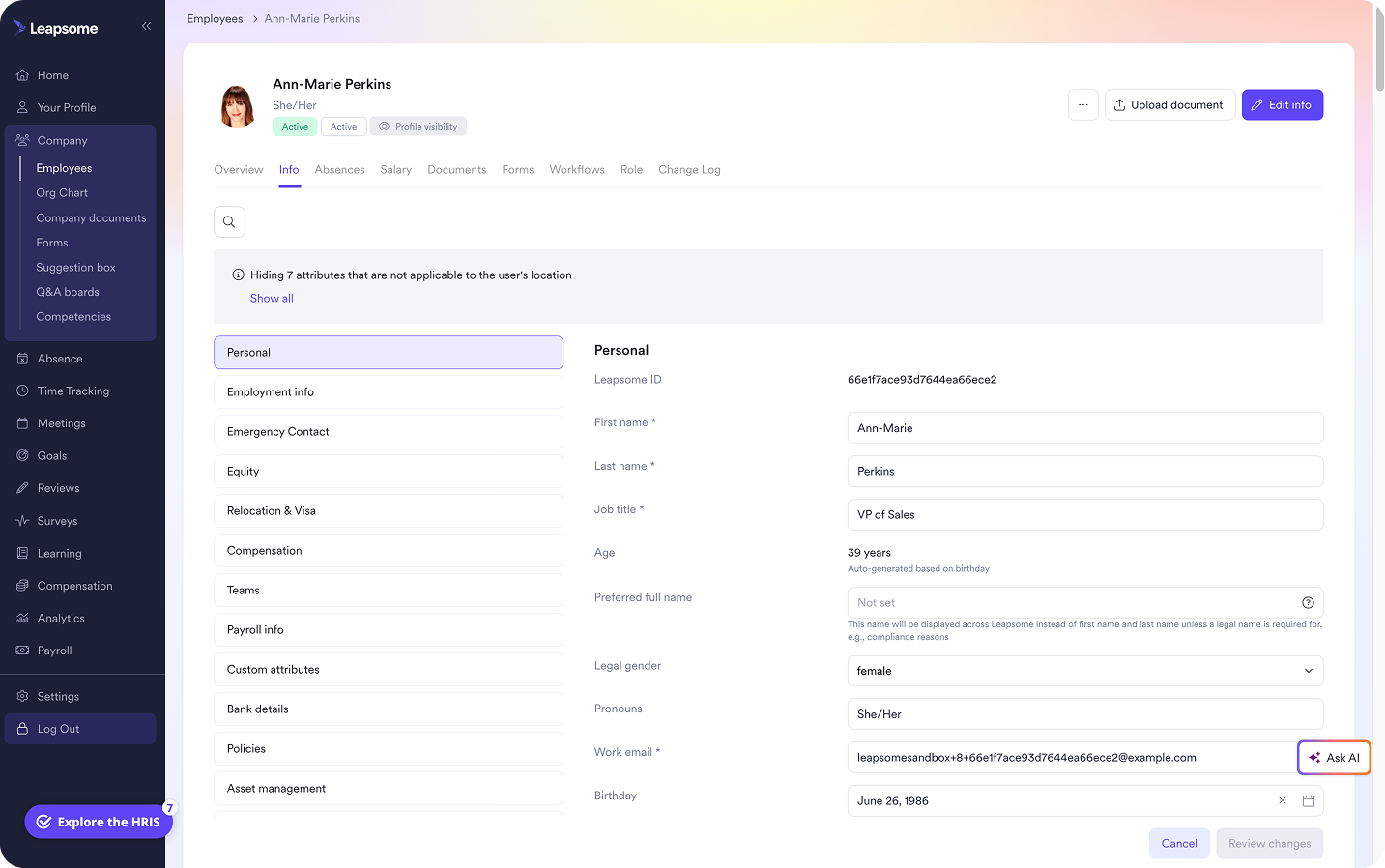
Leapsome helps you stay on top of the core data your organization runs on by offering end-to-end visibility across the entire employee lifecycle. The most important elements are self-service portals and data centralization — and both come out of the box with Leapsome.
“Employees can update their own personal information, and it’s sent to HR for approval — no need for back-and-forth emails.”
— Sophie O’Donoghue, Customer Success Coach at Leapsome
👀 Deep visibility from day one to departur
Leapsome keeps employee info in the same interlinked repository for real-time access, and lets employees update their own data so it’s less likely to ever go stale.
👉 Explore Employee Records
Managing employee information forms 101
Collecting accurate employee information lays the groundwork for strong data, but organizations also need a process for maintaining accurate records long-term. Here are a few time-tested best practices.
Collect information using standardized onboarding workflows
Consistency is just as important as completeness. Each new employee information form should have identical structures and fields, and each new hire should fill it out at the same point in their onboarding journey. This way, nothing gets duplicated or falls through the cracks. And when everything is uploaded to the same place, it’s easy for HR teams to search and report on the data later.
Safeguard sensitive employee information
“You can decide exactly who can view or edit each field based on their role — for example, finance sees salary data, but employees manage their own basic details.”
— Sophie O’Donoghue, Customer Success Coach at Leapsome
Completed employee information forms contain highly sensitive data, like Social Security numbers and bank details, and it’s your job to keep that data safe. Getting this right comes down to your tech stack as much as to your HR policies and procedures. Ensure your solution follows any relevant standards like GDPR, encryption rules, and role-based access controls to restrict who can see sensitive details.
Keep data up-to-date throughout the employee lifecycle
Many types of employee information are subject to change, including job titles, bank account details, and emergency contact information. Employees, their managers, and your HR team are all responsible for keeping that information current.
To make sure task ownership is crystal clear, decide who’s responsible for updating which fields and standardize that division throughout the organization. For example, employees might update personal info and banking details through your HR software’s self-service portal, managers can confirm role or department changes, and HR should take care of anything that touches sensitive information, payroll, and compliance.
Ultimately, keeping information updated means meticulously managing the documents that record that information — and that’s a lot easier when you have the right tools. Leapsome becomes a single source of truth for all your people data, so you can trust all your employees’ details stay up- to date everywhere when changes happen.
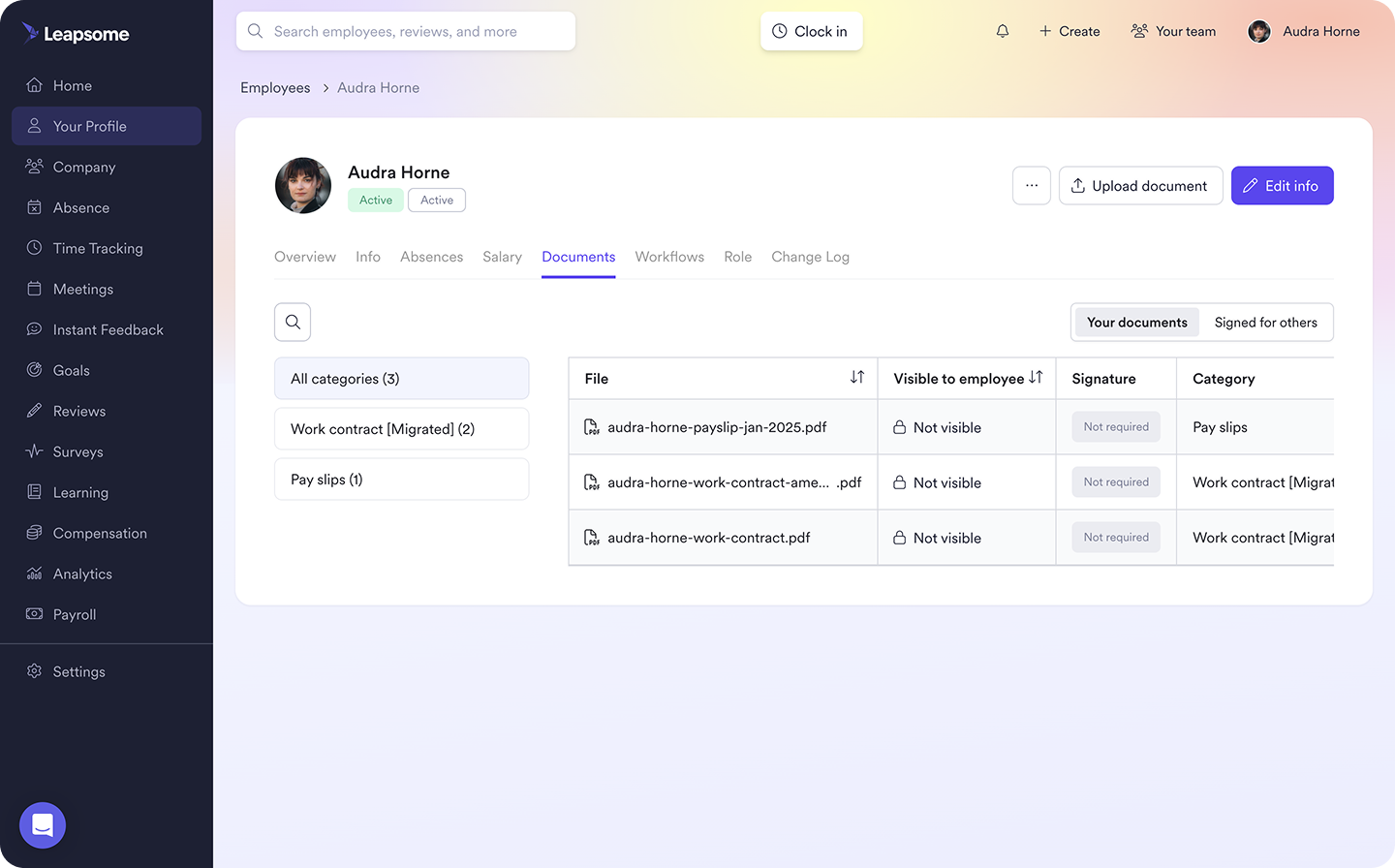
⬆️ Stay on top of updates without extra manual effort
Leapsome lets you centralize employee records and automate document collection and storage so maintaining accurate, complete records isn’t a full-time job.
👉 Explore Documents
Keep clean employee records from day one with Leapsome
Too many organizations waste time and resources correcting employee records because the wrong data crept in during onboarding or details drifted from reality without anyone noticing. Sometimes, HR departments find out the hard way: They cut the wrong paycheck, get hit with a compliance penalty, or make a workforce planning decision based on outdated headcount.
Leapsome’s AI-powered HRIS and people management platform streamlines employee record-keeping (and all the HR processes that rely on it) while lightening the administrative burden. With Leapsome, teams can:
- Centralize employee information: Store all employee details in one connected location, so HR processes all run on the most up-to-date information.
- Streamline onboarding: Gather accurate information from the outset through standardized preboarding and onboarding workflows that leave nothing to chance.
- Create better reports: Produce workforce reports based on clean, current data HR teams and leadership can trust.
- Strengthen compliance: Leave an auditable paper trail that holds up under scrutiny.
“Employees can now find everything in one place — their data, absences, goals, and reviews. I don’t have to explain which tool to use for what. It’s all in Leapsome.” — Merilyn L., Senior People Operations Specialist at Bob W.
🌍 The same source of truth anywhere you go
Leapsome keeps employee records centralized throughout the employee lifecycle, so HR processes run on a rock-solid foundation.
👉 Request a demo
FAQ
What’s an employee form?
An employee form is any document a company uses to collect information about its workers. Common examples of employee forms include:
- Employee information forms
- Performance review forms
- Employee write-up forms
- Disciplinary action forms
- Direct deposit forms
- Employment eligibility verification/authorization forms



.jpg)