Four of the best recruitment software solutions compared for HR teams


Most recruitment software handles the nuts and bolts of hiring workflows well enough, including sourcing, interviews, scheduling, and collaboration. But not all of these tools are so useful beyond the offer stage.
Eighty-nine percent of talent acquisition professionals agree that it’s becoming more important to measure quality of hire.* But that’s tough to do when hiring data gets left behind once a candidate signs on the dotted line. The best recruitment software shouldn’t only make hiring more efficient; it should also preserve valuable role and candidate data for later use in downstream people processes like onboarding.
This guide explains the core features recruiting software should support and what to test during vendor demos. And it offers a comparison of four leading recruitment platforms to help you build your shortlist.
* LinkedIn, 2025
What recruitment software should do before and after hiring
Also called talent acquisition software, recruitment software helps teams manage the hiring workflow end-to-end, from sourcing candidates to making an offer. Some tools are broad in scope, while others called applicant tracking systems (ATSs) have a narrower focus on tracking applicants through the hiring pipeline.
According to SHRM research, 42% of HR professionals report difficulty holding on to full-time employees. Nearly 70% also say they face challenges recruiting for full-time positions.
Recruitment platforms can help change that with core capabilities like:
- Sourcing and candidate management: Multichannel sourcing helps teams build robust talent pipelines without hopping between job boards. Candidate relationship management software keeps the most promising applicants organized, while resume parsing turns their details into searchable candidate profiles.
- Structured interviews and collaboration tools: Recruitment software makes it simpler to create and apply consistent evaluation criteria for hiring managers and interviewers. Research led by psychologist Paul Sackett suggests that structured interview scores may be the strongest predictors of job performance, even more than cognitive ability.
- Automation and analytics: Automated interview scheduling and status updates streamline recruiters’ workflows, cutting down on manual follow-ups with candidates and interviewers. Analytics reporting can identify where candidates tend to fall out of the pipeline, uncovering bottlenecks before they cost you top talent.
- Onboarding handoffs: A candidate’s data shouldn’t disappear just because they became a new hire. Instead of requiring manual reentry, key details like role, contact info, experience, and competencies should carry over from recruitment software into onboarding and beyond. This way, each new hire starts with accurate records from day one, informing the development efforts and performance reviews that come later.
<h2>Three questions to ask in every recruitment software demo</h2>
Here’s what to ask during vendor demos to find out what you can expect after hiring ends:
- Does core hiring data carry into the HRIS automatically? Ask exactly which data transfers into your HRIS and onboarding workflows post-hire, such as contact information, role, start date, and offer terms.
“The goal is to keep reducing those manual touch points.”
– Sammie Masley, People and Talent Partner at Leapsome
- Do hiring insights inform what happens later? The best recruitment software lets HR teams keep competency ratings and interview feedback intact, so they can influence each new hire’s onboarding experience and early performance reviews.
- How much work does integration take? Different tools might offer manual exports/imports, reconciliation procedures, one-way integrations, or a connected system that creates or updates employee records automatically.
How four top recruitment platforms measure up
Adding a new recruitment platform to your HR tech stack is an impactful long-term decision. While this list is far from exhaustive, the four platforms below represent some of the most well-regarded options on the market today.
We’ve evaluated each platform based on the same set of criteria: target company size, hiring workflow coverage, structured interviewing, automation and analytics, integrations, post-hire data continuity, and notable limitations.
“Look for one platform that covers your key needs and integrates with your stack. Don’t scatter data across 10 or 20 disconnected tools.”
– Katerina Arsova, Head of People, Talent Operations, and Partnerships at Leapsome
1. Leapsome
Best for: Growing small and mid-market companies
Key strengths: Leapsome lets HR and hiring teams develop structured interview scorecards based on competencies that carry forward into post-hire performance reviews. Other features like AI-assisted job descriptions, candidate screening, and interview transcription simplify some of the most time-consuming aspects of the hiring process.
Post-hire handoffs: Candidate data becomes employee data that feeds into onboarding from day one. Teams that want to access Leapsome features without leaving their current ATS can integrate with popular tools like Workable and Zoho Recruit.
Notable limitations: As a newer product, Leapsome Recruiting has a shorter track record to evaluate than long-established platforms.
"On the C-level, I learned to doubt people data because it arrived late and conflicted across files. Then, sitting in HR, I felt the pain from the inside and saw how much time went into rebuilding the same reports. Centralizing restores trust and your calendar."
– Florian Klages, Managing Partner at torq.partners
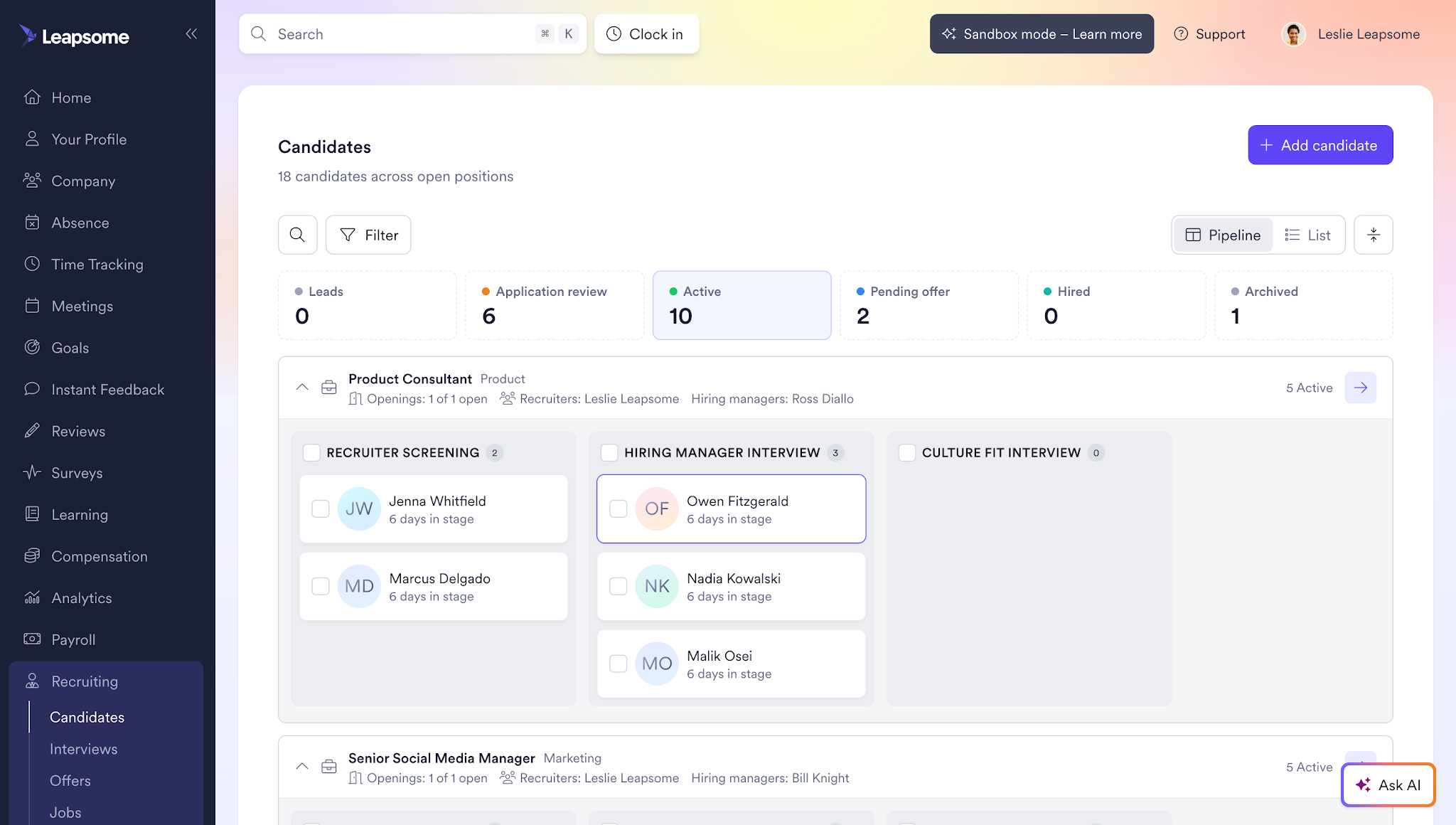
Currently in early access, Leapsome Recruiting supports the entire hiring workflow, including sourcing, candidate pipelines, structured interviews, and cross-team collaboration. When a candidate accepts an offer, HR teams can convert their details into employee data in a single step.
🌱 Start every employee story at the interview
Instead of starting over, turn insights gathered during hiring into a durable foundation for onboarding and growth.
👉 Explore Recruiting
2. Greenhouse
Best for: Mid-market companies looking for a rigorous, structured hiring process
Key strengths: Greenhouse focuses on support for structured interviewing. Interview kits help HR teams organize plans and scorecards, so each evaluation process rests on a shared set of predetermined criteria.
Post-hire handoff: After hiring, teams can move candidate profiles into the Greenhouse Onboarding software. The company also lists dozens of available HRIS and onboarding product integrations.
Notable limitation: Integration takes some work. You have to get in touch with a customer success manager and configure new hire import rules. This process also requires a separate subscription.
3. Workable
Best for: SMBs that want recruiting and core HR workflows in one tool
Key strengths: Workable’s AI recruiting agent automates sourcing and qualifying candidates against provided specs. This software also offers a beginner-friendly interface and supports a streamlined hiring process.
Post-hire handoff: Once a candidate reaches the “Hired” stage of the pipeline, Workable automatically creates a new employee profile. Teams using a separate, supported HRIS can connect it directly to Workable.
Notable limitation: Video interviews and assessments require a Premier plan or paid add-ons.
4. Zoho Recruit
Best for: Small, budget-conscious teams
Key strengths: Zoho Recruit offers a free plan with support for one recruiter, and that covers the basics for lean teams and startups. Paid plans are priced per recruiter rather than per employee. AI assistants can match candidates to open roles and compare shortlisted applicants using generated ratings.
Post-hire handoff: Recruiters can convert candidates into employees and send them to onboarding without manual data entry.
Notable limitation: Smooth data handoff requires a separate license for Zoho People, or a bundle including that software.
Connect hiring to everything that comes after with Leapsome
Recruitment software can do a great job of organizing hiring workflows, while still leaving HR to rebuild every new employee’s data profile from scratch once they come aboard. Leapsome’s all-in-one HRIS and people management platform gives your team that time back by connecting every stage of the employee lifecycle.
With Leapsome, you get:
- A fully integrated HRIS: Once someone accepts an offer, you can turn their candidate profile into a freshly minted employee record in one step. This record becomes the single source of truth for everything that happens later.
- Preboarding and Onboarding: Give new hires their own branded portals complete with personalized welcome messages and essential documents.
- Performance Reviews: Base structured interview scorecards on the same Competency Frameworks as performance reviews, so skills evaluated during hiring form the basis for later growth conversations.
Leapsome Recruiting is currently in early access. Teams that want to keep their current ATS can still take advantage of Leapsome’s HRIS and talent management features by integrating with leading platforms like Greenhouse, Workable, and Zoho Recruit.
“We’ve been able to optimize and automate a lot of the functions that were taking up our time, turning them into one streamlined workflow that connects departments like onboarding, offboarding, training, and hiring.” – Janelle Daugherty, Head of People and Culture at Notion Health
📊 Give new hires a head start
Use the same data you rely on for hiring decisions to inform onboarding and ongoing employee development.
👉 Request a demo
FAQ
What’s the difference between an ATS and HR recruitment software?
While the terms are often used interchangeably, an ATS typically focuses on tracking candidates up to the point of hire. Full recruitment platforms are generally more comprehensive, adding capabilities like candidate relationship management and onboarding handoffs.
Leapsome Team