Five best applicant tracking systems for growing companies


As job application volumes rise, lean HR teams may struggle to manually manage the chaos of resumes, interview schedules, and candidate communications. Rising hiring costs make manual work even harder to justify. SHRM reports the average non-executive hire now costs $5,475.*
An applicant tracking system (ATS) reduces wasted time and duplicated work across the candidate lifecycle. It automates key stages of the recruitment process, from initial screening to first-day onboarding. It also centralizes communication so HR never misses a candidate question or follow-up.
Finding the right ATS for your organization depends considerably on your internal hiring needs. A small business that fills a handful of roles has different priorities compared to a team overseeing a large-scale hiring surge across departments. Your budget and current HR stack also shape the type of ATS you need.
The best ATS also reduces your administrative load after a candidate signs an offer. When an ATS doesn't enable candidate-to-employee workflows, HR may need to manually rebuild each hire's data profile, upload documents, or create onboarding sequences from scratch.
This article reviews the best applicant tracking systems for growing teams. It also shows how modern ATS tools connect everyday hiring work to the systems that support employees after they join.
*SHRM, 2025
What should a company look for in an applicant tracking system?
“Look for one platform that covers your key needs and integrates with your stack. Don’t scatter data across 10 or 20 disconnected tools.”
— Katerina Arsova, Head of People & Talent Operations & Partnerships, Leapsome
When evaluating ATS software for your organization, a report from SHRM recommends evaluating your existing talent acquisition workflows first. Take the time to thoroughly assess your recruitment and hiring processes upfront to identify your friction points and avoid adding yet another data handoff or disconnected workflow.
As you review each ATS, focus on the parts that directly shape how work moves through your team, including:
- Ease of use and automation: Check whether recruiters and hiring managers can adopt the ATS quickly. Look to see if it automates repetitive tasks like scheduling, candidate communications, reminders, approvals, and offers.
- Candidate experience and reporting: Look for candidate relationship management tools that enable a smooth application and structured interview experience. CRM reporting should cover pipeline health, time to hire, and source effectiveness.
- Integrations and scalability: Evaluate how well the ATS connects with your HRIS and onboarding tools. Pricing and functionality should still fit as hiring volume and organizational complexity grow.
"On the C-level, I learned to doubt people data because it arrived late and conflicted across files. Then, sitting in HR, I felt the pain from the inside and saw how much time went into rebuilding the same reports. Centralizing restores trust and your calendar."
— Florian Klages, Managing Partner, torq.partners
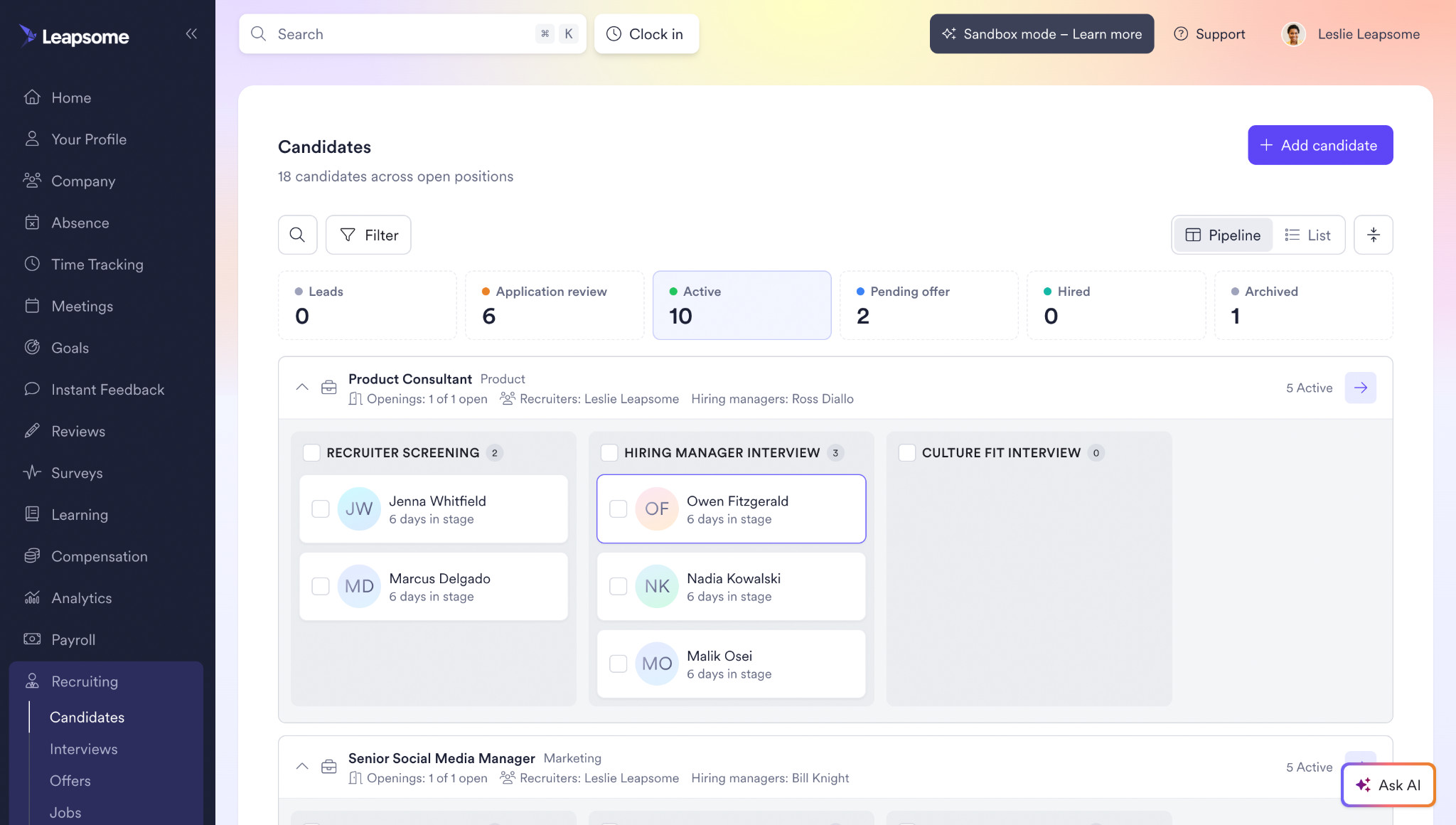
🎯 Make recruitment easier before and after hire
Manage your candidate pipeline with ease using built-in automation for outreach, scheduling, and scoring. Then, once you hire, auto-trigger employee record creation and onboarding flows.
👉 Discover Recruiting
Five best applicant tracking systems for small businesses
"Without a single, reliable data set, AI is just a buzzword. Put your people data in one place, keep it accurate, and only then will AI deliver value on top."
— Florian Klages, Managing Partner, torq.partners
There’s no universal best applicant tracking system for recruiters. The following are top options that work well for small and growing companies. They stand out for reliability and ease of use and won’t create extra work as your team grows.
Leapsome Recruiting
Leapsome Recruiting is an all-in-one HR platform with native recruitment features, including candidate sourcing and shortlisting. It uses AI-driven automation for candidate communication, interview scheduling, and screening summaries. It also supports hiring managers with robust in-platform scorecards to evaluate candidates based on competencies.
Best of all, Leapsome emphasizes candidate-to-employee data continuity by auto-populating records and connecting to custom onboarding flows. Leapsome Recruiting is currently in the early access stage and is available for $5/employee/month on top of the Leapsome HR foundation.
Breezy HR
Breezy HR is a user-friendly ATS that covers the end-to-end recruitment workflow for hiring managers. It helps teams move candidates from the first touchpoint through interviews, offers, and onboarding without adding extra work.
Breezy HR includes a drag-and-drop pipeline creation tool and a pre-boarding flow for smooth candidate-to-employee transitions. It’s built for small HR teams that manage a range of hiring tasks, but its lower tiers offer limited integrations and customizations. It starts at $157/month.
BambooHR
BambooHR is an all-in-one platform with a powerful built-in ATS. It’s ideal for small and mid-sized teams who need to speed up their recruitment processes. It integrates with popular job boards, automates emails, supports self-scheduling, and provides offer management.
One of BambooHR’s stand-out ATS features is its collaborative hiring capabilities. HR team members can leave ratings, share feedback, and tag notes to make hiring decisions together. BambooHR also connects directly to its larger HRIS, so data is auto-transferred upon hire.
BambooHR starts at $10/employee/month. While its customization may feel limited for more complex recruiting volumes, it’s a reliable option for small hiring teams.
Workable
Workable is a popular HR platform with ATS features that include posting jobs, filtering candidates, and self-scheduling interviews. It’s good for mid-sized teams who want to make use of Workable’s existing candidate database or create a robust, custom hiring process.
Workable connects candidates to its HRIS platform, so there’s no duplicate data entry. It also has a suite of AI features for maximum efficiency, such as AI-powered resume parsing and one-way video interviews.
For smaller teams, Workable may have too many bells and whistles and it comes at a higher price point of $299/month.
Greenhouse
Greenhouse is a dedicated ATS that supports candidate sourcing and scheduling. It also offers AI notetaking to help teams capture interview details. Its Model Context Protocol (MCP) extends those AI features by connecting the platform to the tools teams already rely on.
Greenhouse is best known for its modern feature set, which includes fraud detection, advanced reporting analytics, and a wealth of native data integrations with HRIS and HR tools. While its candidate outreach tools can feel limited and pricing isn’t publicly listed, Greenhouse is a solid choice for tech-forward, mid-sized HR groups.
“If the people you hire aren’t aligned, you’ll constantly play catch-up. Use tough interview questions to test alignment and maturity early.”
— Melanie Naranjo, Chief People Officer, Ethena
How to evaluate the candidate-to-employee handoff
“We’ve been able to optimize and automate a lot of the functions that were taking up our time — turning them into one streamlined workflow that connects departments like onboarding, offboarding, training, and hiring. The result is less hassle, more communication, and more time for value-add work.”
— Janelle Doharty, Head of People & Culture, Knowtion Health
Most ATS software comparisons focus on what happens before the candidate gets an offer. They tend to highlight features related to recruitment, such as posting jobs, scheduling interviews, and automating outreach.
But what happens after HR managers send an offer letter is just as important and has significant impacts on your HR team’s workload.
The transition from candidate to employee involves a variety of administrative tasks. For example, HR traditionally sets up the employee’s profile, stores signed contracts and NDAs, and creates onboarding sequences.
When an ATS connects to your larger HRIS, it can speed up candidate-to-employee handoffs by automating data transfers and triggering onboarding workflows. Ultimately, this reduces manual HR oversight.
To select the best overall applicant tracking system for your organization, check for these candidate-to-employee capabilities:
- Data continuity: Does the ATS transition candidate data into an employee record? The best software cleanly transfers profile information and key documents without intervention.
- Onboarding sequences: Can you set up automated onboarding processes? Reusable sequences cut down on manual setup for each new hire.
- Future development: Does important candidate information remain visible post-hire? Interview summaries and manager notes support future development without forcing you to dig through past documentation.
- Modern governance: Can you customize the type of information that carries to the employee record and who has access to it? The strongest ATS allows you to personalize and safeguard governance, data privacy, and overall compliance.
- HR management: Does adding the ATS simplify your HR stack or create another system you have to manage? The ATS should streamline your post-hiring tasks without overly complex setup.
The ATS is also the first point of contact for the employee. When an ATS provides strong candidate-to-employee workflows, it enables a more polished and personalized onboarding process.
This is especially important to make a good impression and pave the way for job satisfaction. According to Gallup, when employees have an "exceptional" candidate experience, they’re 2.7 times as likely to report positive workplace attitudes.
🧩 Transition candidates to employees stress-free
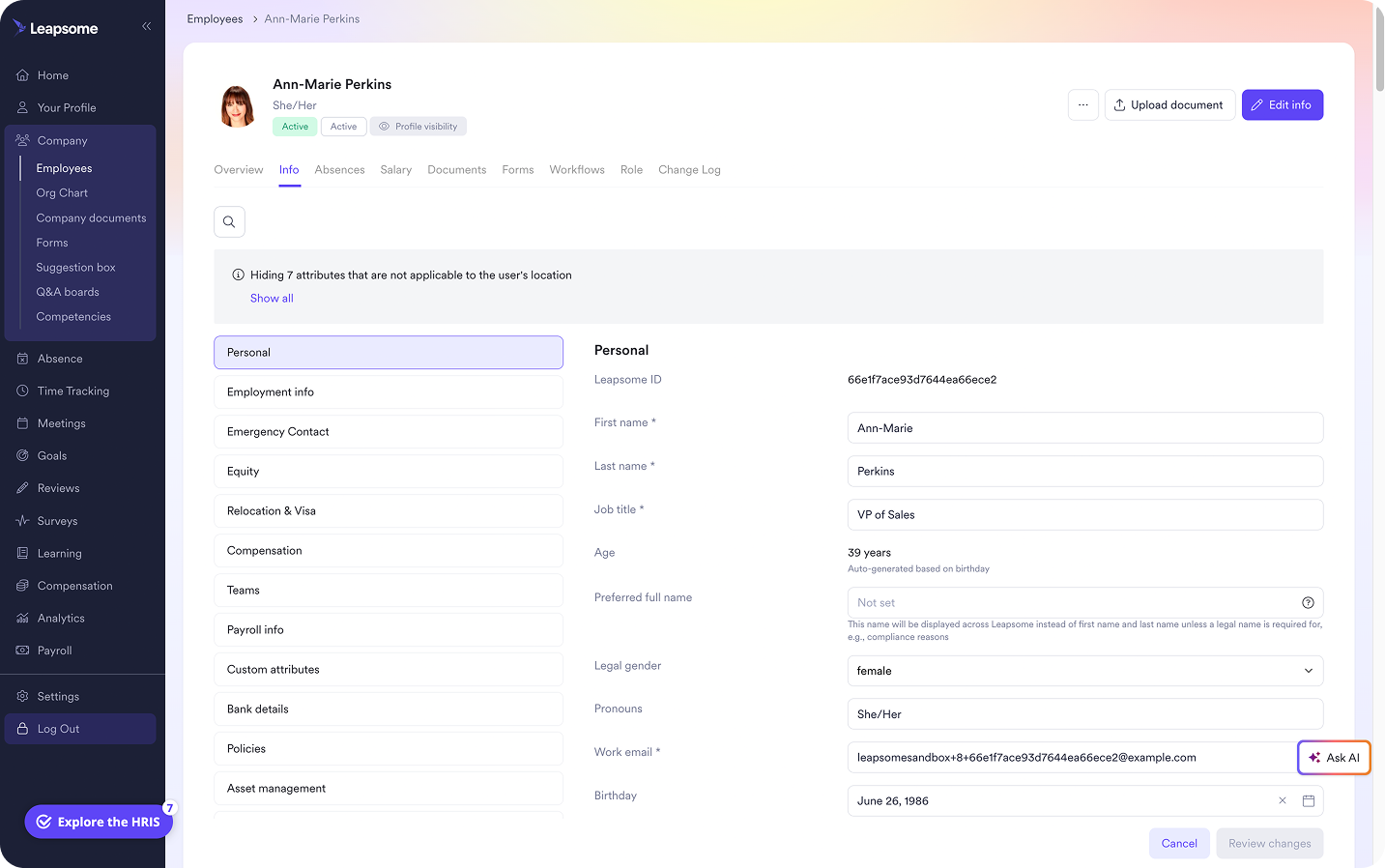
It’s all in Leapsome from day 1: Candidate data automatically populates employee records, hiring paperwork is stored without extra steps, and onboarding workflows are triggered upon hire.
👉 Explore Employee Records
Connect recruiting with the rest of the employee lifecycle with Leapsome
"Many HR teams still struggle with the basics — too many disconnected tools, limited insights. That's why we built a truly people-first HRIS that unifies all employee data into one source of truth." — Suraj Paneru, Customer Success Coach, Leapsome
Lean HR teams can improve recruiting efficiency with ATS software but still end up increasing their operational workload. Disconnected data flows, duplicate admin entry, and fragmented candidate-to-employee handoffs ultimately just add work for HR.
That’s why finding an ATS solution that creates a coherent employee lifecycle — connecting talent acquisition, employee records, onboarding, development, and beyond — is non-negotiable for growing HR teams.
Leapsome Recruiting is designed to connect candidate and employee processes to help create a single, unified flow. With it, hiring managers can:
- Customize and automate your recruitment pipeline: Use Recruiting to set up people-centric hiring processes that include sourcing, screening, scheduling, and scoring candidates.
- Fold hiring data and paperwork into your HRIS: Automate candidate-to-employee data flows instead of rebuilding records after every hire by counting on Employee Records.
- Effortlessly connect with full people processes: Hiring is just the start. Leapsome brings together next stages in employee development, including Pre-boarding & Onboarding, Competencies, Performance Reviews, and Goals.
Create a coherent employee experience with Leapsome and equip your lean HR team with data-driven tooling that actually reduces the workload before and after hiring.
“Leapsome is very user-friendly — both for HR and for our employees. It gave us the flexibility to implement our specific feedback process, and it has reduced a lot of the manual work we would have had to do.” — Nina Thiessen, Head of Talent Acquisition and HR Management, EGYM
🔗 Unify your candidate-to-employee pipeline
Manage full recruitment cycles and next steps, including employee records, onboarding, and future development — all from the same place in Leapsome.
👉 Request a demo
FAQ
What are the best applicant tracking systems in 2026 for automating hiring workflows?
If you’re looking for applicant tracking software with built-in automated workflows, Ashby and Lever offer trigger-based and multi-touch capabilities. Leapsome, Recruitee, and JazzHR have native automation that allows hiring managers to personalize candidate experiences at scale.
What is an ATS for enterprises?
Oracle Taleo, SAP SuccessFactors, and Workday are recognized global enterprise-grade recruitment automation platforms with deep governance controls and system integrations. For high-volume hiring, iCIMS and Greenhouse are also solid choices that provide pipeline customization and AI-assisted candidate scoring for large-scale demands.
What’s highly-rated ATS software for mid-market companies?
Leapsome, Ashby, and Zoho Recruit are top picks for tech-forward, mid-sized HR teams, as they both have some native recruitment automation without the larger overhead of enterprise solutions such as iCIMS and Workday.
Leapsome Team