How to spot and prevent payroll liabilities to maintain compliance


Disclaimer: This content is for general informational purposes only and does not constitute legal advice. Leapsome does not guarantee legal compliance and cannot confirm how specific situations would be assessed in court. If you're unsure how requirements apply to your organization, please consult qualified legal counsel.
Payroll liabilities are the payroll-related amounts a business owes but hasn’t paid yet. That definition sounds simple enough, until the month-end close arrives. Then suddenly finance is asking HR to explain a number that came from a combination of data in three systems, and went through two separate approvals.
While payroll liabilities may sit on the balance sheet, when errors happen, those issues often start in HR data. A late salary update, an undocumented bonus, or a messy onboarding record can turn into an incorrect deduction or tax deposit. According to one Grant Thornton report, around 70% of payroll data issues stem from recruiting and onboarding-related entry mistakes.*
In this article, we’ll explain what payroll liabilities are and how they differ from payroll expenses. Then we’ll explore how better employee records and payroll preparation help you prevent costly mistakes.
* Grant Thornton, 2023
What are payroll liabilities, and how do they work?
Payroll liabilities are the amounts a company owes after payroll runs, but before the money goes out. For example, an employee might earn wages on Wednesday, while their payday is on Friday. Or the company withholds federal income tax, but hasn’t sent that money to the IRS yet. These gaps between “calculated” and “paid” are where payroll liabilities sit.
Whether those liabilities are recorded accurately depends on the information payroll receives. If HR records the wrong salary or works with incomplete time-off data, payroll may calculate the wrong amount. Then, finance reports a number that looks final, even though the employee data behind it needs fixing.
The cost of those mistakes adds up quickly. The IRS applies penalties for late payroll tax deposits, ranging from 2% to 15% based on how late the deposit is. And these issues affect employees too, even when they seem small-scale. As Remote explains, only 24% of employers believe payroll errors have a significant impact, while employees on the receiving end of those errors report high levels of stress and anxiety, plus both financial and familial pressures.
Payroll liabilities vs. payroll expenses: What’s the difference?
While payroll liabilities show what the business still needs to pay, deposit, or remit, payroll expenses represent what employment costs the business. For example, wages become an expense when an employee earns them. But if payday hasn’t arrived yet, payable wages are still a liability.
The employer’s share of payroll taxes, including federal and state unemployment taxes, is also an expense once paid. Taxes withheld from an employee’s paycheck, such as for Social Security and Medicare, are payroll liabilities until the company deposits them with the relevant federal or state tax authority.
Common types of payroll liabilities
Payroll liabilities usually fall into one of three categories:
- Employee compensation and taxes: This broad category includes wages, salaries, overtime, bonuses, commissions, and employment tax liabilities. It also covers employer contributions like FUTA, unemployment, and state payroll taxes.
- Wage garnishments: These are required deductions from employee pay, often tied to child support, tax levies, or court-ordered payments. The company must withhold the correct amount and send it to the right recipient, which makes clear documentation and timing essential.
- Benefits deductions: In this category, you’ll find benefits-related obligations like retirement contributions and accrued leave. For example, health insurance deductions remain liabilities until the company sends them to the provider, while unused PTO may create a liability depending on company policy and local rules.
What all these categories have in common is that they rely on accurate payroll preparation. With Leapsome, HR can review compensation, deductions, and time-off data in one place. That way, payroll closes with clearer inputs, and finance gets more confidence in the numbers.
“All payroll data lives in Leapsome — it’s a living number. When salaries change, managers update them directly.”
– Siddharth Dhanuka, Head of Finance and Operations at SQUAKE
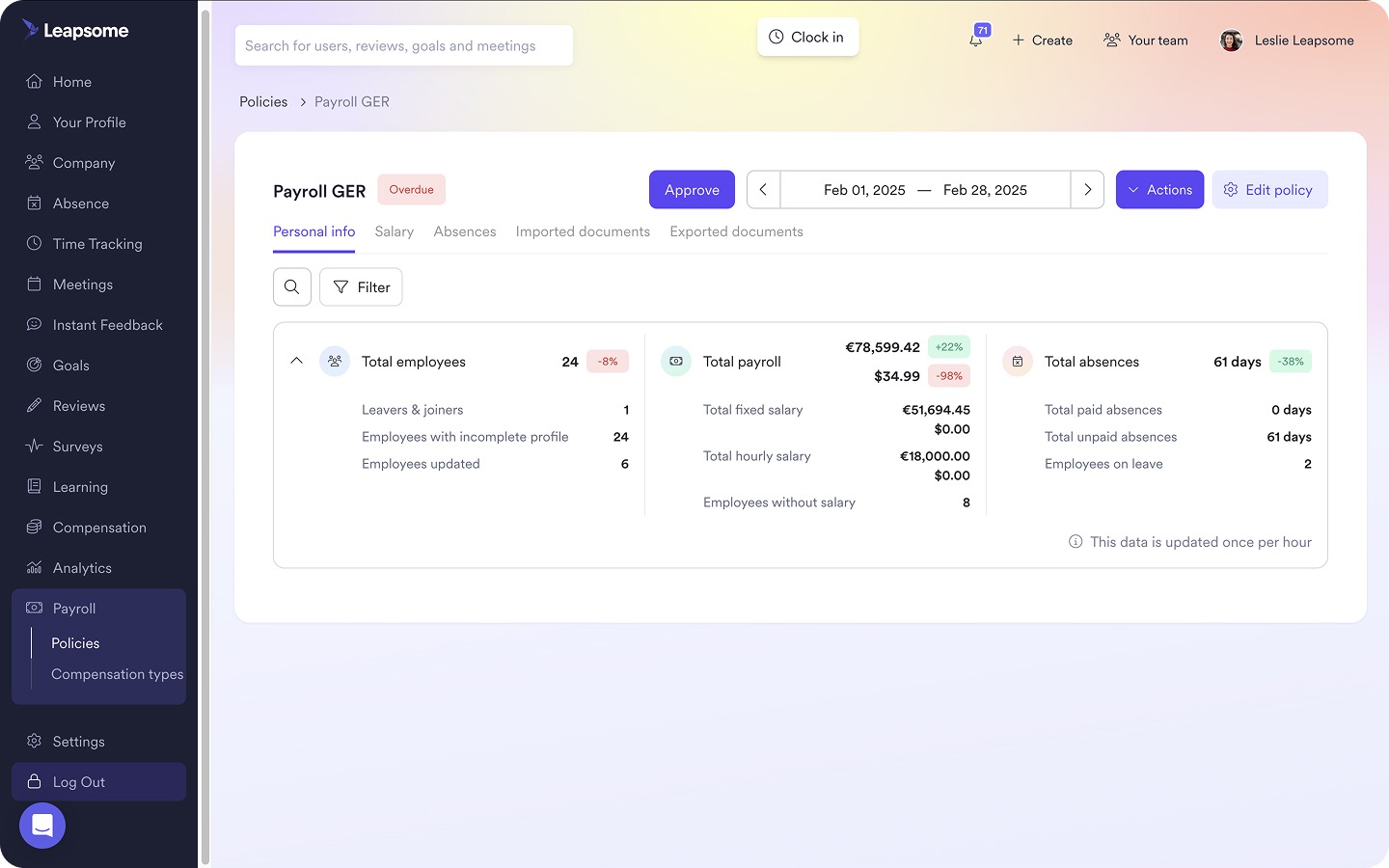
🕵 Track every liability type accurately
Leapsome centralizes employee compensation data and benefits deductions, so your HR team can make sure all payroll liability inputs are accurate before each run closes.
👉 Explore Payroll Prep
How do employers calculate payroll liabilities?
Companies pay liabilities through different channels, depending on what they owe. Employee wages go through payroll, while federal taxes go through the IRS. State taxes, benefits deductions, and garnishments may go to a number of separate agencies, providers, and/or plan administrators.
Employers usually calculate payroll liabilities by following these three steps:
- Calculate gross wages and compensation: Start with regular pay, overtime, bonuses, commissions, and any retroactive pay for the period.
- Determine employee withholdings and deductions: Subtract federal, state, and local taxes, benefits deductions, retirement contributions, and garnishments.
- Add employer contributions and record liabilities: Factor in employer payroll taxes and any employer-paid contributions. Then, record what the company still owes until each payment or remittance clears.
Payroll compliance requirements
Payroll liabilities come with various compliance challenges, including:
- Deposit schedules: Employers must follow the right deposit schedules for payroll tax liabilities, along with any state-specific remittance timelines.
- Record-keeping requirements: Under the FLSA, employers generally need to keep payroll records for at least three years. Records used to calculate wages, such as timecards, wage rate tables, and work schedules, must be retained for at least two years.
- Payroll tax filing deadlines: Employers may need to file IRS forms, such as Form 941, Form 940, and W-2s, by specific deadlines (along with state-specific documentation).
“If your HR systems don’t really talk to each other… You kind of have to pull this from your HRIS, this from your performance review, this from payroll… I think the trails break down a little bit.”
– Sammie Masley, People and Talent Partner at Leapsome
As your company grows, managing these requirements for large teams and multiple locations becomes harder. Leapsome helps you keep employee information audit-ready, so finance and payroll have the data they need before deposit and filing deadlines arrive.
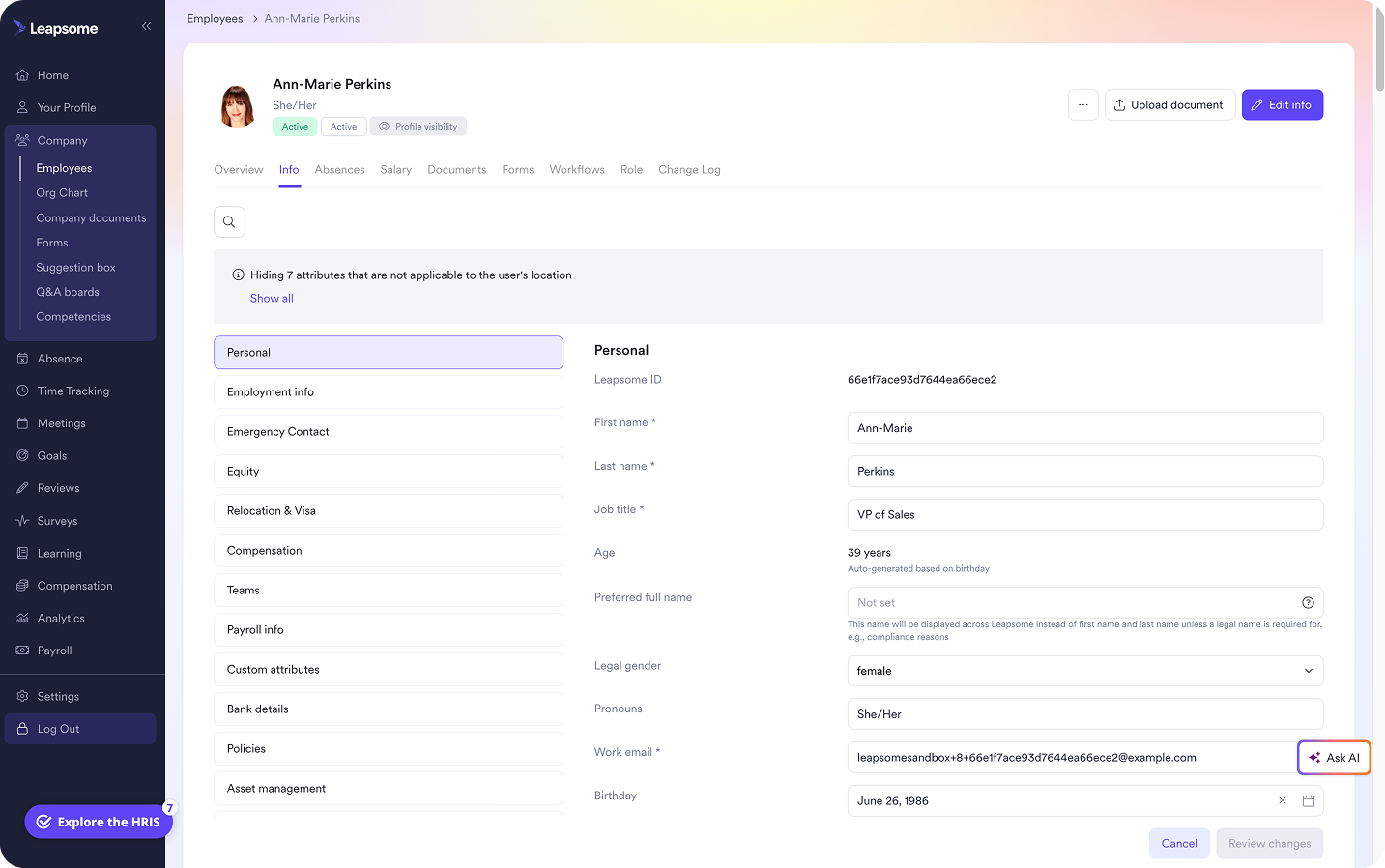
🤝 Make payroll records easier to trust
Leapsome keeps key employee data and docs in one place, so HR stays audit-ready and finance works with cleaner payroll inputs.
👉 Explore Employee Records
Best practices to prevent payroll liability mistakes
“On the C-level, I learned to doubt people data because it arrived late and conflicted across files. Then, sitting in HR, I felt the pain from the inside and saw how much time went into rebuilding the same reports. Centralizing restores trust and your calendar.”
– Florian Klages, Managing Partner at torq.partners
According to a Strada Payroll Complexity Report, 53% of surveyed companies incurred payroll penalties in the last five years for noncompliance. What's more, 51% still use spreadsheets to process payroll.
Liability mistakes rarely come from one dramatic failure, and more often happen because teams rely on manual processes for work that needs clean records and strict timing. A late update may look minor in the moment. But if HR doesn’t fix the process behind that mistake, the problem may repeat every pay period and become harder to explain to finance, employees, and auditors.
“Managers shouldn’t email HR to ask who’s on leave or what a team’s balances are; they should see it live. The moment people self-serve, interruptions drop and decisions speed up. That’s the point of a single source of truth.”
– Carolin Leidel, Consultant at torq.partners
The best HR teams don’t wait for multiple payroll corrections to expose an issue. Instead, they build payroll preparation processes that give every change a clear owner and record. Here’s how that might look in practice.
Manage payroll liabilities with confidence using Leapsome
For scaling organizations, liability errors rarely start during payroll runs. Leapsome helps HR fix the parts that usually break first: the data and workflows behind payroll prep. Instead of chasing managers for context or checking to see which spreadsheet finance used last month, HR can manage payroll inputs in one connected HRIS and people management system.
With Leapsome, HR teams can centralize:
- Employee records and role changes
- Compensation updates and approval histories
- Time-off balances and absence data
- Payroll-ready exports for finance and payroll partners
As a result, people data stays connected to payroll outcomes across the employee lifecycle, helping HR move from reactive cleanup to proactive preparation.
“Employees can now find everything in one place — their data, absences, goals, and reviews. I don’t have to explain which tool to use for what. It’s all in Leapsome.” - Merilyn L, Senior People Operations Specialist at Bob W.
💪 Turn payroll prep into payroll confidence
Leapsome connects employee records, approvals, and payroll-ready data, so HR can close each cycle with fewer surprises.
👉 Request a demo
Disclaimer: This content is for general informational purposes only and does not constitute legal advice. Leapsome does not guarantee legal compliance and cannot confirm how specific situations would be assessed in court. If you're unsure how requirements apply to your organization, please consult qualified legal counsel.


.jpg)



.png)