What’s a training matrix? The strategy behind skills development


Informal training sessions and ad hoc knowledge sharing might be enough to get your organization off the ground, but these early-stage strategies aren’t sustainable as your company scales. There’s more at risk than just operational efficiency: LinkedIn’s 2025 Workplace Learning Report states that 88% of companies worry about retention. Offering learning opportunities was the #1 retention tactic amongst survey responders.* Finding ways to make skills acquisition more accessible plays a massive role in employee satisfaction.
The training matrix is one of the most powerful tools you can use to address these development challenges across your growing team. When it’s treated like a living document rather than a static reference, your training matrix can accurately point toward the best path for improvement. In this guide, we’ll cover what a training matrix is and how HR leaders can use it to give their learning programs more structure.
* LinkedIn, 2025
What’s a training matrix?
A training matrix is a tool that gives HR leaders a structured way to identify skills gaps and define development priorities for different roles. These frameworks provide an overview of who’s completed which certifications and training programs, along with data on where skill development is lacking.
With this centralized system in place, HR teams can create more targeted skill development and regularly compare the organization’s current skillset to organizational needs. Scaling organizations especially benefit from training matrices, because they track the necessary certification completion for legal compliance as well as who has the right skills for a promotion.
Skills matrix vs. training matrix
A skills matrix tracks employee competencies across a range of skills, and it plays a supporting role in workplace development. But it stops at evaluating your team’s current skill levels. A training matrix is more forward-thinking. It can help you identify the latest requirements and set plans for ongoing professional development that’ll actually help your team, and HR leaders can track past learning initiatives to see what stuck and what stayed in the training module.
How to create a training matrix: A five-step guide
“Commit to development versus growth. Creep, not leap. Invest constantly and develop people on their strengths so they can perform better.”
— Steve Browne, Chief People Officer at LaRosa’s, Inc.
You can build a high-impact employee training matrix that keeps teams aligned and effective in just five steps.
1. Identify roles and key skills
Start by defining the roles you want to include in your training matrix, with a focus on existing clusters of job functions and responsibilities. Keep these categories deliberately broad for a more flexible training matrix that changes alongside your team. Over-segmenting into individual roles means you’ll likely lose sight of the bigger picture, and makes for a messy matrix or overly complex string of documents.
For each role, write down five to 10 core skills necessary for success. These should include a mix of role-specific technical skills (what those employees do), functional skills for day-to-day tasks (how they do it), and soft skills like communication and time management.
2. Define proficiency levels
Establish a shared language with standard labels for each proficiency, such as “beginner,” “intermediate,” and “advanced,” then link specific skills and abilities to each one. Defining these levels in advance keeps evaluations objective and actionable.
3. Map employees
After plugging employees into the matrix, draw on multiple data points to assess each individual’s skill levels. Refer back to self-assessments, manager evaluations and performance reviews, and HR input to get a well-rounded picture. Including multiple resources at this stage helps create the most thorough perspective on each employee’s strengths and support needs.
4. Identify gaps
Look for high-risk areas or troubling patterns across employees, such as underrepresented skills or mission-critical tasks that rely too heavily on a small set of experts. As you identify these gaps, prioritize dealing with the disparities that have an immediate impact on performance and those that threaten long-term business goals. Start with a short list to avoid overwhelm and make sure the new knowledge sticks.
5. Assign trainings
“Mentoring and job shadowing — that’s taking time and transferring it. Microlearning where folks come together and focus on one skill… and learning extraction sharing so people aren’t reinventing the wheel.”
— Stephanie Shuler, Chief People Officer at LifeLabs Learnings
Once you’ve chosen the skills gaps you want to address, make a game plan with concrete tasks to build up those skills. Whether you use workshops, mentorships, or certification programs, the goal is to create clear, specific steps that align with your organizational outcomes and employees’ optimal career progressions.
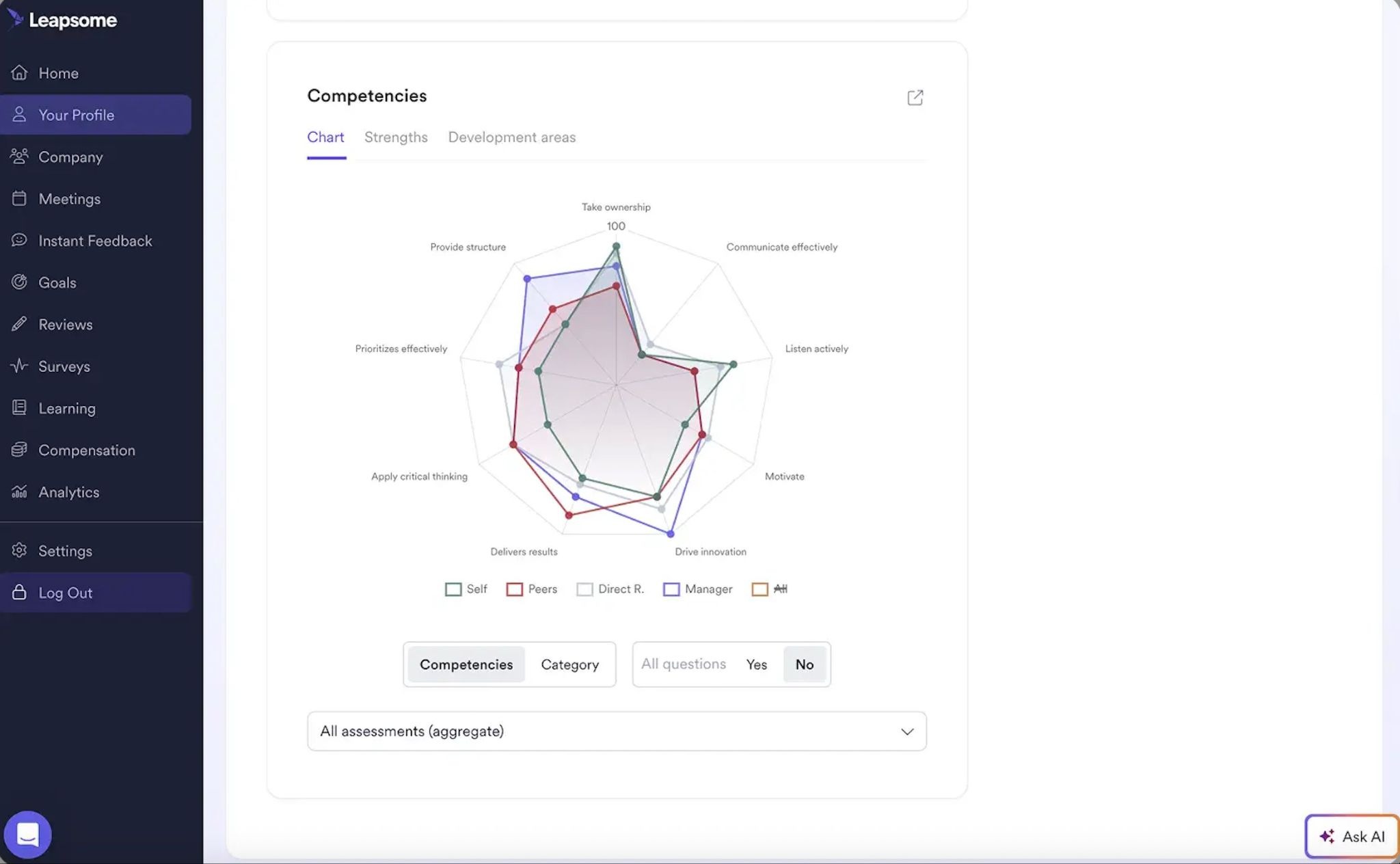
Integrating with Leapsome makes this process easier with tools like our Competency Framework and Goals. As an all-in-one HR platform, our software for training matrix and skill development draws on multiple centralized data points — including performance reviews, feedback, and business goals — to give an accurate representation of each employee’s performance.
🧠 Make skill development more structured and scalable
Leapsome’s Competency Framework gives HR teams clarity on each employee’s current skills to build the most effective learning plans.
👉 Explore Competency Framework
A training matrix example and template
From management’s perspective, training matrices create a shared and objective reference point for evaluating employee performance at different stages. The following sample training matrix template can help you better appreciate how HR uses this tool to set expectations for different roles and support organizational consistency.
🧩Connect your training matrix with real employee development
Use Leapsome’s development plan template to transform lists of role-based skill requirements into a clear series of actionable growth steps.
👉 Download the template
How does a training matrix influence your operational performance?
On the surface, training matrices are tools for tracking completed qualifications, but they have a much deeper strategic value than that. According to SHRM, 76% of employees view mentoring, a valuable training tool, as essential for their career development. So, the info you collect and update in a training matrix can help you make more consistent people decisions that improve employee engagement and retention.
Here are a few organizational elements a well-designed training matrix can strengthen.
Performance reviews
In performance reviews, training matrices help managers set expectations and ask fair questions. Instead of relying on vague impressions or biased perspectives, managers have access to objective evaluation criteria so they can take a more objective approach to assessing an employee’s strengths and skills gaps.
For example, instead of saying “Alice is doing well,” data from a training matrix lets Alice’s manager know that she currently is at an intermediate skill level for CRM use, which is expected for her role, and needs to work on customer communication. With that info, it’s easier to customize an improvement plan that accurately reflects Alice’s situation.
Development plans
Identifying skills gaps also helps learning managers plan development programs. They can target specific learning initiatives rather than trying to scrape together a topic that covers everyone’s broad goals.
For example, rather than just “improving leadership skills,” a training matrix may reveal that the real struggle sales team members are having is effective public speaking during deck presentations. The learning manager could then put together a weekly hour-long call for team members to practice presenting and role-playing client dynamics, so everyone can workshop their skills together.
To support your learning initiatives, Leapsome Learning puts the best parts of an LMS in your HRIS and talent management program. You can create and automate courses for full control over your learning strategies, and automatically link those programs to employee competencies and performance reviews for insights on what worked.
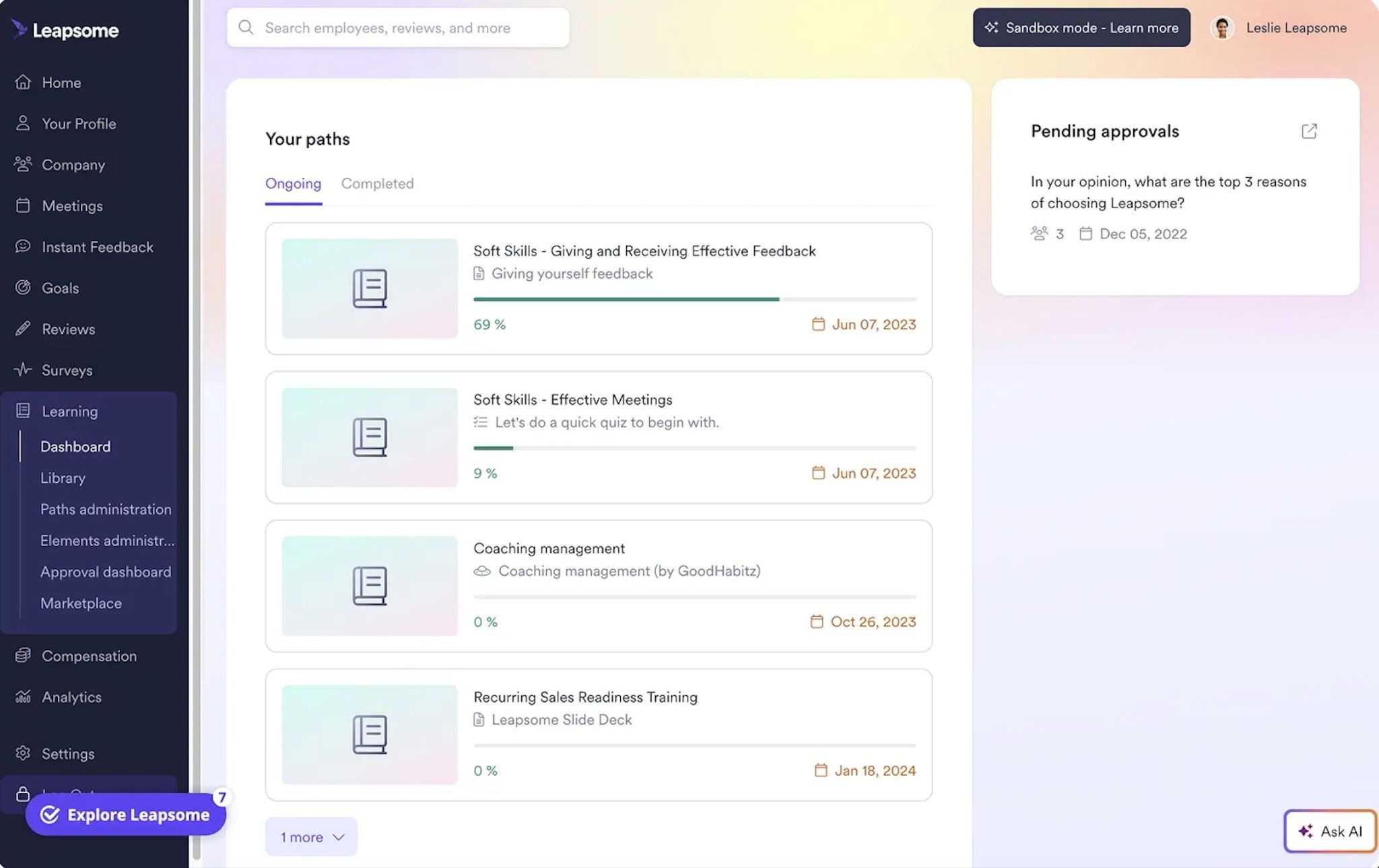
🎓 Connect learning to performance and growth
Leapsome’s LMS links training programs directly to employee skills and organizational goals, helping HR teams deliver targeted learning experiences.
👉 Explore Learning
Career progression
“Leadership readiness shouldn’t start after promotion; it should be part of the path toward it.”
— Melanie Naranjo, VP of People at Ethena
An effective training matrix makes promotion decisions more fair by clearly listing the required skills for each role. That way, employees have greater visibility into what they need to advance, and managers can use a standardized model to evaluate readiness.
Workforce planning
Any team-wide gaps in team matrices can inform big HR strategies, like what to look for in new talent and training investments. For example, instead of immediately increasing headcount in customer support to improve time to resolution, a workforce training matrix might show that 70% of the team lacks advanced product knowledge, so tickets wait while the team researches an answer. With this information, it likely makes more sense to focus on targeted training instead of hiring more workers.
Simplify training matrix management with Leapsome
For small and mid-sized businesses, managing a training matrix is a great way to stay on top of your growing organization’s needs — but it can quickly get out of hand as you hire new talent and build out teams. Without a direct link to the most recent performance reviews and relevant employee records, this tool could lose its relevance.
A scalable HR platform like Leapsome can centralize your data to help you turn outdated spreadsheets into a clear document that reflects the team’s latest performance. Leapsome Learning helps you make sense of analytics and give your teams the best career roadmaps. This organized data will help you make faster, more informed decisions that are better for everyone’s growth.
“A big part of our people work happens through Leapsome — we have many manager touch points there, such as pulse surveys where managers gain a good overview over their team’s mood and health. We also have a yearly talent assessment cycle, with performance reviews and career development conversations tracked through Leapsome. Managers prepare these meetings through the Meetings function, set up developmental goals, and track them over the quarter. Additionally, we track company goals through Leapsome.” — Eva Gallee, Senior People Business Partner at ProGlove
🗂️Centralize your people operations
Leapsome’s HRIS and talent management platform brings employee data and development opportunities into a synchronized system.
👉 Request a demo
FAQ
Where can I find a training matrix template?
You can find training matrix templates online that link to spreadsheet tools like Excel. Customize these templates to fit your team’s training and compliance needs, then upload them to a central place (like the employee’s profile in Leapsome) to keep track of individual performance.


.jpg)


.jpg)