HR service delivery: best practices and methods for scaling people support
.png)
.jpg)
Too many HR questions still land in inboxes or Slack DMs. Employees don't know where to go for help, and they often get different answers depending on who they ask. The cost adds up quickly. Employees spend about 1.8 hours every day just searching for information.*
Meanwhile, leadership expects you to scale HR support without adding headcount every year. If you lead People Operations, this probably feels familiar. Pressure builds when your team is juggling ad hoc requests, fragmented workflows, and rising expectations.
That's why you need a structured approach to HR service delivery that clears the noise for employees, ensures consistency, and protects your team's time for the strategic work that moves the business forward.
This guide shows you how to structure "help from HR" as a repeatable system across the employee lifecycle.
You'll learn how to build an HR Request Routing Map that makes it clear where every type of question should go: self-service, your HR team, or specific HR specialists. You'll also see how an all-in-one platform like Leapsome helps operationalize this structure across reviews, surveys, and workflows.
🏗️ Build a people platform that scales with your operations
Leapsome connects your HRIS, performance reviews, engagement surveys, and learning in one place so your service delivery model actually works.
👉 Learn about our all-in-one HRIS
HR service delivery: definition, goals, and where it breaks today
HR service delivery is the repeatable way your company receives, routes, and resolves HR questions across the employee lifecycle. It's the entire system that determines how employees get help, who provides that help, and how quickly issues get resolved.
This system sits on top of your HRIS platform and core HR processes. Most companies have assembled pieces over time without connecting them. You might have a handbook, an HRBP (HR Business Partners) team, or a Slack channel for questions. But that doesn't mean you have a service delivery system.
Platforms like Leapsome help operationalize this structure by coordinating engagement, performance, and learning workflows in one place. According to a recent survey, organizations that integrate their HR tools see roughly twice the ROI of those running siloed systems.
How HR service delivery turns "help from HR" into a repeatable system
The difference between ad-hoc HR support and structured HR service delivery comes down to predictability.
When someone asks a question in HR on Slack or Teams, the answer depends on who sees the message first, their level of busyness, and whether they recall similar questions from last month.
A structured model defines where questions originate, how they are triaged, who is responsible for which types of requests, and how employees are informed. It's not bureaucracy. It's about reducing confusion, delays, and duplicated work.
For example, with Leapsome, HR teams can standardize recurring touchpoints, such as onboarding checklists, review cycles, and survey-driven action plans. This means your service delivery model doesn't just live in slide decks. It becomes the way work actually flows through your team.
The "repeatable" part means that an employee asking about parental leave receives the same quality of response, regardless of whether they ask on Monday or Friday, whether their manager is new or experienced, and whether HR is in back-to-back meetings or not.
The outcomes your HR service delivery model should be built to achieve
Think of these outcomes as your design spec, not a generic benefits list. Your model should deliver faster and more predictable answers so employees aren't left wondering if their request got lost.
It should reduce escalations to senior HR by routing routine questions appropriately. It should ensure consistent and compliant decisions across regions, managers, and request types.
Most importantly, a good model improves employee experience while protecting HR time for strategic work. According to Leapsome's 2026 Workforce Trends Report, 66% of employees report rising personal workloads. When HR can't respond quickly or consistently, that pressure compounds.
The right service delivery system helps both sides. Employees get clearer paths to answers. HR teams can focus on high-impact work like manager enablement, culture initiatives, and retention strategies instead of answering the same payroll question five times a week.
Where ad-hoc HR support breaks as your company grows
When you don't have clear HR service delivery, requests scatter across multiple inboxes, DMs, and hallway conversations.
There's no way to prioritize or track what's coming in, which means different HR team members often give conflicting answers to the same policy question.
Meanwhile, the most approachable people on your HR team become bottlenecks. Everyone knows Sarah responds fast, so her inbox explodes while other team members wonder why they're not getting pinged. Sensitive issues get buried in Slack threads where they're easy to miss.
This erosion of trust accelerates as headcount increases. According to ISG's research, fragmented tools and unclear channels create significant friction in HR service delivery, slowing down decision-making exactly when speed matters most.
The building blocks of modern HR service delivery (and how they work together)
Effective HR service delivery requires several components working in concert:
- A single "front door" — where employees know to bring HR questions
- Employee self-service — for simple, repeatable queries
- Your HR team — for moderately complex requests
- Senior HR specialists — for sensitive or strategic issues
Then there's the technology layer that connects everything: your HRIS, case management tools, knowledge bases, and automation that routes work to the right place.
According to a 2025 study, HR automation shows a strong positive correlation with both employee experience and service delivery efficiency. Therefore, the key is integration, and not just adoption.
📊 See how centralized employee data powers better service delivery
Watch how Leapsome's HRIS brings all your people data together so HR can route, track, and resolve requests faster.
👉 Take the HRIS walkthrough
Creating one clear front door for all HR questions
HR needs a single, obvious entry point rather than a mix of Slack messages, email aliases, and hallway conversations.
This could be an HR portal, a help center page, or a dedicated channel. What matters is that it's easy to find and clearly signposted.
A good front door makes it immediately clear what employees can find themselves versus when they need to contact HR. It includes a searchable knowledge base so people can check for answers before submitting a request. It also provides a simple way to escalate when self-service doesn't work.
This becomes especially critical for remote and hybrid teams where the old "just ask someone in HR" approach doesn't exist anymore. When everyone knows where to go, requests don't get lost, and HR can actually see demand patterns instead of guessing.
For example, with Leapsome, teams can create a centralized hub where employees can access onboarding checklists, request time off, and find policy documentation in one place, which reduces the "who do I ask about this?" confusion that can clog up your HR inboxes.
Balancing self-service, your HR team, and HR specialists in one model
Your HR service layers need to work together without overlapping or causing confusion.
Therefore, self-service handles quick answers and FAQs, your generalist HR team manages repeatable but slightly more complex requests, and HR specialists focus on high-impact work like sensitive employee issues, strategic initiatives, or anything requiring deep organizational context.
The point isn't to shield HR from people, but to keep the right work at the right level. When your senior HR people spend their time resetting passwords or explaining how to find pay stubs, they can't focus on manager coaching, culture work, or retention conversations.
This layered model only works when employees understand which layer handles what. Otherwise, issues still escalate to the most senior person by default, which defeats the purpose of having tiers in the first place.
Using case management and knowledge bases to cut resolution time
HR case management systems give you visibility into what's coming in, who's working on what, and where bottlenecks form.
Structured cases with categories, SLAs, and audit trails turn invisible inbox work into trackable demand patterns.
A well-maintained knowledge base reduces repetitive questions over time. However, it only works if you treat it as living documentation. When your HR team keeps getting the same question, that's a signal to update an article or create a template.
The connection between these tools matters most. If a question like "How do I request parental leave?" comes up frequently, that article should be prominently featured in your self-service portal.
Where automation and AI realistically improve HR service delivery today
When it comes to automation and AI in HR service delivery, focus on near-term, practical use cases rather than longer-term promises.
Automation can route and triage tickets based on keywords or categories, suggest relevant knowledge base articles when someone starts typing a question, and pre-fill forms with employee data from your HRIS. It can also generate first-draft responses to standard queries, such as "Where do I find my tax forms?"
AI surfaces insights from case data, showing you which topics consume the most HR time or which questions spike during certain periods, and in our experience, well-implemented HR process automation significantly improves the employee experience as well as efficiency.
That said, sensitive situations still require human judgment, so at Leapsome, we take care not to automate performance issues, grievances, or any case that involves employee relations risk.
"We've been able to optimize and automate a lot of the functions that were taking up our time – turning them into one streamlined workflow that connects departments like onboarding, offboarding, training, and hiring. The result is less hassle, more communication, and more time for value-add work."
— Janelle Daugherty, Head of People & Culture, Notion Health
🤖 Let AI handle the repetitive work, so your team can focus on people
Leapsome AI helps automate routine HR tasks, surface insights from case data, and route requests.
👉 Explore Leapsome's AI features
Turning your HR service delivery model into an HR request routing map
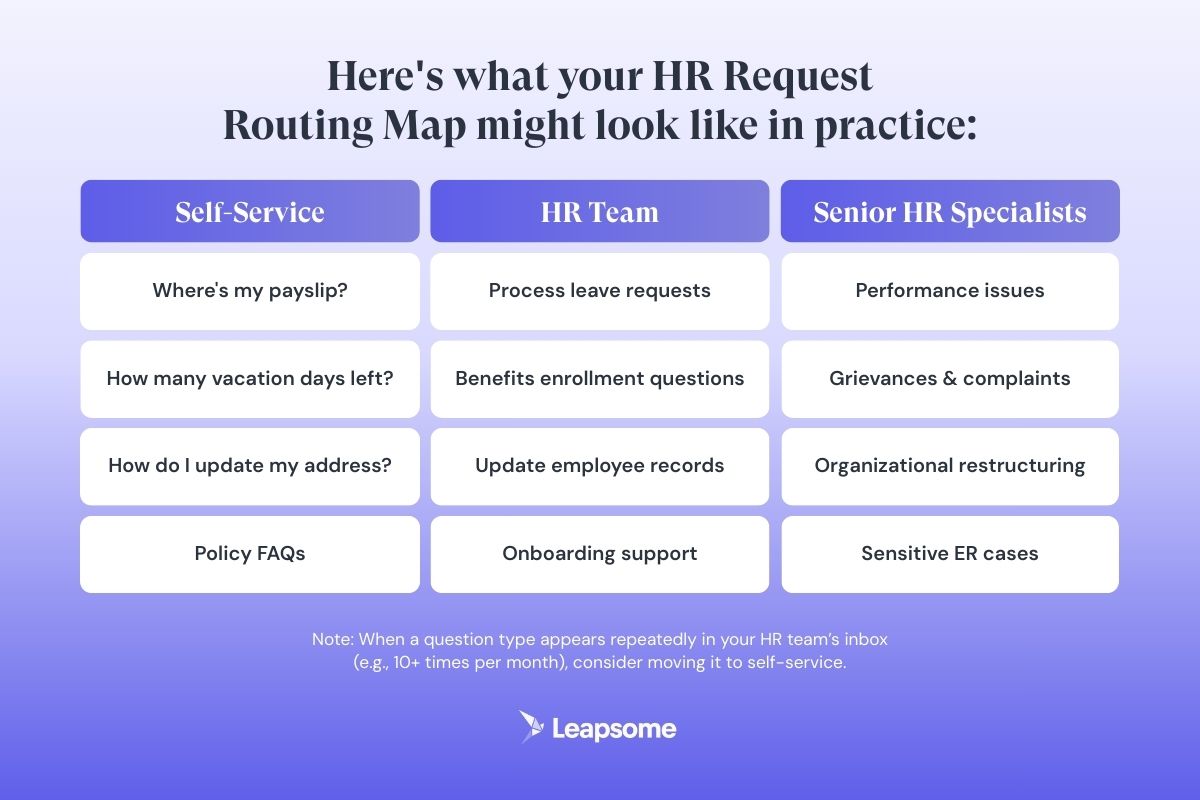
The HR Request Routing Map is a practical way to turn tiered service delivery into everyday routing decisions.
Instead of just describing tiers in theory, this framework helps you decide which questions go to self-service, which to your HR team, and which to HR specialists.
This matters because managers and HR teams need to make consistent decisions under pressure. For example, if an employee asks, "Can I take unpaid leave next month?" on a Friday afternoon, your routing map tells them exactly where to go. When your HR team sees the same low-risk question for the tenth time, it's a strong signal that it's time to move that topic into self-service.
Let's walk through the process of building your own map.
Step 1: Listing your real HR questions
Before you draw any boxes or tiers, pull 30-60 days of HR requests from your inboxes, chat tools, or case management system if you already have one.
Group them into a list of recurring questions, for example:
- Payroll issues
- Leave requests
- Benefits questions
- Performance concerns
- Employee relations topics
- Onboarding questions
- Policy clarifications
This list becomes the raw material for your routing map. More importantly, it often reveals that HR is handling many low-risk, repetitive queries manually when those questions could live in a knowledge base or self-service portal.
Step 2: Deciding what belongs in self-service, your HR team, or with specialists
Once you have your list of real questions, map each one to three tiers: self-service, your HR team, and senior HR specialists. Use a few simple criteria to guide your decisions.
Self-service handles questions that are simple, low-risk, and highly repeatable. Think "Where's my payslip?" or "How many vacation days do I have left?" If the answer is the same every time and there's minimal risk if someone gets it slightly wrong, it belongs here.
Your HR team manages moderate complexity with some pattern-based work. Examples include processing leave requests, updating employee records, or answering benefits enrollment questions. These require a human touch but don't necessitate deep organizational context or sensitive judgment calls.
Senior HR specialists tackle high-risk, sensitive, or ambiguous issues, such as performance management, grievances, organizational restructuring, or any matter involving potential legal exposure. These require judgment, coaching skills, and knowledge of team dynamics.
Step 3: Simple guardrails that protect senior HR specialist time for high-impact work
Your routing map needs a few basic rules to keep HR specialists focused on the right work. For example, if a low-risk question type exceeds a certain volume threshold in your general HR team’s queue (e.g., ten requests per month), consider moving it into self-service with a knowledge base article or an automated workflow.
Only route issues above a defined risk or impact level to specialists. Make it clear that routine administrative questions, such as "Can I change my direct deposit?" should never reach senior HR, even if someone escalates loudly.
Review your case data quarterly to see which topics are consuming specialist time. If your team is spending hours on benefits enrollment questions, that's a signal to improve your self-service content or train your HR team better. Share these guardrails with managers to ensure expectations remain clear and consistent throughout your organization.
🗺️ Turn your routing map into reality with an integrated HRIS
Leapsome gives you the workflows, automation, and analytics to operationalize your HR service delivery model.
👉 Explore Leapsome HRIS
Turning HR service delivery into your next 12-month people plan
Building effective HR service delivery takes time and iteration. Think of it as a way of running HR that feeds into engagement, performance, and workforce planning decisions over time.
Here's a realistic 12-month sequence:
- Diagnose your current state and list real questions
- Design a first version of your routing map
- Pilot it in one domain, like onboarding or leave management
- Use data and feedback to refine
- Layer in more automation and self-service as you identify patterns
This makes a structured approach to service delivery, such as our routing map and framework, essential rather than optional.
Platforms like Leapsome can underpin a 12-month sequence like the one above by centralizing data and workflows across the employee lifecycle, making it easier to monitor the impact of changes and adjust your routing map as your team evolves.
🎯 Ready to transform your HR service delivery?
See how Leapsome helps scaling teams centralize data, automate workflows, and improve employee experience across the entire lifecycle.
👉 Book a demo
Frequently asked questions about HR service delivery
What is HR service delivery, and how does it differ from traditional HR support?
HR service delivery is the repeatable system your company uses to receive, route, and resolve HR questions across the employee lifecycle. Traditional HR support often means ad-hoc responses through inboxes and DMs. A service-oriented HR model provides clear entry points, defined tiers, and consistent processes, enabling employees to know where to go and allowing HR to track demand patterns.
How can an HR service delivery model help a small HR team support a fast-growing company?
An HR service delivery system enhances scalability by routing routine questions to self-service and your HR team, thereby protecting specialist time for strategic work. This means your team can handle more requests without needing to add headcount. Better routing also improves the employee experience by providing faster and more consistent answers as complexity increases.
Which metrics should HR leaders track to measure the success of their HR service delivery model?
Useful metrics to track include resolution time (the speed at which requests are answered), deflection rate (the percentage of questions handled through self-service), case volume by category, and employee satisfaction with HR support. These analytics help you identify bottlenecks, refine your routing map, and demonstrate cost-efficiency improvements to leadership.
Sam Abrahams

.jpg)
.jpg)
.jpg)

.jpg)