Core HR software: Why it's the foundation of your HR strategy


Core HR software may sound like just a place to store employee records and prepare payroll. But the data it holds supports much more consequential work. An outdated reporting line can skew performance calibration and engagement analysis. An incorrect salary record can undermine compensation planning.
Many organizations already have HR technology in place, yet only 35% of HR leaders feel confident their approach to HR technology supports business objectives.* Instead of browsing software’s feature lists, you need to know whether people data stays accurate, flows into other HR processes, and gives employees appropriate control over their information.
This guide explains what core HR software covers and how to tell if your current setup supports your people strategy.
* Gartner, 2024
What core HR software actually covers
Core HR software is the central system that maintains workforce data and supports the administrative processes that depend on it.
The category overlaps closely with an HRIS, so you’ll often see the terms used interchangeably. Both should give your organization one reliable place to manage employee information.
Core HR software usually covers the following functions.
Employee records
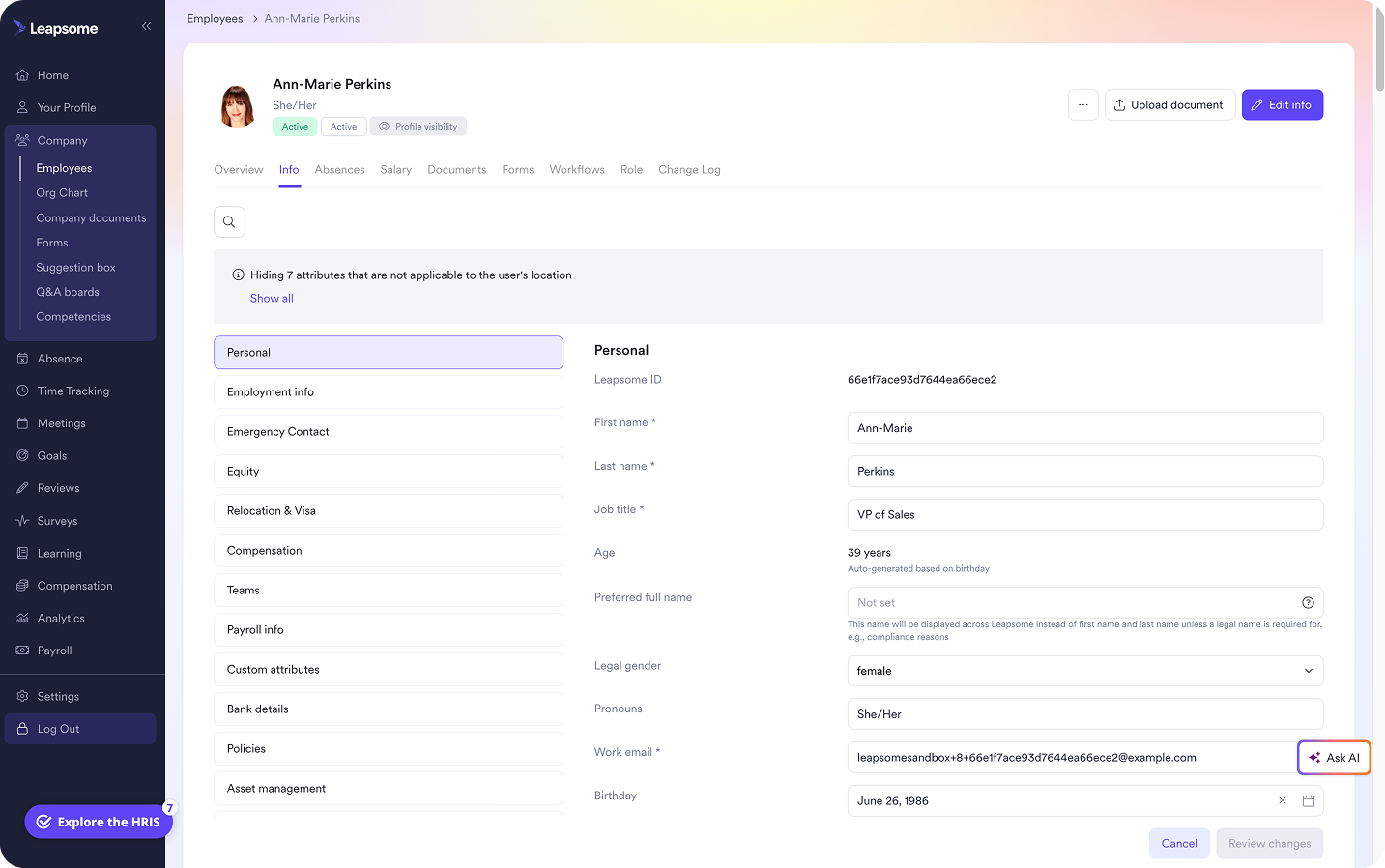
Each employee needs one structured profile containing current personal and role information. The record should also preserve employment history and relevant documents.
It’s important to keep this information in a centralized HRIS like Leapsome’s and connected to other HR processes. This way, each data update automatically flows to relevant workflows such as payroll.
🗂️ Create one reliable employee record
Leapsome’s Employee Records connect role history with relevant people data, while configurable permissions keep sensitive information protected.
👉 Explore Employee Records
Time and attendance
"Managers shouldn't email HR to ask who's on leave or what a team's balances are; they should see it live. The moment people self-serve, interruptions drop and decisions speed up. That's the point of a single source of truth."
— Carolin Leidel, Consultant, torq.partners
Core HR software gives employees a clear way to request leave and check their available balance. Managers can approve requests while the system applies the relevant absence policy.
Accurate attendance tracking and absence data also need to flow into payroll preparation. Otherwise, HR teams end up manually checking one system against another whenever leave affects pay.
Payroll preparation and compliance
While an HR software might not always process payroll itself, it should organize the approved employee changes that payroll depends on, including salary and absence updates.
The system should also control who can access sensitive data and maintain a history of changes. These safeguards help HR protect employee information and produce reliable records when an audit or compliance review occurs.
"We even flag compliance risks — for example, if a country requires a minimum of 20 paid days off, the platform won't let you go below that."
— Suraj Paneru, Customer Success Coach, Leapsome
The best core HR software options
Once you understand the HR software baseline, you can compare platforms based on how well they support your operating model. The following options on the core HR software market cover different company sizes and workforce needs.
1. Leapsome
Leapsome combines core HR with people enablement in one connected platform. Its HRIS centralizes employee records and documents, while Absence Management and Payroll Prep use the same data. That information also feeds Performance Reviews and Engagement Surveys.
Leapsome is best for growing small and mid-sized businesses that want core HR data to support people development and workforce decisions.
2. HiBob
HiBob’s platform provides employee records and configurable HR workflows. It also offers time-off management and workforce analytics with additional systems for areas like performance and compensation.
HiBob is best suited for mid-sized or larger businesses with distributed teams and more complex organizational structures.
3. BambooHR
BambooHR centralizes employee records and supports onboarding and offboarding. Its broader platform includes time tracking and payroll with availability depending on the market. The intuitive interface makes routine self-service easier for employees and managers.
It's one of the best core HR software for small businesses moving away from spreadsheets or basic HR tools.
4. Rippling
Rippling connects HR administration with payroll and benefits. Its platform also extends into device management and app access, allowing employee changes to trigger workflows beyond HR.
Rippling is a good option for mid-sized companies that want workforce data to coordinate HR and IT operations.
5. Deel
Deel combines a global HRIS with international payroll. It also supports employer of record services and contractor management across multiple countries.
It’s a reliable option for mid-sized or enterprise businesses managing an international workforce across several employment models.
6. Justworks
Justworks offers payroll and HR tools alongside compliance support. Its PEO plans also provide benefits administration through a co-employment model.
Justworks is best for small U.S. businesses that want hands-on HR support alongside their core software.
How to tell if your core HR software is actually a foundation, not a liability
"On the C-level, I learned to doubt people data because it arrived late and conflicted across files. Then, sitting in HR, I felt the pain from the inside and saw how much time went into rebuilding the same reports. Centralizing restores trust and your calendar."
— Florian Klages, Managing Partner, torq.partners
Most HR teams can name their system of record. Fewer can prove that the rest of their HR stack uses it as one.
Gartner has found that only 24% of HR functions maximize the business value of their HR technology. Having a core system in place is only the starting point. It creates value when its data stays reliable and flows into the rest of HR without repeated manual work.
Use these questions to assess whether your current setup provides that foundation:
- Is it a genuine single source of truth? HR should know which system owns each data point. If someone changes an employee’s role in one platform, connected tools should use that update instead of storing competing versions.
- Does data flow into other HR processes automatically? Test a common change, like a promotion. If HR must export a file or re-enter the information for payroll preparation, the core system is failing to improve efficiency.
- Can employees and managers self-serve? Employees should be able to update appropriate personal information, while managers access relevant team data. Clear permissions protect sensitive records without bogging down the HR department with routine changes.
"With self-service, employees can manage their own data — update addresses or personal info — while sensitive details like salary stay restricted to admins."
— Sophie O'Donoghue, Customer Success Coach, Leapsome
How to evaluate core HR software before you buy or switch platforms
Choose core HR software by testing whether it can support your future HR operating model and be implemented without losing important workforce data.
Once your audit explains why the current setup needs to change, evaluate the vendors. A new platform should solve problems without introducing new limitations.
- Test the data model against future complexity: Give vendors scenarios based on planned growth or restructuring. Check whether the system can represent your reporting relationships and preserve employment history. Confirm that you can migrate existing data without flattening useful context.
- Investigate what each integration transfers: Ask for a field-level integration map instead of accepting a list of connected platforms. Confirm which system initiates each update and who maintains the connection. You also need a clear process for identifying failed transfers.
- Run a usability test with end users: Ask an employee and manager to complete a daily task with limited guidance. A self-service feature has little value if people can’t find it or understand how to use it. Also check whether HR can adapt workflows without vendor support.
Use this checklist during vendor demonstrations:
- Can you migrate historical employee data accurately?
- Can the system support planned organizational changes?
- Do permissions match your governance model?
- Does each integration transfer the required fields?
- Is responsibility for maintaining integrations clear?
- Can HR change workflows without technical support?
- Can employees complete common tasks with minimal guidance?
If you’re looking for a broader comparison, check out our guides on different types of HR software and the best HRMS platforms.
"There was this shift of like, trust this. This is our one source of truth."
— Sammie Masley, People and Talent Partner, Leapsome
🔗 Give every HR process the same data foundation
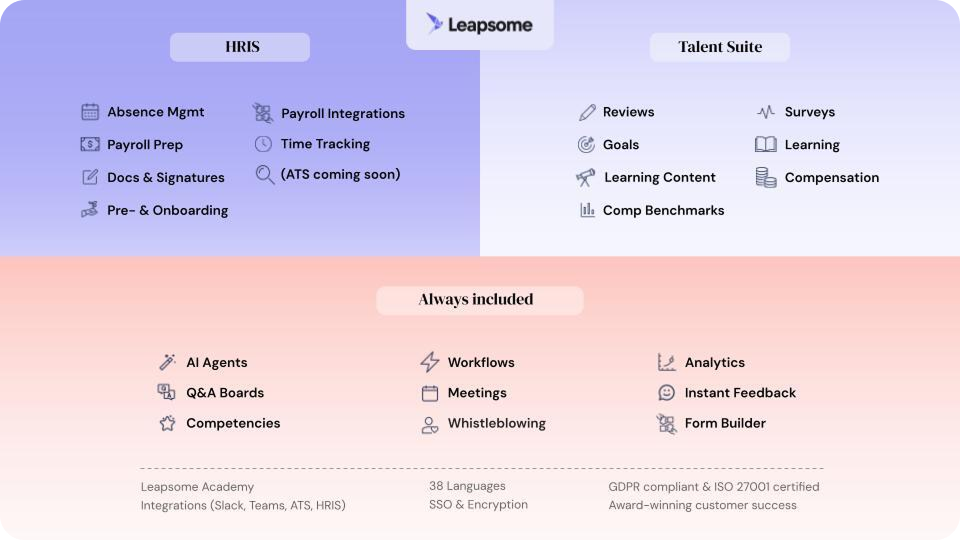
Leapsome’s HRIS connects employee data with people processes that depend on it.
👉 Explore HRIS
Leapsome: Core HR software built to power your people strategy
Choosing the right core HR software sets the data foundation for every workforce decision that follows. If that foundation ends with recordkeeping, HR has to rebuild context when running reviews, analyzing engagement, or plans compensation.
Leapsome keeps that context connected through:
- Centralized employee information: Employee Records and Documents give HR one structured source of current people data.
- Connected core processes: Absence Management and Payroll Prep use the same employee information, reducing the need to reconcile updates.
- Consistent decision context: Performance Reviews and Engagement Surveys draw from the shared data layer. Compensation decisions stay connected to the relevant employee records.
- AI-powered insights: Leapsome AI works across the platform, helping HR identify patterns using consistent organizational context.
"All payroll data lives in Leapsome — it's a living number. When salaries change, managers update them directly." — Siddharth Dhanuka, Head of Finance & Operations, SQUAKE
🏗️ Build your people strategy on reliable data
Leapsome connects core HR with the decisions that shape employee performance and growth.
👉 Request a demo
FAQ
What's the difference between core HR software and an HRIS?
There’s little practical difference between core HR software and an HRIS, so teams often use the terms interchangeably. Core HR software describes the essential tools used to manage employee data and routine HR administration. An HRIS is the system that centralizes that information and supports those processes.