HR guide to co-employment: Benefits, risks, and management tips


Disclaimer: This content is for general informational purposes only and does not constitute legal advice. Leapsome does not guarantee legal compliance and cannot confirm how specific situations would be assessed in court. If you're unsure how the requirements apply to your organization, please consult qualified legal counsel.
On paper, a co-employment setup can look like a strategic way to reduce HR complexity. An external partner handles admin and compliance duties, while your organization manages the work and shapes the employee experience. And this split in responsibilities can help you scale with less added pressure on HR.
But co-employment can also blur accountability when employees need support and HR needs reliable workforce data. With the global professional employer organization (PEO) market projected to grow at a CAGR of about 9% through 2035*, HR leaders need to stop looking at employment models through compliance lenses alone. Co-employment only works well if you have a clear operating model, where responsibilities, communications, and employee data all stay connected.
In this article, we’ll look at how co-employment works, where it creates risk, and how HR teams can protect accountability across the employee lifecycle.
* Industry Research, 2025
What’s co-employment?
Co-employment is a shared arrangement where your organization and an external partner both hold responsibilities for the same employees. Your company manages the day-to-day work, while your chosen partner takes on certain employer responsibilities.
The most common co-employment arrangement is a PEO partnership. NAPEO reports that 14% of employers with 20–499 employees use a PEO, which makes this a familiar model for many growing companies.
While the specifics vary, a PEO usually handles payroll admin and benefits support, and it may also help with employment tax filings. Your organization still owns business decisions, including hiring, wages, and employee management and development.
This split in roles should be made clear in a contract, and needs to be easy for managers to follow in practice. Otherwise, employees may get process support from the PEO while lacking direction from their managers or HR.
Co-employment risks: Keeping an eye on accountability and employee experience
Companies usually evaluate risk through potential co-employment law liabilities and HR compliance duties. But in many arrangements, the formal responsibilities are well-defined enough to minimize issues.
The greater hazards often hide in daily operations that are unclear or poorly owned. When support requests, manager guidance, and workforce data sit in an awkward middle ground between your company and the PEO, small handoffs can easily turn into big gaps.
This consumes time and reduces the chance of errors. More importantly, while employees probably don’t care who owns which processes, they will notice slow answers and managers who hesitate to take accountability.
Let’s dig a little deeper into the potential co-employment issues you’ll need to tackle upfront.
Messy ownership over employee support
Often, the legal structure between your company and co-employment provider is well documented, but the on-the-ground support feels improvised. For instance, payroll issues may clearly belong to the PEO, while team conflict mediation stays firmly with the organization.
But some policy issues need input from both sides, and it’s not clear how that process is supposed to work. If resolution paths are cloudy, team members are left guessing where to turn for support — which isn’t great for the employee experience. Managers may also over-escalate simple issues, or avoid difficult conversations because they’re unsure where their authority ends.
Confusion around performance and development
“Teams assume that there’s an ownership, but it’s actually never been defined.”
– Erica Ancobia, CEO and Managing Director at KUNO
Performance and development management usually remain the organization’s responsibility (as it should). Yet co-employment may still blur ownership, especially if HR treats the PEO as the default answer for every people process.
A PEO can support employment admin, but it can’t coach an employee through a difficult role transition or replace a manager’s feedback. If performance reviews and coaching don’t have clear owners, employees might receive their paychecks on time but miss out on guidance that would help them grow.
Limited visibility into workforce issues
When responsibilities are divided, employee data often gets split too. The PEO may hold payroll or leave-related information, while the company focuses on performance notes and engagement feedback. If those systems don’t connect, HR leaders lose the full picture of what’s happening across the workforce.
That disconnect creates practical co-employment risks. A leave trend may appear in one system, while the engagement or manager feedback that might explain the shift lives somewhere else. Or performance concerns might show up in company reviews, while the PEO handles related support requests through a process that doesn’t account for those issues.
So in distributed HR environments, it’s vital to have a centralized system like Leapsome that improves data handling and employee visibility.
“Many HR teams still struggle with the basics — too many disconnected tools, limited insights. That’s why we built a truly people-first HRIS that unifies all employee data into one source of truth.”
– Suraj Paneru, Customer Success Coach at Leapsome
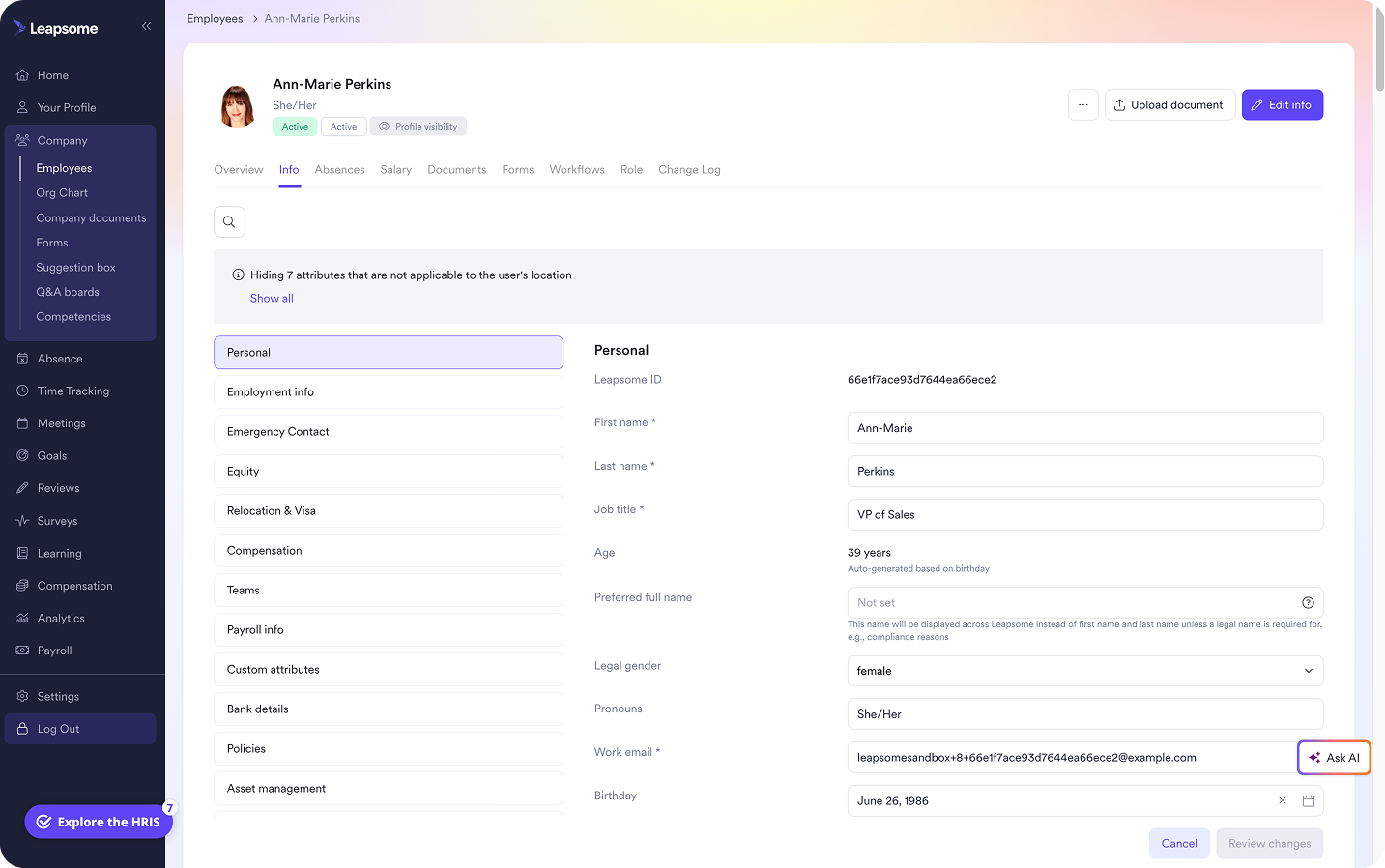
🎯 Centralize the employee lifecycle
Leapsome helps HR teams connect employee records with performance data and people insights, so shared employment structures don’t turn into scattered workforce visibility.
👉 Learn about Employee Records
Disconnected career growth opportunities
Even when no one is audibly complaining, there may still be issues lurking underneath your co-employment system. Workers can feel supported because basic admin works fine, yet lack clear learning paths and growth opportunities.
That gap gets worse when predictive analytics depend on records that are split between your company and the PEO. For example, the PEO may hold updated employment status or tenure data, while your organization's learning tools use older records.
As a consequence, a team member who’s eligible for manager training or a role-specific development program might never be added to the right cohort. If that seems like a manageable risk, keep in mind that, according to Deloitte’s reporting, employees who don’t have access to growth opportunities are 2.5 times more likely to leave over the coming year.
That’s why HR needs a platform that connects employee data and learning initiatives in one place. With Leaspome’s combined HRIS features and people management systems, your team can act immediately on career growth opportunities.
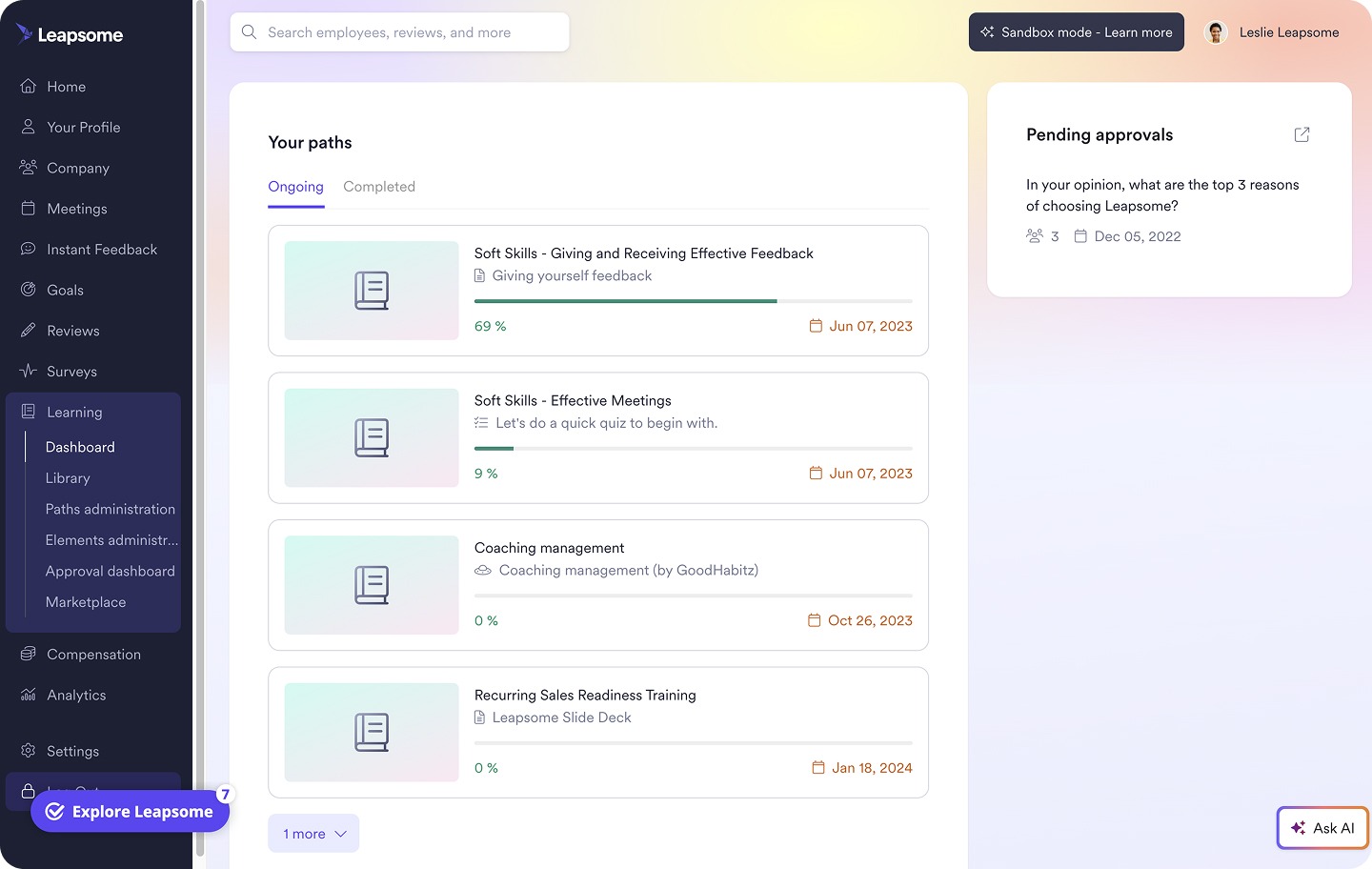
🤝 Don’t let growth opportunities disappear during admin handoffs
Leapsome helps HR teams connect learning paths with reviews and feedback, so managers can turn development chats into clear next steps.
👉 Explore Learning Management System
How to manage co-employment successfully
“The purpose of an HR function is to create a people strategy that effectively drives business goals. It starts with the business, then you build your people strategy from there.”
– Melanie Naranjo, Chief People Officer at Ethena
As we’ve seen, a co-employment arrangement can define legal obligations, but it can’t create operational clarity on its own. HR leaders have to make the responsibility split clear enough for managers to follow, and easy enough for employees to understand.
Here’s how you can do just that.
Don’t leave anything up to chance or individual whims
Instead of assuming “HR will handle it,” or leaving daily employee moments up to manager judgements, document who’s responsible for each employee-facing process. Create a simple ownership map of the employment relationship, showing what the PEO handles and what internal HR maintains.
This map should cover the most important moments in the employee lifecycle, including onboarding, support, feedback, and development. Make sure it’s easily accessible to everyone who needs it for daily work, and add in supplemental docs that dive deeper into how managers should handle each opportunity or challenge.
Bridge the gaps with empowered management
Don’t confuse smoother admin with a consistent employee experience. A PEO can support your processes, but as Gallup reports, it’s managers who account for at least 70% of the variance in engagement scores.
If managers don’t know what they own, one leader might give clear answers, while another redirects everything to HR or the co-employer (or a confusing mix of both). That’s why managers need to be your bridge between the formal structure of a co-employment setup and employees’ daily realities. They should be the ones explaining key decisions and helping employees understand what happens next.
“If it’s your decision, you should be the one who communicates it. Plain and simple.”
– Melanie Naranjo, Chief People Officer at Ethena
When managers do that well, employees don’t feel stuck in limbo between your company and the PEO. Instead, team members feel managers' confident guidance, and they can match it with high engagement.
Make sure you can see everything important, all at once
In a co-employment setup, HR should define which employee data needs to flow from the PEO into the company’s HRIS. You’ll also have to know what internal people signals need to stay connected to employee records.
The practical move here is to create one reliable view of each team member’s details, regardless of your co-employer structure. HR should have core records, understand how updates move between systems, and check information before leaders use it for planning. This way, your team can spot patterns earlier and keep accountability from disappearing between systems.
Strengthen ownership and workforce visibility with Leapsome
Co-employment works best when shared responsibility doesn’t weaken HR’s view of your workforce. A PEO can be very useful for supporting admin without adding headcount. But your company still needs clear internal records, performance context, and people insights to manage the employee experience well. Without that visibility, HR may have a compliant setup and still struggle to see what’s happening across teams.
Leapsome’s HRIS and people management platform helps organizations centralize workforce info and employee records, while connecting them to performance and development data. This gives HR leaders more clarity across employment structures.
With Leapsome, you can:
- Improve workforce visibility: Keep team data and people insights connected across the employee lifecycle.
- Strengthen performance management: Link reviews, goals, and feedback to real-time employee records.
- Support employee development: Connect learning paths with performance context and growth conversations.
- Create consistent employee experiences: Give managers clearer data so they can support employees reliably.
“With Leapsome, we were able to automate performance reviews, goal setting, onboarding, and offboarding, and together that helped us reduce our team’s manual effort by about 20%.” – Weronika Czerny-Nowakowska, Chief Operating Officer at Neurons Lab
🧑🤝🧑 One home for the entire employee lifecycle
Leapsome’s centralized HRIS and people management tools make it easy to maintain a strong co-employment structure, thanks to clear data and built-in support for employee development.
👉 Request a demo