Workforce optimization: Building a tactical framework for growth


Workforce optimization (WFO) can reduce labor costs and increase efficiency, and that’s enough to make it worthwhile. But those benefits are incidental when you consider the bigger picture: giving your team the tools and support they need to maximize performance.
After all, small and mid-sized companies face a variety of workforce challenges, from scrambling to justify people decisions with hard evidence to facing increasing headcount without a matching performance boost. A well-designed optimization strategy helps by combining good workforce planning, a strong analytics program, and meaningful engagement initiatives.
Yet according to Deloitte, nearly half of organizations don’t include workforce management metrics in their analytics landscapes. (1) And Gartner reports that only 15% employ strategic workforce planning. (2) This article is your guide for getting ahead of the companies that don’t take WFO as seriously as they should.
1. Deloitte, 2024
2. Gartner, 2025
What’s workforce optimization?
WFO focuses on improving productivity by combining data and technology with workforce planning and performance management. It’s a process designed to help your people do their best work, both at crunch time and beyond.
Launching a strong WFO strategy is a smart move for any organization that wants to scale performance without increasing headcount. But it’s especially valuable for growing small and mid-sized companies, because they don’t have the same resources or infrastructure as larger organizations. They can’t easily absorb the cost of too many reactive decisions that don’t work out, so they need tighter systems.
Key components of workforce optimization
Here’s a closer look at what a WFO strategy typically includes:
- Workforce analytics: Analytics help you convert people data, such as headcount and productivity, into actionable insights.
- Performance management: By setting targets and building development plans, performance management lays the groundwork for the rest of your WFO efforts.
- Employee engagement: The cost of low employee engagement is staggering: Gallup reports that disengaged employees cost the global economy $8.8 trillion in 2023, or 9% of GDP.
Aim, analyze, adjust, repeat: A four-step workforce optimization framework
Workforce optimization isn’t a program you can run once and call it a day. It’s a continuous feedback loop of measuring how work gets done, diagnosing problems, and mitigating them.
That’s why you need a complete framework and the right supporting tools. Your WFO strategy should enable employee performance and smart decision-making, instead of just cutting labor costs and reacting when something goes wrong.
This is a tall order — if you rely on manual methods. HRIS software like Leapsome helps HR leaders run heavily automated WFO strategies, so you can pour your efforts into people strategy instead of tracking and managing admin by hand.
“Change is constant, so reactivity just doesn’t work anymore. Responsiveness isn’t about speed; it’s about design. If you don’t build the structure before the next fire, you’ll default to knee-jerk moves that create confusion and burnout.”
– Craig Forman, Founder and Principal Consultant at CultureC Consulting
Here are the core steps for building a comprehensive workforce optimization strategy.
1. Set clear and achievable goals
“The purpose of an HR function is to create a people strategy that most effectively drives business goals. It starts with the business, then you build your people strategy from there.”
– Melanie Naranjo, Chief People Officer at Ethena
Define measurable, realistic goals to give your WFO strategy direction:
- Align with business needs: Each of your objectives should connect to a high-level business outcome, such as better employee retention or customer satisfaction, so you’re not optimizing in a vacuum.
- Select and monitor relevant KPIs: If the goal is improved productivity, for example, track HR metrics like output per employee and OKR progress.
- Review and refine often: Treat your goals as moving targets, not annual checkboxes. Regularly review how your KPIs change over time, and calibrate your WFO strategy accordingly.
2. Make sure you have the right people in the right roles
To avoid overstaffing, overloaded employee schedules, and excessive overtime shifts, you need to forecast capacity needs accurately while matching skills to roles. This lets you surface problems before they escalate, which in turn boosts operational efficiency.
Run regular workload audits to see how evenly tasks are spread out across teams, and identify where it makes sense to redistribute work or bring in a new hire. Get department heads involved in these audits, and in your workforce planning endeavors in general. They have firsthand visibility into capacity gaps and workload imbalances.
As for metrics, consider tracking your internal mobility rate. If it’s consistently low, you might overlook internal talent in favor of outside hires, which increases labor costs and doesn’t leverage your existing workforce efficiently.
3. Look at what the data is telling you
“Good data helps us identify pain points early, plan development initiatives, and return to the business with clear, actionable insights.”
– Victor Tomas, Learning and Development Specialist at Swapfiets
Without analytics, your WFO is based on instinct over evidence. Digging into the data helps your team anticipate potential issues and address them before they spiral into serious problems. For example, when you spot dipping engagement early, you can keep it from translating into higher turnover numbers.
One simple but powerful way to strengthen your analytics program is to benchmark metrics against industry standards. This gives you a realistic idea of whether measures like employee engagement and turnover rate are competitive or cause for concern.
Review the way your data is structured, too. If it’s spread across multiple locations, there’s a good chance you’re missing connections that tell a more complete story. A dip in output doesn’t say much on its own, but add in overtime data and employee engagement scores, and you may find clues indicating that teams are overworked and headed for mass burnout.
4. Know whether teams meet performance targets
Strong performance management requires continuous feedback, plus learning and development plans designed to close skills gaps. You can gauge how well your performance management works by tracking metrics like 360-degree feedback scores and time to productivity for new hires.
Keep employee satisfaction in mind when creating or modifying your performance management strategy. Involve team members in the feedback process using a platform like Leapsome, and be open to their criticism as well so they feel heard.
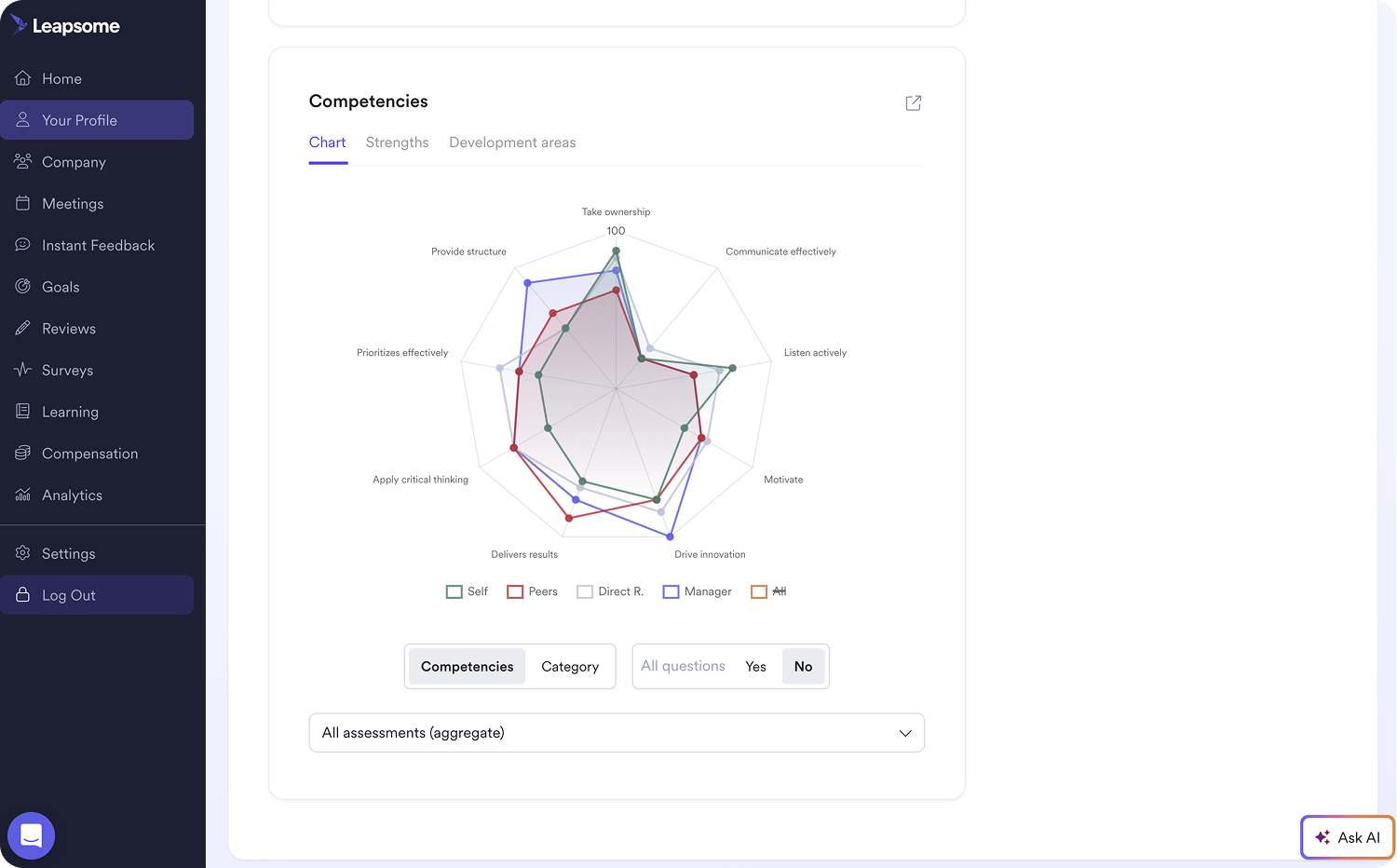
🔢 Bridge all your data for smarter decision-making
Centralized and connected performance data, feedback, and analytics help your HR team take WFO strategies organization-wide, and you don’t have to worry about losing visibility as the company grows.
👉 Explore Performance Management
Effective workforce optimization strategies
A WFO framework is invaluable as a jumping-off point, but the way you apply it will vary based on your organization’s specific needs and goals. For best results, take these strategies and tailor them to your organizational reality:
- Optimize first: Increasing headcount isn’t the only way to address capacity or skill gaps. Before writing up a new LinkedIn job post, explore whether there might be a way to solve the problem internally. Labor optimization cuts down on costs and builds a more agile, adaptable workforce.
- Tap the experts: HR doesn’t have the same on-the-ground insight into day-to-day operations as managers and employees do. Involve a range of people in the decision-making process, to ensure that initiatives reflect real business needs instead of HR assumptions.
- Don’t optimize for optimization’s sake: Focus on outcomes, not just activity metrics that are easier to measure. Slightly trickier numbers, like revenue per employee, are more insight-rich. Plus, they're still simple to track with Leapsome’s reporting features.
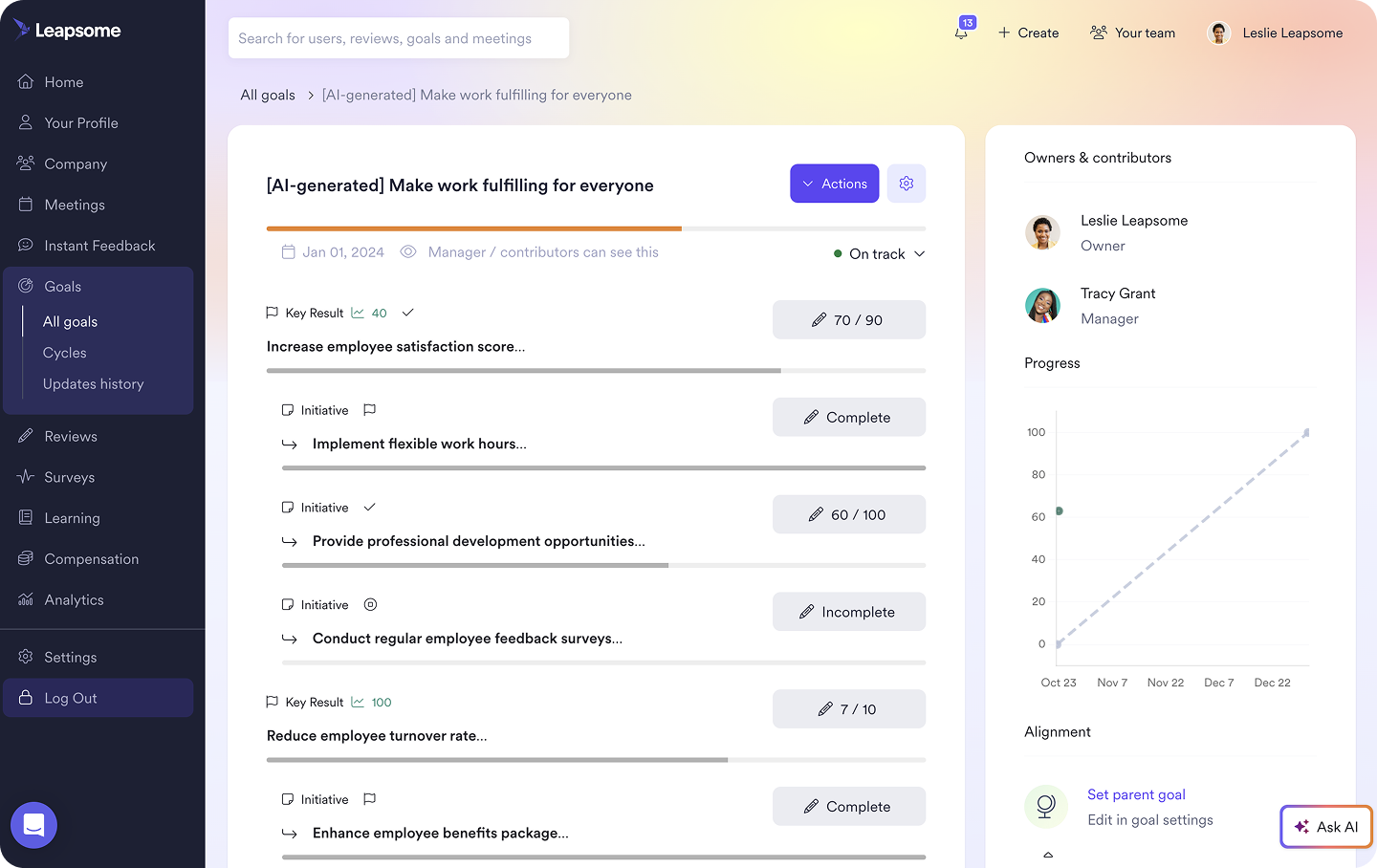
☑️ Simplify goal-tracking and collaboration
Align teams by plugging goals and OKRs seamlessly into the rest of your digitized WFO strategy, for full visibility and accountability.
👉 Explore Goals and OKRs
What workforce optimization technology is available?
Once you’ve assembled your roster of WFO strategies, you need the right tools to bring them to life. Here are some of the top workforce optimization solutions on the market:
- Leapsome offers a full suite of workforce optimization tools that connect performance and engagement with people data. You get goal-tracking, comprehensive analytics with AI-powered insights, and robust feedback and development features, all of which you control from a centralized command center.
- Workday helps HR teams take care of everyday tasks and visualize costs and trends, making it easier to spot issues.
- Workleap’s AI-first workforce management software gives managers tools, like engagement surveys and reporting, to take some of the busywork off their plates.
Build a connected, scalable WFO system with Leapsome
Even well-designed WFO strategies can break down under the stress of real-world implementation. The usual reason isn’t poor design, but disconnected systems that make it difficult to go from insights to measurable gains. This type of broken framework leads to reactive decisions based on limited visibility.
Leapsome puts the pieces back together, linking performance, engagement, goals, and HR data in one platform. When everything lives in the same space, you see the full picture behind the data, and you’re better positioned to improve how work gets done.
“We now have a powerful tool that helps our employees get the feedback they need to help them reach their full potential.” – Jeron Bitto, Head of People and Organization
💪 Build a plug-and-play workforce optimization HQ
Leapsome centralizes and automates workforce planning, performance management, and analytics, giving you maximum visibility without the heavy lifting.
👉 Request a demo

.jpg)

.jpg)