Introducing the Tech-Maturity Matrix framework for workforce planning
.png)
.jpg)
Workforce planning is how you ensure your organization has the right people, with the right skills, in the right roles, at the right time.
However, what worked even two years ago no longer matches today's reality. 73% of HR leaders say their organization is planning workforce restructuring to integrate AI, with, of those, 85% expecting it to accelerate within the next 12 months.*
This rapid shift means the skills and roles your workforce needs today look fundamentally different from what they were just a few years back.
That's why workforce planning has evolved into a continuous, data-driven process. With today's integrated systems, automated processes, and AI tools, you can stay ahead of volatile markets and emerging technology instead of constantly playing catch-up.
In this guide, you'll learn about the Tech-Maturity Matrix framework, a practical approach to modernizing your workforce planning across five maturity layers.
You'll get:
- Actionable steps for each stage — from aligning strategy to enabling scenario planning
- Six workforce planning best practices — so you can optimize strategies and quickly respond to change
- A breakdown of what to prioritize — in your planning tools and software
Ready to modernize your approach to workforce planning?
Explore Leapsome's people enablement platform to discover how a unified HRIS, performance, and learning system helps you hire strategically and plan ahead.
👉 Book a demo
*Leapsome 2025 HR Insights Report
What is workforce planning?
Workforce planning is the systematic process of forecasting talent supply and demand to ensure organizations have the right people, with the right skills, in the right roles, at the right time.
At its core, workforce planning analyzes current workforce capacity, projects future needs based on business objectives, identifies gaps, and builds implementation plans to close them. Its scope includes:
- Full-time employees
- Contractors and contingent workers
- Gig and freelance talent
- Remote and distributed team members
- AI contributors
Workforce planning operates at two levels
You can split workforce planning into either strategic or operational concerns. Here’s how they differ:
- Strategic workforce planning takes a three- to five-year view, aligning talent decisions with business goals such as market expansion, product launches, or digital transformation. This connects directly to your HR strategy planning.
- Operational workforce planning focuses on short-term optimization, such as your quarterly or annual capacity needs, scheduling, and immediate skill gaps.
McKinsey research shows that only 12% of organizations in 2023 were taking a longer view with strategic planning and workforce planning; however, a growing number of large enterprises are deploying dedicated strategic workforce planning tools, signaling a shift in approach.
By becoming more strategic and integrating people analytics with scenario-based planning, these enterprises aim to plan ahead, fill skill gaps more effectively, align hiring and budgeting with business strategy, and mitigate risk.
Unified platforms like Leapsome play a key role in this process by eliminating data silos and connecting employee records, performance data, and learning systems.
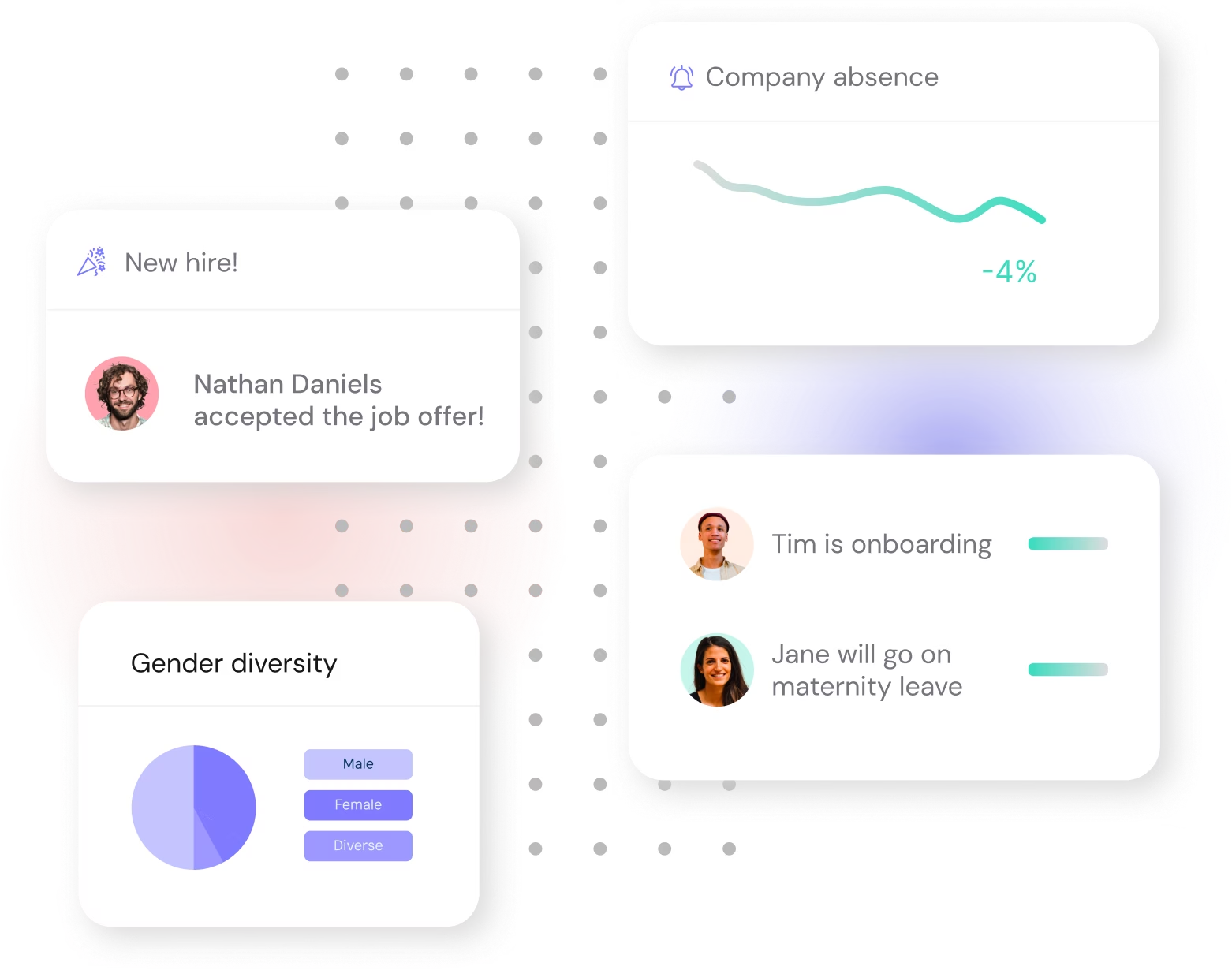
See how Leapsome’s HRIS connects every stage of the employee lifecycle and facilitates data-driven people decisions.
👉 Discover Leapsome HRIS
The workforce planning Tech-Maturity Matrix: a modern framework and how to execute it
Most workforce planning frameworks follow familiar logic: analyze supply and demand, identify gaps, and implement solutions.
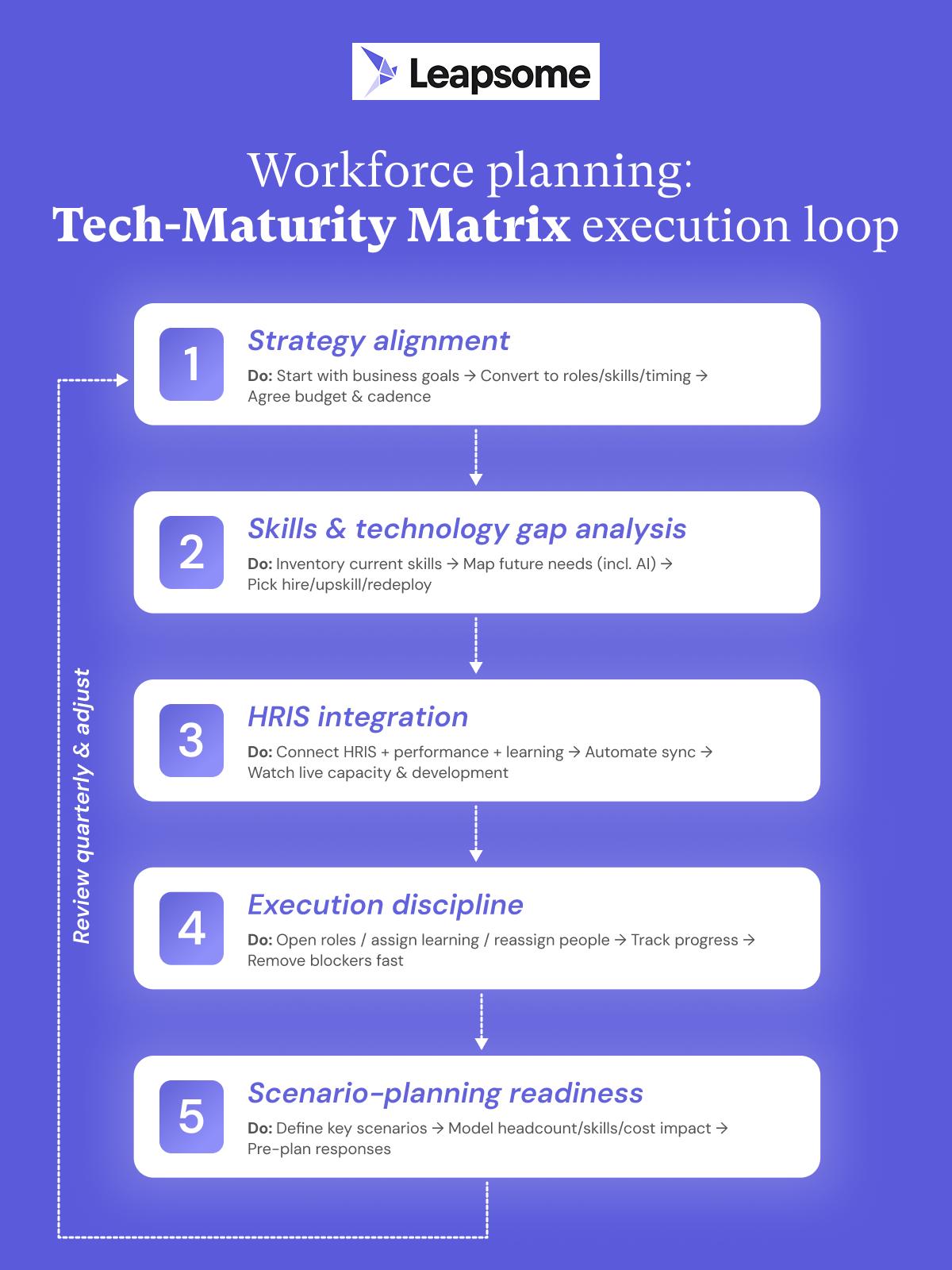
The Workforce Planning Tech-Maturity Matrix modernizes these steps by factoring in integration, automation, and continuous iteration. This allows you to assess your organization's current maturity across five layers:
- Strategy alignment
- Skills & technology gap analysis
- HRIS integration
- Execution discipline
- Scenario-planning readiness
With these factors – or layers – in place, you can better identify gaps and prioritize improvements that will move you from basic headcount planning to strategic workforce planning. Below, we discuss the layers in more detail and explain how to execute each one.
Layer 1: Strategy alignment
This first layer unifies workforce planning with your business and financial goals. Instead of just reacting to headcount requests, you translate revenue targets, market expansion plans, and product roadmaps into specific talent needs.
Achieving strategic alignment in practice involves cross-functional teams making workforce decisions together. So, you need to connect People, Finance, and Operations teams to agree on the right roles, timing, and budget using shared data. Then, you can adjust together when plans change.
Compare this with plans made in HR silos, which can lead to mismatched roles and budget issues.
How to execute:
- Start with your business strategy. Review revenue targets, expansion plans, and product roadmaps with finance and business leaders.
- Translate these into specific talent needs that ladder up to business outcomes (eg, 30% revenue growth = 10 new sales roles)
- Establish cross-functional planning owners and maintain both a three-year strategic view and quarterly review cycles.
Layer 2: Skills & technology gap analysis
Traditional skills audits focus on what capabilities you have today. This layer expands that view to consider how automation and AI will impact roles, map how positions will evolve over time, and identify which skills will matter in 18 months rather than just what exists now.
KPMG research shows the need for a shift toward skills-based planning, with organizations building structured frameworks that map skills to roles as they'll evolve with technology and business models.
How to execute:
- Inventory current skills by role and team, then compare against future needs based on business plans. Prioritize gaps by business impact (critical vs. nice-to-have).
- Determine solution paths for each gap: hire externally, develop internally through training, redeploy existing talent, or restructure roles.
- Quantify gaps with data to build your business case.
“50% of employees say they actually need stronger AI skills to fully leverage the technology to manage their workloads.”
- Jenny Podewils, CEO, Leapsome
Layer 3: HRIS integration
HRIS integration replaces manual spreadsheets with connected systems that link workforce data, performance metrics, and learning platforms.
Instead of exporting quarterly reports from disconnected tools, people analytics gives you real-time visibility into capacity, skills, performance levels, and development progress. You can forecast based on actual trends rather than static snapshots, turning workforce planning into predictive intelligence.
For example, with Leapsome’s HRIS, workforce data flows automatically between core HR records, performance reviews, competency frameworks, and learning paths.
This means you can see not just who has which skills today, but who's actively developing new capabilities through training programs.
As a result, you can decide sooner whether to hire, redeploy, or upskill, and time those actions to meet projected staffing needs at the lowest cost.
How to execute:
- Use a unified platform to connect employee records, performance management, competency assessments, and learning systems in one place, eliminating manual data exports by automating data flows between systems.
- Use real-time visibility into skills, capacity, and development trajectories across your workforce to update your plans.
- Keep track using continuous data access, which shows you who's developing which capabilities and how fast.
Learn how Leapsome consolidates HRIS, performance management, learning, and engagement
👉 Discover our all-in-one platform
Layer 4: Continuous planning
This layer shifts workforce planning from one-off annual projects to continuous cycles with clear ownership. You establish measurable milestones, track progress monthly, and create cross-functional accountability so everyone knows who's responsible for what.
Instead of creating a plan that remains static, you review quarterly, flag deviations early, and course-correct as conditions change. The ability to measure, iterate, and adapt is key to the successful execution of your strategy.
How to execute:
- Build and launch your talent pipeline by opening roles based on gap analyses and kicking off development programs aligned to business needs.
- Track progress monthly by monitoring hiring velocity, learning completion rates, and attrition patterns to spot issues early.
- Review quarterly and adjust by incorporating engagement scores and retention data into your forecasts, then update your plan based on what's actually happening.
Layer 5: Scenario-planning readiness
The highest maturity layer enhances the adaptability of your workforce planning through rolling forecasts and talent scenarios tied to market changes. Companies using scenario-based planning maturity frameworks outperform their peers by approximately 27% in meeting future skills targets.
Here, you run multiple "what-if" analyses, such as:
- Best-case growth scenarios
- Recession planning
- Competitive talent wars
- Automation acceleration
This helps you maintain flexible approaches that you can quickly adapt as assumptions change, rather than committing to single-point forecasts that could become outdated within months.
How to execute:
- Build multiple scenarios (optimistic, realistic, conservative) to prepare for uncertainty.
- Factor in role evolution from AI and automation, and incorporate external factors like talent market availability by geography.
- Use AI-augmented tools to run "what-if" scenarios and maintain rolling forecasts that adapt as conditions change.
Workforce planning best practices
Effective workforce planning requires a continuous feedback loop, cross-functional ownership, real-time data, scenario planning, and manager empowerment. The recommendations below help you implement all these key ideas and, as you’ll see, they closely align with five layers of the Tech-Maturity Matrix.
Shift to continuous planning
Quarterly or biannual reviews help you adapt as conditions change. When your priorities shift, revise your projections rather than sticking to your forecasts.
This enables you to respond in real-time as you align with iterations of your organization’s business model, the latest developments in AI, and how your workforce’s skills have evolved.
Build cross-functional teams
You can't plan your workforce in HR alone. Include:
- Finance for budget alignment
- Operations for capacity insights
- Department leaders for strategic priorities
Cross-functional teams ensure your talent decisions connect to budget realities and operational needs. When everyone owns workforce planning together, you avoid disconnects between what you plan and what your business can actually execute.
Prioritize clean, integrated data
HR leaders cite data quality as a top barrier to mature workforce planning, yet clean data is the foundation of fast, accurate decision-making.
Siloed systems undermine your forecasting accuracy, while unified platforms give you real-time visibility across performance metrics, skills, and capacity.
“I now have more data to back me up because we had previously data scattered in different platforms… like in different spreadsheets and now it’s mostly in one place. So if somebody’s asking something, I can just show the reports. This is how things are. And I don’t need to justify as much as I did before.”
- Merilyn Laanemets Senior People Specialist, Bob W, a Leapsome User
Model multiple scenarios
Plan for different outcomes, such as:
- Rapid growth and hiring as you roll out new features or services
- Controlled, predictable expansion that reflects historical growth patterns
- Aggressive competitor behavior, including poaching talent
- The loss of key contracts or major customers
- The urgent need to redeploy employees or optimize specific teams
Don't commit to single forecasts in volatile markets. Scenario planning prepares you for uncertainty and enables quick pivots when conditions change.
Empower your managers with data
Centralized planning fails without manager buy-in. Give your frontline leaders visibility into team capacity, skill gaps, and development priorities. After all, they're the ones who actually hire and retain talent.
Automate where possible
Five years ago, manual data work consumed 70% of HR's planning time. However, with today's HR automation tools you can eliminate spreadsheet work, copy-paste reporting, and manual reconciliations.
Platforms connecting HRIS, performance, and learning data automatically surface insights. AI integration enables predictive analytics that would be impossible to do manually. This frees your team from managing time-consuming manual processes and sifting through raw data to focus instead on strategy and improving the employee experience.
Choosing workforce planning tools and software
Your workforce planning tools need to integrate deeply with your HRIS, performance systems, and learning platforms. Unified people enablement platforms outperform standalone solutions by eliminating manual data consolidation, and below, we look at what to prioritize.
Must-have capabilities
When evaluating your workforce planning tools and software, look for these core features:
- HRIS integration that automatically syncs employee data, org structures, and headcount
- Skills and competency tracking that maps current capabilities and development progress
- Predictive analytics that forecast future needs based on business trends
- Scenario modeling that lets you test multiple "what-if" workforce plans
- Real-time HR analytics dashboards that surface insights without manual reporting
Why integrated platforms matter for workforce planning
Workforce planning requires performance data, engagement metrics, and learning progress all in one place.
You can't accurately forecast without knowing who's developing which skills and how fast, which teams show engagement or attrition risk, and how performance trends connect to capacity needs.
That's why standalone workforce planning tools that operate in isolation create problems. You end up manually exporting data from your HRIS, pulling performance metrics from another system, and consolidating learning progress from a third platform. This defeats the purpose of automation and slows down your decision-making when speed matters most.
Unified platforms solve this by connecting workforce planning across your entire HR ecosystem.
For example, with an all-in-one people management platform like Leapsome, you see live HRIS, performance, goals, and learning data in one dashboard. This means you get faster, more accessible insights that are crucial for planning and iteration.
What to look for in practice
The strongest workforce planning solutions connect talent strategy across your entire employee lifecycle.
For example, Leapsome unifies HRIS data, performance management, competency frameworks, learning pathways, and engagement insights in one system.
This means you see not just current skills but development velocity. Not just engagement scores but predictive attrition risk.
Learn more about Leapsome’s all-in-one people enablement platform
👉 Book a demo
Transform workforce planning, so it becomes a continuous competitive advantage
Workforce planning has evolved into a highly strategic, continuous, and data-driven process. The Tech-Maturity Matrix provides a roadmap to execute this process, enabling you to assess your organization, identify gaps, and prioritize cross-functionally.
To successfully integrate data, enable cross-functional collaboration, and leverage AI, you should:
- Evaluate your current workforce planning maturity across the five layers
- Explore how unified platforms eliminate the costs of manual processes and data silos
- See the methodology in action
Ready to modernize your approach to workforce planning?
Explore Leapsome's people enablement platform to see how unified HRIS, performance, and learning systems help you hire strategically and improve productivity.
👉 Book a demo
FAQs about workforce planning
What are the main benefits of workforce planning?
Workforce planning benefits include aligning workforce and business strategy, reducing hiring costs through better talent pipeline development, lowering attrition by anticipating skill needs, and enabling workforce cost optimization.
You avoid scrambling to fill critical roles and reduce expensive last-minute hires. Strategic planning also improves team productivity by ensuring you have the right capacity when business demands spike.
How do you conduct a skills gap analysis in workforce planning?
Skills gap analysis compares your current workforce supply against future demand. Start with competency mapping and catalog existing skills by role and team.
Then forecast future needs based on business plans. Identify gaps by function and severity. Then determine solutions – hire externally, develop internally, or redeploy talent. This informs your talent acquisition strategy and workforce supply planning.
What tools do I need for effective workforce planning?
You need workforce planning tools and software with HRIS integration, people analytics, and scenario modeling capabilities.
Look for platforms that connect employee data, performance metrics, and learning systems. Real-time dashboards surface workforce planning and analytics insights. Unified people enablement platforms help you minimize manual processes across multiple systems.
How does AI improve workforce planning?
AI-driven planning tools enable predictive resourcing and scenario-based planning at scale. AI and human resources integration automates data analysis, runs multiple "what-if" scenarios simultaneously, and flags risks before they materialize. HR process automation eliminates manual forecasting work and surfaces patterns that could be key factors in your decision-making.
Sam Abrahams

.jpg)