Payroll integration: How simplifying payroll can boost employee trust


Payroll integration connects payroll software with the employee data necessary to pay your teams accurately and on time. Many HR teams use integrations to eliminate repetitive data entry practices and automatically sync payroll-related changes, like time off and salary updates.
But HR leaders should see beyond integrations’ time-saving selling claims. Their real value lies in reliable data. Every pay run needs to be updated with changes to what an employee receives during their pay period. If those updates stay trapped in separate tools, HR has to fill in the gaps by hand before any mistakes reach someone’s paycheck.
Employees feel the impact immediately. In 2024, Remote found that 53% of surveyed employees had experienced a payroll issue during their careers.* While 95% of HR leaders in that study recognized payroll discrepancies affect employees, a devastating 30% believed they have little-to-no impact.
That perception gap between HR leaders and employees is exactly why this article will cover how payroll integration can be more than a way to move data faster. We’ll explore how it helps keep employee data accurate across systems so employees feel like their company is consistent, reliable, and trustworthy.
* Remote, 2024
What’s a payroll integration?
A payroll integration allows payroll software to exchange information with other business applications. For example, when HR updates an employee record, approves a leave request, or confirms a compensation change in their HRIS, the integrated payroll system can receive the relevant update without a separate manual entry.
Some platforms include prebuilt integrations with payroll tools. Others require a payroll API integration to move data between systems.
Common programs that can use payroll integrations include:
- HRIS tools and employee records: Payroll needs to take employee details, like employment exemption status, salary, and tax information, into account.
- Time tracking and attendance systems: Time and attendance data, like approved leave and overtime, all change hours worked, and flow into payroll automatically.
- Employee benefits and compensation management: Payroll gets updates on deduction, bonus, and compensation changes.
Four payroll integration software options
The best choices connect HR decisions to payroll without changing, duplicating, or losing data between systems. But the right payroll integration software for your organization depends on where your payroll process loses accuracy.
Here are four reliable options to consider.
1. Leapsome
“All payroll data lives in Leapsome — it’s a living number. When salaries change, managers update them directly.”
— Siddharth Dhanuka, Head of Finance and Operations at SQUAKE
Leapsome is an all-in-one HRIS and talent management system that’s a strong option for small and mid-sized companies that want to know their data is accurate long before payroll runs. Our Payroll Prep pulls every piece of relevant information from the employee records into one connected workflow, so HR teams don’t have to re-enter data every time there’s a small change.
A big advantage of using Leapsome is cleaner payroll preparation, as you can review integrated payroll data that automatically updates before handing it off to providers like ADP, DATEV, and Paylocity. But Leapsome supports payroll preparation rather than replacing a payroll provider, so the actual payment process still depends on another organization.
2. Workday
Workday is an enterprise-scale people management tool for HR and finance teams. It fits large organizations with complex HR and payroll operations. The biggest advantage is scalability, as it supports teams with over 100,000 employees for data management in one place. The trade-off is complexity, especially for smaller companies that don’t need all the bells and whistles that come with this payroll software integration tool.
3. Deel
Deel works well for companies juggling international payroll and contractors who need the support of an employer of record (EOR). Its main advantage is its global scale, as it offers secure payroll compliant with 150 countries' requirements. On the other hand, users often report hidden fees and clunky customer support at lower tiers as major trade-offs.
4. NetSuite
Oracle’s NetSuite was designed for companies that want payroll tied closely to ERP, accounting, and finance workflows. Its SuitePeople Payroll module uses a unified database, so payroll data can flow into general ledger expenses without manual reconciliation or file imports. However, its pricing is steep, and the Payroll module can’t be bought separately from NetSuite’s core ERP solution.
How payroll problems impact the employee experience
HR teams often describe payroll issues as admin mistakes or system glitches. Employees, on the other hand, experience them as trust problems. Here’s how this loss of trust can manifest and erode your company culture over time.
Employees question organizational reliability
Payroll accuracy tells employees whether the company can handle the basics. When someone sees the wrong pay, a missing salary update, or an incorrect deduction, they don’t think about broken data flows. They wonder why the company missed something so important.
The unjust feeling often snowballs into bigger problems with retention; Gartner found that employees who perceive pay as inequitable have 15% lower intent to stay and 13% lower engagement.
Managers lose credibility
Managers often communicate the decisions that affect pay before payroll processes them. They’re the ones who discuss pay changes (whether it’s a one-time holiday bonus or a big promotion), schedules, and time off.
If disconnected processes keep these decisions from reaching payroll, the employee’s trust in the company weakens. They heard one thing from their leader and saw another on their pay stub. That frustration carries over to the manager, too: The awkward situation corners them into explaining and taking accountability for a mistake they may not have made.
Small payroll errors become larger employee retention issues
If HR misses a salary change or leave update because data lives in disconnected tools, the team can fix the paycheck and still find the same error pop up in the next pay cycle. That’s when employees stop seeing payroll errors as one-off mistakes and start checking every payslip and saving every approval. According to NAWBO, about half of employees will start looking for another job after only two inaccurate payrolls.
You can reduce that attrition risk with platforms like Leapsome, which keeps employee records and payroll inputs connected from day one.
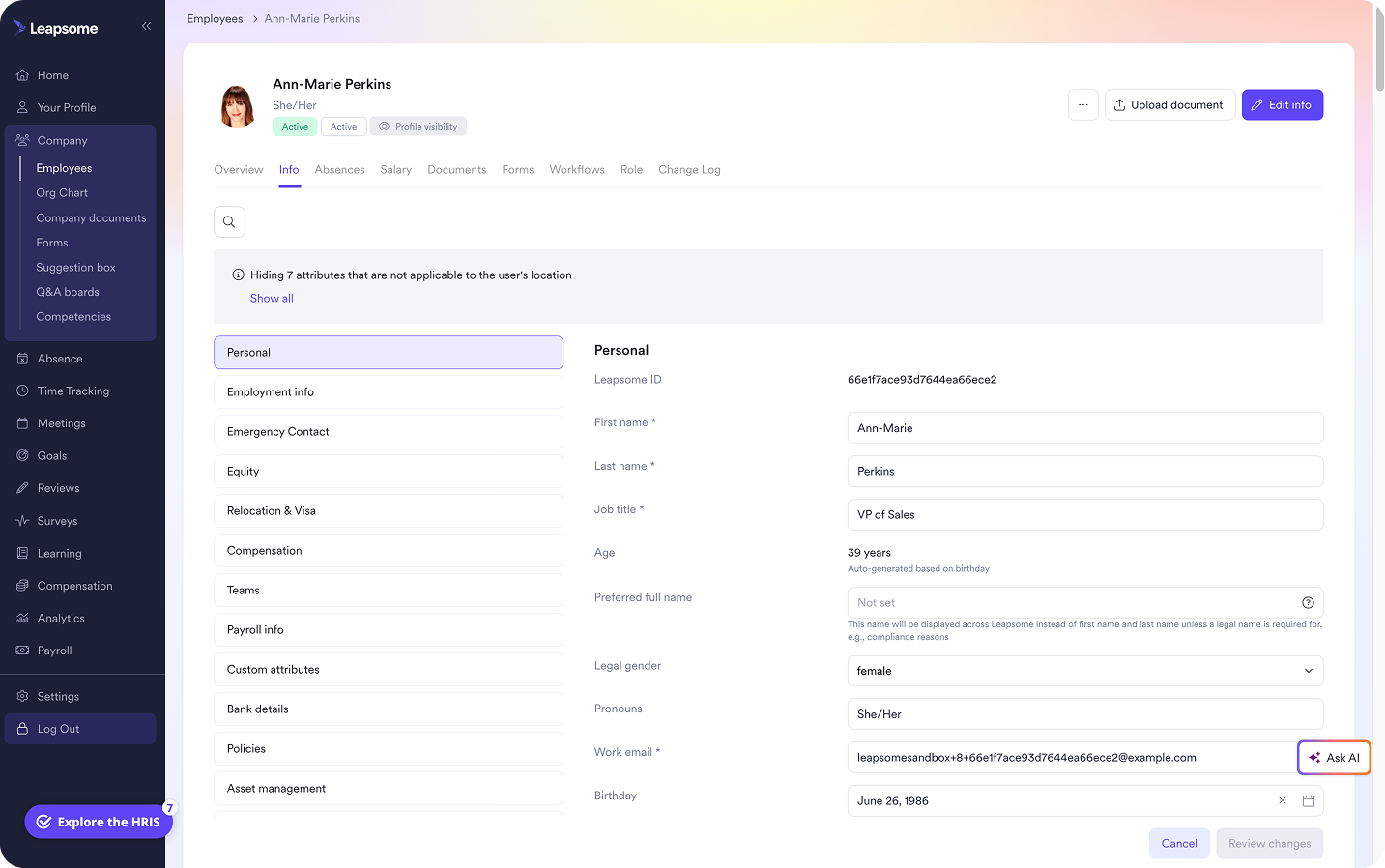
🛑 Stop payroll errors at the source
Leapsome’s HRIS and people management platform connects employee records and compensation information so HR can prepare payroll with accurate information every time.
👉 Explore Employee Records
Can employees trust your payroll processes?
“If your HR systems don’t really talk to each other… You kind of have to pull this from your HRIS, this from your performance review, this from payroll… I think the trails break down a little bit.”
— Sammie Masley, People and Talent Partner at Leapsome
Payroll maturity isn’t just about how quickly HR can close a pay run. It’s also about whether employees can trust the information behind their pay without checking every detail themselves.
Use the following warning signs to assess where your payroll process may need stronger integration to keep employee trust high.
Employees regularly report payroll discrepancies
If employees frequently flag missing hours or outdated salary information, what appears to be a payroll issue likely sits upstream. The root cause is often an employee record that isn’t updated, or a compensation change that didn’t reach payroll in time. But because payroll problems are a major driver of low trust, regular discrepancies are a serious red flag.
HR teams spend significant time fixing payroll-related issues
Payroll correction work can look productive because it solves urgent problems. But when the same issues keep coming back, your team is actually spending their time compensating for weak systems.
Deloitte found that HR teams spend up to 57% of their time on administrative tasks. Payroll errors add to that burden. Every spreadsheet check, manager follow-up, and last-minute correction pulls HR into process administration and further away from people strategizing.
Onboarding and employee changes require duplicate data entry
Shifts in the talent structure create payroll risks when HR has to enter the same information in multiple places. Those duplicate entries increase the chance of mismatched data and dampen the employee experience at moments when accuracy matters most, like a first paycheck or a promotion.
Best practices for successful payroll integration
Here are some steps you can take to improve your HR and payroll software integration practices.
Standardize employee data management
“We can prepare everything, lock the data, export it, and hand it off. It’s clean, fast, and consistent.”
— Siddharth Dhanuka, Head of Finance and Operations at SQUAKE
Payroll integration needs a clear source of truth to pull data from before it can automate transfers.
Decide who owns each payroll-related field, from job status to benefits administration, then specify exactly who can change those fields. With clear task ownership, you can make sure that changes follow a predetermined approval path before they reach payroll.
Automate routine payroll workflows
“You can assign payroll or IT tasks automatically to the right team when a new employee is created — or even set them to trigger 10 days before the start date.”
— Suraj Paneru, Customer Success Coach at Leapsome
Payroll automation should remove error-prone repeat handoffs. Set triggers around the moments that always affect pay. For example, when HR adds a new hire, the system should move their employment exemption status, hours, and wage information into payroll prep for their first check and assign any follow-up tasks automatically.
Regularly audit payroll-related processes
Employee data and compliance requirements change too often for a "set it and forget it” approach.
Instead of checking scattered spreadsheets after something goes wrong, payroll integrations should make it easy for HR teams to review the final math before the pay run. This check feels like a counterintuitive move for teams trying to automate their payroll, but it can help the team catch errors before they reach the payroll provider, then refine their process to prevent them from happening again.
Leapsome makes those reviews easier by bringing payroll-relevant changes into Payroll Prep, so HR teams can check one updated set of inputs instead of rebuilding the full picture from scratch.
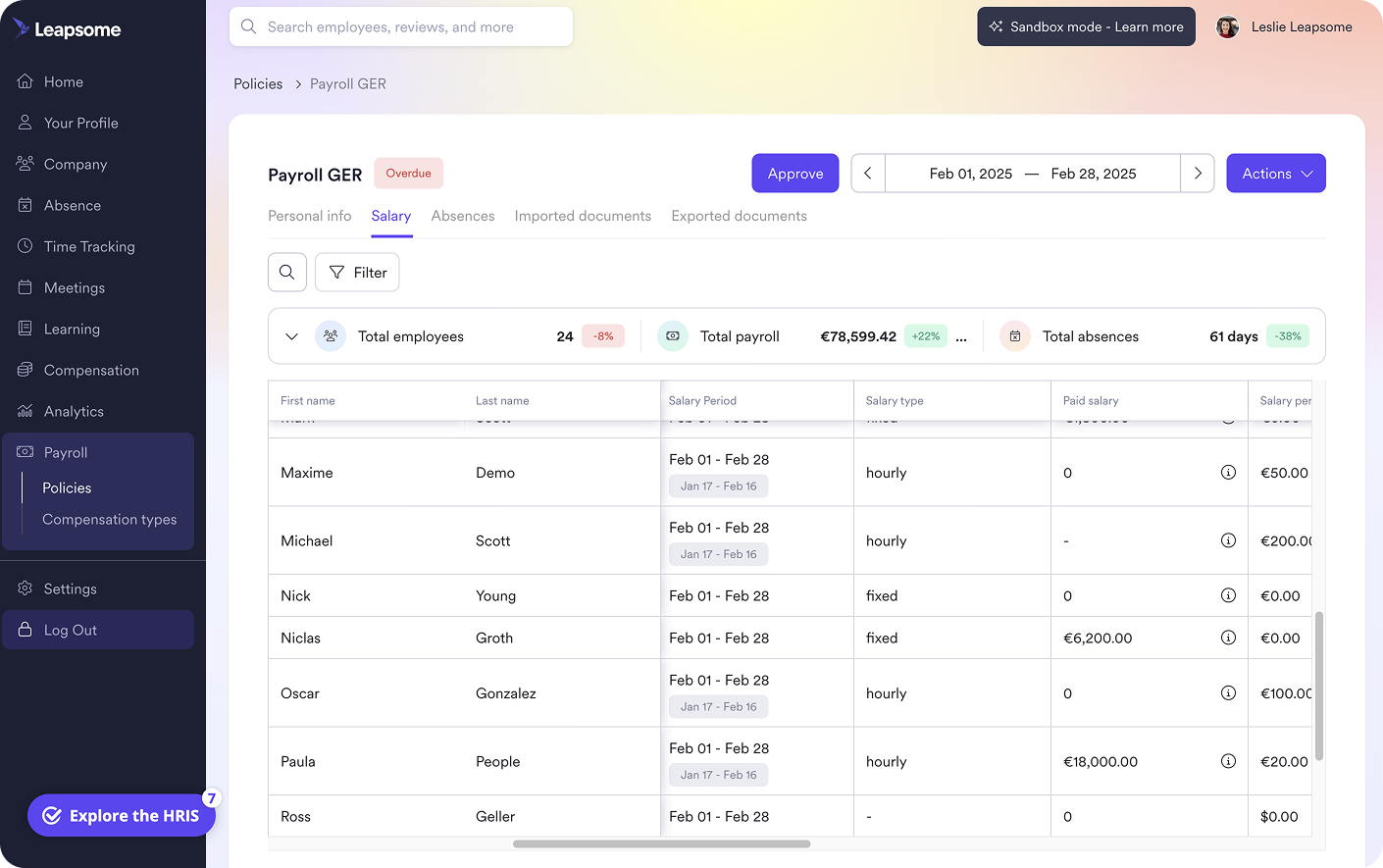
🧑🍳 Prep payroll with reliable data
Leapsome connects payroll inputs across employee records, absences, and compensation, so HR can catch issues long before payroll runs.
👉 Explore Payroll Prep
Create a stronger payroll foundation with Leapsome
Payroll accuracy depends on the quality of the people data behind it. When employee records, compensation changes, and absences sit in different places, HR has to rebuild the payroll picture every cycle. That creates more admin work, more room for error, and more quiet resentment building among employees.
Leapsome gives HR teams a stronger foundation for their payroll by connecting employee data across the lifecycle before prep begins. With Leapsome’s AI-powered HRIS and people management platform, teams can:
- Maintain accurate employee information: Keep employee records, job details, compensation data, and absences connected in one platform.
- Improve onboarding processes: Collect new hire information early and trigger payroll-related tasks before the first pay cycle.
- Strengthen workforce reporting: Use all your people data to understand compensation changes across employees while referencing performance reviews and goal-tracking.
- Support payroll accuracy and compliance: Configure payroll inputs before they’re sent to your provider, with configurable payroll rules and GDPR-compliant processes built in.
“Employees can now find everything in one place — their data, absences, goals, and reviews. I don’t have to explain which tool to use for what. It’s all in Leapsome.” — Merilyn L., Senior People Operations Specialist at Bob W.
🛠️ Build payroll processes everyone can trust
Leapsome helps HR prepare payroll from connected employee data, so teams can reduce manual fixes and employees can rely on accurate, on-time pay.
👉 Request a demo

.jpg)


.jpg)
.png)
.jpg)